Table of Contents
Why Box 19 Is the First Thing a Reviewer Reads
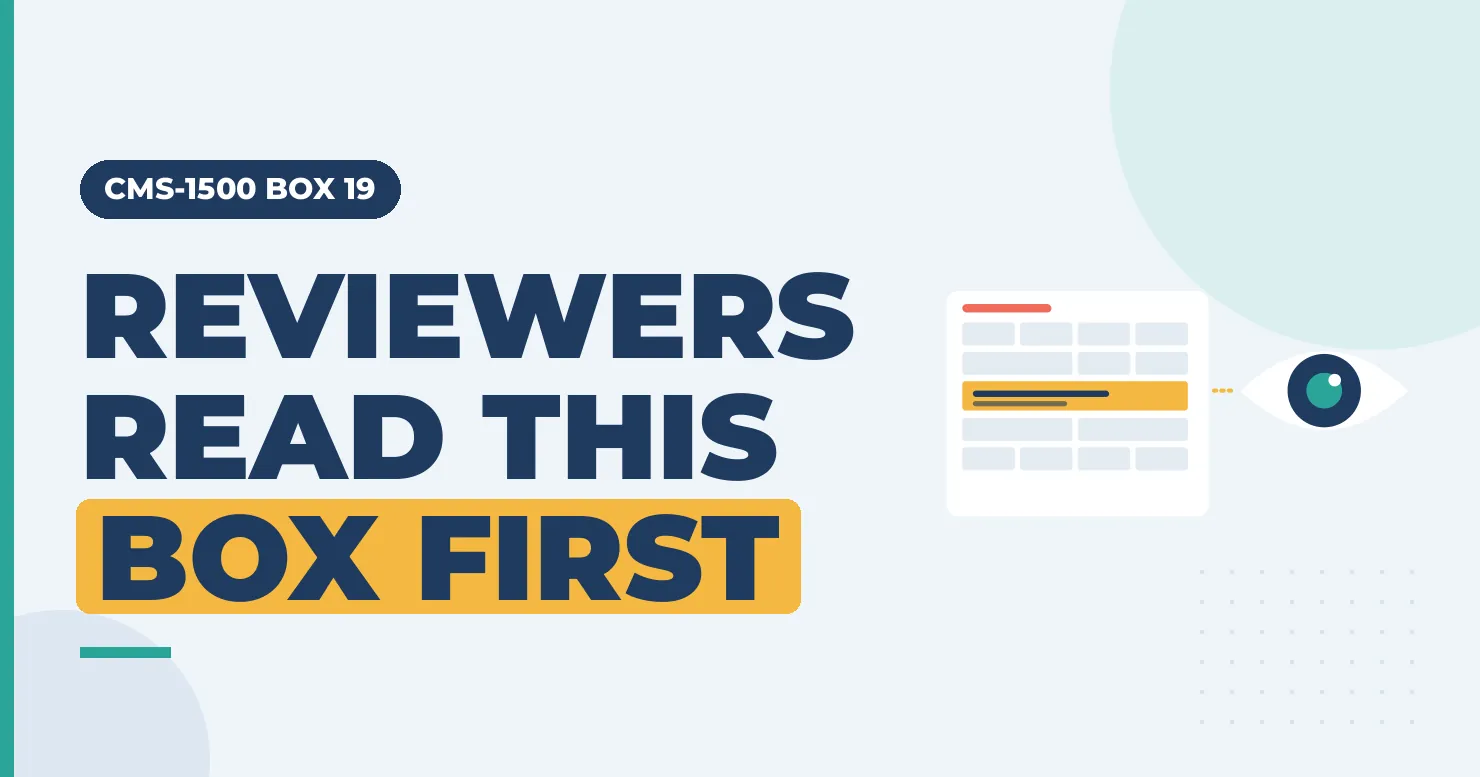
When a claim lands on a payer reviewer’s desk with an unlisted procedure code in Box 24D, the reviewer does not open the attached operative report first. They read Box 19. That single field, labeled Additional Claim Information on the current version of the CMS-1500 form, is where the billing team has its first and often only chance to frame the claim favorably before the reviewer makes a coverage judgment.
The CMS Medicare Claims Processing Manual, Chapter 26, states explicitly that when reporting an unlisted procedure code or a Not Otherwise Classified code, a narrative description must be included in Item 19 if a coherent description can be given within the confines of that box. The word must matters here. Box 19 is not optional for unlisted code claims. Noridian Medicare, the MAC for Jurisdictions F and J, confirms that if required information is missing, the code will be deemed unprocessable. The claim does not get denied with an explanation. It gets returned with no payment and no adjudication. Understanding unlisted CPT code documentation rules in full is the foundation. Box 19 is where those rules meet the actual claim form.
What Box 19 Is and What It Is Not
Box 19 on the paper CMS-1500 form is a free-text field that accommodates supplementary information the form’s standard fields cannot capture. Its official NUCC label is Additional Claim Information, a change from the older Reserved for Local Use label that still appears on some legacy form versions. The July 2025 NUCC 1500 Instruction Manual Version 13.0 updated the field guidance specifically to clarify that Box 19 supports unlisted procedure explanations, overflow data, and attachment references.
Box 19 is not a substitute for the operative report. It is not where medical necessity is proven. It is a concise indexing statement that tells the reviewer what the attached documentation contains and why the unlisted code is present on this claim. Think of it as a table of contents sentence for the full documentation package. The operative report, the comparable procedure narrative, and any supporting clinical literature live in the attachments. Box 19 tells the reviewer that those attachments exist and what they will find in them.
Box 19 is also not a field where modifiers are listed as an alternative to appending them in Box 24D. Some billing teams confuse the two uses. Modifiers for the procedure go in Box 24D. If more than four modifiers are needed, modifier 99 goes in Box 24D and the remaining modifiers are listed in Box 19 per Noridian guidance. But for unlisted code claims, the procedure description takes priority and should not compete with overflow modifier lists in the same field.
The 80-Character Constraint and How to Work Within It
The electronic equivalent of Box 19, which maps to Loop 2300 NTE segment or Loop 2400 NTE segment in the 837P transaction depending on the payer’s companion guide, holds up to 80 characters for the concise statement per Noridian’s published guidance. Paper claims allow slightly more space physically, but billing teams should write to the 80-character limit regardless of submission format, because the electronic version is what most claims become even when initiated on paper.
Eighty characters is roughly one tight sentence. That constraint forces a discipline that actually improves the field. A billing team that must describe a novel laparoscopic procedure in 80 characters or fewer cannot pad the description with clinical jargon. They must identify the body area, the approach, the reason, and the comparable code in as few words as possible. That precision is exactly what the reviewer needs.
The formula that works within 80 characters follows this structure: procedure name, body area, approach if relevant, reason no specific code exists, comparable CPT code number, and whether the operative report is attached. Every element that does not fit the formula goes in the attachment, not in Box 19.
What to Include: The Five Required Elements
Based on Noridian’s published guidance and CMS Claims Processing Manual Chapter 26 requirements, a complete Box 19 entry for an unlisted procedure code contains five elements.
The first element is the procedure name in plain language. Use the clinical name the surgeon used in the operative report, not a generic term. If the operative report says laparoscopic excision of retroperitoneal lymph node cluster, that is what goes in Box 19, not laparoscopic surgery.
The second element is the body area treated. Payers use this to verify that the unlisted code selected comes from the correct anatomic section of the CPT code book. A mismatch between the body area stated in Box 19 and the anatomic section of the unlisted code is an immediate red flag.
The third element is the reason the service was performed, expressed as briefly as possible. This does not need to be a full medical necessity statement. A three to five word clinical rationale is sufficient for Box 19. The full medical necessity justification belongs in the attached documentation.
The fourth element is the comparable CPT code number. Include the five-digit code only, not the full descriptor, to conserve characters. The payer’s reviewer knows the code descriptors. Stating the number is enough to anchor the pricing analysis.
The fifth element is a notation that the operative report is attached. The phrase Op report attached or documentation attached signals to the reviewer that the claim is complete and the full narrative is available for review.
Word for Word Examples by Scenario
The following examples are written to fit within 80 characters where possible. Each is followed by the character count so billing teams can calibrate their own entries.
For a laparoscopic musculoskeletal procedure with no Category I code: Lap resection retroperitoneal mass; no Cat I code; compare 49215; op rpt attached. This example runs 78 characters and covers all five required elements.
For an orthopedic joint preservation procedure: Arthroscopic biologic augmentation knee; no Cat I/III code; compare 27096; op rpt attached. This runs 83 characters. To trim it: Arthroscopic biologic knee augmentation; compare 27096; no specific code; op rpt attached. That version runs 80 characters exactly.
For a nervous system procedure: Percutaneous spinal cord stimulation trial, novel electrode config; compare 63650; op rpt attached. This runs 79 characters.
For a general surgery procedure combining open and laparoscopic elements: Hybrid lap-open pancreatic debridement; no single code; compare 48105; op rpt attached. This runs 76 characters.
For a procedure where the closest comparable code is also partial: Endoscopic retrograde bile duct reconstruction, partial; compare 47630 and 47556; op rpt attached. This runs 82 characters. Trim by abbreviating: ERCP bile duct reconstruction variant; compare 47630/47556; op rpt attached. That is 71 characters.
Notice that none of these examples uses the word complex, advanced, novel, or innovative. Those adjectives add nothing a reviewer can act on. Body area, approach, comparable code, and attached documentation are what drive the payment decision.
Electronic Claim Submission: Where Box 19 Actually Goes
For electronic claims submitted via the HIPAA-mandated 837P transaction, the data entered in Box 19 on a paper form does not automatically map to a single location in the electronic transaction. This is where many billing systems create silent errors that result in the narrative never reaching the payer.
The narrative content generally maps to either Loop 2300 NTE segment at the claim level or Loop 2400 NTE segment at the service line level, depending on whether the payer’s companion guide specifies claim-level or line-level notes for unlisted procedure descriptions. Some payers, including several major commercial carriers, expect the narrative in Loop 2400 NTE with the ADD qualifier, meaning the data should be entered in the service line description field of the practice management system rather than the claim-level additional information field.
Before submitting an unlisted code claim electronically, billing teams must confirm two things with the payer. First, which loop receives the Box 19 narrative for unlisted procedures. Second, whether the payer’s system accepts electronic attachments or requires a paper attachment to be mailed separately with a cover sheet referencing the claim. Submitting the narrative to the wrong loop means the reviewer never sees it. Submitting the operative report electronically to a payer that requires paper attachments means the reviewer prices the claim from Box 19 alone, which is never sufficient for full reimbursement.
Payer-Specific Variations That Affect Box 19
Medicare MACs are consistent in their Box 19 requirements for unlisted codes because they follow the CMS Claims Processing Manual. Commercial payers vary more widely. Some require a prior authorization number in Box 19 when the unlisted procedure was pre-authorized, which means the authorization reference and the procedure narrative must share the same 80-character field. In those cases, lead with the authorization number using the format AUTH followed by the number, then abbreviate the procedure description to fit.
State Medicaid programs add another layer of variation. South Dakota Medicaid, for example, designates Box 19 as mandatory for all NOC codes and may require a procedure description be indicated in this field as a condition of claim processing. Some state programs also use Box 19 for urgent care indicators, origin and destination information for transportation claims, and other local use data that can create conflicts when an unlisted code is billed on the same claim as one of those other service types.
When billing in a new state Medicaid program or with a new commercial payer for the first time on an unlisted code claim, contacting provider relations before submission to confirm Box 19 expectations takes less time than managing the denial and resubmission cycle afterward.
Common Mistakes That Result in Unprocessable Claims
Before using an unlisted code at all, confirm no Category III code exists — see our comparison of Category III CPT codes vs unlisted codes. The most common mistake is leaving Box 19 blank. Some billing teams treat Box 19 as optional because the form label says Additional Claim Information rather than Required Field. For unlisted codes it is mandatory, and a blank Box 19 on an unlisted code claim returns as unprocessable without explanation.
The second most common mistake is writing a vague generic description. Entries like surgical procedure, office procedure, or unlisted service tell the reviewer nothing useful and often result in the claim being priced at the minimum rate for the anatomic subsection.
The third mistake is omitting the comparable code number. Without it, the reviewer has no pricing anchor. Building a full comparable procedure narrative — beyond just the code number — is covered in our guide on how to write a comparable procedure narrative for unlisted CPT codes. The code number alone and must make an arbitrary determination. Including the comparable code invites the reviewer to compare your charge to a known benchmark, which is almost always a better outcome than arbitrary pricing.
The fourth mistake is using Box 19 to re-argue medical necessity rather than describe the procedure. Medical necessity arguments belong in the attached letter and operative report. Box 19 that consists of a medical necessity paragraph has no comparable code reference, no procedure name, and no attachment notation, which means it fails on the three most critical elements.
Conclusion
Box 19 on the CMS-1500 is the unlisted code claim’s first impression. If a claim is denied despite a correctly completed Box 19, see our guide on how to appeal CPT unlisted code denials. It must contain the procedure name, body area, brief rationale, comparable CPT code number, and an attachment notation, all within approximately 80 characters for electronic submission compatibility. It is not optional, not a substitute for the operative report, and not a field for vague descriptors or medical necessity arguments. When written precisely and confirmed to map correctly in the 837P transaction for each payer, Box 19 becomes the single most reliable factor in whether an unlisted code claim moves forward to a fair reimbursement decision or returns as unprocessable before a reviewer even looks at it.
Frequently Asked Questions: CMS-1500 Box 19
What goes in Box 19 on the CMS-1500 claim form?
Box 19 on the CMS-1500 claim form is used for additional information needed to process the claim, most commonly for unlisted procedure codes. For unlisted CPT codes, Box 19 should contain a brief description of the procedure performed, the comparable CPT code that most closely matches the service, and a statement of how the procedure differs from the comparable code. Some payers also require a charge justification and prior authorization number in Box 19 for unlisted procedure claims.
Is Box 19 required for all claims or only unlisted codes?
Box 19 is required whenever a payer’s instructions specify additional information must accompany the claim. It is most commonly required for unlisted CPT codes, but may also be required for claims with certain modifiers, referral information, or supplemental coverage details depending on the payer. For Medicare, specific secondary payer information may be required in Box 19. Always check the payer’s claims submission guide for Box 19 requirements specific to your procedure type.
Have a denial question or a topic you want covered?
Send me the details. I read every message and use them to decide what to write next.