
CO-16 is a Claim Adjustment Reason Code meaning the claim or line lacks information or has a billing error, and its remark code tells you what to fix before you resubmit. (Primary sources: X12 Claim Adjustment Reason Codes · CMS Medicare Claims Processing Manual, Ch. 1 · Ch. 22)
Quick answer: CO-16 means the payer could not process the claim or service line because information was missing, incomplete or invalid. The CO-16 code on its own doesn’t tell you what is wrong. The remark code (RARC) next to it does. Find that remark code, correct the field it points to, and send a new or corrected claim. For Medicare, a CO-16 claim is usually “returned as unprocessable,” which means it has no appeal rights. You fix it and resubmit within the timely filing limit.
Part of our denial codes library. Written by Manikandan, a revenue cycle management specialist with more than 10 years of US medical billing experience. Last reviewed: 3 October 2026. Official code wording is quoted word for word from X12; Medicare rules link to their CMS or Medicare contractor source.
Official CARC 16 description
X12 Claim Adjustment Reason Code 16, verbatim:
“Claim/service lacks information or has submission/billing error(s). Usage: Do not use this code for claims attachment(s)/other documentation. At least one Remark Code must be provided (may be comprised of either the NCPDP Reject Reason Code, or Remittance Advice Remark Code that is not an ALERT.) Refer to the 835 Healthcare Policy Identification Segment (loop 2110 Service Payment Information REF), if present.”
Source: X12 Claim Adjustment Reason Codes. Start: 01/01/1995 | Last Modified: 03/01/2018.
Some payer and MAC pages still show older wording that ends “…which is needed for adjudication.” The X12 text above is the current official description.
What CO-16 means in plain English
Each part of a denial tells you something different:
- CO (Contractual Obligation) is the group code, and it tells you who carries the amount. CMS describes CO adjustments as amounts that are “generally… considered a write off for the provider and are not billed to the patient” (Medicare Claims Processing Manual, Ch. 22, §60.1). So don’t bill the patient for a CO-16 line. Fix the claim instead.
- 16 is the reason: something on the claim is missing, incomplete, invalid or formatted wrong.
- The RARC is the detail. X12 requires at least one remark code that isn’t an “Alert” with CARC 16, so your ERA or EOB should always show one. That remark code names the field to fix.
CO-16 is an “administrative” denial, not a clinical one. The payer hasn’t decided the service isn’t covered. It just couldn’t adjudicate what you sent.
CO-16 vs. a rejection vs. a denial
- Front-end rejection: the clearinghouse or payer bounces the claim before it reaches adjudication. CMS notes that for some front-end returns, “No RA is issued.”
- CO-16 on the remittance: the claim made it into the payer’s system and was returned through the ERA with CARC 16 plus a remark code.
- True denial (e.g., CO-50): a payment decision you can appeal.
For Medicare, CMS is explicit: “A claim returned as unprocessable for incomplete or invalid information does not meet the criteria to be considered as a claim, is not denied, and, as such, is not afforded appeal rights” (IOM 100-04, Ch. 1, §80.3.1).
Common causes of CO-16
The remark code is the real cause. These are the pairings Medicare contractors publish most often:
| Remark code | Official X12 description | What to check |
|---|---|---|
| M51 | “Missing/incomplete/invalid procedure code(s).” | Invalid or deleted CPT/HCPCS code for the date of service. Unlisted/NOC code with no description. |
| N56 | “Procedure code billed is not correct/valid for the services billed or the date of service billed.” | Code effective dates; code matches the documented service. |
| N290 | “Missing/incomplete/invalid rendering provider primary identifier.” | Rendering NPI in Item 24J / loop 2310B, and whether it’s linked to the group NPI. |
| N257 | “Missing/incomplete/invalid billing provider/supplier primary identifier.” | Billing/group NPI in Item 33a / loop 2010AA. |
| N382 | “Missing/incomplete/invalid patient identifier.” | Member ID or Medicare Beneficiary Identifier (MBI) typed exactly as on the card or eligibility response. |
| MA36 | “Missing/incomplete/invalid patient name.” | Name matches the payer’s eligibility file. |
| MA04 | “Secondary payment cannot be considered without the identity of or payment information from the primary payer. The information was either not reported or was illegible.” | Primary payer details and payment info on secondary claims. |
| N264 / N265 | “Missing/incomplete/invalid ordering provider name.” / “Missing/incomplete/invalid ordering provider primary identifier.” | Ordering/referring provider name and NPI on labs, imaging and DME. |
| M81 | “You are required to code to the highest level of specificity.” | ICD-10-CM codes reported to the full required character. |
| M123 | “Missing/incomplete/invalid name, strength, or dosage of the drug furnished.” | NOC drug code without drug name and dosage in the claim narrative. |
| MA120 | “Missing/incomplete/invalid CLIA certification number.” | CLIA number on lab claims. |
Pairings come from Noridian JE Part B’s Denial Code Resolution table and First Coast’s Apr–Jun 2026 top rejections list. Descriptions are verbatim from X12.
The bigger causes behind these remark codes tend to be: – Registration and eligibility data entered wrong at the front desk. – Provider enrollment or NPI linkage that doesn’t match what’s on the claim. – Outdated codes after an annual code-set update. – Missing narrative for unlisted/NOC codes. – Missing primary payer information on secondary claims.
Not a CO-16 cause: missing medical records or attachments. X12’s usage note says CARC 16 should not be used for “claims attachment(s)/other documentation.” Payers use CARC 252 for that instead.
How to fix CO-16: step by step
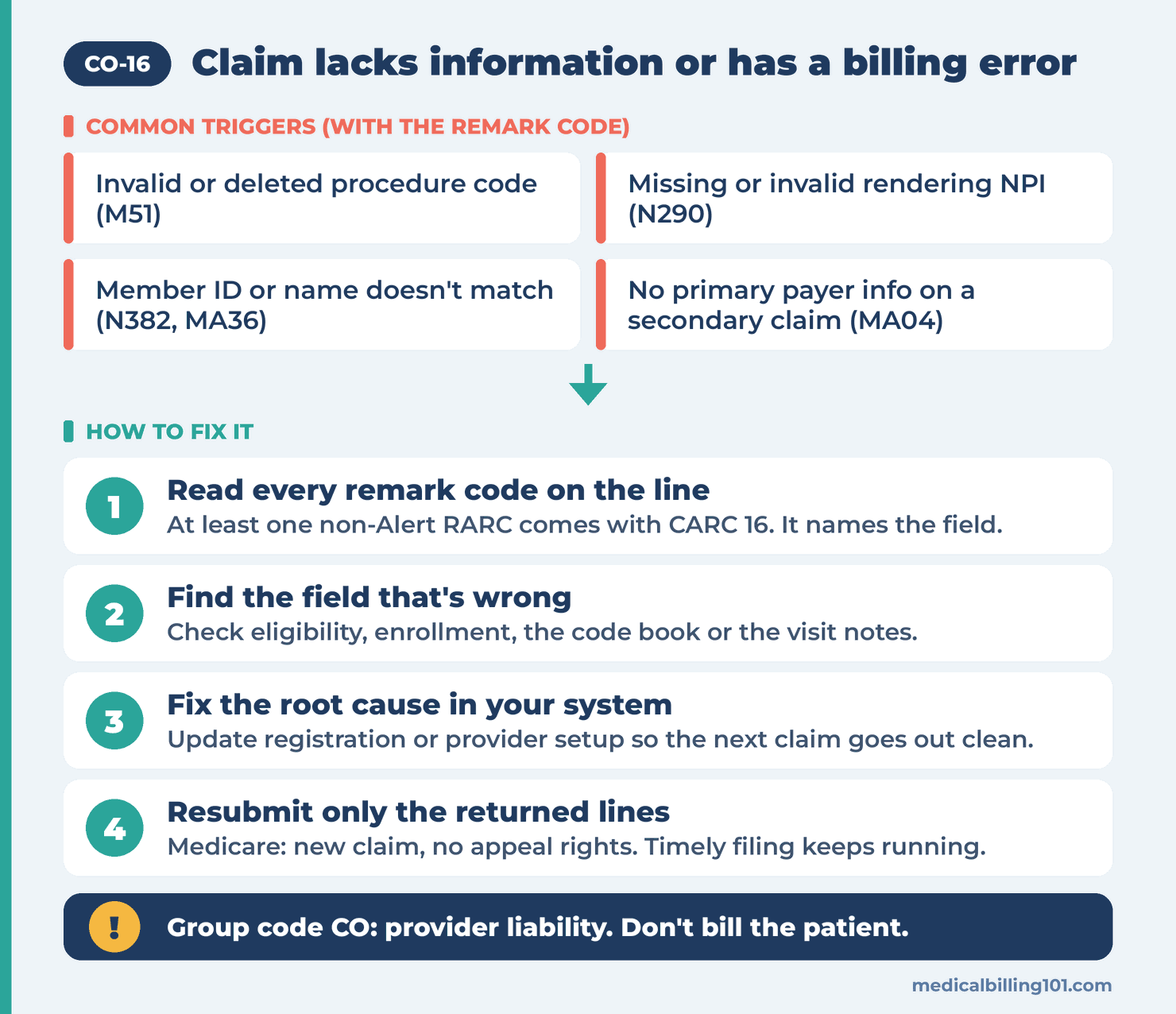
- Read the whole adjustment line. Note the group code, CARC 16, every RARC, and whether the adjustment is at claim level or line level. If the 835 includes a Healthcare Policy Identification (loop 2110 REF) segment, read it as well. X12’s usage note points you there.
- Look up each remark code in the official X12 RARC list. Note any Alert codes. MA130 and N704 tell you the item can’t be appealed and must be resubmitted:
- MA130: “Your claim contains incomplete and/or invalid information, and no appeal rights are afforded because the claim is unprocessable. Please submit a new claim with the complete/correct information.”
- N704: “Alert: You may not appeal this decision but can resubmit this claim/service with corrected information if warranted.”
- Find the field that’s wrong. Compare the claim with the source record. That may be the eligibility response, the provider enrollment record (PECOS for Medicare), the code book for that date of service or the visit notes.
- Fix the root cause in your system, not just on this claim. For example, update the patient’s registration or the provider’s NPI mapping. Then the next claim goes out clean.
- Resubmit the right way for the payer:
- Medicare Part B: Noridian’s guidance for CO-16 is “Submit new claim with corrected/complete information” and “Claim is unprocessable; no appeal rights.” CMS notes that carriers pay the clean lines on a claim and return only the “dirty” ones (IOM 100-04, Ch. 1, §80.3.2). So resubmit only the returned lines and don’t duplicate the paid ones. Re-billing paid lines invites a duplicate denial (see OA-18).
- Commercial, Medicaid and Medicare Advantage plans: follow the payer’s own corrected-claim or resubmission policy in its provider manual. Some want a corrected (replacement) claim, others a brand-new claim. See our corrected claim resubmission guide.
- Watch the clock. Resubmitting doesn’t pause timely filing. Medicare FFS claims generally must be filed within 12 months (1 calendar year) after the date of service (42 CFR 424.44; IOM 100-04, Ch. 1, §70). Novitas states that this includes resubmitting corrected claims that were unprocessable. For other payers, check the contract.
- Appeal only when the payer got it wrong. Sometimes the information really was on the original claim. If the payer allows an appeal or reconsideration for that remark code, appeal with proof, such as the 837 data or the clearinghouse acceptance report. For Medicare lines returned with MA130 or N704, Noridian’s appeals decision tree says the line “is not appealable. Correct the coding and resubmit claim.”
- Log it. Track CO-16 by remark code, payer and staff member so you can see which fix will prevent the most denials.
How to prevent CO-16 denials
- Run eligibility before every visit and copy IDs and names from the eligibility response, not from memory or old registrations.
- Keep provider data in sync. Link each rendering NPI to the billing group with the payer before that provider’s claims go out. For Medicare, do the same in PECOS.
- Turn on clearinghouse edits for NPI format, missing ordering/referring provider and invalid or deleted codes. Our clearinghouse scrubbing setup guide walks through it.
- Update code tables for annual CPT, HCPCS and ICD-10-CM changes before the effective date.
- Build narratives into unlisted and NOC workflows (Item 19 / loop 2300 NTE or SV101-7, per Noridian). See what to put in Box 19 for unlisted procedures.
- Capture primary payer details on every secondary claim.
- Review your top 3 CO-16 remark codes monthly and fix the upstream process that causes them.
Group codes and remark codes you’ll see with 16
- CO-16 is the combination Medicare contractors publish in their CARC 16 guidance (Noridian, First Coast). Payers assign the group code, so if CARC 16 shows up with a different prefix, the liability changes. Either way, read the RARC first.
- Frequent RARC partners: M51, N56, N290, N257, N382, MA36, MA04, N264/N265, M81, M123, MA120, plus MA130 or N704 as the no-appeal, resubmit alert.
Related denial codes
- CO-252: an attachment or other documentation is required (X12 points attachment issues here, not to 16).
- CO-4: procedure code inconsistent with the modifier.
- CO-11: “The diagnosis is inconsistent with the procedure.”
- CO-31: “Patient cannot be identified as our insured.”
- CO-97: bundled service already adjudicated.
- CO-A1: generic denial, used “only when a more specific Claim Adjustment Reason Code is not available.”
- N290 and MA130: two remark codes that often appear with CARC 16 on Medicare remits (FCSO top rejections; Noridian appeals decision tree).
FAQ
What does CO-16 mean on an EOB or ERA? It means the claim or service line lacked information or had a submission or billing error, and the provider is responsible for fixing it (group code CO). The remark code next to it tells you exactly what was missing or invalid.
Can I bill the patient for a CO-16 denial? No. CO means contractual obligation, and CMS describes CO adjustments as generally a provider write-off that isn’t billed to the patient. With CO-16, the right step is to correct the claim and resubmit, not to write it off or bill the patient.
Can I appeal a CO-16 denial from Medicare? Usually not. CMS says a claim returned as unprocessable for incomplete or invalid information “is not afforded appeal rights.” If the remit shows MA130 or N704, correct the claim and submit it again.
Why is there no remark code with my CO-16? X12 requires at least one non-Alert remark code (or an NCPDP reject code) with CARC 16. If yours is missing, check the full 835 (including any loop 2110 REF policy segment) or call the payer to get it. Don’t guess.
Does resubmitting a CO-16 claim reset timely filing? No. For Medicare, the 12-month limit still runs from the date of service, and Novitas says this includes resubmitted unprocessable claims. Commercial deadlines vary by contract.
Is CO-16 the same as “denial code 16” or “CO16”? Yes. They’re the same CARC written different ways. Only the group prefix (CO, PR, OA, PI) changes who is responsible for the amount.
Sources
- X12, Claim Adjustment Reason Codes (CARC 16, 4, 11, 31, 252, A1). CARC 16 Start 01/01/1995, Last Modified 03/01/2018. Accessed 3 Oct 2026.
- X12, Remittance Advice Remark Codes (M51, N56, N290, N257, N382, MA36, MA04, N264, N265, M81, M123, MA120, MA130, N704). Accessed 3 Oct 2026.
- CMS, Medicare Claims Processing Manual (IOM 100-04), Ch. 1, §70 (Rev. 2140), §80.3.1 (Rev. 1588), §80.3.2 (Rev. 4388)
- CMS, Medicare Claims Processing Manual (IOM 100-04), Ch. 22, §60.1 Group Codes
- Noridian JE Part B, Denial Code Resolution
- Noridian JE Part B, Missing/Incorrect Required Claim Information (last updated Apr 30, 2025)
- Noridian JE Part B, Missing/Incorrect Required NPI Information (last updated Apr 30, 2025)
- Noridian JE Part B, Appeals Decision Tree (last updated Dec 10, 2023)
- First Coast Service Options, Top claim errors, Apr–Jun 2026
- Novitas Solutions JL, Top claim denials Apr–Jun 2026 (last modified 07/02/2026)
Last reviewed: 3 October 2026 · This page is educational and doesn’t replace payer-specific instructions.