
CO-4 is a Claim Adjustment Reason Code meaning the modifier on a procedure code doesn’t fit that code, or a required modifier is missing, so the line can’t be paid as billed. (Primary sources: X12 Claim Adjustment Reason Codes · CMS Medicare Claims Processing Manual, Ch. 26)
Quick answer: Look up the procedure code and modifier together for the date of service. Then correct the modifier (or add the one that’s missing) and resubmit. For Medicare, First Coast treats CO-4 as a rejected, unprocessable claim: “Claims that are rejected cannot be appealed,” so you send a corrected claim. First Coast ranked CARC 4 with N519 among its top five claim rejections for April–June 2026.
Part of our CARC and RARC lookup table. Written by Manikandan, a revenue cycle management specialist with more than 10 years of US medical billing experience. Last reviewed: 3 October 2026. Official code wording is quoted word for word from X12; Medicare rules link to their CMS or Medicare contractor source.
Official CARC 4 description
X12 Claim Adjustment Reason Code 4, verbatim:
“The procedure code is inconsistent with the modifier used. Usage: Refer to the 835 Healthcare Policy Identification Segment (loop 2110 Service Payment Information REF), if present.”
Source: X12 Claim Adjustment Reason Codes. Start: 01/01/1995 | Last Modified: 03/01/2020.
Some contractor tables show the wrong text for CARC 4. One quarterly list shows the CARC 50 medical-necessity wording next to code 4. Always check descriptions against the X12 list.
What CO-4 means in plain English
A modifier is, in First Coast’s words, “a two-position alpha or numeric code that is added to the end of a CPT or HCPCS code to provide additional information or to clarify the service(s) being billed.” CO-4 means the payer’s edits found a mismatch. The modifier can’t be used with that code, two modifiers conflict, or the code needs a modifier that’s missing. Group code CO puts the amount on the provider. Correct the claim instead of billing the patient (CMS IOM 100-04, Ch. 22, §60.1).
Common causes of CO-4
First Coast describes CO-4 as received “when a claim is submitted and the procedure code(s) are billed with the wrong modifier(s), or the required modifier(s) are missing.” Typical examples:
- Modifier 26 on a code with no professional/technical split. First Coast’s example: modifier 26 is fine with G0202 (digital screening mammography), which has both components, but “is not permitted when billing procedure code 80048 (basic metabolic panel).” Other lab codes it lists as having no professional and technical components: 85025, 80053, 83735, 84100, 85610, 82803, 82615 and 85027.
- An invalid combination of HCPCS modifiers on one line (remark code N519).
- A required modifier left off, for example a payer- or policy-required modifier for that service.
- Outdated codes or modifiers. First Coast advises using “the most current year’s CPT codes and modifiers.”
- Dates of service from different years on one claim. First Coast: “A procedure code or modifier valid in one year may not be valid in the other and will cause the entire claim to reject or deny.”
The N519 remark code
The pairing First Coast reports is CO-4 with N519:
“Invalid combination of HCPCS modifiers.” (X12 RARC N519, Start: 07/01/2009)
When you see N519, look at all the modifiers on the line together, not just the first one.
Worked example (illustrative)
Hypothetical scenario based on First Coast’s published example.
A practice bills 80048 (basic metabolic panel) with modifier 26 because the physician reviewed the results. The line comes back CO-4. Per First Coast, modifier 26 “is not permitted when billing procedure code 80048,” because that lab code has no professional and technical split. The biller removes modifier 26 and resubmits only that line as a corrected claim. Then the biller adds a claim edit that blocks modifier 26 on lab codes without a professional component.
How to fix CO-4: step by step
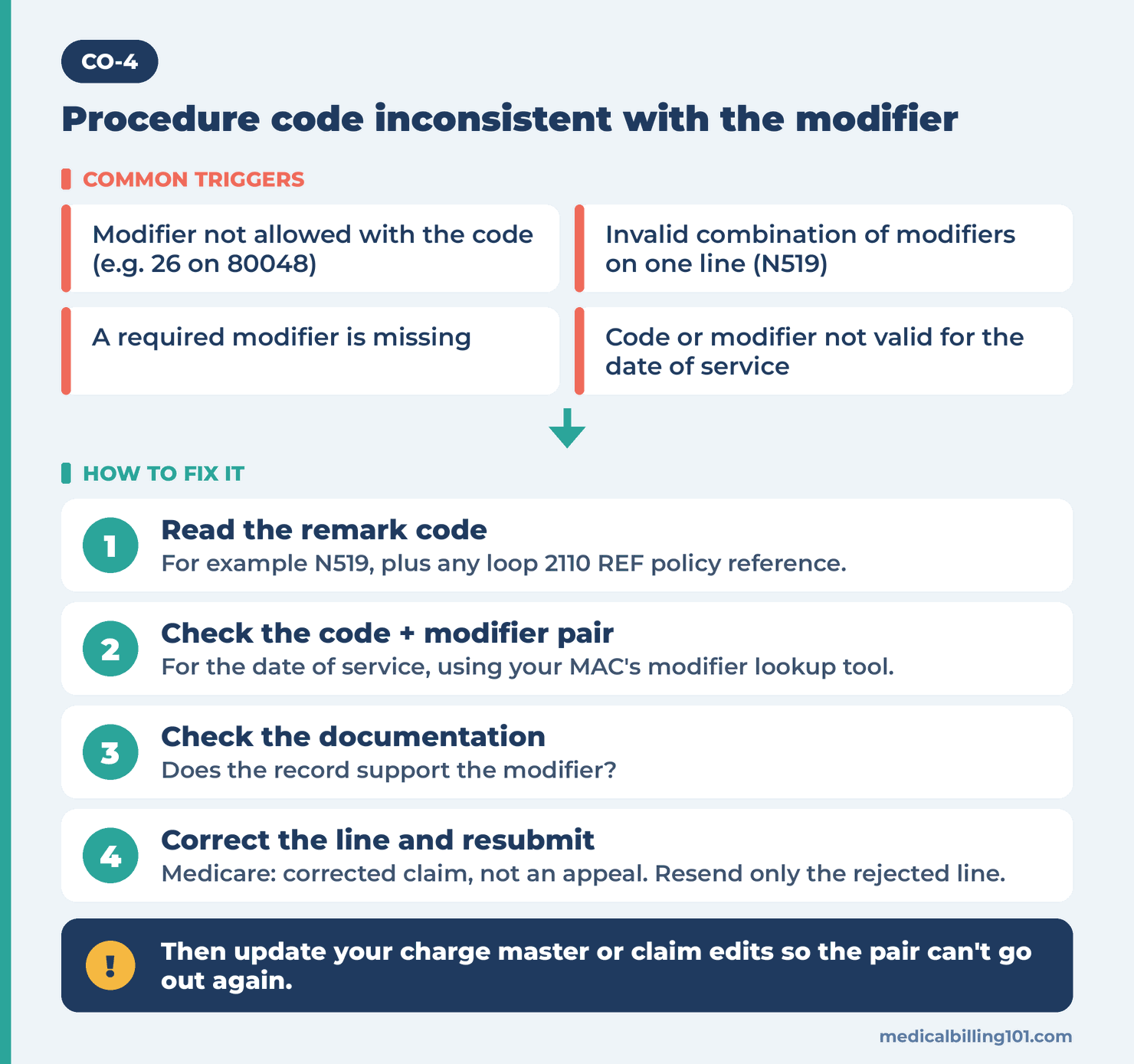
- Read the remark code (for example N519) and any loop 2110 REF policy reference. X12’s usage note points there.
- Check the code and modifier pair for the date of service. For Medicare, use your MAC’s modifier lookup tool. First Coast’s tool says a valid combination “does not imply coverage.” It currently carries a notice about data issues and recommends cross-checking the Medicare Claims Processing Manual.
- Check the documentation. Does it support the modifier, for example a separate professional interpretation for modifier 26?
- Correct the line. Remove the invalid modifier, fix the conflicting combination or add the required modifier.
- Resubmit.
- Medicare: First Coast: “To avoid delays in payments, providers must resubmit a corrected claim. Claims that are rejected cannot be appealed.” Resubmit only the rejected line, because First Coast warns that resending a whole claim causes a duplicate denial (see OA-18). Timely filing still applies: claims returned as unprocessable “are not considered filed or submitted,” and Medicare’s limit is 12 months from the date of service (First Coast; CMS IOM 100-04, Ch. 1, §70).
- Other payers: use the payer’s corrected-claim process. See our corrected claim resubmission guide.
- Update your charge master or claim edits so the same pair can’t go out again.
How to prevent CO-4 denials
- Update CPT, HCPCS and modifier tables every year before the effective date.
- Turn on clearinghouse edits for modifier and procedure compatibility. See our clearinghouse scrubbing setup guide.
- Train coders on professional and technical component rules (26/TC).
- Bill dates of service from different calendar years on separate claims (First Coast).
- Review your top CO-4 code and modifier pairs monthly.
Group codes and remark codes you’ll see with 4
- CO-4 is the form Medicare contractors publish.
- N519 flags an invalid combination of HCPCS modifiers.
- CO-4 vs. CO-236: CARC 236 covers a procedure or procedure/modifier combination that’s “not compatible with another procedure or procedure/modifier combination provided on the same day according to the National Correct Coding Initiative…” CO-4 is a mismatch within one line. CO-236 is a conflict between lines. Our guide to searching NCCI PTP tables covers CO-236 checks.
Related codes
- CO-236: NCCI procedure-to-procedure conflict.
- CO-97: bundled service.
- CO-16: missing or invalid claim information.
- MA130: unprocessable claim, no appeal rights.
FAQ
What does CO-4 mean? The procedure code doesn’t match the modifier billed with it, or a required modifier is missing. X12’s description: “The procedure code is inconsistent with the modifier used.”
Can I appeal a CO-4 rejection from Medicare? First Coast says no: “Claims that are rejected cannot be appealed.” Correct the modifier and resubmit within the timely filing limit.
What does N519 mean with CO-4? N519 is “Invalid combination of HCPCS modifiers.” Check every modifier on the line together.
What’s the difference between CO-4 and CO-236? CO-4 is a code and modifier mismatch on a line. CO-236 means the procedure or procedure/modifier combination conflicts with another procedure billed the same day under NCCI or workers’ compensation rules.
Can modifier 26 cause a CO-4? Yes, when the code has no professional component. First Coast’s example is modifier 26 on 80048 (basic metabolic panel), which “is not permitted.”
Sources
- X12, Claim Adjustment Reason Codes (CARC 4, 236). CARC 4 Start 01/01/1995, Last Modified 03/01/2020. Accessed 3 Oct 2026.
- X12, Remittance Advice Remark Codes (N519). Accessed 3 Oct 2026.
- CMS, Medicare Claims Processing Manual (IOM 100-04), Ch. 22, §60.1
- CMS, Medicare Claims Processing Manual (IOM 100-04), Ch. 1, §70
- CMS, Medicare Claims Processing Manual (IOM 100-04), Ch. 26 (CMS-1500 completion)
- First Coast, Tips to prevent RUC CO4 (Sept 16, 2026)
- First Coast, Top claim errors (Apr–Jun 2026)
- First Coast, Returned or rejected as unprocessable claims affect timely filing (Feb 17, 2026)
- First Coast, Modifier lookup tool
- First Coast, Using web tools to handle top denied claims
Last reviewed: 3 October 2026 · This page is educational and doesn’t replace payer-specific instructions.