
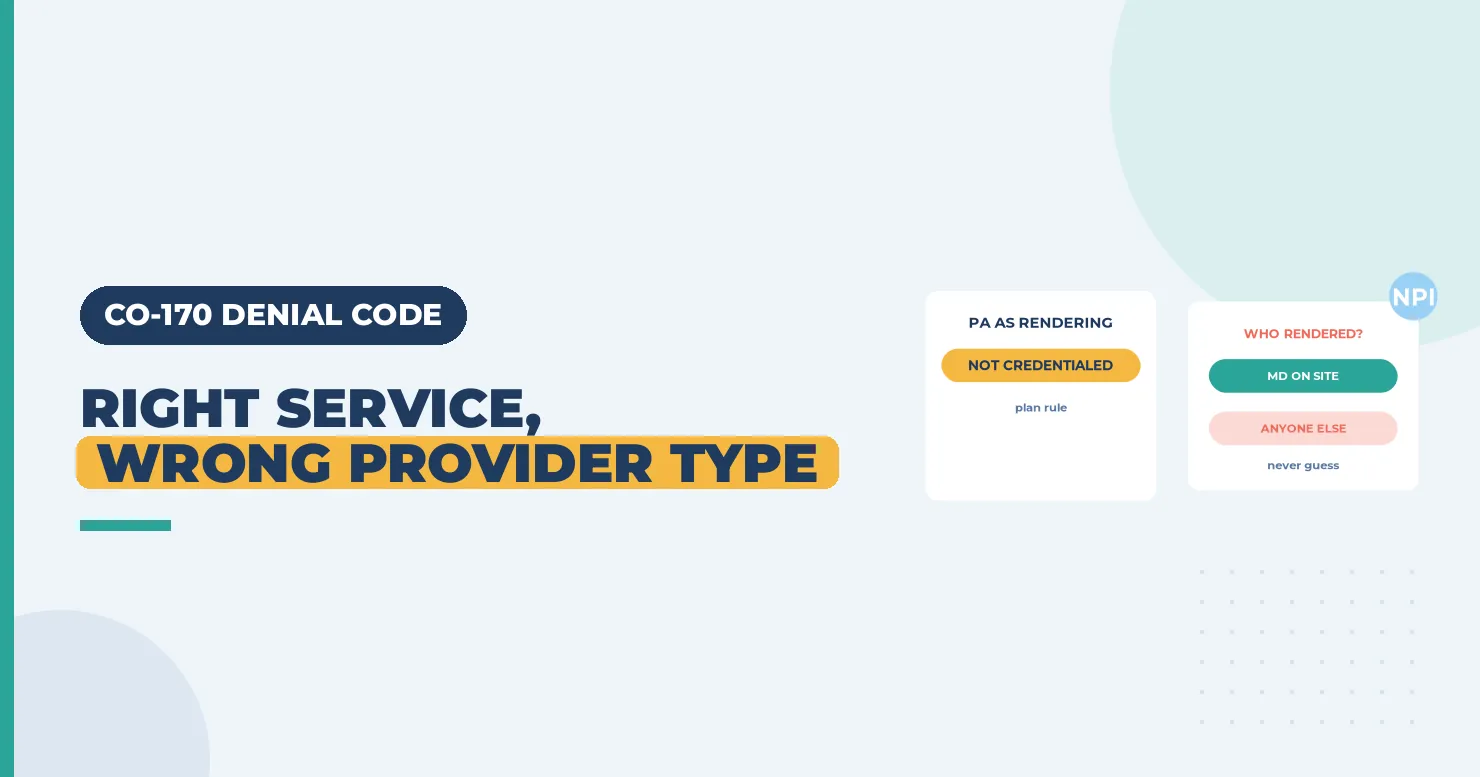
CO-170 is about who, not what. The service itself may be covered, but the payer won’t pay it when this type of provider performs or bills it. It might be a nurse practitioner or physician assistant the plan doesn’t credential as a rendering provider, a therapist billing a service outside the plan’s list for that license, or a supplier type that can’t bill a certain code. The fix depends on whether the claim named the wrong provider or the plan’s rule truly blocks that provider type. (Primary source: X12 Claim Adjustment Reason Codes)
In brief: CARC 170 reads “Payment is denied when performed/billed by this type of provider.” Check the payer’s policy for that service and provider type, and the policy reference in the 835 if one is present. If the plan requires a different rendering provider and the rules allow it, correct the claim. If the service truly can’t be paid for that provider type, the CO amount is a write-off.
Part of our denial codes library. Written by Manikandan J, CPC, CRCR, who has handled credentialing and rendering-provider denials for multi-specialty groups. Published 22 October 2026. Last updated: 22 October 2026. Code wording quoted word for word from X12.
Official CARC 170 description
| Field | X12 text |
|---|---|
| Code | 170 |
| Description | “Payment is denied when performed/billed by this type of provider.” |
| X12 usage note | Refer to the 835 Healthcare Policy Identification Segment (loop 2110 Service Payment Information REF), if present. |
| Start | 06/30/2005 |
| Last modified | 07/01/2017 |
Source: X12 Claim Adjustment Reason Codes, checked 22 October 2026.
Key terms behind CARC 170
A rendering provider is the person who performed the service, reported in Box 24J on the CMS-1500. A billing provider is the entity that gets paid, in Box 33. A provider type is the license or category the payer has on file, such as physician, nurse practitioner, physician assistant or physical therapist.
The Healthcare Policy Identification segment is a REF in the 835 service loop that can point to the payer policy behind the denial. X12’s usage note for CARC 170 tells you to look there. CMS’s NPPES NPI registry shows each provider’s taxonomy, which payers often use to set provider type.
Common causes of CO-170
- The plan doesn’t credential that provider type as rendering. For example, some commercial plans require services by physician assistants to be billed under the supervising physician.
- The service is outside the plan’s list for that license. A plan may pay a code to physicians but not to therapists.
- Wrong rendering NPI on the claim. The claim names the wrong person, such as a nurse instead of the physician who did the procedure.
- Taxonomy mismatch. The NPI’s taxonomy in the payer file doesn’t match the service type.
Example scenario (fictional names), part 1
CO-170 Denial Example: What Happened
Elena Petrova bills for Maple Hollow Internal Medicine. A physician assistant, working with Dr. Samuel Reyes on site, saw an established patient for hypertension follow-up (I10) and billed 99213. The claim to Cobalt Ridge Health, a fictional commercial plan, listed the PA’s NPI as the rendering provider in Box 24J.
The 835 showed CAS*CO*170 on the line with remark LQ*HE*N95, “This provider type/provider specialty may not bill this service.” A REF segment pointed to Cobalt Ridge’s policy on advanced practice providers.
Did Maple Hollow have to write the visit off, or could it be billed another way? Keep reading, or jump to how the CO-170 denial was resolved.
Remark codes often paired with CARC 170
| RARC | X12 wording | What it tells you |
|---|---|---|
| N95 | “This provider type/provider specialty may not bill this service.” | The payer’s provider type rule blocked it |
| N574 | “Our records indicate the ordering/referring provider is of a type/specialty that cannot order or refer. Please verify that the claim ordering/referring provider information is accurate or contact the ordering/referring provider.” | The ordering or referring provider type is the issue |
| N55 | “Procedures for billing with group/referring/performing providers were not followed.” | Billing rules for the group were not followed |
See the X12 RARC list for the full set.
How to fix a CO-170 denial
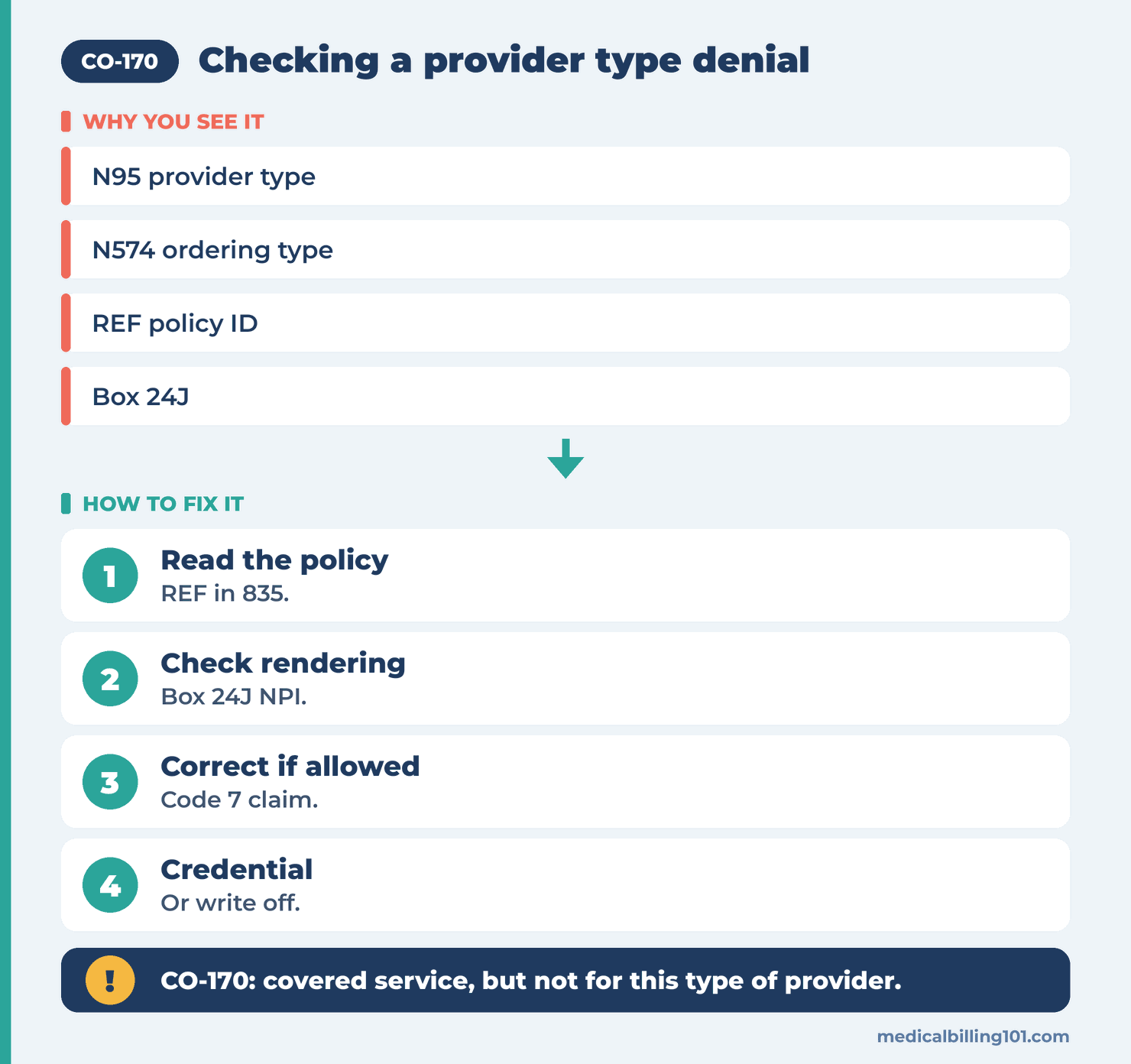
- Read the policy reference. Look for a REF segment in the 835 service loop pointing to the payer’s policy.
- Read the payer’s provider type rule. Find which provider types can render and bill the service.
- Check the claim. Confirm Box 24J names the person who actually performed the service, and that the NPI’s taxonomy is right.
- If the plan requires billing under a supervising physician, confirm the visit meets the plan’s conditions (such as on-site supervision), then send a corrected claim with the physician as rendering provider and frequency code 7.
- If the provider type truly can’t bill it, post the CO amount as a write-off. Don’t bill the patient.
- Fix credentialing. Ask the plan whether that provider type can be credentialed for future visits.
Example scenario (fictional names), part 2
How the CO-170 Denial Was Resolved
Elena read Cobalt Ridge’s policy. The plan didn’t credential physician assistants as rendering providers. It required their services to be billed under the supervising physician when that physician was on site, with a modifier the policy named. Dr. Reyes had been in the office that day, and the note said so.
Fix: Elena sent a corrected claim with Box 22 resubmission code 7, the original claim number and Dr. Reyes’s NPI in Box 24J, with the modifier the policy required. The PA’s involvement stayed documented in the note.
Outcome: Cobalt Ridge paid the visit under its policy terms. Maple Hollow set up a payer rule so that PA visits for Cobalt Ridge route to the supervising physician automatically, and asked about credentialing PAs directly.
Names and details are illustrative; no real patient data.


- Box 24J: rendering NPI changed from the physician assistant to the supervising physician, who was on site, as the plan’s policy required (fake NPIs).
- Box 24D: the modifier named in the plan’s policy is added if the policy requires one.
- Box 22: resubmission code 7 with the original claim number.
- Box 21A / 24E: I10 with pointer A is unchanged.
- UB-04 (hospital clinic): FL 76 attending NPI changed to the supervising physician; type of bill 0137 with the original claim number in FL 64.
Worked example (illustrative)
A physical therapy practice bills 97750 (physical performance test) for a patient. The plan’s policy lists 97750 as payable only when a physician or a physical therapist renders it, and the claim named a physical therapist assistant. The 835 shows CO-170 with N95. The practice checks the record: the therapist did perform the test, and the assistant only helped set up. It sends a corrected claim naming the therapist in Box 24J and the plan pays.
CO-170 vs similar codes
| Code | What it means | Main difference |
|---|---|---|
| CO-170 | Denied for this type of provider | Provider type blocks payment |
| CO-171 | Denied for this provider type in this type of facility | Provider type plus setting |
| CO-172 | Adjusted for a provider of this specialty | Payment changed, not denied |
| CO-8 | Procedure inconsistent with provider type or specialty | Code and taxonomy don’t fit |
Checklist
- Box 24J names the person who performed the service.
- NPI taxonomy is current in NPPES and the payer file.
- Payer rules for advanced practice providers are in payer setup.
- Supervision is documented when billing under a supervising physician.
Recap
CO-170 means the payer won’t pay this service for this type of provider. Read the policy reference, check the rendering provider and taxonomy, and correct the claim only when the payer’s rules and the record support it. Otherwise write it off and fix credentialing for the future.
FAQ
What does denial code CO-170 mean?
The payer won’t pay the service when this type of provider performs or bills it.
Can I just change the rendering provider to a physician?
Only if the payer’s policy allows it and the record supports it, such as on-site supervision. Never name someone who wasn’t involved.
Where do I find the payer’s reason?
Check the REF segment in the 835 service loop and the payer’s policy on provider types.
Can I bill the patient for CO-170?
No. It’s a CO denial, so the patient isn’t responsible.
What’s the difference between CO-170 and CO-8?
CO-170 is a provider type rule. CO-8 says the procedure code doesn’t fit the provider type or specialty.
Will credentialing fix CO-170?
Sometimes. If the plan can credential that provider type, future claims may pay.
Sources
How we checked: each code quote on this page was matched word for word with the X12 CARC and RARC lists on 22 October 2026.
- X12, Claim Adjustment Reason Codes (CARC 170, 171, 172, 8). Accessed 22 Oct 2026.
- X12, Remittance Advice Remark Codes (N95, N574, N55). Accessed 22 Oct 2026.
- CMS, NPPES NPI Registry. Accessed 22 Oct 2026.
- NUCC, 1500 claim form instructions (Items 24J and 33). Accessed 22 Oct 2026.
Last updated: 22 October 2026 · Educational content; not legal advice.