Enter the date of service or the denial date and the filing limit to see the exact deadline, how many days are left, and add a reminder to your calendar.
Key takeaways
- Medicare, Medicaid and TRICARE all cap initial claims at 12 months or one year from the date of service, set by federal rule.
- Commercial and Medicare Advantage limits come from your contract or provider manual, so check them there.
- The 277CA acceptance and the payer claim number are your proof of filing. A rejected claim does not stop the clock.
How to use the calculator
- Choose a rule. The Medicare presets follow CMS rules. The other presets are examples only; replace them with the limit in your payer contract or provider manual.
- Pick the deadline type and what you count from: the date of service for claims, or the date on the denial or remittance notice for corrected claims and appeals.
- Enter the start date and the limit in days, months or years. Tick the 5-day mail presumption when the rule counts from the date you received the notice.
- Read the result. Green means more than 30 days left, amber means under 30 days, and red means the deadline has passed.
- Add to calendar. The .ics file works with Google Calendar, Outlook and Apple Calendar and includes a reminder 7 days before.
Medicare timely filing and appeal limits
- Claims: within 12 months, or 1 calendar year, after the date of service (42 CFR 424.44). A service on March 22 must be filed by March 22 of the following year.
- Redetermination (first-level appeal): within 120 days of receiving the initial determination. Receipt is presumed 5 days after the date on the notice, unless there is evidence otherwise (42 CFR 405.942).
- Reconsideration by the QIC (second level): within 180 days of receiving the redetermination decision (42 CFR 405.962).
Missed a filing limit? See the CO-29 timely filing guide. Ready to appeal? Use the Appeal Letter Generator.
Federal timely filing limits at a glance
The limits below come straight from federal regulations. Your payer manual can’t lengthen them. A state Medicaid program can set a shorter window, but federal rules don’t let it go past 12 months.
| Program and deadline | Limit | Counted from | Primary source |
|---|---|---|---|
| Medicare Part A and B claim | 12 months (1 calendar year) | Date of service; the “through” date for span claims | 42 CFR 424.44 |
| Medicare redetermination (level 1 appeal) | 120 days | Receipt of the initial determination, presumed 5 days after the notice date | 42 CFR 405.942 |
| Medicare reconsideration by the QIC (level 2) | 180 days | Receipt of the redetermination decision | 42 CFR 405.962 |
| Medicaid fee-for-service claim | No later than 12 months; many states set less | Date of service | 42 CFR 447.45(d)(1) |
| Medicaid claim after a timely Medicare claim (crossover) | The state may pay within 6 months | Notice of the Medicare claim’s outcome | 42 CFR 447.45(d)(4)(ii) |
| TRICARE claim | 1 year | Date the service was provided | 32 CFR 199.7(d) |
| TRICARE claim returned for more information | The later of 1 year from service or 90 days from the return | Date the claim was returned | 32 CFR 199.7(d)(1) |
| Commercial and Medicare Advantage plans | Set by contract | Usually the date of service; check the manual | Your payer contract or provider manual |
For example, a Medicaid claim for a June 3, 2026 visit must reach the state by June 3, 2027 at the latest. If your state’s manual says 180 days, the earlier date wins. Enter the state’s limit in the calculator, not the federal maximum.
How to find the limit that applies to your claim
There is no single commercial timely filing limit. Work through these five checks, in order, before you trust a number.
- Participation status. For an in-network claim, your provider agreement sets the limit. For an out-of-network claim, the member’s plan terms and state law apply.
- Line of business. Original Medicare follows the 1-year rule in 42 CFR 424.44, explained in the Medicare Claims Processing Manual, chapter 1, section 70. Medicaid follows the state plan. Medicare Advantage and commercial plans follow the contract.
- State floor. Some states set a filing window by statute. For example, Texas requires a physician or provider to submit a claim to an insurer within 95 days of the service under a preferred provider plan (Texas Insurance Code §1301.102). Check your own state’s insurance code.
- Secondary claims. Ask whether the secondary payer counts its window from the date of service or from the primary payer’s EOB date. Keep the primary EOB with the claim either way.
- Contract vs default edit. A payer’s claim system may apply its standard limit even when your contract or an addendum allows longer. If a CO-29 denial conflicts with your contract, appeal and quote the contract section.
Proof of timely filing: the 277CA and the claim number
Most timely filing appeals turn on one question: can you prove the payer accepted the claim inside the window? Proof that you only sent it is weak. These are the reports to know.
- The 837 is the electronic claim file you or your clearinghouse send to the payer.
- The 999 is the implementation acknowledgment. It confirms the file passed X12 syntax edits. It doesn’t say each claim was accepted.
- The 277CA is the claim acknowledgment. It reports each claim as accepted or rejected after the payer’s front-end business edits.
- The ICN or DCN is the payer’s claim number. Medicare assigns an internal control number (ICN) to Part B claims and a document control number (DCN) to Part A claims once they pass the front-end edits.
CMS explains that a claim which fails these first two edit levels gets no ICN or DCN. You’ll see the rejection on the 277CA instead (CMS MLN3171902, Checking Medicare Claim Status). The CMS acknowledgment guidance describes the 277CA as the report that shows the status of each claim (CMS 5010 acknowledgment transactions call).
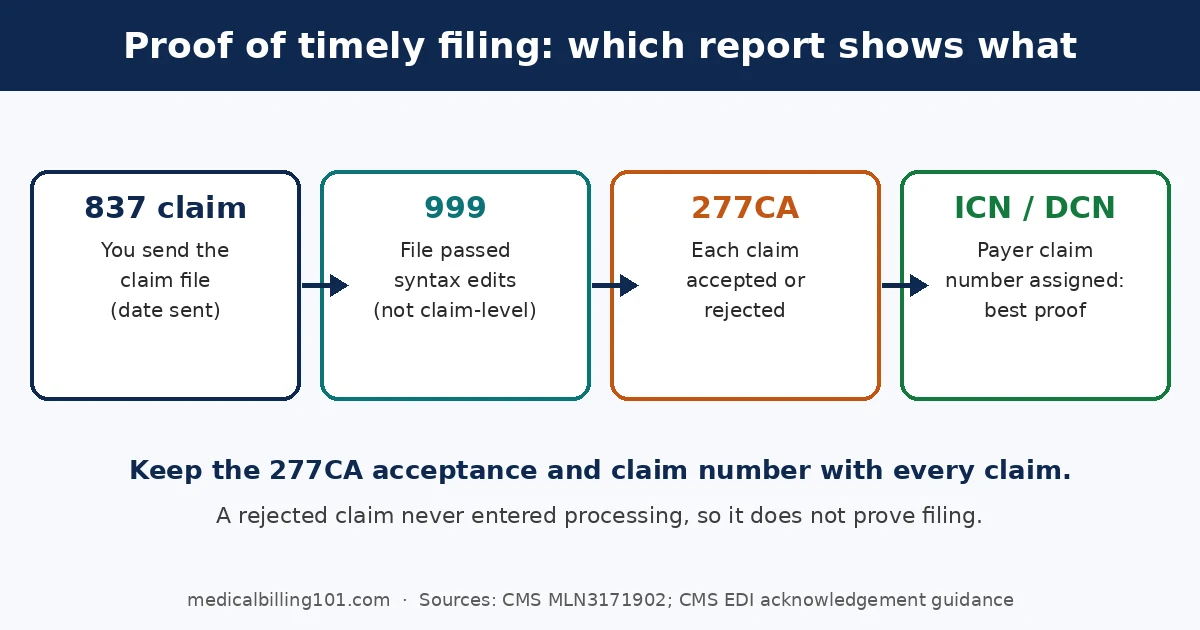
Here’s an example. A Medicare claim for a January 10, 2026 visit was sent on December 20, 2026. The 999 came back accepted, but the 277CA rejected the claim for an invalid member ID. Nobody worked the rejection until January 15, 2027, which is past the 12-month limit. The resubmitted claim was then denied with CO-29. The December 999 won’t help here, because the claim itself never entered processing. Always work 277CA rejections the day they arrive.
What to save with every claim
- The 277CA showing accepted, with the date and the payer claim number.
- The clearinghouse report showing the date it forwarded the claim to the payer.
- For paper claims, certified mail or courier tracking with the delivery date.
- Any payer portal screenshot or 276/277 claim status response that shows the claim on file.
When a payer denies a claim you can prove was accepted on time, appeal with the 277CA attached. The Appeal Letter Generator has a timely filing argument that lists this proof as an enclosure.
Frequently asked questions
What is the Medicare timely filing limit?
Medicare fee-for-service claims must be filed within 12 months, or 1 calendar year, after the date of service (42 CFR 424.44). For institutional claims that cover a span of dates, the “through” date on the claim is used.
How long do I have to appeal a Medicare claim denial?
You have 120 days from the date you receive the initial determination to request a redetermination. Receipt is presumed to be 5 days after the date on the notice, so in practice the window is 125 days from the notice date unless you can show you received it later.
What is the 5-day mail presumption?
Medicare presumes you received a notice 5 days after the date printed on it, unless there is evidence that you received it later. The calculator adds those 5 days before counting the appeal limit when the box is ticked.
How does the calculator handle month-end dates and leap years?
Month and year limits land on the same calendar day. When that day doesn’t exist in the target month, the last day of the month is used: January 31 plus 1 month is February 28, or February 29 in a leap year, and February 29 plus 1 year is February 28. Day limits are counted on the calendar, so leap days are included.
What are the timely filing limits for commercial payers?
They are set by each payer’s contract, provider manual and, in some cases, state law, and they differ for claims, corrected claims and appeals. The example presets are not real payer rules; always enter the limit from your own contract.
What happens if a claim is filed after the deadline?
The payer will usually deny it with CARC 29 (the time limit for filing has expired), and under a CO group code the amount is generally a provider write-off. These denials are usually overturned only with proof that the claim was filed on time or a documented exception.
Does the calculator save my dates?
No. Everything runs in your browser. Nothing is stored or sent, and the calendar file is created on your device.
Sources
- eCFR, 42 CFR 424.44 (time limits for filing claims)
- eCFR, 42 CFR 405.942 and 405.962 (Medicare appeal time frames)
- CMS, Medicare Claims Processing Manual (IOM 100-04), Ch. 1, §70