
CO-29 is a Claim Adjustment Reason Code meaning the payer received the claim after its filing deadline and denied it as untimely, so under group code CO the provider absorbs the amount. (Primary sources: X12 Claim Adjustment Reason Codes · CMS Medicare Claims Processing Manual, Ch. 1, §70)
Quick answer: First make sure the date of service on the claim is correct. A wrong or misread date can trigger CO-29 by mistake. If the claim really was late, Medicare doesn’t give appeal rights for timely filing denials. Your only routes are proving the date was wrong, or qualifying for one of the four exceptions in Medicare’s regulations. Medicare fee-for-service claims generally must be filed within 12 months (1 calendar year) after the date of service. Novitas ranked CARC 29 with N211 as its #4 claim denial for April–June 2026.
Part of our denial code library. Written by Manikandan, a revenue cycle management specialist with more than 10 years of US medical billing experience. Last reviewed: 3 October 2026. Official code wording is quoted word for word from X12; Medicare rules link to their CMS or Medicare contractor source.
Official CARC 29 description
X12 Claim Adjustment Reason Code 29, verbatim:
“The time limit for filing has expired.”
Source: X12 Claim Adjustment Reason Codes. Start: 01/01/1995.
The usual Medicare remark code is N211:
“Alert: You may not appeal this decision.” (X12 RARC N211, Start: 06/30/2003 | Last Modified: 03/14/2014)
What CO-29 means in plain English
Every payer sets a deadline for receiving claims. CO-29 means yours arrived after it. Under group code CO, CMS describes the amount as “generally… considered a write off for the provider and are not billed to the patient” (CMS IOM 100-04, Ch. 22, §60.1).
Medicare’s timely filing rules
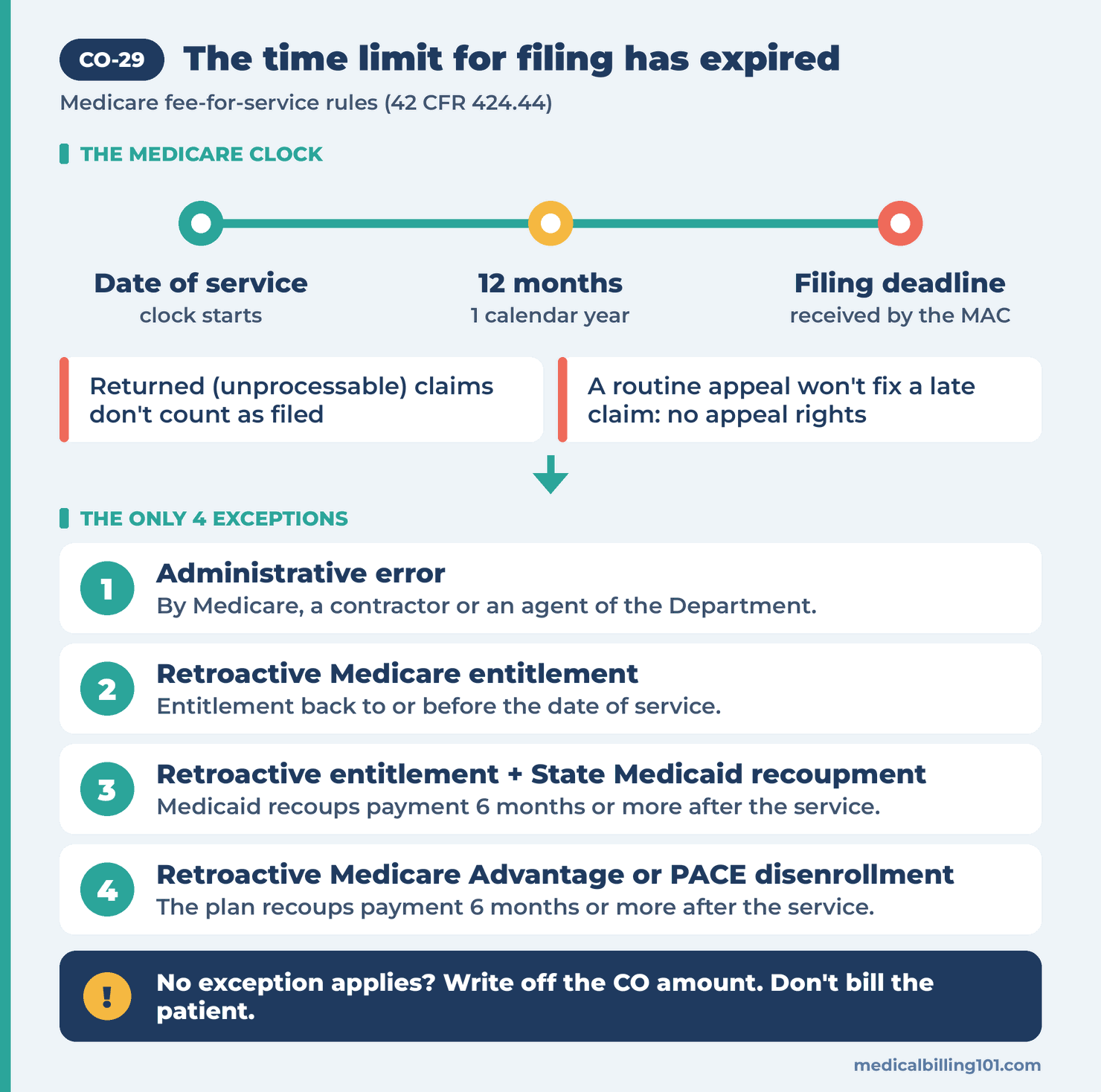
- The limit (§70): “Medicare regulations at 42 CFR 424.44 define the timely filing period… such claims must be filed to the appropriate Medicare claims processing contractor no later than 12 months, or 1 calendar year, after the date the services were furnished.”
- When the clock starts (§70.1): generally the date of service or “From” date.
- Institutional claims with span dates use the “Through” date.
- Professional claims (CMS-1500/837-P) with span dates use the line item “From” date. If the “From” date isn’t timely but the “To” date is, the contractor splits the line and denies the untimely services.
- Claims with a date of service on February 29 “must be filed by February 28 of the following year.”
- When the clock stops (§70.3): the date the submission is received by the appropriate Medicare contractor.
- Returned claims don’t count as filed. First Coast: claims returned as unprocessable “are not considered filed or submitted,” and Novitas notes the 12-month rule “includes resubmitting corrected claims that were unprocessable.”
The four exceptions (42 CFR 424.44(b), CMS Ch. 1 §70.7)
- Administrative error by Medicare, a contractor or an agent of the Department. The limit is extended “through the last day of the 6th calendar month following the month in which the error is rectified,” and contractors “will not accept requests for extensions for such errors that extend beyond 4 years from the date of service” (§70.7.1).
- Retroactive Medicare entitlement to or before the date of service (§70.7.2).
- Retroactive Medicare entitlement involving State Medicaid Agencies, where the Medicaid agency recoups payment 6 months or more after the service (§70.7.3).
- Retroactive disenrollment from a Medicare Advantage plan or PACE organization, where the plan recoups payment 6 months or more after the service (§70.7.4).
The Medicare contractor decides whether an exception applies, based on the documentation you submit (§70.7). For administrative error, Noridian advises including “an appropriate comment in Item 19 of the CMS 1500 Claim Form or the electronic equivalent.”
Common causes of CO-29
- A claim that sat in a work queue, rejected at the clearinghouse unnoticed, or was never sent.
- A claim returned as unprocessable (e.g., CO-16 with MA130) and corrected too late. It was never “filed.”
- Waiting on a primary payer and then billing the secondary late.
- A wrong or misread date of service. Noridian lists “Illegible DOS on CMS 1500 Claim Form” and recommends typed claims, because its optical character recognition “may misread handwritten claims.”
How to handle CO-29: step by step
- Check the date of service on the claim against the record. Noridian: “If the DOS was incorrect, submit a new claim with corrected DOS.”
- Work out the deadline correctly, using the right start date (§70.1) and the receipt date (§70.3). Novitas offers a timely filing calculator.
- Check whether an exception applies (administrative error, retroactive entitlement, retroactive Medicaid recoupment, or retroactive MA/PACE disenrollment), and gather the documentation.
- Don’t file a routine appeal for a late claim. Noridian: “A claim denied for timely filing is not afforded appeal rights.” N211 says the same.
- Other payers: check the contract or provider manual for the filing limit. Look for a reconsideration process that accepts proof of timely filing, such as a clearinghouse acceptance report.
- Write off the CO amount if no route applies. Don’t bill the patient.
How to prevent CO-29 denials
- Work clearinghouse rejection reports daily, so a rejected claim isn’t mistaken for a filed one.
- Correct and resubmit unprocessable claims quickly, because they don’t stop the clock.
- Track a days to timely filing field per payer in your practice management system.
- Bill secondary payers as soon as the primary adjudicates.
- Send claims electronically, or type paper claims. Noridian warns that handwritten dates can be misread.
Group codes and remark codes you’ll see with 29
- CO-29 is the form Medicare contractors publish.
- N211 (“Alert: You may not appeal this decision.”) is the usual Medicare remark. Some contractor tables paraphrase it with different wording, but the X12 text is the official one.
Related codes
- CO-16 / MA130: unprocessable claims that must be corrected inside the filing window.
- CO-22: coordination of benefits, a common source of delay.
- OA-18: duplicate claim. Resubmitting doesn’t reset the clock.
FAQ
What is the Medicare timely filing limit? 12 months, or 1 calendar year, after the date of service, under 42 CFR 424.44 as described in CMS IOM 100-04, Ch. 1, §70.
Can I appeal a CO-29 denial from Medicare? Noridian says “A claim denied for timely filing is not afforded appeal rights.” If the date of service was wrong, submit a new claim with the correct date. If an exception applies, document it.
Does resubmitting an unprocessable claim restart the timely filing clock? No. First Coast says claims returned as unprocessable “are not considered filed or submitted,” and Novitas says the 12-month limit includes resubmitted unprocessable claims.
What are the exceptions to Medicare timely filing? Administrative error, retroactive Medicare entitlement, retroactive entitlement involving State Medicaid Agencies, and retroactive disenrollment from a Medicare Advantage plan or PACE organization (CMS Ch. 1, §70.7).
What date starts the clock on a professional claim with span dates? The line item “From” date (CMS Ch. 1, §70.1).
Sources
- X12, Claim Adjustment Reason Codes (CARC 29). Start 01/01/1995. Accessed 3 Oct 2026.
- X12, Remittance Advice Remark Codes (N211). Accessed 3 Oct 2026.
- CMS, Medicare Claims Processing Manual (IOM 100-04), Ch. 1, §70, 70.1, 70.3 (Rev. 2140) and §70.7 (Rev. 12909, effective 11-26-24)
- CMS, Medicare Claims Processing Manual (IOM 100-04), Ch. 22, §60.1
- Noridian JE Part B, Timely Filing reason code guidance (last updated Apr 30, 2025)
- First Coast, Returned or rejected as unprocessable claims affect timely filing (Feb 17, 2026)
- Novitas JL, Top claim denials Apr–Jun 2026 (last modified 07/02/2026)
Last reviewed: 3 October 2026 · This page is educational and doesn’t replace payer-specific instructions.