
CO-22 is a Claim Adjustment Reason Code meaning the payer believes another insurer should pay first under coordination of benefits, so it won’t pay as primary until that is resolved. (Primary sources: X12 Claim Adjustment Reason Codes · CMS Medicare Claims Processing Manual, Ch. 22)
Quick answer: Find out which plan is primary for the date of service. If another plan is primary, bill it first, then send the secondary claim with the primary’s payment information. Sometimes the denying payer really is primary and the patient’s records are wrong. Then the patient needs to update them before you rebill. For Medicare, that goes through the Benefits Coordination & Recovery Center. Novitas ranked CO-22 with MA92 as its #2 claim denial for April–June 2026.
Part of our list of denial codes. Written by Manikandan, a revenue cycle management specialist with more than 10 years of US medical billing experience. Last reviewed: 3 October 2026. Official code wording is quoted word for word from X12; Medicare rules link to their CMS or Medicare contractor source.
Official CARC 22 description
X12 Claim Adjustment Reason Code 22, verbatim:
“This care may be covered by another payer per coordination of benefits.”
Source: X12 Claim Adjustment Reason Codes. Start: 01/01/1995 | Last Modified: 09/30/2007.
What CO-22 means in plain English
Coordination of benefits (COB) decides the order in which a patient’s plans pay. A CO-22 means the payer’s records show other coverage that should pay first. Or the claim is missing the other plan’s details. Under group code CO, the amount isn’t billed to the patient (CMS IOM 100-04, Ch. 22, §60.1). It’s a billing-order problem to fix.
Remark codes that explain CO-22
| Remark code | Official X12 description | Who publishes the pairing |
|---|---|---|
| N598 | “Health care policy coverage is primary.” | Noridian (CO-22 + N598) |
| MA92 | “Missing plan information for other insurance.” | Novitas (CARC 22 + MA92) |
Common causes of CO-22
Noridian lists these reasons: – “Patient has another insurance primary to Medicare” – “Patient’s coordination of benefits is not up-to-date”
Novitas’s resolution for 22/MA92: “Medicare is the secondary payer, and the claim must be sent to primary insurer first.” It also points billers to item 11c of the CMS-1500 (or the electronic equivalent), where you should “provide the 9-digit payer identification number of the primary insurance plan or program.”
In practice, these usually trace back to: – Registration not capturing every insurance card. – An employer or group plan, or another policy, that the patient didn’t mention. – COB records at the payer that haven’t been updated after coverage changed.
Worked example (illustrative)
Hypothetical scenario for illustration only.
A 67-year-old patient who is still working is seen and billed to Medicare as primary. The remit shows CO-22 + N598. At the next visit, front-desk staff ask the MSP questions and learn the patient has an employer group health plan. The biller sends the claim to the employer plan first and waits for its remittance. Then the biller sends Medicare a secondary claim with the primary plan’s payer ID and adjudication details. What if the employer coverage has ended? Then the patient contacts the BCRC to update the record. The claim then goes to Medicare as primary. (Whether Medicare or the employer plan pays first depends on MSP rules for that patient’s situation. Confirm in eligibility before you rebill.)
How to fix CO-22: step by step
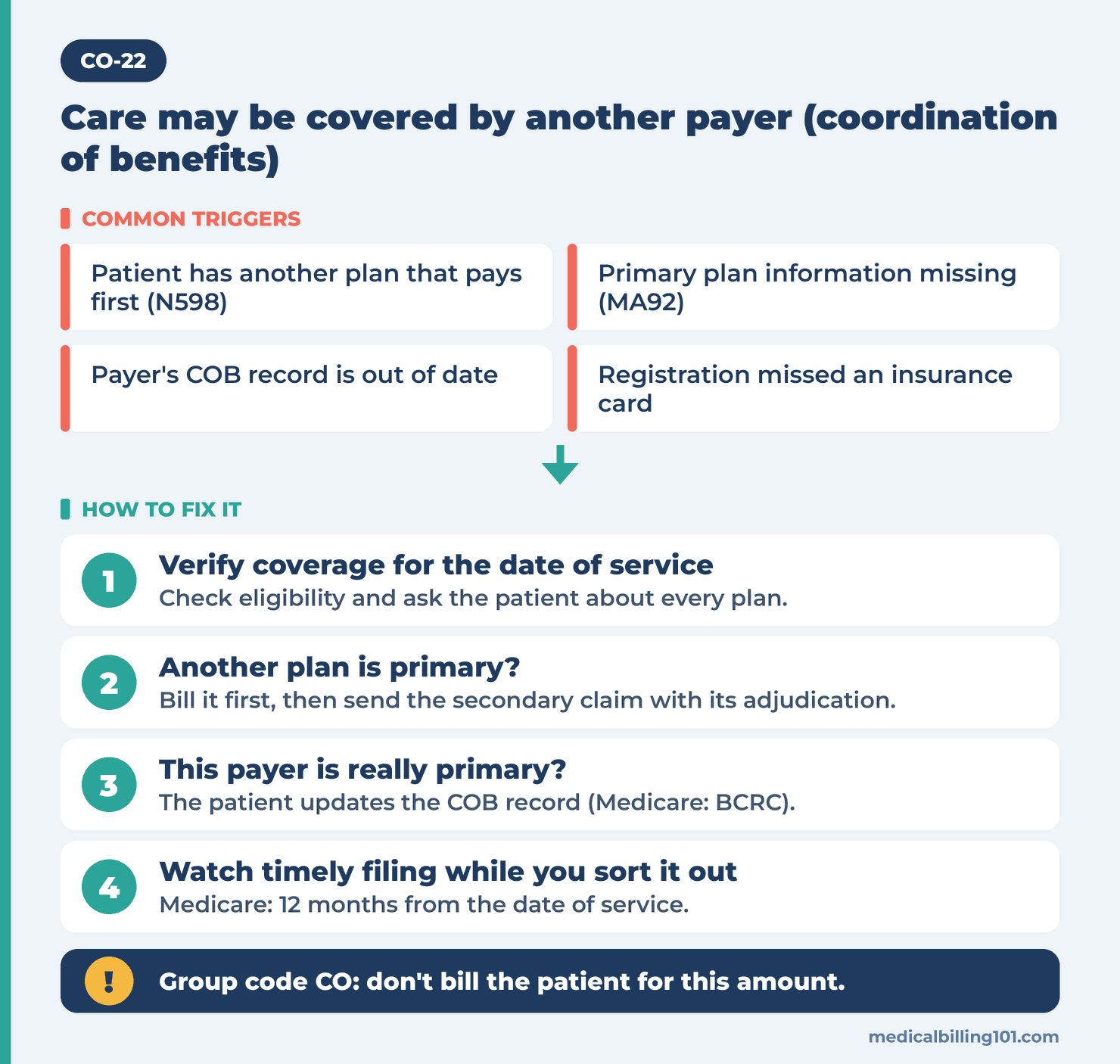
- Verify coverage for the date of service. Check eligibility in the payer portal. For Medicare, use your MAC’s portal. Ask the patient about every plan they have.
- If another plan is primary: bill that plan first. Noridian’s next step: “After billing primary insurance, submit secondary claim to Medicare.” Include the primary payer’s details and adjudication on the secondary claim. Missing primary information on a Medicare secondary claim can cause a CO-16 with MA04: “Secondary payment cannot be considered without the identity of or payment information from the primary payer.”
- If the denying payer is actually primary: the patient’s COB record needs correcting. Noridian: “If patient’s insurance needs to be updated, the beneficiary may contact Benefits Coordination,” and if there’s a problem with the file, “patient may contact Benefits Coordination & Recovery Center (BCRC) at 1-855-798-2627 to make necessary corrections.” Once it’s updated, “submit primary claim to Medicare.”
- For electronic claims, Noridian advises verifying “that all necessary primary information is correctly submitted on claim.” Noridian links Medicare Secondary Payer (MSP) electronic billing guides from its page.
- Watch timely filing while you sort out COB. Medicare’s limit is 12 months from the date of service (CMS IOM 100-04, Ch. 1, §70). For other payers, check the contract.
How to prevent CO-22 denials
- Collect every insurance card before the visit. Noridian: “Prior to rendering services, obtain all patient’s health insurance cards.”
- Use an MSP questionnaire for Medicare patients. Noridian points to its “Admission Questions to Ask Medicare Beneficiaries” form.
- Run eligibility at every visit, not just the first one, so COB changes get caught.
- Fill in item 11c / primary payer data on every Medicare secondary claim (Novitas).
- Send secondary claims with the primary’s adjudication attached or in the 837.
Group codes and remark codes you’ll see with 22
- CO-22 is the pairing Noridian and Novitas publish.
- N598 (primary coverage on file) and MA92 (missing other insurance plan information) are the usual remarks.
- MA04 comes with CO-16 when a secondary claim lacks primary payer information.
Related codes
- OA-23: “The impact of prior payer(s) adjudication including payments and/or adjustments. (Use only with Group Code OA)”: the normal secondary-claim adjustment.
- CO-19: “This is a work-related injury/illness and thus the liability of the Worker’s Compensation Carrier.”
- CO-109: “Claim/service not covered by this payer/contractor. You must send the claim/service to the correct payer/contractor.”
- CO-24: “Charges are covered under a capitation agreement/managed care plan.”
- CO-16: missing or invalid information, including MA04 on secondary claims.
- PR-1, PR-2, PR-3: deductible, coinsurance and copay amounts that the primary payer’s remittance reports.
- CO-29: timely filing limit expired. Check the deadline before you rebill.
FAQ
What does CO-22 mean? The payer thinks another plan should pay first. X12: “This care may be covered by another payer per coordination of benefits.”
What does MA92 mean with CO-22? MA92 is “Missing plan information for other insurance.” For Medicare, Novitas says to send the claim to the primary insurer first. Then report the primary plan’s 9-digit payer ID in item 11c or its electronic equivalent.
The patient says Medicare is primary. What now? The patient’s COB record needs updating. Noridian says the beneficiary can contact the Benefits Coordination & Recovery Center (BCRC) at 1-855-798-2627. Once it’s updated, submit the claim to Medicare as primary.
Can I bill the patient for a CO-22? No. Under group code CO, the amount isn’t billed to the patient. Bill the correct primary payer, then the secondary.
What’s the difference between CO-22 and CO-109? CO-22 means another payer may be primary under COB. CO-109 means the claim was sent to the wrong payer or contractor altogether and must go to the correct one.
Sources
- X12, Claim Adjustment Reason Codes (CARC 22, 23, 19, 109, 24). CARC 22 Start 01/01/1995, Last Modified 09/30/2007. Accessed 3 Oct 2026.
- X12, Remittance Advice Remark Codes (N598, MA92, MA04). Accessed 3 Oct 2026.
- CMS, Medicare Claims Processing Manual (IOM 100-04), Ch. 22, §60.1
- CMS, Medicare Claims Processing Manual (IOM 100-04), Ch. 1, §70
- Noridian JE Part B, Coordination of Benefits (last updated Apr 02, 2025)
- Noridian JE Part B, Medicare is Secondary Payer
- Novitas JL, Top claim denials Apr–Jun 2026 (last modified 07/02/2026)
Last reviewed: 3 October 2026 · This page is educational and doesn’t replace payer-specific instructions.