

PR-1, PR-2 and PR-3 are Claim Adjustment Reason Codes meaning the payer applied part of its allowed amount to the patient’s deductible (1), coinsurance (2) or copay (3), so the amount is patient responsibility, not a denial. (Primary sources: X12 Claim Adjustment Reason Codes · CMS Medicare Claims Processing Manual, Ch. 22)
Quick answer: These aren’t denials. The claim processed, and the plan’s cost-sharing rules moved part of the allowed amount to the patient. Bill any secondary or supplemental payer first. Then post the PR amount to the patient’s balance and collect it under your financial policy.
Part of our denial codes lookup. Written by Manikandan, a revenue cycle management specialist with more than 10 years of US medical billing experience. Last reviewed: 3 October 2026. Official code wording is quoted word for word from X12; Medicare rules link to their CMS or Medicare contractor source.
Official X12 descriptions
| CARC | Official X12 description (verbatim) | Dates |
|---|---|---|
| 1 | “Deductible Amount” | Start: 01/01/1995 |
| 2 | “Coinsurance Amount” | Start: 01/01/1995 |
| 3 | “Co-payment Amount” | Start: 01/01/1995 |
Source: X12 Claim Adjustment Reason Codes.
What the PR group code means
CMS defines group code PR as follows: “This group code shall be used when the adjustment represent an amount that may be billed to the patient or insured. This group would typically be used for deductible and copay adjustments” (CMS IOM 100-04, Ch. 22, §60.1). That’s the key difference from a CO adjustment, which CMS describes as generally a provider write-off that isn’t billed to the patient.
PR-1, PR-2 and PR-3 in plain English
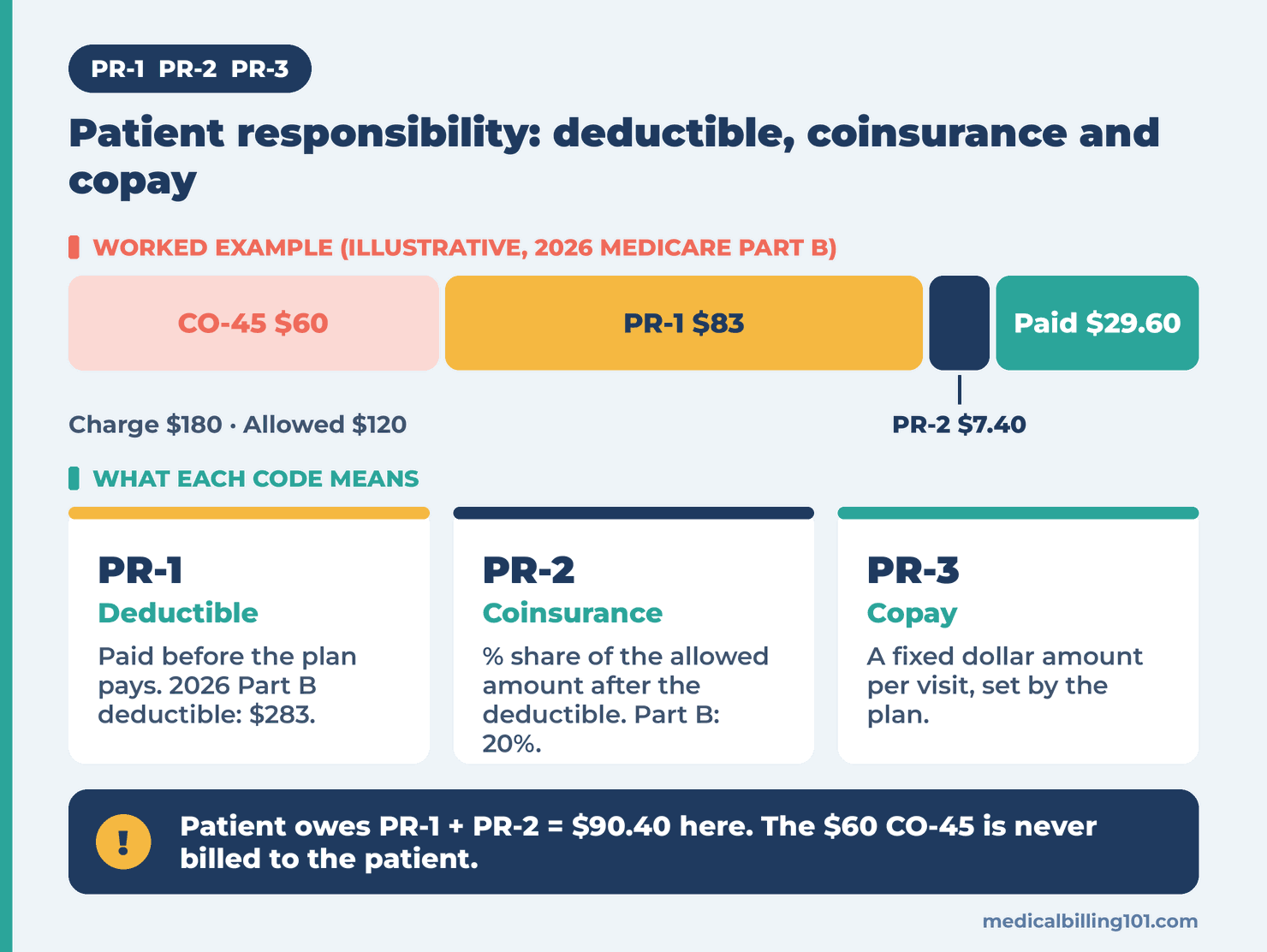
- PR-1 (deductible): the amount the patient pays before the plan starts paying. For Original Medicare, CMS set the 2026 Part B deductible at $283 for all Part B beneficiaries (CMS 2026 fact sheet; MLN MM14279). Early in the year, a line may show the whole allowed amount as PR-1 and pay $0. That’s still a processed claim, not a denial.
- PR-2 (coinsurance): the patient’s percentage share of the allowed amount after the deductible. CMS lists Part B coinsurance as 20% for 2026 (MLN MM14279). Commercial percentages depend on the plan.
- PR-3 (copayment): a fixed dollar amount per visit or service, set by the patient’s plan.
Common reasons you see PR-1, PR-2 or PR-3
- The patient hasn’t met the annual deductible yet (PR-1).
- The plan has coinsurance after the deductible (PR-2).
- The plan charges a fixed copay for this kind of visit (PR-3).
- Noridian notes that a CO-45 “pay message” can come with payment applied “to patient’s deductible and/or coinsurance.” That’s why PR lines often sit next to CO-45.
Worked example (illustrative)
Hypothetical numbers for illustration only. Your payers’ allowed amounts and the patient’s benefits will differ.
A Medicare patient has an office visit in February 2026. The provider charges $180 and the Medicare allowed amount is $120. The patient has already paid $200 toward the $283 2026 Part B deductible, so $83 of the deductible is left.
| Remit line item | Amount | What it means |
|---|---|---|
| CO-45 | $60 | $180 charge − $120 allowed. Provider write-off. |
| PR-1 | $83 | Rest of the patient’s Part B deductible. |
| PR-2 | $7.40 | 20% coinsurance on the $37 left after the deductible ($120 − $83). |
| Paid | $29.60 | Medicare’s payment (80% of $37). |
The patient’s responsibility is PR-1 + PR-2 = $90.40, unless a supplemental plan picks it up (look for MA18 on the remit). The $60 CO-45 is never billed to the patient. (This example simplifies the actual Medicare payment calculation, which can include other adjustments.)
How to work PR-1, PR-2 and PR-3: step by step
- Reconcile the line. Compare the billed charge, allowed amount, payment and each adjustment. Then you know which part is PR (patient) and which is CO (provider adjustment).
- Check for a secondary or supplemental payer.
- Medicare crossover: if the remit carries MA18, “Alert: The claim information is also being forwarded to the patient’s supplemental insurer. Send any questions regarding supplemental benefits to them.” Wait for the crossover payment before billing that payer yourself, to avoid a duplicate (see OA-18).
- No crossover: send the secondary claim with the primary’s adjudication.
- Bill the patient for what’s left after secondary payments, following your financial policy and the payer contract.
- Check eligibility if the PR amount looks wrong. For example, the patient may say the deductible is already met. Ask the payer to review it if needed.
- Post PR and CO separately, so the patient’s balance includes only PR amounts.
How to prevent surprises with PR amounts
- Check eligibility and benefits before the visit, including the remaining deductible, coinsurance percentage and copay.
- Collect known copays at check-in.
- Give good-faith cost estimates where your policies (and applicable rules) call for them.
- Capture secondary and supplemental coverage at registration so PR balances go to the right payer first.
Group codes and remark codes you’ll see with 1, 2 and 3
- PR-1, PR-2, PR-3 are the standard forms, since these amounts are patient responsibility by definition (CMS: PR “would typically be used for deductible and copay adjustments”).
- MA18 on Medicare remits means the claim was crossed over to a supplemental insurer.
- CO-45 often appears on the same line for the amount above the allowed amount.
Related codes
- CO-45: charge above the allowed or contracted amount. A provider adjustment, not patient responsibility.
- OA-23: “The impact of prior payer(s) adjudication including payments and/or adjustments. (Use only with Group Code OA)”: seen on secondary claims.
- CO-22: coordination of benefits.
- OA-18: duplicate. Watch for crossover duplicates.
FAQ
Is PR-1 a denial? No. PR-1 means the allowed amount was applied to the patient’s deductible (“Deductible Amount”). The claim was processed, and the patient (or a secondary payer) owes that amount.
What’s the difference between PR-2 and PR-3? PR-2 is coinsurance, a percentage of the allowed amount. PR-3 is a copayment, a fixed dollar amount set by the plan.
Can I bill the patient for PR amounts? Yes, subject to your contracts and any secondary coverage. CMS defines PR as an amount “that may be billed to the patient or insured.”
What is the Medicare Part B deductible in 2026? $283, per CMS’s 2026 fact sheet and MLN MM14279. Part B coinsurance is 20%.
Should I bill the supplemental insurer when I see PR amounts on a Medicare remit? Check for MA18 first. It means Medicare already forwarded the claim to the supplemental insurer. Billing it again can cause a duplicate denial.
Sources
- X12, Claim Adjustment Reason Codes (CARC 1, 2, 3, 23, 45). Accessed 3 Oct 2026.
- X12, Remittance Advice Remark Codes (MA18). Accessed 3 Oct 2026.
- CMS, Medicare Claims Processing Manual (IOM 100-04), Ch. 22, §60.1
- CMS, 2026 Medicare Parts A & B Premiums and Deductibles (fact sheet, Nov 14, 2025)
- CMS MLN, MM14279 Medicare Deductible, Coinsurance & Premium Rates: CY 2026 Update
- Noridian JE Part B, Claim Paid at Maximum Allowed Amount (last updated Apr 30, 2025)
Last reviewed: 3 October 2026 · This page is educational and doesn’t replace payer-specific instructions.