

CO-45 is a Claim Adjustment Reason Code meaning your charge was higher than the payer’s allowed or contracted amount, so the difference is adjusted off and, under group code CO, written off. (Primary sources: X12 Claim Adjustment Reason Codes · CMS Medicare Claims Processing Manual, Ch. 22)
Quick answer: CO-45 usually isn’t a denial. The payer processed the service and paid it, or applied it to the deductible, based on its allowed amount. The gap between your charge and that amount is a contractual adjustment. Noridian, a Medicare contractor, puts it plainly: “This is NOT a denial but a pay message.” Only work the CO-45 lines where the allowed amount is lower than your contract or fee schedule says it should be.
Part of our full denial code lookup. Written by Manikandan, a revenue cycle management specialist with more than 10 years of US medical billing experience. Last reviewed: 3 October 2026. Official code wording is quoted word for word from X12; Medicare rules link to their CMS or Medicare contractor source.
Official CARC 45 description
X12 Claim Adjustment Reason Code 45, verbatim:
“Charge exceeds fee schedule/maximum allowable or contracted/legislated fee arrangement. Usage: This adjustment amount cannot equal the total service or claim charge amount; and must not duplicate provider adjustment amounts (payments and contractual reductions) that have resulted from prior payer(s) adjudication. (Use only with Group Codes PR or CO depending upon liability)”
Source: X12 Claim Adjustment Reason Codes. Start: 01/01/1995 | Last Modified: 07/01/2017.
What CO-45 means in plain English
Here is an illustrative example (the numbers are made up). Say you bill $200 and the payer’s allowed amount is $120. The payer reports $80 as a CARC 45 adjustment, then pays the $120, or applies part of it to the patient’s deductible or coinsurance.
- Group code CO (Contractual Obligation): CMS describes CO adjustments as “generally… considered a write off for the provider and are not billed to the patient” (CMS IOM 100-04, Ch. 22, §60.1). For a CO-45, the $80 above is written off.
- Group code PR: X12 allows CARC 45 with PR “depending upon liability.” PR-45 tells you the patient, not the provider, owes that amount. Noridian’s guidance page lists both CO-45 and PR-45.
Two details in the X12 usage note are useful when you reconcile: 1. CARC 45 can’t equal the full charge. If a line paid $0, another code explains the rest. That may be the patient’s deductible (PR-1) or a true denial code. 2. CARC 45 shouldn’t repeat a prior payer’s adjustment. On secondary claims, the secondary payer’s CARC 45 should reflect its own allowance, not copy the primary’s contractual reduction.
Common reasons you see CO-45
Noridian lists these reasons for the message: – “Item or service paid Medicare allowed amount” – “Item or service paid to patient’s deductible and/or coinsurance” – “Item or services paid with partial units”
In day-to-day billing, CO-45 lines also flag: – A chargemaster set above every payer’s allowance (normal and expected). – A fee schedule or contract loaded wrong in your practice management system, so the expected payment doesn’t match what was paid. – A real payer underpayment against your contract.
How to work a CO-45 line: step by step
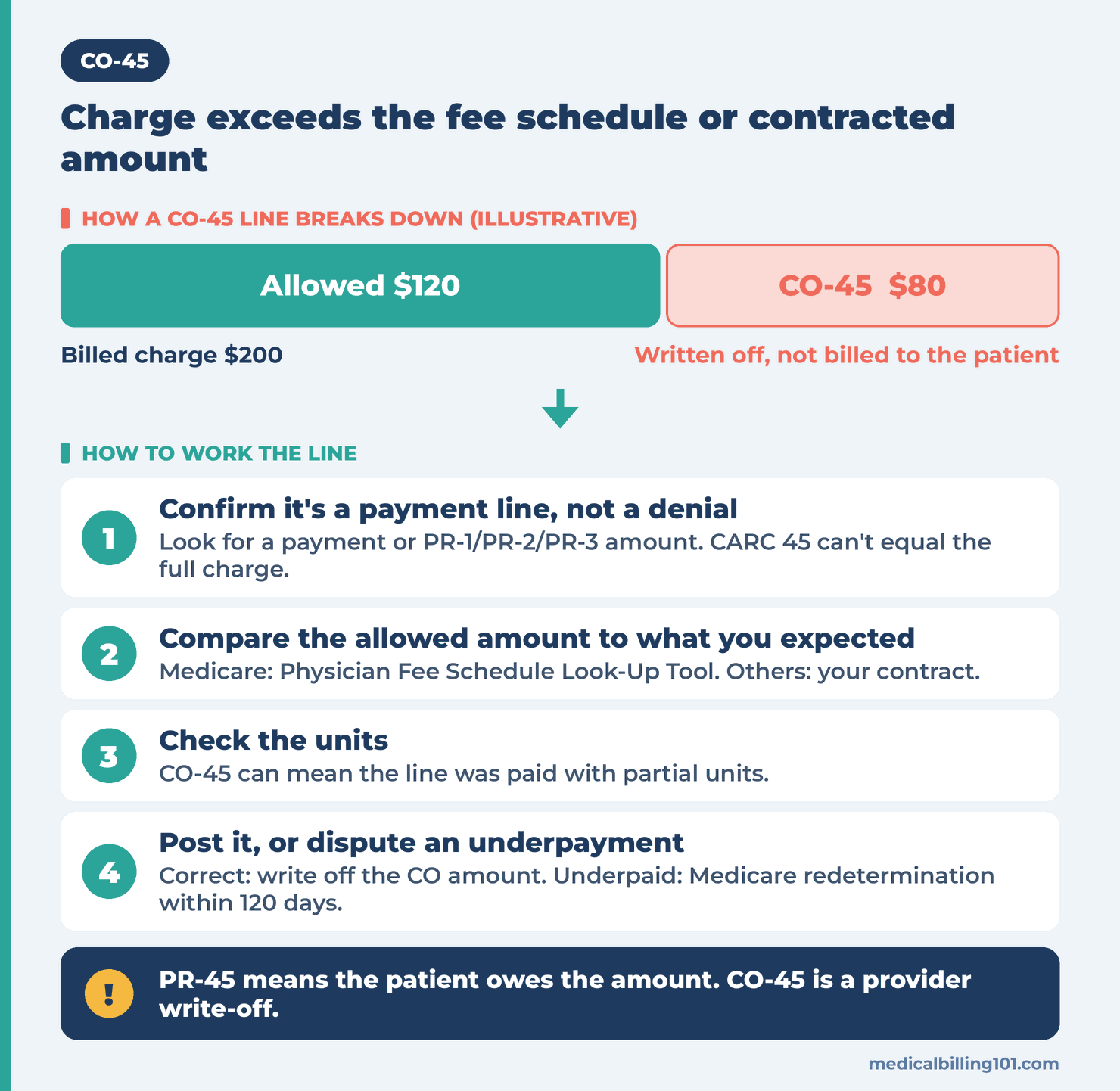
- Confirm it’s a payment line, not a denial. Check for a payment amount or a PR-1/PR-2/PR-3 amount on the same line. If the line paid $0 and the only adjustment is CARC 45, read the whole remit again, because X12 says CARC 45 can’t equal the total charge.
- Compare the allowed amount to what you expected.
- Medicare: check the allowed amount against the CMS Physician Fee Schedule Look-Up Tool for the date of service, locality and modifier.
- Commercial and Medicare Advantage plans: check it against your contract’s fee schedule.
- Check units. Noridian notes that CO-45 can mean “paid with partial units.” Make sure the paid units match the units you billed and documented.
- If the allowed amount is correct, post the adjustment. Write off the CO-45 amount, bill the patient only for PR amounts, and bill any secondary payer.
- If you were underpaid, dispute it.
- Medicare: Noridian says “Items or services with this message have appeal rights” and recommends reviewing claim status before you file a redetermination. CMS gives you 120 days from receipt of the initial determination to request one. It presumes you received the notice 5 calendar days after its date (CMS: Redetermination). Use form CMS-20027 or a written request, and attach your supporting documents.
- Commercial plans: follow the payer’s reconsideration or appeal process and its deadlines in your contract or provider manual.
- Fix the root cause. If your system’s expected payment was wrong, update the fee schedule so future CO-45 lines reconcile automatically.
How to prevent CO-45 problems
You can’t prevent a normal CO-45 adjustment, because it’s how contracted pricing works. What you can prevent is CO-45 errors: – Load each payer’s current fee schedule into your practice management system and update it when contracts or the Medicare Physician Fee Schedule change. – Set up variance reports that flag lines where allowed amount ≠ expected amount. – Check units on time-based and per-unit codes before the claim goes out. – Keep CO-45 and PR-45 separate when you post, so patient balances are right.
Group codes and remark codes you’ll see with 45
- CO-45: the provider writes off the difference. This is the most familiar form.
- PR-45: the patient is liable for the difference, as allowed by X12 “depending upon liability.”
- Remark codes: Noridian’s denial resolution table lists CARC 45 without a paired remark code, and you’ll often see it alone. Read any RARC that does appear.
Related codes
- PR-1, PR-2, PR-3: deductible, coinsurance and copay amounts that often appear on the same line.
- CO-16: missing or invalid claim information. A true rejection, unlike CO-45.
- CO-97: bundled service with no separate allowance.
- CO-151: “Payment adjusted because the payer deems the information submitted does not support this many/frequency of services.”
FAQ
Is CO-45 a denial? No. CO-45 is an adjustment for the amount above the payer’s allowed or contracted rate. Noridian calls it “NOT a denial but a pay message.”
Can I bill the patient for a CO-45 amount? No. Under group code CO, the adjustment is a contractual write-off. CMS says CO adjustments are generally “not billed to the patient.” Only PR amounts go to the patient, such as PR-45 or the deductible, coinsurance and copay.
What’s the difference between CO-45 and PR-45? The group code. X12 says CARC 45 is used “with Group Codes PR or CO depending upon liability.” CO means the provider absorbs the difference. PR means the patient is responsible for it.
Can I appeal a CO-45 adjustment? Yes, if the allowed amount is wrong. For Medicare, Noridian says these items have appeal rights, and the redetermination deadline is 120 days from receipt of the initial determination. For other payers, use their reconsideration process.
Why does CO-45 show up on a line that paid nothing? It may sit next to a deductible (PR-1). X12 says CARC 45 can’t equal the total charge, so look for the other adjustment that explains the rest of the line.
Sources
- X12, Claim Adjustment Reason Codes (CARC 45, 151). CARC 45 Start 01/01/1995, Last Modified 07/01/2017. Accessed 3 Oct 2026.
- CMS, Medicare Claims Processing Manual (IOM 100-04), Ch. 22, §60.1 Group Codes
- CMS, First Level of Appeal: Redetermination by a Medicare Contractor
- CMS, Physician Fee Schedule Look-Up Tool
- Noridian JE Part B, Claim Paid at Maximum Allowed Amount (last updated Apr 30, 2025)
- Noridian JE Part B, Denial Code Resolution
Last reviewed: 3 October 2026 · This page is educational and doesn’t replace payer-specific instructions.