Free, browser-based helpers for medical billers, coders and practice staff. No sign-up, and nothing you type is saved or sent.
Key takeaways
- Use the Appeal Letter Generator when a claim was right and the payer denied it.
- Use the Timely Filing Calculator to see how many days you have left to file or appeal.
- Use the Denial Code Lookup to learn what a CARC or RARC means and how to fix it.
Tools to Fix Claims and Denials
Quick, free helpers for billers, coders and patients. No sign-up.
Appeal Letter Generator
Pick a denial code and payer, fill in claim details, copy a ready-to-edit appeal letter.
Timely Filing Deadline Calculator
Enter the date of service or EOB date to see claim and appeal deadlines.
Denial Code Lookup
Search any CARC/RARC (e.g. CO-97, CO-16) for its meaning and fix steps.
NPI Lookup
Search the CMS NPI Registry by NPI or name and state. See type, taxonomy and address.
Appeal Letter Generator
Pick the CARC denial code and payer, add the claim details, tick the arguments that fit, and get an editable, professional appeal letter you can copy, download as .docx or print. It covers more than 50 common denial codes, including every code with a guide on this site. For Original Medicare claims it switches to redetermination wording, which must be filed within 120 days of receiving the notice (42 CFR 405.942).
Open the Appeal Letter Generator →
Timely Filing & Appeal Deadline Calculator
Enter the date of service or the denial date and the filing limit. You’ll see the exact claim, corrected claim or appeal deadline and how many days are left. You can also add a reminder to your calendar. Medicare’s 12-month claim limit (42 CFR 424.44) and 120-day appeal rule, with the 5-day mail presumption, are built in.
Open the Timely Filing & Appeal Deadline Calculator →
Denial Code Lookup
Search CARC and RARC codes for the official X12 wording, what each code means in plain English, and how to fix it. X12 maintains the official lists, which change over time, so check the current X12 CARC list for new or retired codes.
Most-searched denial codes
Each link opens a full guide with the official meaning, the usual causes and a step-by-step fix. The plain-English summaries below paraphrase the X12 code descriptions.
| Code | What it means | Usual first step |
|---|---|---|
| CO-16 | The claim lacks information or has a billing error | Read the remark code, fix the field and resubmit |
| CO-45 | The charge is above the fee schedule or contracted rate | Usually a contractual write-off; check the allowed amount |
| CO-50 | Not deemed medically necessary by the payer | Compare the record to the payer policy, then appeal |
| CO-97 | Included in the payment for another service | Check NCCI edits and modifier use |
| CO-29 | The time limit for filing has expired | Find proof of timely filing, such as the 277CA |
| CO-197 | Precertification or authorization was absent | Look for an auth on file or a retro-auth option |
| CO-4 | The procedure code doesn’t match the modifier | Correct the modifier and send a corrected claim |
| CO-11 | The diagnosis doesn’t match the procedure | Check diagnosis pointers and coding |
| CO-22 | Another payer may be primary | Verify coordination of benefits with the patient |
| OA-18 | Exact duplicate claim or service | Check claim status before you resubmit |
| CO-27 | Service was after coverage ended | Re-verify eligibility and find other coverage |
| CO-109 | Not covered by this payer; send to the correct one | Identify the right payer or contractor |
| PR-1, PR-2, PR-3 | Deductible, coinsurance and copay amounts | Bill the patient or the secondary payer |
For the full list, see the denial code library or the CARC and RARC guide.
How to read a denial code
Every denial on an 835 remittance or paper EOB combines up to three codes. CMS explains the 835 format on its payment and remittance advice page. Reading all three tells you who owns the balance and what to do next.
- A group code is the two-letter prefix that says who is responsible for the adjustment: CO (contractual obligation), PR (patient responsibility), OA (other adjustment) or PI (payer-initiated reduction). X12 maintains the group code list.
- A CARC is a Claim Adjustment Reason Code. It explains why the claim or line was paid differently than billed. See the official CARC list.
- A RARC is a Remittance Advice Remark Code. It adds detail, such as which document is missing or which policy applied. See the official RARC list.
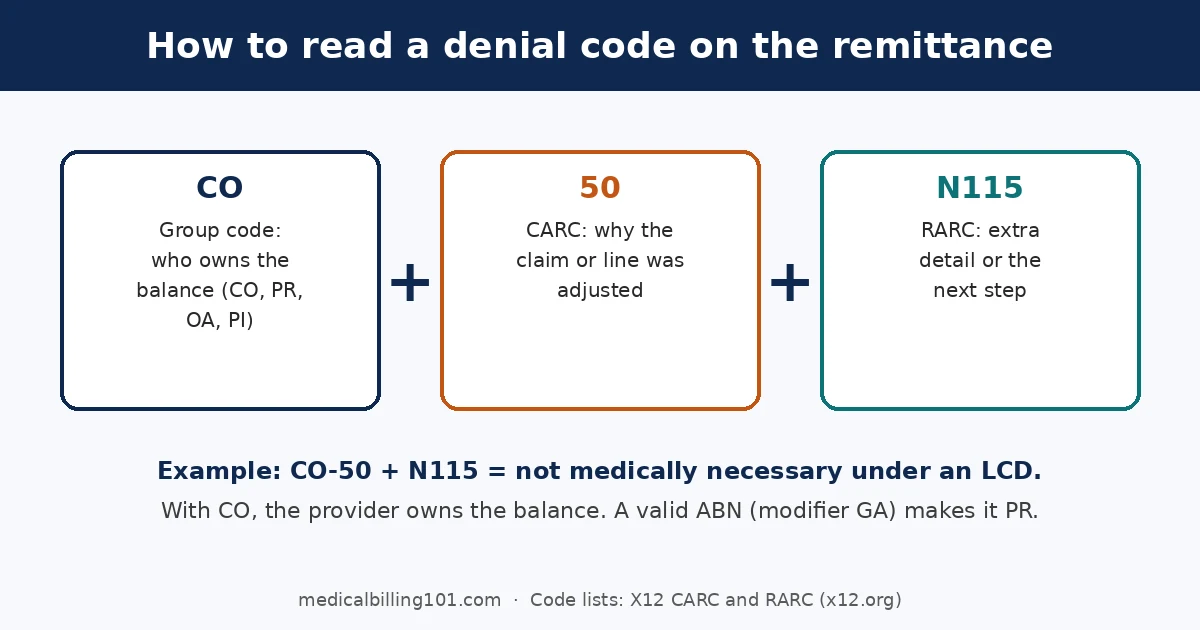
For example, CO-50 with remark N115 means the payer found the service not medically necessary, and the decision was based on a Local Coverage Determination. The CO group means the provider carries the balance, so the patient can’t be billed. On a Medicare claim, a valid ABN billed with modifier GA would have shifted it to PR. The rules on when a patient knew a service might not be paid are in 42 CFR 411.404.
Which tool to use for which job
| Task | Tool | What you get |
|---|---|---|
| Write a payer appeal for a denied claim | Appeal Letter Generator | An editable letter, an enclosure list and a .docx download |
| Check a claim, corrected claim or appeal deadline | Timely Filing Calculator | The exact deadline, days left and a calendar reminder |
| Understand a CARC or RARC on a remittance | Denial Code Lookup | Official wording, causes and a step-by-step fix |
These tools are built and maintained by Manikandan J, CPC, CRCR. Read about the author, our editorial policy, or contact us to report an error.