
CARC and RARC codes are the standard reason and remark codes payers put on electronic remittance advice (835/ERA) and paper EOBs when a claim or service line is paid differently than billed. Together with a group code (CO, PR, OA or PI), they answer three questions: who carries the amount, why it was adjusted, and what exactly needs fixing. (Primary sources: X12 Claim Adjustment Reason Codes · X12 Remittance Advice Remark Codes · X12 Claim Adjustment Group Codes · CMS Medicare Claims Processing Manual, Ch. 22, §60.1–60.2)
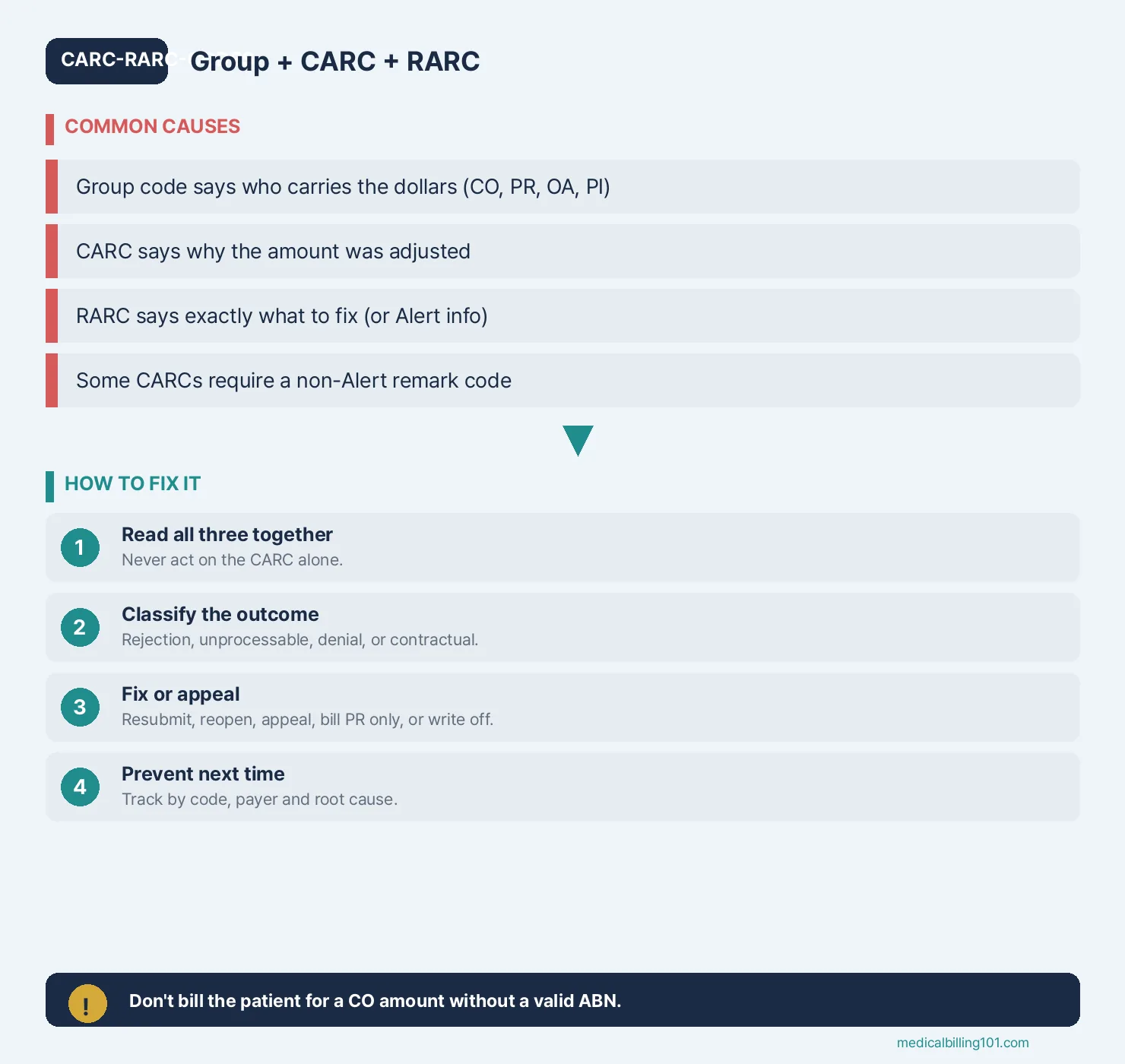
Quick answer: Read every adjustment as group code + CARC + RARC. The group code says who is responsible. The CARC says why. The RARC (when present) says exactly what. Then decide: correct and resubmit, appeal, bill the patient (only if PR applies), or write it off.
Part of our denial codes library. Written by Manikandan, a revenue cycle management specialist with more than 10 years of US medical billing experience. Last reviewed: 10 October 2026. Official code wording is quoted word for word from X12; Medicare rules link to their CMS or Medicare contractor source.
What are CARC codes?
CARC means Claim Adjustment Reason Code. X12 describes these codes as explaining why a claim or service line was paid differently than it was billed. Each CARC is a number or letter-number combination (for example 16, 45, 97, 151, B9 or A1). One CARC explains one adjustment amount; a single service line can carry several CAS segments with different CARCs.
HIPAA requires payers to use these standard codes instead of proprietary reason codes on remittance advice. CMS notes that the CARC list is updated three times a year (Medicare Claims Processing Manual, Ch. 22, §60.2).
What are RARC codes (remark codes)?
RARC means Remittance Advice Remark Code (also called a remark code). X12 says RARCs provide additional explanation for an adjustment already described by a CARC, or convey information about remittance processing. RARCs start with M, MA or N.
There are two types:
- Supplemental RARCs — most of the list. They pinpoint what was wrong (for example N290: rendering provider primary identifier missing/invalid).
- Informational / Alert RARCs — every one is prefaced with “Alert:”. They convey processing information and are never tied to a specific monetary adjustment.
Some CARCs require at least one remark code that is not an Alert. Examples include CARC 16, 96, 234, 252 and A1. Always open the RARC before you decide how to fix the line.
Group codes: CO, PR, OA and PI
The group code (Claim Adjustment Group Code) sits in front of the CARC on the remit — for example CO-16 or PR-1. X12’s current group list:
| Group code | X12 name | What it means for posting |
|---|---|---|
| CO | Contractual Obligation | CMS: generally “considered a write off for the provider and are not billed to the patient” |
| PR | Patient Responsibility | CMS: an amount that “may be billed to the patient or insured” (deductible, coinsurance, copay, or other PR) |
| OA | Other Adjustment | CMS: used “when no other group code applies” (common with OA-18 duplicates and OA-23 prior-payer impact) |
| PI | Payer Initiated Reductions | Appears on non-Medicare remits; CMS lists only CO, OA and PR as valid on Medicare remittances |
| CR | Corrections and Reversal | X12 note: not to be used with 005010 and up |
CMS quotes are from Ch. 22, §60.1. Do not bill the patient for a CO amount unless a valid ABN (or plan equivalent) and a PR group code actually shift liability.
How to read an 835 / ERA line
For example, a trimmed CAS + LQ remittance line looks like this:
CLP*PT20261010A*1*200.00*80.00*100.00*MB*2626000123456~
SVC*HC:99213*200.00*80.00~
CAS*CO*45*20.00~
CAS*PR*1*100.00~
LQ*HE*N130~
Reading it left to right:
- CLP / SVC — claim and service charged vs paid.
- CASCO45*20.00 — group CO + CARC 45: $20 contractual reduction (charge above allowed).
- CASPR1*100.00 — group PR + CARC 1: $100 deductible (patient responsibility).
- LQHEN130 — remark: consult plan benefit documents/guidelines.
This 835 snippet is illustrative only. Real remits may stack more CAS segments and remark codes at claim or line level.
CARC vs RARC vs group code (side-by-side)
| Piece | Answers | Example | Where maintained |
|---|---|---|---|
| Group code | Who carries the dollars? | CO, PR, OA, PI | X12 Claim Adjustment Group Codes |
| CARC | Why was the amount adjusted? | 16, 45, 97, 151, 234, 253 | X12 CARC list |
| RARC | What exactly / more detail? | N290, N115, M15, MA130 | X12 RARC list |
Common CARC patterns (with links to our guides)
Missing or invalid information
- CO-16 — claim/service lacks information or has submission/billing error(s); requires a remark code.
- CO-252 — attachment/other documentation required.
- M51, N290, MA130 — common remark codes that name the missing field.
Eligibility, coverage and COB
Authorization
- CO-197 — precert/authorization/notification absent.
- CO-39 — services denied at the time authorization was requested.
Coding, bundling and “not paid separately”
Medical necessity, non-covered, frequency, benefit max
Payment adjustments that are not coverage denials
- CO-45 — charge exceeds fee schedule/allowed.
- CO-253 — sequestration (federal payment reduction).
- CO-70, CO-307.
Duplicates and timely filing
Rejection vs unprocessable vs denial
| Outcome | What happened | Typical next step |
|---|---|---|
| Rejection | Clearinghouse or payer front-end stop | Fix and resubmit; no appeal |
| Returned as unprocessable (Medicare) | Incomplete/invalid data; CMS: not afforded appeal rights | Correct and send a new claim (Ch. 1, §80.3.1) |
| Denial / payment decision | Adjudicated; amount adjusted or zero-paid | Corrected claim, reopening or appeal per payer rules |
How to work any remittance adjustment (5 steps)
- Read the full set — every group code, CARC and RARC at claim and line level.
- Classify it — rejection, unprocessable, contractual adjustment, patient responsibility, or appealable denial.
- Find the root cause — registration, eligibility, coding, authorization, documentation or enrollment.
- Act — resubmit, reopen, appeal, bill patient (PR only), or write off. See our corrected claim guide and Medicare appeal guide.
- Prevent — track by code, payer and cause; put edits upstream.
Worked example (illustrative)
A secondary Medicare remit shows CAS*OA*23*450.00 plus CAS*PR*2*40.00 on a surgery line. The primary commercial payer already paid and took a contractual write-off. OA-23 is the impact of that prior adjudication (not a new denial). Post OA-23 as informational (already on AR), collect the remaining PR coinsurance, and do not re-post the primary payment.
Prevention checklist
- Train posters to read group + CARC + RARC together, never the CARC alone.
- Map top 20 CARCs to work queues (eligibility, coding, auth, medical necessity, COB).
- Flag CARCs that require a non-Alert RARC (16, 96, 234, 252, A1 and others).
- Never auto-transfer CO amounts to patient statements.
- Keep X12 list bookmarks and MAC denial-resolution pages in your playbook.
- Review most common claim denial reasons quarterly against your own denial dashboard.
Code-set maintenance dates and volumes (context)
X12 refreshes the CARC list about three times a year (CMS Ch. 22). On this site’s 10 October 2026 keyword-gap pull, “carc” showed about 4,400 US searches per month, “rarc” about 1,300, “rarc codes” about 1,000, “remark codes” about 1,000, and “claim adjustment reason codes” about 590. Those queries all point at the same 835 toolkit: Group Codes CO/PR/OA/PI, CARCs such as 16, 45, 97, 151, 234 and 253, and RARCs such as N290, N115, M15 and MA130.
HIPAA named the ASC X12 835 as the remittance standard. Medicare Administrative Contractors (MACs) such as Noridian, Novitas and First Coast Service Options publish denial-resolution pages that pair CARCs with RARCs. When you train posters, map those MAC pages beside the live X12 list rather than a static PDF snapshot.
High-volume denial codes to learn next
| Label | CARC / RARC | Approx. US monthly volume (OpenSEO gap, 10 Oct 2026) | Guide |
|---|---|---|---|
| OA-23 | CARC 23 | 1,300 (“denial code oa 23”) | OA-23 |
| CO-234 | CARC 234 | 720 (“co 234 denial code”) | CO-234 |
| CO-253 | CARC 253 | 720 (“co 253”) | CO-253 |
| PR-119 / CO-119 | CARC 119 | 590 (“denial code pr 119”) | PR-119 |
| CO-16 | CARC 16 | 2,900 (“co 16 denial code”) | CO-16 |
| CO-45 | CARC 45 | (fee-schedule adjustment; high remit volume) | CO-45 |
| CO-97 | CARC 97 | 1,900 (“co 97 denial code”) | CO-97 |
| CO-197 | CARC 197 | 1,300 (“denial code co 197”) | CO-197 |
| N290 | RARC N290 | common with CO-16 | N290 |
| MA130 | RARC MA130 | unprocessable-claim alert | MA130 |
Volumes are search estimates from the 10 October 2026 OpenSEO / DataForSEO gap pull for medicalbilling101.com vs mdclarity.com, not claim counts.
Related guides
- Full lookup table: Denial codes library
- What is medical billing?
- Most common claim denial reasons
- How to appeal a denied Medicare claim
In short
CARC says why. RARC says what. Group code says who. Read all three, then fix, appeal, bill or write off — in that order of discipline.
FAQ
What does CARC mean in medical billing?
CARC means Claim Adjustment Reason Code. It is the standard X12 code that explains why a claim or service line was paid differently than billed. Payers print it on the 835/ERA with a group code such as CO or PR.
What does RARC mean?
RARC means Remittance Advice Remark Code (also called a remark code). It adds detail to a CARC or gives Alert information about remittance processing. RARCs start with M, MA or N.
What is the difference between a CARC and a RARC?
A CARC explains why an amount was adjusted. A RARC adds the specific detail or an Alert. Some CARCs require at least one non-Alert remark code before the adjustment is complete.
What do CO, PR, OA and PI mean?
They are group codes. CO is usually a provider write-off. PR may be billed to the patient. OA is Other Adjustment. PI is payer-initiated reduction (mainly non-Medicare). See CMS Ch. 22 §60.1.
Where can I find the official CARC and RARC lists?
X12 publishes the official CARC, RARC and group code lists. CMS also discusses them in the Medicare Claims Processing Manual, Chapter 22.
How often are CARC codes updated?
CMS says the CARC code set is updated three times a year. Each X12 list page shows its own update / last-modified dates for individual codes. Key named sources on this page include Claim Adjustment Reason Codes, Remittance Advice Remark Codes, Claim Adjustment Group Codes and the Medicare Claims Processing Manual from Centers For Medicare guidance.
Quick facts
| Item | Value |
|---|---|
| Last reviewed | 10 October 2026 |
Sources
- X12, Claim Adjustment Reason Codes. Accessed 10 Oct 2026.
- X12, Remittance Advice Remark Codes. Accessed 10 Oct 2026.
- X12, Claim Adjustment Group Codes. Accessed 10 Oct 2026.
- X12, Example 07: Coordination of Benefits (OA-23 / CARC 23). Accessed 10 Oct 2026.
- CMS, Medicare Claims Processing Manual (IOM 100-04), Ch. 22, §60.1–60.2
- CMS, Medicare Claims Processing Manual (IOM 100-04), Ch. 1, §80.3.1 (unprocessable claims)
Access dates and figures on this page were checked on 10 October 2026 against X12 and CMS sources.
Last reviewed: 10 October 2026 · This page is educational and doesn’t replace payer-specific instructions.