
CO-253 is the Claim Adjustment Reason Code for Medicare sequestration. Sequestration means a required cut in federal payment. The claim was paid. The payment is just smaller. This is not a denial of the service, the coding, or medical need. (Primary sources: X12 Claim Adjustment Reason Codes · CMS Transmittal 2739 / CR 8378 · Noridian JF Part B Sequestration · CMS Medicare Claims Processing Manual, Ch. 22, §60.1)
Quick answer: CO-253 is the usual two percent Medicare fee-for-service sequestration cut (until the law changes). Check that it was taken after deductible, coinsurance, and MSP math. Post it as a write-off. Do not bill the patient for that slice on assigned claims.
Part of our denial codes library. Written by Manikandan, a revenue cycle management specialist with more than 10 years of US medical billing experience. Last reviewed: 10 October 2026. Official code wording is quoted word for word from X12; Medicare rules link to their CMS or Medicare contractor source.
CO-253 denial code description (official X12 wording)
X12 Claim Adjustment Reason Code 253, verbatim:
“Sequestration – reduction in federal payment”
Source: X12 Claim Adjustment Reason Codes, checked 10 October 2026. Start: 06/02/2013 | Last Modified: 11/01/2013.
What CO-253 means in plain English
- CO means Contractual Obligation. CMS treats this cut as a provider write-off on assigned claims.
- CARC 253 means the federal sequestration order reduced the Medicare payment.
- Not a denial means the claim still paid. The paid amount is about two percent lower than the pre-sequester Medicare payment.
Noridian’s FAQ says a two percent drop on the remittance is usually mandatory sequestration. It shows as CO-253 with the reason “Sequestration – reduction in federal payment.” For example, a $80 Medicare payment may show about $1.60 as CO-253.
CMS history (Transmittal 2739 / CR 8378)
CMS Transmittal 2739 (July 25, 2013) is Change Request 8378. Here is the short story:
- Sequestration order March 1, 2013 → Medicare FFS claims with dates of service or discharge on or after April 1, 2013 incur a two percent reduction in Medicare payment.
- Contractors first used CARC 223 (mandated federal/state/local law) for the cut.
- Effective June 3, 2013, CARC 253 replaces 223 for sequestration reductions (implementation date January 6, 2014 per the CR).
Note: early CMS papers sometimes said “Sequestration – Reduction in Federal Spending.” The live X12 list now says “Sequestration – reduction in federal payment.” Quote the live X12 list when you document.
How the two percent is applied (high level)
MAC pages (including Noridian) say the cut is applied after coinsurance, deductible, and MSP adjustments. Patient deductible and coinsurance stay the same. The two percent comes out of Medicare’s payment to the provider on assigned claims.
Reporting level (Noridian FAQ):
- Institutional Part A — often at claim level.
- Part B physician/practitioner and institutional outpatient — often at line level.
Exact math belongs in your fee-schedule file. This page stays at the CARC level.
CO-253 vs CO-45, CO-223, CO-237 and CO-144
| Code | Role | Difference from 253 |
|---|---|---|
| 253 | Sequestration – reduction in federal payment | Across-the-board federal payment cut |
| 45 | Charge exceeds fee schedule/allowed | Contractual allowed-amount reduction |
| 223 | Mandated federal/state/local law (generic) | Used briefly for sequestration before 253 |
| 237 | Legislated/Regulatory Penalty (remark required) | Different regulatory penalty category |
| 144 | Incentive adjustment (e.g. preferred product) | Not sequestration; some MACs use nearby codes for quality programs |
Keep sequestration in its own GL bucket. For example, do not mix CO-253 with CO-45 fee-schedule variance in the same denial KPI.
CO-253 vs PR-253 vs OA-253
| Group + 253 | Expected? | Bill patient? |
|---|---|---|
| CO-253 | Yes — standard Medicare reporting | No on assigned claims |
| PR-253 | Not the Medicare pattern | Do not invent patient liability from sequestration |
| OA-253 | Unexpected for classic FFS sequestration | Investigate before posting |
Where CO-253 shows up in the 835
Illustrative Part B line after allowed amount and coinsurance:
SVC*HC:99214*200.00*128.00~
CAS*CO*45*40.00~
CAS*PR*2*32.00~
CAS*CO*253*2.56~
- CO-45 = contractual to fee schedule.
- PR-2 = coinsurance.
- CO-253 = two percent sequestration on the Medicare payment portion (illustrative amount).
This 835 snippet is illustrative only; your MAC’s line vs claim placement may differ.
How to handle CO-253: decision path
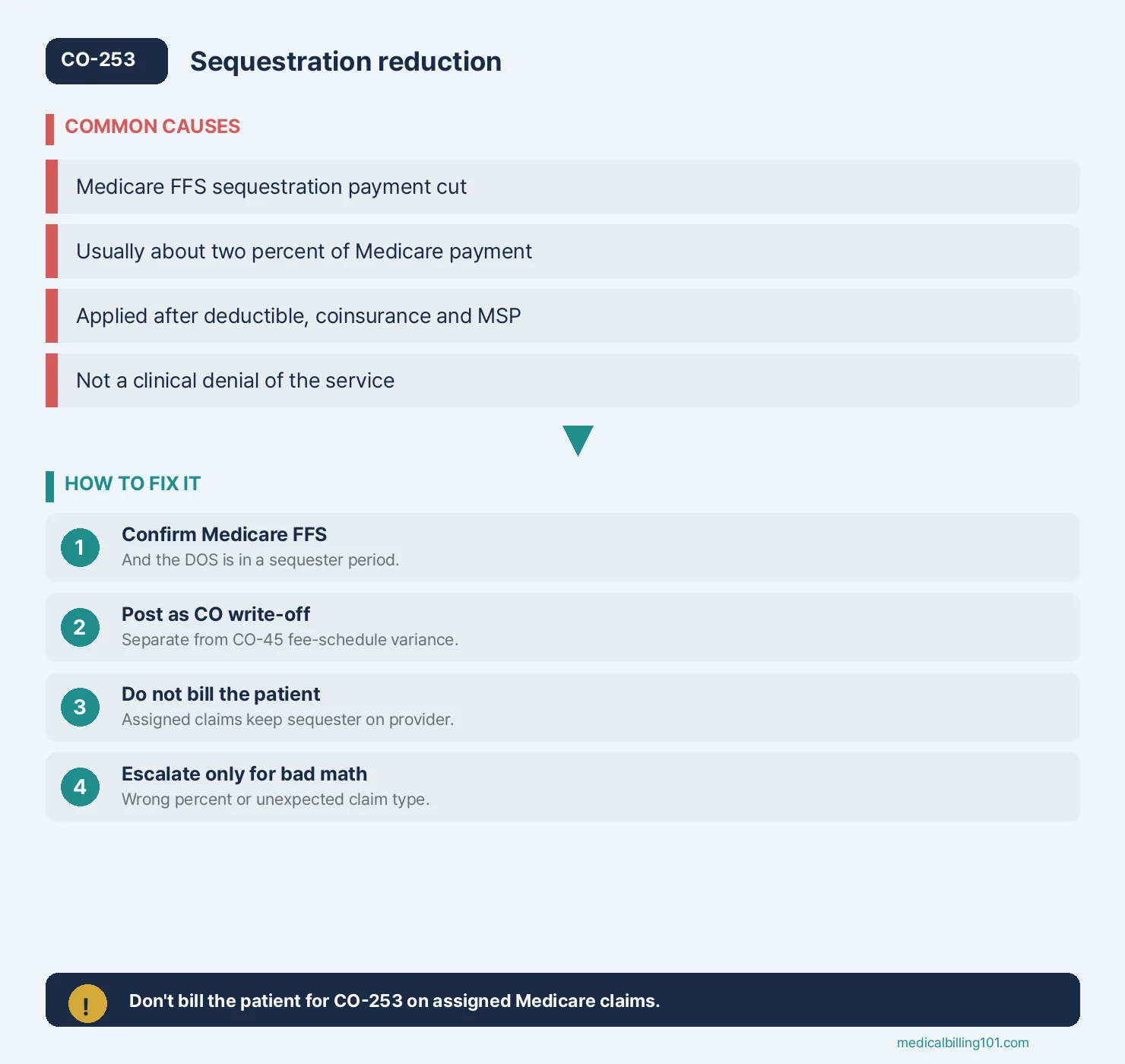
- Confirm payer is Medicare FFS (or another federal program that uses 253). Commercial “sequestration-like” cuts may use different CARCs.
- Confirm date of service / discharge / rental start is in a period subject to the two percent reduction.
- Verify order of operations — sequestration after deductible, coinsurance and MSP adjustments per MAC education.
- Post as contractual write-off (CO). Do not transfer to patient AR on assigned claims.
- Separate from CO-45 in reports so fee-schedule underpayments stay visible.
- Escalate only if the percentage or base looks wrong (wrong allowed amount, duplicate 253, or 253 on a claim not subject to sequestration).
- Do not appeal “medical necessity” for a clean CO-253 — there is nothing clinical to appeal.
Medicare contractor notes
Noridian JE/JF sequestration pages confirm:
- CARC 253 reports the reduction on ERA and SPR.
- Verbiage: “Sequestration – reduction in federal payment.”
- two percent continues for FFS claims with DOS/discharge on/after April 1, 2013 until further notice (check current law/CMS notices for any temporary suspensions Congress may enact).
Re-check the MAC bulletin if Congress changes the rate. The CARC stays the same. The percent can change by law.
Worked example (illustrative)
A participating physician claim allows $100 after CO-45, patient coinsurance $20, Medicare payment calculated $80 before sequester. Remit pays $78.40 with CO-253 $1.60.
Reading it: service payable; federal payment reduced two percent.
Fix: post $1.60 to a sequestration contractual adjustment code. Collect $20 coinsurance. Do not balance-bill the $1.60 on an assigned claim.
Prevention: build expected-payment files with a sequestration flag so posters are not chasing “underpays” that are statutory.
CO-253 reconciliation note template
[Date]
Internal payment posting / expected payment file

Re: CO-253 sequestration posting standard
Payer: Medicare FFS
Rule: Post CAS*CO*253 to contractual adjustment reason "Sequestration"
      (not denial, not patient responsibility on assigned claims).
Escalate if: percentage ≠ current statutory rate on the Medicare payment
base, duplicate 253, or 253 present on a non-sequestered claim type.

[RCM lead]  [Effective date]
CO-253 prevention / posting checklist
- Map CO-253 to a dedicated contractual adjustment code in the PM.
- Exclude sequestration from denial rate KPIs.
- Never auto-transfer CO-253 to patient statements on assigned claims.
- Reconcile expected Medicare payment with a two percent sequester flag (or current statutory rate).
- Watch for CARC 223 still appearing — rare legacy; confirm with the MAC.
- Separate quality-program adjustments (e.g. 144/237) from 253 in dashboards.
- Re-read CMS/MAC notices when Congress changes sequestration.
- Train new posters using CARC & RARC guide.
Reporting and KPI hygiene
Sequestration is law, not a denial. If you fold CO-253 into “denial rate” or “underpayment rate,” Medicare looks worse than it is. Keep a sequestration measure beside CO-45 allowed variance and true denials such as 50, 96, 197, and 16.
Assigned vs non-assigned claims (educational)
On assigned Medicare claims, you accept the Medicare-approved amount plus normal patient cost-sharing. Sequestration lowers Medicare’s share. It does not add a new patient balance for the cut dollars. On non-assigned claims, limiting-charge rules still apply. Sequestration is not a reason to pass the two percent to the patient as an extra fee. When unsure, follow the MAC FAQ and your participation agreement.
DME, rentals and multi-day supplies
DMEPOS claims, including Competitive Bidding, also take the two percent cut when the date of service — or the rental or multi-day supply start date — is on or after April 1, 2013 (until the law changes). For rentals, post CO-253 on each payment cycle. Do not invent one yearly write-off that no longer matches the remits.
Related denial codes
- CO-45: fee schedule / allowed amount contractual reduction.
- CO-70: cost outlier adjustment (different payment math).
- CO-307: Medicare Maximum Fair Price adjustment.
- PR-1 / PR-2 / PR-3: deductible, coinsurance, copay.
- CARC & RARC guide.
In short
CO-253 is the Medicare sequestration cut. Post it as CO. Do not bill the patient. Do not call it a clinical denial.
FAQ
What is the CO-253 denial code description?
X12 describes CARC 253 as “Sequestration – reduction in federal payment”. On Medicare remits it appears as CO-253 for the mandatory sequestration reduction.
Is CO-253 a denial?
No. The service was adjudicated; Medicare’s payment was reduced by the statutory sequestration percentage (commonly two percent for FFS). It is a payment adjustment, not a coverage denial.
Can I bill the patient for CO-253?
Not on assigned Medicare claims. Sequestration reduces Medicare’s payment to the provider. Patient deductible and coinsurance follow normal PR rules and are not a place to shift the sequestered amount.
What is the Medicare sequestration percentage?
CMS implemented a two percent reduction for Medicare FFS claims with dates of service or discharge on or after April 1, 2013 (Transmittal 2739). Confirm the current percentage against the latest CMS/MAC notice if Congress changes the law.
How is CO-253 different from CO-45?
CO-45 reduces charges to the fee schedule or contracted allowed amount. CO-253 is an additional federal payment reduction applied under sequestration after normal payment calculation steps.
Why did CMS create CARC 253?
Transmittal 2739 / CR 8378 replaced the generic mandated-law code 223 with 253 so sequestration reductions are clearly identified on the remittance advice. Key named sources on this page include Claim Adjustment Reason Codes, CMS Transmittal 2739, Noridian sequestration FAQs and the Medicare Claims Processing Manual from Centers For Medicare guidance.
Quick facts
| Item | Value |
|---|---|
| X12 code | 253 |
| X12 start | 06/02/2013 |
| Last modified | 11/01/2013 |
| Last reviewed | 10 October 2026 |
| Page type | WordPress Page under Denial Codes hub 183 |
| Primary keyword | co 253 |
Sources
- X12, Claim Adjustment Reason Codes (CARC 253). Start 06/02/2013, Last Modified 11/01/2013. Accessed 10 Oct 2026.
- CMS Transmittal 2739, CR 8378 (PDF)
- Noridian JF Part B, Sequestration
- Noridian JE Part A, Sequestration
- CMS, Medicare Claims Processing Manual (IOM 100-04), Ch. 22, §60.1 Group Codes
Access dates and figures on this page were checked on 10 October 2026 against X12 and CMS sources.
Last reviewed: 10 October 2026 · This page is educational and doesn’t replace payer-specific instructions.