
PR-119 is Claim Adjustment Reason Code 119 with group code PR. CARC 119 means the benefit maximum for this time period or occurrence has been reached. CO-119 means the same CARC with group code CO. Search demand often uses “denial code pr 119,” so this page uses slug pr-119 while covering both common group codes in the body. (Primary sources: X12 Claim Adjustment Reason Codes · CMS Medicare Claims Processing Manual, Ch. 22, §60.1 · related CMS examples assigning CARC 119 with Group Code CO for certain benefit limits)
Quick answer: Confirm which maximum was hit (visits, dollars, units, episodes). If the count is wrong, correct history or appeal. If the max is real and group code is PR, bill the patient per plan rules. If group code is CO, treat it as a contractual write-off unless an ABN or plan notice shifts liability.
Part of our denial codes library. Written by Manikandan, a revenue cycle management specialist with more than 10 years of US medical billing experience. Last reviewed: 10 October 2026. Official code wording is quoted word for word from X12; Medicare rules link to their CMS or Medicare contractor source.
PR-119 / CO-119 denial code description (official X12 wording)
X12 Claim Adjustment Reason Code 119, verbatim:
“Benefit maximum for this time period or occurrence has been reached.”
Source: X12 Claim Adjustment Reason Codes, checked 10 October 2026. Start: 01/01/1995 | Last Modified: 02/29/2004.
The CARC is 119. Payers attach group code PR or CO (occasionally OA/PI on non-Medicare remits) depending on who they assign for leftover dollars.
What PR-119 and CO-119 mean in plain English
- CARC 119 means a capped benefit was exhausted for a defined period (calendar year, plan year, benefit period) or for a defined occurrence (episode, transplant, maternity event, therapy cap-style limit, etc.).
- PR-119 — payer says the patient is responsible for the adjusted amount (common on commercial plans when covered visits/dollars are used up).
- CO-119 — payer says the amount is a contractual/provider write-off (seen on some Medicare and contracted commercial remits when the limit is applied as non-covered to the provider under contract).
Always trust the group code on the remit, not the informal name “PR-119 denial,” when deciding whether to bill the patient.
PR-119 vs CO-35, CO-149, CO-151 and CO-50
| Code | Official X12 text | Difference |
|---|---|---|
| 119 | Benefit maximum for this time period or occurrence has been reached. | Period/occurrence max |
| 35 | Lifetime benefit maximum has been reached. | Lifetime (not period) max |
| 149 | Lifetime benefit maximum has been reached for this service/benefit category. | Lifetime within a category |
| 151 | Payment adjusted because the payer deems the information submitted does not support this many/frequency of services. | Documentation/frequency support — see CO-151 |
| 50 | Not deemed a ‘medical necessity’ by the payer. | Medical necessity — see CO-50 |
119 is a hard benefit ceiling. 151 is “you haven’t shown this many are supported.” Do not work them the same way.
Group code matrix for CARC 119
| Group + 119 | Who carries the amount | Typical next step |
|---|---|---|
| PR-119 | Patient | Verify max, then patient bill or financial counseling |
| CO-119 | Provider | Verify max; write off unless ABN/plan notice shifts liability |
| OA-119 | Neither fits cleanly | Read remarks; rare |
| PI-119 | Payer-initiated | Non-Medicare; investigate contract |
CMS Ch. 22 §60.1: PR amounts “may be billed to the patient or insured”; CO amounts are generally provider write-offs not billed to the patient.
Remark codes that help with CARC 119
| RARC | Role |
|---|---|
| N130 | Consult plan benefit documents/guidelines for restrictions |
| N117 | This service is paid only once in a patient’s lifetime |
| N118 / N119 | Frequency limits (e.g., every 28 days) — related idea, different codes |
| N386 | Decision based on an NCD (appears with some Medicare benefit-limit scenarios) |
| M90 | Not covered more than once in a 12 month period |
Always open the remark and the plan’s benefit booklet page that defines the maximum.
Where PR-119 / CO-119 shows up in the 835
SVC*HC:97110*480.00*0.00**12~
CAS*PR*119*480.00~
LQ*HE*N130~
- Therapy units denied after the plan’s outpatient therapy visit/unit maximum.
- Group PR → patient responsibility after benefits exhausted.
Illustrative only.
How to fix PR-119 / CO-119: decision path
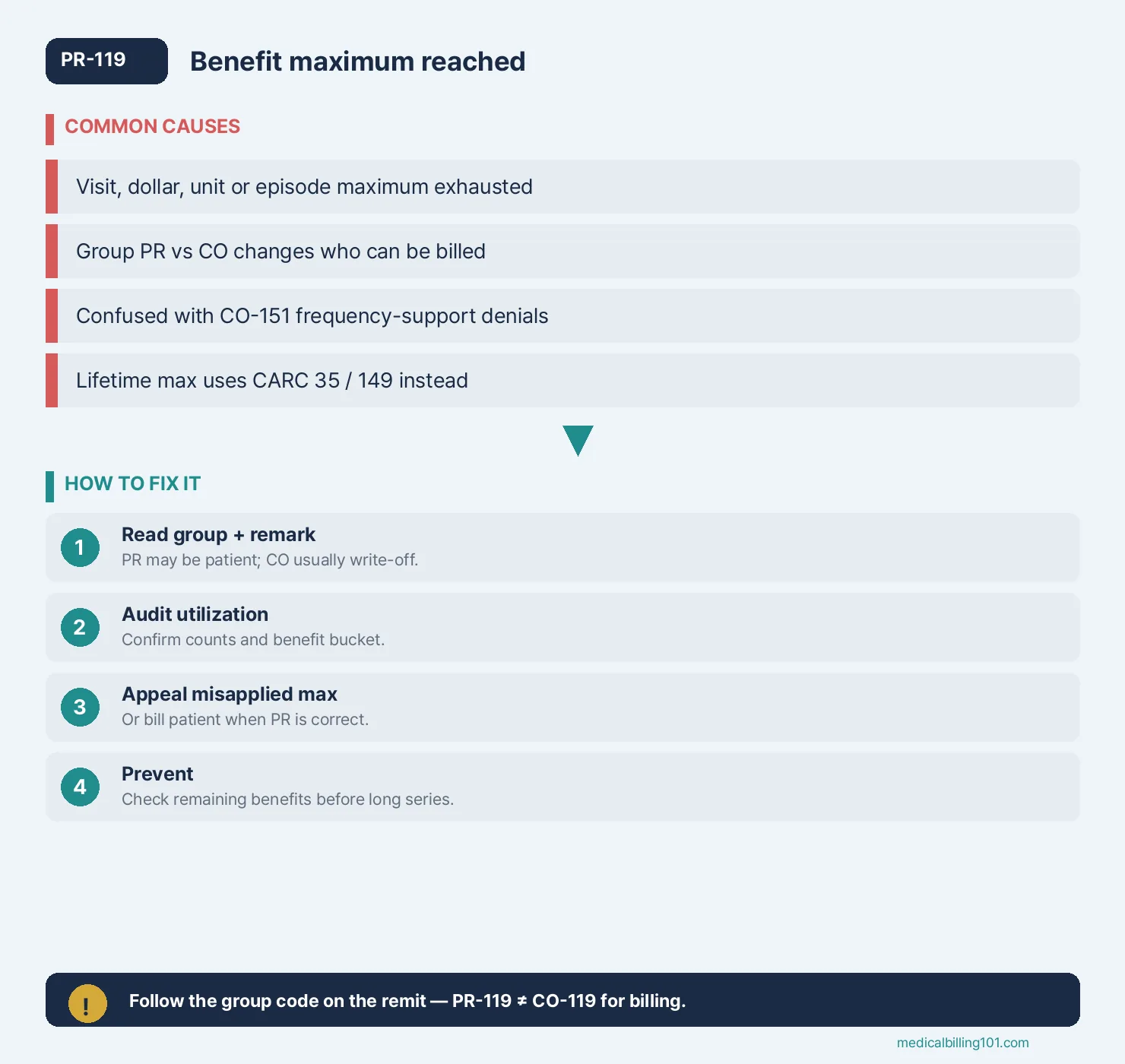
- Read group code + remark codes. PR vs CO decides patient billing.
- Identify the maximum. Visits, dollars, units, days, episodes, lifetime category — get the plan language.
- Audit utilization. Did another provider consume the max? Were units over-billed? Wrong date span?
- Eligibility / other coverage. Is there a secondary plan, rider or Medicaid wrap that still pays?
- If the max was misapplied — corrected claim or appeal with chronologic utilization and medical necessity for additional units when the plan allows exceptions.
- If the max is real and PR — bill the patient (or offer self-pay / ABN-equivalent notice going forward).
- If the max is real and CO — write off; do not balance-bill unless a valid notice shifted liability.
- Forward-looking — obtain remaining-benefit checks before authorizing long therapy or high-cost series.
Medicare and commercial notes
Medicare. CMS manuals sometimes instruct MACs to use CARC 119 with Group Code CO when a coverage limit for a time period is reached (for example certain limited-benefit services). Remits may also use other CARCs (96, 50, 151) depending on the edit. Match the code you received.
Commercial. “denial code pr 119” is common vernacular because many employer plans report exhausted visit or dollar maximums as PR-119. Always confirm whether a stop-loss, secondary or HRA/HSA affects patient billing.
Therapy and chiropractic. Period maximums and medical-necessity reviews often collide — you may see 119 on one remit and 50/151 on another for related dates. Work each code on its own terms.
Worked example (illustrative)
For example, a commercial plan allows 20 outpatient PT visits per plan year. Visit 21 returns PR-119 with N130. Group code PR.
Reading it: benefit max reached; patient liable per remit.
Fix: confirm 20 prior paid visits in the plan year; if a visit was miscoded or belonged to another benefit, appeal. If accurate, bill the patient and discuss cash-pay or alternate coverage for further visits. For future episodes, check remaining benefits at visit 15–18.
Prevention: real-time or batch benefit accumulators in the PM; authorization notes that state remaining visits.
PR-119 / CO-119 appeal or patient-notice template
[Date]
[Payer] Appeals / Provider Service
[Address, fax or portal]

Re: CARC 119 (benefit maximum) — [appeal / reconsideration]
Patient: [Name]   Member ID: [ID]   DOB: [MM/DD/YYYY]
Claim number: [Claim #]   Date(s) of service: [MM/DD/YYYY]
CPT/HCPCS: [Code]   Group code on remit: [PR / CO]

The remittance shows CAS*[PR/CO]*119 with remark [code]. Please reprocess
because:
[ ] Utilization history is incorrect; enclosed chronology shows [N] covered
    units remaining under [plan document section].
[ ] Services qualify for an exception / additional benefits under [policy].
[ ] Wrong benefit bucket applied; payable under [other benefit].

Enclosed: remit, claim, plan benefit excerpt, visit/unit log, clinical notes.

[Name, credentials]  [Practice, NPI]  [Phone / email]
Patient financial notice (when PR-119 is confirmed):
We received a remittance showing benefit maximum (CARC 119) with patient
responsibility for DOS [date], charge $[amt]. Your plan reports the
[visit/dollar] maximum for [period] has been reached. Please contact us
by [date] to arrange payment or to share other coverage.
Prevention checklist
- Verify remaining benefits before multi-visit or high-cost series.
- Track accumulators by plan year vs calendar year.
- Separate lifetime (35/149) from period (119) maximums in work queues.
- Do not confuse 119 with 151 frequency-support denials.
- Respect PR vs CO when building patient statements.
- Offer ABN or plan equivalent when you expect Medicare/commercial not to pay beyond a known limit.
- Route secondary claims when primary hits a max but secondary may still pay.
- Train staff with the CARC & RARC guide.
Related denial codes
- CO-151: frequency/units not supported (not the same as a hard max).
- CO-50: medical necessity.
- PR-204: not covered under current benefit plan.
- CO-96: non-covered charge.
- PR-1 / PR-2 / PR-3: deductible/coinsurance/copay.
- CARC & RARC guide.
In short
CARC 119 means a benefit max was hit. Read PR vs CO. Fix bad counts, bill patients only for true PR, and prevent the next series with accumulator checks.
FAQ
What is the PR-119 denial code description?
X12 describes CARC 119 as “Benefit maximum for this time period or occurrence has been reached.” PR-119 means that CARC with group code PR (patient responsibility). CO-119 is the same CARC with group code CO.
Is CO-119 the same as PR-119?
Same reason code (119), different group code. PR may be billed to the patient; CO is generally a provider write-off. Always follow the group code on the remittance.
How do I fix a PR-119 denial?
Confirm the maximum and utilization history. Appeal if the count or benefit bucket is wrong. If the max is real and group code is PR, bill the patient or arrange self-pay. Check secondary coverage.
What is the difference between CARC 119 and CARC 151?
119 is a hard benefit maximum for a period or occurrence. 151 means the information submitted does not support this many/frequency of services. One is a benefit ceiling; the other is a documentation/frequency support issue.
What is the difference between CARC 119 and CARC 35?
119 is a maximum for a time period or occurrence. 35 is a lifetime benefit maximum. 149 is a lifetime maximum for a service/benefit category.
Can I bill the patient for CO-119?
Usually no. CO amounts are generally provider write-offs. Bill the patient only when the remit shows PR (or a valid ABN/plan notice shifts liability and patient responsibility is reported). Key named sources on this page include Claim Adjustment Reason Codes, Remittance Advice Remark Codes and the Medicare Claims Processing Manual from Centers For Medicare guidance.
Quick facts
| Item | Value |
|---|---|
| X12 code | 119 |
| X12 start | 01/01/1995 |
| Last modified | 02/29/2004 |
| Slug | pr-119 (covers PR-119 and CO-119) |
| Last reviewed | 10 October 2026 |
| Page type | WordPress Page under Denial Codes hub 183 |
| Primary keyword | denial code pr 119 |
Sources
- X12, Claim Adjustment Reason Codes (CARC 119, 35, 149, 151, 50). CARC 119 Start 01/01/1995, Last Modified 02/29/2004. Accessed 10 Oct 2026.
- X12, Remittance Advice Remark Codes. Accessed 10 Oct 2026.
- CMS, Medicare Claims Processing Manual (IOM 100-04), Ch. 22, §60.1 Group Codes
- CMS, Medicare Claims Processing Manual examples assigning CARC 119 (benefit-limit messaging patterns; verify current chapter text)
Access dates and figures on this page were checked on 10 October 2026 against X12 and CMS sources.
Last reviewed: 10 October 2026 · This page is educational and doesn’t replace payer-specific instructions.