
CO-151 is a Claim Adjustment Reason Code that means the payer adjusted (or denied) payment because the information on the claim does not support the number or frequency of services billed. On Medicare DME claims it often pairs with remark code N115 when an LCD sets the frequency limit. (Primary sources: X12 Claim Adjustment Reason Codes · Noridian JA DME, Reason Code 151 | Remark Code N115 · CMS Medically Unlikely Edit (MUE)s)
Quick answer: CO-151 means the plan says the claim doesn’t support this many services or this frequency. Review the LCD or policy frequency limit, the MUE unit max, prior paid claims and date spans. Fix overlapping dates with a reopening when allowed, reduce units if supplier-liable, or appeal with documentation that supports medical need.
Part of our denial codes library. Written by Manikandan, a revenue cycle management specialist with more than 10 years of US medical billing experience. Last reviewed: 9 October 2026. Official code wording is quoted word for word from X12; Medicare rules link to their CMS or Medicare contractor source.
CO-151 denial code description (official X12 wording)
X12 Claim Adjustment Reason Code 151, verbatim:
“Payment adjusted because the payer deems the information submitted does not support this many/frequency of services.”
Source: X12 Claim Adjustment Reason Codes, checked 9 October 2026. Start: 10/31/2002 | Last Modified: 01/27/2008.
CARC 151 was split out of the older code 57 (Stop: 06/30/2007), which covered level of service, quantity, length, dosage and day’s supply in one line. Today 150–154 each cover one of those ideas. The phrase that matters here is this many/frequency of services.
What CO-151 means in plain English
Each part of the code answers a different question:
- CO (Contractual Obligation) is the payer’s classification of who carries the amount. CMS says these adjustments are “Generally… considered a write off for the provider and are not billed to the patient” (Medicare Claims Processing Manual, Ch. 22, §60.1).
- CARC 151 tells you why: the payer does not agree that the documentation or claim data supports the units or how often the service was billed.
Typical triggers include, for example, an LCD frequency ceiling. Other common causes are overlapping DME date spans, same-or-similar equipment already on file, units above an MUE, or a plan visit limit.
In plain terms: the payer says you billed too many units or too often. Check the frequency rule, then fix units or appeal with proof.
CO-151 vs CO-150, CO-152, CO-119 and CO-50
| Code | Official X12 text | What it tells you |
|---|---|---|
| 151 | “Payment adjusted because the payer deems the information submitted does not support this many/frequency of services.” | Units or frequency aren’t supported |
| 150 | “Payer deems the information submitted does not support this level of service.” | Level of service (for example E/M intensity), not quantity |
| 152 | “Payer deems the information submitted does not support this length of service.” | Length of service, not how many times |
| 119 | “Benefit maximum for this time period or occurrence has been reached.” | A hard benefit max was hit (different from “documentation doesn’t support”) |
| 50 | “These are non-covered services because this is not deemed a ‘medical necessity’ by the payer.” | Medical necessity denial. See CO-50 |
When the payer is objecting to how many or how often, look for 151. When it is objecting to medical necessity as a whole, look for 50 (often with N115).
CO-151 vs PR-151 vs OA-151 vs PI-151
CARC 151 can come with any group code, and payers don’t all use the same one:
| Group + 151 | Who carries the amount | Can you bill the patient? | When you’ll typically see it |
|---|---|---|---|
| CO-151 | Provider | No, unless a valid ABN shifts liability | Common on Medicare DME and commercial remits |
| PR-151 | Patient | Only after you confirm patient liability (for example a signed ABN) | Some remits when the patient was notified |
| OA-151 | Neither group fits | Check the remark codes | Used “when no other group code applies” (CMS Ch. 22, §60.1) |
| PI-151 | Payer-initiated reduction | No | Non-Medicare remits only. CMS lists just CO, OA and PR as valid on Medicare remittances |
Don’t bill the patient for a CO-151 until you’ve ruled out a billing or documentation fix and confirmed that an ABN (or plan equivalent) actually shifts liability.
Remark codes that help with CARC 151
Noridian JA/JD DME publishes Reason Code 151 with remark code N115 when the decision rests on an LCD:
| RARC | Official X12 text | What it adds |
|---|---|---|
| N115 | “This decision was based on a Local Coverage Determination (LCD) (LCD). An LCD provides a guide to assist in determining whether a particular item or service is covered. A copy of this policy is available at www.cms.gov/mcd, or if you do not have web access, you may contact the contractor to request a copy of the LCD.” | The frequency or coverage limit comes from an LCD |
| N130 | “Consult plan benefit documents/guidelines for information about restrictions for this service.” | Plan documents set the restriction (often commercial) |
| M80 | “Not covered when performed during the same session/date as a previously processed service for the patient.” | Same-day overlap with a prior paid service |
RARC wording is quoted from the X12 RARC list, checked 9 October 2026. Always open the LCD or policy article named by the MAC before you appeal.
Where CO-151 shows up in the 835
Here’s a trimmed, illustrative example for a DME supply line billed with 4 units:
CLP*PT20261001A*1*480.00*120.00*360.00*MB*2626000987654~
SVC*HC:A4253*480.00*120.00**4~
CAS*CO*151*360.00~
LQ*HE*N115~
SVCshows HCPCS A4253 with 4 units billed.CAS*CO*151*360.00is the group code, reason code and adjusted amount for the unsupported units.LQ*HE*N115points to an LCD-based decision.
This 835 snippet is illustrative only.
How to fix CO-151: decision path
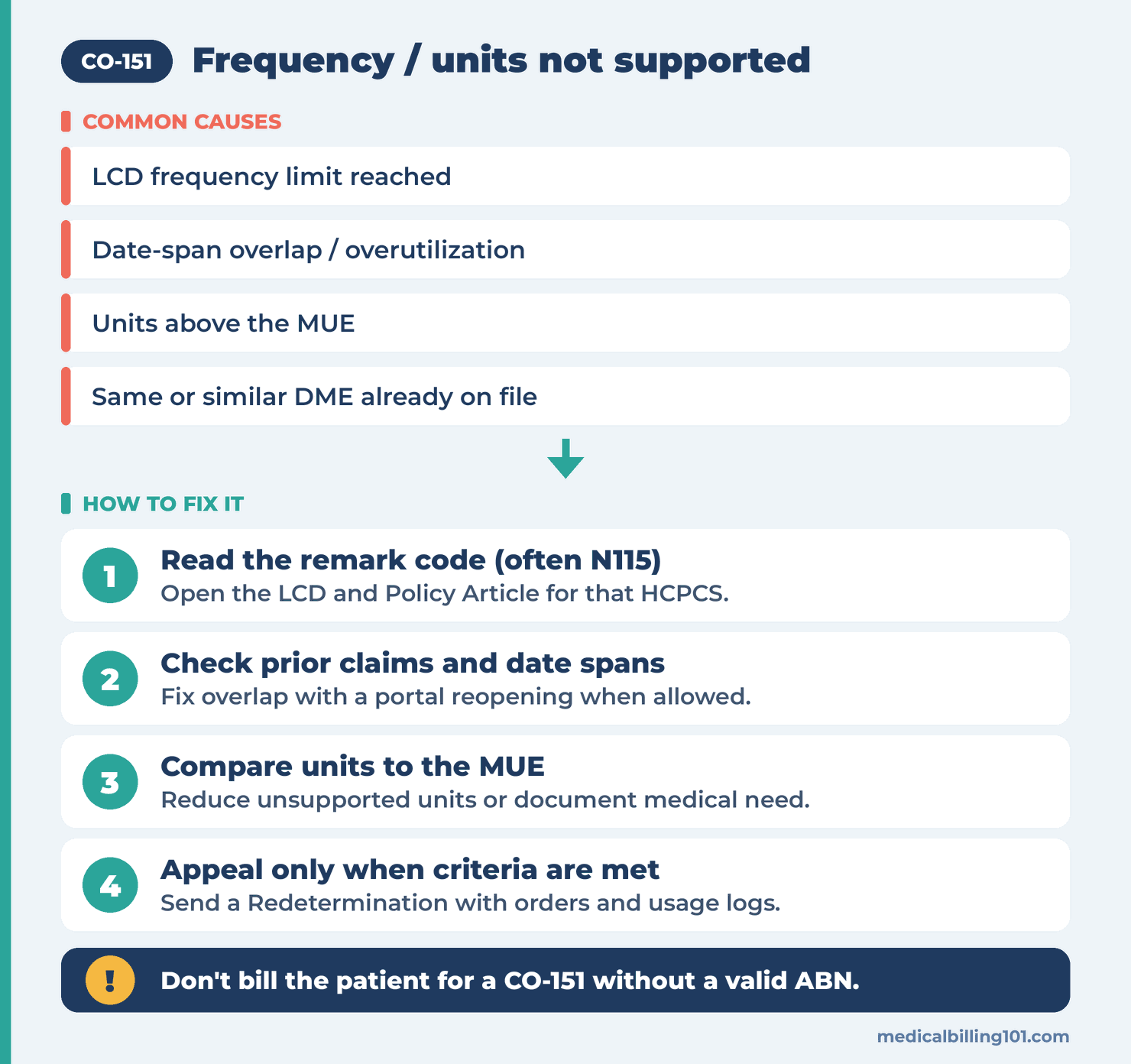
- Read every remark code. If you see N115, open the LCD and policy article for that HCPCS. Noridian lists “Policy frequency limits may have been reached, per LCD” and “date span overlap or overutilization based on related LCD” as common reasons (Noridian JA DME, 151 | N115).
- Check prior claims and date spans. Overlapping rental or supply periods are a frequent DME trigger. Noridian: “To avoid overlap, review previous claim submissions and date spans.”
- Check the MUE. CMS publishes Medically Unlikely Edit (MUE)s for the “maximum units of service… under most circumstances for a single beneficiary on a single date of service” (CMS MUE). Compare billed units to the MUE and to the LCD frequency.
- Same or similar equipment? For DME, use the Noridian Medicare Portal Same or Similar options (or the IVR) before you dispense.
- Date-span clerical fix? Noridian allows a portal reopening in the portal “To adjust date span based on medical records available to supplier.”
- Medical need above the usual limit? Submit a redetermination appeal with supporting documentation. Noridian encourages portal appeals and says to review the LCD, policy article and Documentation Checklists first.
- Supplier liable vs patient liable. If you knew the frequency wouldn’t be covered, an ABN may have been required. Without a valid ABN, don’t bill the Medicare patient for a CO write-off.
Medicare and major payer notes
Noridian JA and JD DME both publish Reason Code 151 alone and paired with N115. Common causes on the 151 page include same-or-similar equipment and date-span overlap. On the N115 pairing page they add LCD frequency limits and point suppliers to the MUE tool, portal reopenings for date-span fixes, and redetermination appeals when medical need must be shown (Noridian JA 151, 151 | N115, JD DME 151 | N115).
MUE vs LCD. An MUE is a unit edit for one date of service. An LCD frequency limit can span days, months or a certification period. Hitting either can surface as CO-151 (or a related code). Check both.
Commercial plans. Many plans use visit or unit caps in prior-auth review. The same CARC 151 wording applies; the accompanying RARC (often N130) and the plan’s medical policy tell you which limit was applied.
Worked example (illustrative)
A DME supplier bills four boxes of diabetic test strips (A4253) for a period that overlaps a prior paid span by 10 days. The remit returns CAS*CO*151 with N115.
Reading it: the LCD frequency and the overlapping dates are the problem, not medical necessity of diabetes testing in general.
Fix: reopen in the Noridian portal to correct the date span to the non-overlapping days, or reduce units to the LCD-supported quantity. If usage above the usual limit is medically necessary, appeal with the physician order, testing log and LCD checklist.
Prevention: check Same or Similar and prior paid spans before shipping, and set claim edits for the LCD frequency.
CO-151 appeal / reopening template
Use this when you need a date-span reopening or a redetermination appeal for medical need above the usual frequency. Replace the bracketed text.
[Date]
[MAC / payer] Appeals / Reopening
[Address, fax or portal reference]

Re: CO-151 (frequency/units not supported) — [reopening / redetermination]
Patient: [Name]   MBI / Member ID: [ID]   DOB: [MM/DD/YYYY]
Claim number: [Claim #]   Date(s) of service: [MM/DD/YYYY]
HCPCS / CPT: [Code]   Units billed: [N]   NPI: [NPI]

The remittance shows CAS*CO*151 with remark [N115 / other]. Please:
[ ] Reopen to correct the date span to [corrected span] per the enclosed
    delivery ticket / order (clerical date-span fix).
[ ] Redetermine medical need for [units / frequency] under LCD [LCD #]
    and the enclosed clinical documentation.
[ ] Confirm the applicable MUE and LCD frequency we should use going
    forward.

Enclosed: remittance advice, claim copy, LCD/policy article excerpt,
order, [testing log / notes], same-or-similar printout.

[Name, credentials]  [Practice / supplier, NPI]  [Phone / email]
CO-151 prevention checklist
- Look up the LCD and policy article frequency before you dispense or schedule repeat services.
- Check MUE unit maximums for the HCPCS on that date of service.
- Review prior paid claims and date spans for overlap.
- Run Same or Similar (DME) in the portal or IVR before shipping.
- Set PM edits for common frequency ceilings by payer.
- Obtain an ABN when you expect Medicare won’t cover the frequency.
- Keep orders, delivery tickets and usage logs ready for appeal.
- Track CO-151 by HCPCS and site to target training.
Related denial codes
- CO-50: medical necessity denial; often paired with N115 for an LCD.
- CO-96: non-covered charge.
- CO-252: payer needs an attachment or documentation.
- CO-16: claim lacks information; fix data and resubmit.
- CO-236: procedure/service not payable under this benefit.
- PR-204: not covered under the patient’s current benefit plan.
In short
CO-151 means the units or the frequency look too high. Read the remark code. Check the LCD and the unit limit. Fix the date span or the units. Appeal only when you have proof of need.
FAQ
What is the CO-151 denial code description?
X12 describes CARC 151 as “Payment adjusted because the payer deems the information submitted does not support this many/frequency of services.” It means the payer adjusted payment because the units or how often the service was billed aren’t supported by the claim or documentation.
How do I fix a CO-151 denial?
Read the remark codes, open the LCD or plan policy, check MUEs and prior date spans, then reopen for a clerical date-span fix, reduce unsupported units, or appeal with documentation that supports medical need above the usual limit.
What does N115 mean with CO-151?
N115 means the decision was based on a Local Coverage Determination (LCD) (LCD). Noridian publishes Reason Code 151 with N115 for LCD frequency limits and overutilization. Open the LCD and policy article before you appeal.
Is CO-151 the same as an MUE denial?
Not always. An MUE is a CMS unit edit for a single date of service. CO-151 can also come from LCD frequency limits, overlapping date spans or same-or-similar equipment. Check both the MUE and the LCD.
Can I bill the patient for CO-151?
Usually no when the group code is CO. Bill the patient only if a valid ABN (or plan equivalent) shifts liability and the remit shows patient responsibility. Confirm before you send a statement.
What is the difference between CO-151 and CO-119?
CO-151 means the information submitted doesn’t support the units or frequency. CO-119 means a benefit maximum for the time period or occurrence has been reached. One is about support for the quantity; the other is about hitting a hard benefit cap. Key named sources on this page include Claim Adjustment Reason Codes, Remittance Advice Remark Codes, Local Coverage Determinations, Policy Article rules, Noridian Medicare Portal steps and Medically Unlikely Edits from Centers For Medicare guidance.
Quick facts
| Item | Value |
|---|---|
| X12 code | 151 |
| X12 start | 10/31/2002 |
| Last reviewed | 9 October 2026 |
| Page type | WordPress Page under Denial Codes hub 183 |
| Primary keyword | co-151 denial code |
Named contractor sources include First Coast Service Options materials where linked, plus Novitas Solutions and Noridian Healthcare Solutions pages cited above.
Sources
- X12, Claim Adjustment Reason Codes (CARC 151, 150, 152, 119, 50, 57). CARC 151 Start 10/31/2002, Last Modified 01/27/2008. Accessed 9 Oct 2026.
- X12, Remittance Advice Remark Codes (N115, N130, M80). Accessed 9 Oct 2026.
- Noridian JA DME, Reason Code 151
- Noridian JA DME, Reason Code 151 | Remark Code N115
- Noridian JD DME, Reason Code 151 | Remark Code N115
- CMS, Medically Unlikely Edit (MUE)s (MUEs)
- CMS, Medicare Claims Processing Manual (IOM 100-04), Ch. 22, §60.1 Group Codes
Access dates and figures on this page were checked on 9 October 2026 against X12 and CMS sources.
Last reviewed: 9 October 2026 · This page is educational and doesn’t replace payer-specific instructions.