

CO-50 is a Claim Adjustment Reason Code meaning the payer found the service not medically necessary, so group code CO puts the amount on the provider unless the patient got valid advance notice. (Primary sources: X12 Claim Adjustment Reason Codes · CMS Medicare Claims Processing Manual, Ch. 30)
Quick answer: CO-50 is a clinical coverage denial, not a paperwork rejection, so it can be appealed. First check the diagnosis codes you billed. Do they support medical necessity under the payer’s policy? For Medicare, that policy is the LCD or NCD named by the remark code. If the documentation supports the service but the claim didn’t show it, correct or appeal. If the service really wasn’t covered, Medicare’s tool for next time is the ABN. Novitas and Noridian both listed CO-50 with N115 among their top claim denials in their latest published quarters.
Part of our denial codes guide. Written by Manikandan, a revenue cycle management specialist with more than 10 years of US medical billing experience. Last reviewed: 3 October 2026. Official code wording is quoted word for word from X12; Medicare rules link to their CMS or Medicare contractor source.
Official CARC 50 description
X12 Claim Adjustment Reason Code 50, verbatim:
“These are non-covered services because this is not deemed a ‘medical necessity’ by the payer. Usage: Refer to the 835 Healthcare Policy Identification Segment (loop 2110 Service Payment Information REF), if present.”
Source: X12 Claim Adjustment Reason Codes. Start: 01/01/1995 | Last Modified: 07/01/2017.
What CO-50 means in plain English
The payer checked the service against its coverage rules. Those may be a Medicare Local or National Coverage Determination or a commercial medical policy. It decided the claim didn’t show why this patient needed the service. Under group code CO, CMS describes the amount as “generally… considered a write off for the provider and are not billed to the patient” (CMS IOM 100-04, Ch. 22, §60.1). The exception is a valid advance notice to the patient (see “ABN” below).
Remark codes that explain CO-50
| Remark code | Official X12 description |
|---|---|
| N115 | “This decision was based on a Local Coverage Determination (LCD). An LCD provides a guide to assist in determining whether a particular item or service is covered. A copy of this policy is available at www.cms.gov/mcd, or if you do not have web access, you may contact the contractor to request a copy of the LCD.” |
| N386 | “This decision was based on a National Coverage Determination (NCD). An NCD provides a coverage determination as to whether a particular item or service is covered. Visit CMS.gov and search for Medicare Coverage Database to find a copy of the policy.” |
N115 is the pairing Noridian and Novitas publish. Descriptions are from the X12 RARC list. N386 was last modified 03/01/2026.
Common causes of CO-50
- The billed diagnosis doesn’t support the service. Noridian’s listed reason is “Missing diagnosis that supports medical necessity.”
- The service doesn’t meet the LCD or NCD rules for coverage (how often, why, and what records are needed).
- Diagnosis codes aren’t specific enough, or the supporting diagnosis is left off the claim line.
- The documentation doesn’t show why the service was needed. See our guide to medical necessity documentation.
- Commercial plans: the service falls outside the plan’s medical policy criteria.
How to fix CO-50: step by step
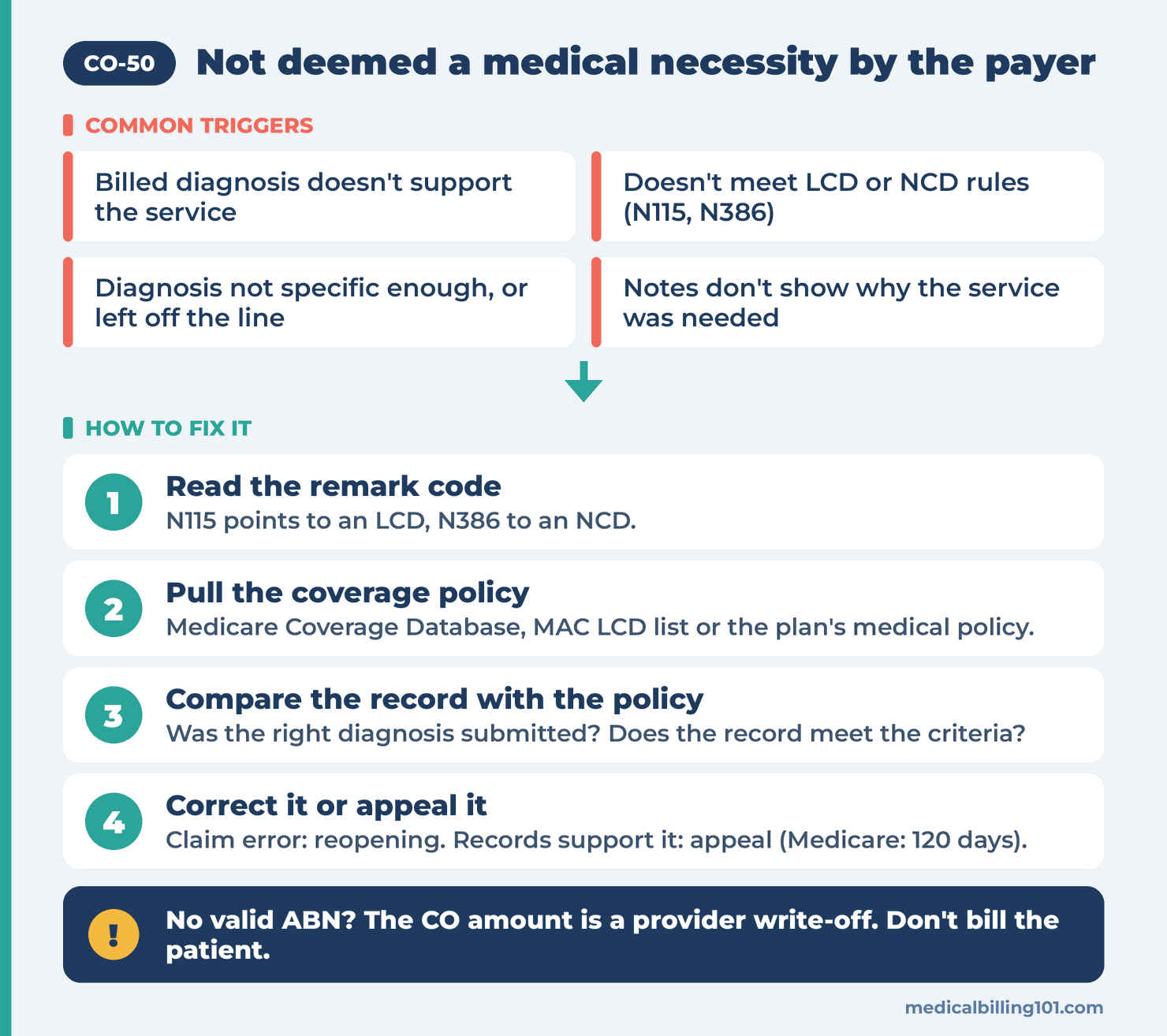
- Read the remark code. N115 points to an LCD and N386 to an NCD. Also check the loop 2110 REF segment if present, which X12’s usage note points to.
- Pull the policy. For Medicare, search the CMS Medicare Coverage Database or your MAC’s active LCD list. Search for the denied procedure, as Noridian advises. For commercial plans, pull the plan’s medical policy for the date of service.
- Compare the record with the policy. Noridian’s next step is to review the medical documentation “to determine that appropriate diagnosis code was submitted.”
- Choose the path:
- Diagnosis or coding error on the claim: for Medicare, Noridian’s appeals page covers both a reopening and a redetermination. CMS notes that MACs “do not process claim corrections involving minor errors and omissions through the appeals process,” and handles those as reopenings instead (CMS: Redetermination).
- Documentation supports the service: appeal. Noridian: “Items or services with this message have appeal rights.” The Medicare redetermination deadline is 120 days from receipt of the initial determination. The notice is presumed received 5 calendar days after its date. File on form CMS-20027 or by written request, include “any and all documentation that supports” your position, and expect a decision generally within 60 days (CMS).
- Commercial plans: follow the plan’s appeal process, with the policy criteria and records attached.
- If the service truly wasn’t covered and no valid ABN was given, the CO amount is a provider write-off. Don’t bill the patient.
ABN: protecting yourself on Medicare claims
The Advance Beneficiary Notice of Noncoverage (ABN), Form CMS-R-131 is issued to Original Medicare patients “in situations where Medicare payment is expected to be denied,” to “transfer potential financial liability to the Medicare beneficiary in certain instances” (CMS: FFS ABN). The claim can show that a valid written notice was given, with the GA modifier or occurrence code 32. In that case, CMS’s claims manual says “the Medicare contractor will hold the beneficiary, not the healthcare provider or supplier liable for the denied charges.” If the notice turns out to be invalid, “the contractor will override the GA code, and the healthcare provider or supplier will be found liable” (CMS IOM 100-04, Ch. 30, §30.2.3). ABN instructions start at Chapter 30, §50.
How to prevent CO-50 denials
- Check active LCDs and NCDs for your busiest and costliest services. Build their covered diagnosis lists into your claim edits.
- Link the supporting diagnosis to each service line.
- Code to the highest level of specificity the documentation supports.
- Expect Medicare to deny a service as not reasonable and necessary? Give a valid ABN before the service, and add the GA modifier.
- Track CO-50 by procedure and policy. Use the trends to fix templates and coach providers.
Group codes and remark codes you’ll see with 50
- CO-50 is the standard Medicare pairing published by Noridian and Novitas.
- N115 (LCD) and N386 (NCD) name the policy behind the decision.
- With a valid ABN and the GA modifier, CMS holds the beneficiary liable. The amount becomes patient responsibility, not a provider write-off (see PR codes).
Related codes
- CO-96: non-covered charge.
- CO-167: “This (these) diagnosis(es) is (are) not covered.”
- CO-11: “The diagnosis is inconsistent with the procedure.”
- CO-151: frequency or units not supported.
- CO-197: precertification or authorization absent.
FAQ
What does CO-50 mean? The payer decided the service wasn’t medically necessary. X12: “These are non-covered services because this is not deemed a ‘medical necessity’ by the payer.”
Can I appeal a CO-50 denial? Yes. Noridian says these items have appeal rights. For Medicare, ask for a redetermination within 120 days of getting the initial determination. Send the records that show why the service was needed. Our guide to how to appeal a denied Medicare claim covers all five levels.
What does N115 mean with CO-50? N115 means the decision was based on a Local Coverage Determination. Look up the LCD in the CMS Medicare Coverage Database and compare its criteria with your documentation.
Can I bill the patient for a CO-50 denial? Not under CO without a valid ABN. CMS says that with a valid written notice (shown with the GA modifier), the contractor holds the beneficiary liable. If the notice was invalid, the provider is liable.
Is CO-50 the same as CO-96? No. CARC 50 is specifically a medical necessity determination. CARC 96 is “Non-covered charge(s)” and needs a remark code to explain why.
Sources
- X12, Claim Adjustment Reason Codes (CARC 50, 96, 167, 11, 151). CARC 50 Start 01/01/1995, Last Modified 07/01/2017. Accessed 3 Oct 2026.
- X12, Remittance Advice Remark Codes (N115, N386). Accessed 3 Oct 2026.
- CMS, Medicare Claims Processing Manual (IOM 100-04), Ch. 22, §60.1
- CMS, Medicare Claims Processing Manual (IOM 100-04), Ch. 30, §30.2.3 and §50
- CMS, FFS ABN (page last modified 07/17/2026)
- CMS, Redetermination by a Medicare Contractor
- CMS, Medicare Coverage Database
- Noridian JE Part B, Medical Necessity/No Payable Diagnosis (last updated Apr 30, 2025)
- Noridian JE Part B, Top Denials and Solutions Q4 2025 (last updated Mar 09, 2026)
- Novitas JL, Top claim denials Apr–Jun 2026 (last modified 07/02/2026)
Last reviewed: 3 October 2026 · This page is educational and doesn’t replace payer-specific instructions.