
CO-31 is a Claim Adjustment Reason Code that means the payer couldn’t match the patient on the claim to anyone in its membership records. A wrong member ID, a name that doesn’t match the card, a wrong date of birth or a patient who isn’t enrolled with that payer at all are the usual causes. (Primary sources: X12 Claim Adjustment Reason Codes · Noridian JE Part B, Patient Cannot Be Identified · CMS, Medicare Beneficiary Identifiers)
Quick answer: CO-31 means the payer can’t find the patient as one of its members. Compare the member ID, name and date of birth on the claim with the current card and an eligibility response. For Medicare, use the MBI and the name exactly as printed. Correct the claim and send it as a new claim, or bill the right payer.
Part of our denial codes library. Written by Manikandan, a revenue cycle management specialist with more than 10 years of US medical billing experience. Last reviewed: 7 October 2026. Official code wording is quoted word for word from X12; Medicare rules link to their CMS or Medicare contractor source.
CO-31 denial code description (official X12 wording)
X12 Claim Adjustment Reason Code 31, verbatim:
“Patient cannot be identified as our insured.”
Source: X12 Claim Adjustment Reason Codes, checked 7 October 2026. Start: 01/01/1995 | Last Modified: 09/30/2007.
The phrase that matters is cannot be identified. The payer isn’t judging the service or the dates yet. It stopped one step earlier, because the identifying data on the claim didn’t match a member. That’s why the fix is almost always a data correction, not an appeal.
What CO-31 means in plain English
Each part of the code answers a different question:
- CO (Contractual Obligation) is the payer’s classification of who carries the amount. CMS says these adjustments are “Generally… considered a write off for the provider and are not billed to the patient” (Medicare Claims Processing Manual, Ch. 22, §60.1).
- CARC 31 tells you why: no member in the payer’s file matched the patient’s ID, name and other details.
Typical triggers include problems such as a mistyped or old member ID, a nickname or a missing hyphen in the last name, a swapped first and last name, a wrong date of birth, a dependent billed under the wrong subscriber, or a card from a payer the patient no longer has.
CO-31 vs CO-140, CO-32, CO-26/27 and CO-109
| Code | Official X12 text | What it tells you |
|---|---|---|
| 31 | “Patient cannot be identified as our insured.” | No member match at all |
| 140 | “Patient/Insured health identification number and name do not match.” | The ID exists, but the name on the claim doesn’t fit it |
| 32 | “Our records indicate the patient is not an eligible dependent.” | The subscriber was found, but this person isn’t a covered dependent |
| 26 / 27 | “Expenses incurred prior to coverage.” / “Expenses incurred after coverage terminated.” | The member was found, but not covered on that date. See CO-26 and CO-27 |
| 109 | “Claim/service not covered by this payer/contractor. You must send the claim/service to the correct payer/contractor.” | Wrong payer or contractor. See CO-109 |
When the payer finds the member but something else is wrong, you’ll usually see one of the other codes. CO-31 means it couldn’t get that far.
CO-31 vs PR-31 vs OA-31 vs PI-31
CARC 31 can come with any group code, and payers don’t all use the same one:
| Group + 31 | Who carries the amount | Can you bill the patient? | When you’ll typically see it |
|---|---|---|---|
| CO-31 | Provider | No, fix the data and resubmit | Common on commercial and managed care remits |
| PR-31 | Patient | Not until you’ve ruled out a data error | Noridian JE Part B publishes the Medicare message as “PR-31” |
| OA-31 | Neither group fits | Check the remark codes | Used “when no other group code applies” (CMS Ch. 22, §60.1) |
| PI-31 | Payer-initiated reduction | No | Non-Medicare remits only. CMS lists just CO, OA and PR as valid on Medicare remittances |
Even with PR, a CO-31 or PR-31 is usually a front-desk data problem. Don’t send the patient a bill for a claim the payer simply couldn’t match.
Remark codes that help with CARC 31
Noridian’s PR-31 pages list no remark code. When a payer does add one, or when the problem comes back as a CO-16 instead, these RARCs point to the field to fix:
| RARC | Official X12 text | What it adds |
|---|---|---|
| MA27 | “Missing/incomplete/invalid entitlement number or name shown on the claim.” | The Medicare number or name on the claim is the problem |
| N382 | “Missing/incomplete/invalid patient identifier.” | The patient ID is missing or wrong |
| MA36 | “Missing/incomplete/invalid patient name.” | The patient name doesn’t match |
| N340 | “Missing/incomplete/invalid subscriber birth date.” | The subscriber’s date of birth doesn’t match |
RARC wording is quoted from the X12 RARC list, checked 7 October 2026. Noridian JD DME publishes CO-16 with MA27 and N382 for an invalid or mismatched MBI, so you may see the same problem under CO-16. See CO-16.
Where CO-31 shows up in the 835
Here’s a trimmed, illustrative example for a $160.00 office visit line:
CLP*PT20260914A*4*160.00*0.00**MB*2626000123456~
NM1*QC*1*LOPEZ*MARIA****MI*1EG4TE5MK7O~
CAS*CO*31*160.00~
CLPstatus4means the claim was denied.NM1*QCis the patient name and ID exactly as the payer received them. Compare them with the card.CAS*CO*31*160.00is the group code, reason code and adjusted amount. Here it sits at claim level, because the whole claim failed to match.
How to fix CO-31: decision path
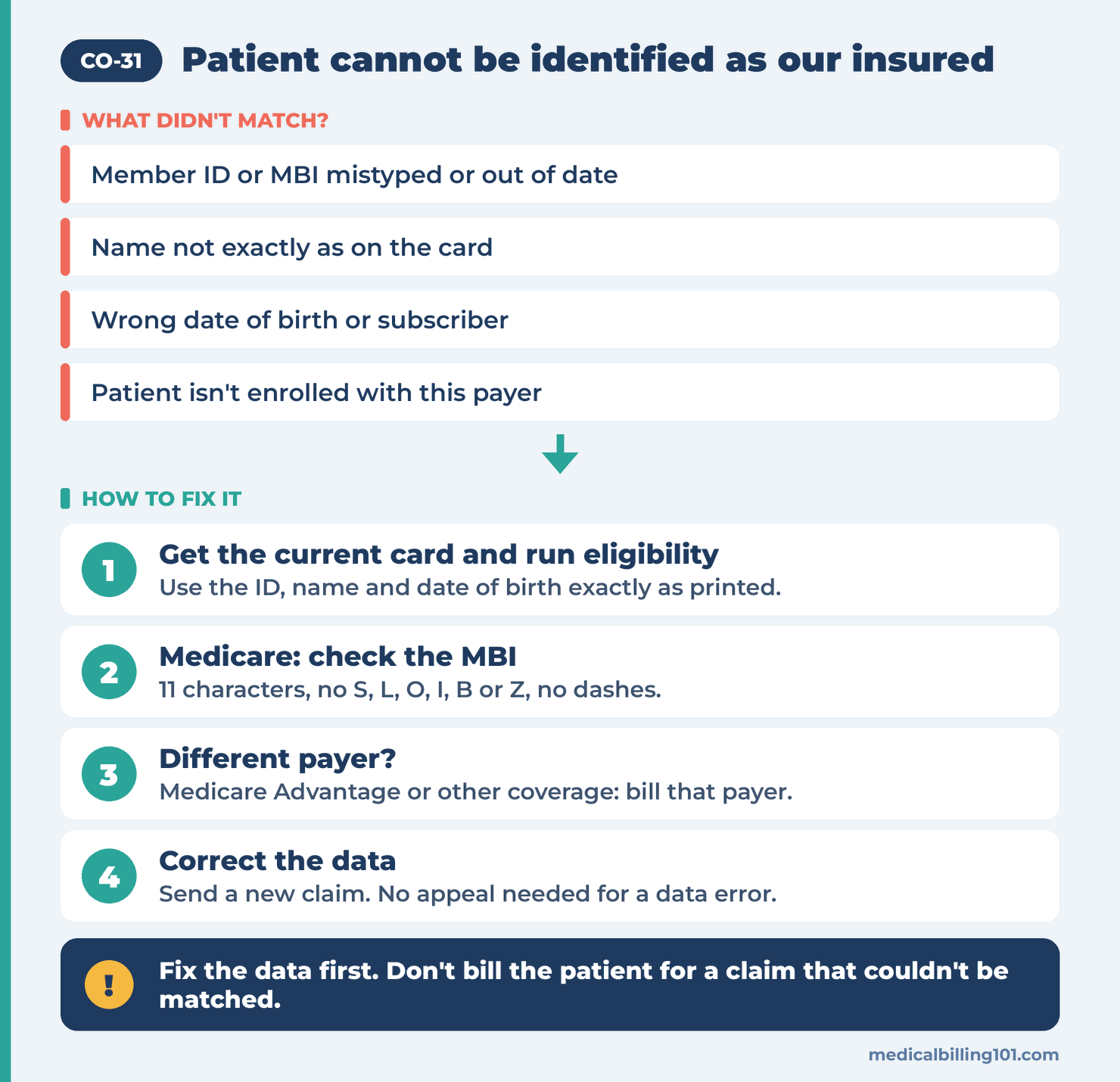
- Get the current card and run eligibility. Use the payer portal or a 270/271 inquiry with the ID, name and date of birth from the card. For Medicare, CMS’s HETS lets you “check Medicare beneficiary eligibility data in real-time” (CMS HETS).
- Compare the claim field by field. For example, check the member ID character by character, the first and last name and their order, the suffix, the date of birth and the subscriber (if the patient is a dependent).
- For Medicare, check the MBI. CMS says you “MUST submit claims using MBIs, no matter what date you performed the service, with a few exceptions.” An MBI is 11 characters, and it “doesn’t use the letters S, L, O, I, B, and Z” (CMS). The dashes on the card “aren’t used as part of the MBI” (CMS MBI format).
- Check the name exactly as printed. Noridian JE: “If patient has two last names or hyphenated last name, submit each character exactly as it appears on the Medicare card.”
- Confirm the patient really has this coverage. Noridian lists “Patient does not have Medicare Part B entitlement” as the common Part B cause. If the patient has a Medicare Advantage plan or other coverage, bill that payer.
- Correct the claim and send it as a new claim. Noridian JD DME: “Correct and resubmit as a new claim.” No appeal is needed when the error was in the claim data.
- If the payer’s record is wrong, have the patient fix it. Noridian: “If patient sees a problem or has an error on his/her Medicare card, they must contact Social Security Administration (SSA) at 800-772-1213.” Commercial members should call the plan’s member services.
Medicare and major payer notes
Noridian JE Part B labels the Medicare message “PR-31” and lists one common reason: the patient doesn’t have Part B entitlement. Its next steps: “Verify patient has Medicare Part B entitlement”, then resubmit with the MBI and “First and last name (in proper order)” exactly as on the Medicare card (Noridian JE).
Noridian JD DME lists “Incorrect Medicare number was submitted on the claim” and “Beneficiary is not enrolled in Medicare” (Noridian JD DME, Reason Code 31). On its MA27/N382 page it adds that beneficiaries “receive a new Medicare Beneficiary Identifier (MBI) number when they report their Medicare card lost or stolen”, and that suppliers “must immediately switch to billing with the new MBI.”
Medicare Advantage. CMS tells MA members to “keep using their Medicare Advantage and/or Medicare drug plan cards” for care. An MA member’s plan ID card goes to the MA plan, not the MAC. Mixing the two is a common way to get CO-31 or CO-24.
Commercial plans. Many plans give each family member their own ID or suffix. For example, a spouse may have the subscriber’s ID with a different two-digit suffix. Check the payer’s companion guide for how to report the subscriber and the patient, and copy the ID exactly, including any prefix.
Worked example (illustrative)
A Medicare patient’s card reads “MARIA GARCIA-LOPEZ”. The registration screen has “Maria Lopez”, and the MBI was keyed with the letter O in place of the final zero. The claim comes back CAS*CO*31*160.00 at claim level.
Reading it: two things are wrong. MBIs never use the letter O, so the ID can’t match. The last name also doesn’t match the card.
Fix: update registration to “GARCIA-LOPEZ”, re-key the MBI from the card, run eligibility to confirm Part B is active for the date of service, and send a new claim.
Prevention: scan the card at every visit, and set your PM system to reject an MBI containing S, L, O, I, B or Z.
CO-31 eligibility correction request template
Use this when the claim data was right and the payer’s member record is wrong, or when you need the payer to confirm the correct ID. Replace the bracketed text.
[Date]
[Payer name] Provider Services / Eligibility
[Address, fax or portal reference]

Re: Claim denied CO-31 (patient cannot be identified as our
insured): request to verify member record
Patient: [Name exactly as on card]   DOB: [MM/DD/YYYY]
Member ID on card: [ID]   Subscriber: [Name, ID, relationship]
Claim number: [Claim #]   Date(s) of service: [MM/DD/YYYY]
Provider: [Name, NPI]

The patient presented the enclosed ID card. Please:
[ ] Confirm the correct member ID and name on your records for
    the date of service.
[ ] Correct your member record to match the ID card
    (difference: [name spelling / DOB / ID]).
[ ] Reprocess the claim, or confirm that we should submit a new
    claim with the corrected data.

Enclosed: copy of ID card (front and back), remittance advice,
claim copy, [eligibility response dated (date)].

[Name, credentials]  [Practice, NPI]  [Phone / email]
CO-31 prevention checklist
- Scan the front and back of the insurance card at every visit.
- Enter names exactly as on the card, including hyphens and suffixes.
- Run a 270/271 or portal check before the visit, not after the denial.
- Set an MBI format edit (11 characters, no S, L, O, I, B or Z).
- Ask Medicare patients whether they have a Medicare Advantage plan.
- Record the subscriber’s name, date of birth and relationship for dependents.
- Update the MBI right away when a patient gets a replacement card.
- Track CO-31 by registration user and location to target training.
Related denial codes
- CO-16: claim lacks information, sometimes with MA27 or N382 for patient ID errors.
- CO-26: coverage hadn’t started on the date of service.
- CO-27: coverage ended before the date of service.
- CO-109: the claim went to the wrong payer or contractor.
- CO-24: covered under a capitation or Medicare Advantage plan.
- CO-140: the member ID and name don’t match.
FAQ
What is the CO-31 denial code description?
X12 describes CARC 31 as “Patient cannot be identified as our insured.” It means the payer couldn’t match the patient on the claim to a member in its records, usually because of an ID, name or date of birth mismatch.
How do I fix a CO-31 denial?
Get the current insurance card, run eligibility, and compare the member ID, name, date of birth and subscriber details with the claim. Correct what doesn’t match and send a new claim. If the patient has a different payer, bill that payer.
What is the difference between CO-31 and PR-31?
The reason is the same: the payer couldn’t identify the patient. The group code differs. Noridian publishes the Medicare message as PR-31. Either way, check for a data error before billing the patient.
Why does Medicare deny a claim as patient cannot be identified?
Noridian lists two common causes: an incorrect Medicare number on the claim and a patient without Medicare Part B entitlement. A name that doesn’t match the Medicare card, including hyphenated last names, can also prevent a match.
Do I need to appeal a CO-31 denial?
Usually not. CO-31 is a data-match problem, so you correct the claim and send it as a new claim. Noridian JD DME says to “Correct and resubmit as a new claim.” Appeal only if the payer’s record is wrong and it won’t correct it.
What is the difference between CO-31 and CO-140?
CO-31 means the payer couldn’t identify the patient at all. CO-140 is “Patient/Insured health identification number and name do not match.” It means the ID was found but the name didn’t fit it.
Sources
- X12, Claim Adjustment Reason Codes (CARC 31, 140, 32, 26, 27, 109). CARC 31 Start 01/01/1995, Last Modified 09/30/2007. Accessed 7 Oct 2026.
- X12, Remittance Advice Remark Codes (MA27, N382, MA36, N340). Accessed 7 Oct 2026.
- Noridian JE Part B, Patient Cannot Be Identified (last updated Apr 30, 2025)
- Noridian JD DME, Reason Code 31 (last updated Oct 25, 2024)
- Noridian JD DME, Reason Code 16 | Remark Code MA27 N382
- CMS, Medicare Beneficiary Identifiers (MBIs)
- CMS, Understanding the MBI Format (PDF)
- CMS, HIPAA Eligibility Transaction System (HETS)
- CMS, Medicare Claims Processing Manual (IOM 100-04), Ch. 22, §60.1 Group Codes
Last reviewed: 7 October 2026 · This page is educational and doesn’t replace payer-specific instructions.