

CO-24 is a Claim Adjustment Reason Code that means the payer won’t pay this claim fee-for-service because the patient’s care falls under a capitation agreement or managed care plan, and the CO group code keeps the amount off the patient’s bill. (Primary sources: X12 Claim Adjustment Reason Codes · Noridian JE Part B, Medicare Advantage Plan · First Coast, Tips to prevent RUC CO 24)
Quick answer: CO-24 means a capitation agreement or managed care plan covers the service. From Medicare it usually means the patient was in a Medicare Advantage plan on the date of service, so bill that plan. From a commercial HMO it often means your capitation payment already covers the service. Check eligibility before you rebill or adjust.
Part of our denial codes library. Written by Manikandan, a revenue cycle management specialist with more than 10 years of US medical billing experience. Last reviewed: 6 October 2026. Official code wording is quoted word for word from X12; Medicare rules link to their CMS or Medicare contractor source.
CO-24 denial code description (official X12 wording)
X12 Claim Adjustment Reason Code 24, verbatim:
“Charges are covered under a capitation agreement/managed care plan.”
Source: X12 Claim Adjustment Reason Codes, checked 6 October 2026. Start: 01/01/1995 | Last Modified: 09/30/2007.
The same short description covers two very different situations:
- The claim went to the wrong payer. The patient’s managed care plan, often Medicare Advantage, should get it. This is a routing fix.
- The claim went to the right payer, but you’re already paid. Your contract pays a monthly capitation amount for this patient and service, so the claim is an encounter record and the line pays $0. This is an expected adjustment.
What CO-24 means in plain English
- CO (Contractual Obligation) means the provider carries the amount on this remit. Don’t bill the patient for it.
- CARC 24 means the service sits inside a managed care arrangement. Either another plan pays it or your capitation already did.
- A Medicare CO-24 is usually a return, not a payment decision. First Coast says a claim for an MA enrollee sent to Medicare “will be returned as an unprocessable claim, and the remittance advice (RA) will indicate CARC CO 24,” and that “claims that are returned as unprocessable cannot be appealed.”
CO-24 was among First Coast’s top claims rejected as unprocessable on its top claim errors page when we checked on 6 October 2026, alongside CO-4, CO-16, CO-109 and CO-181.
CO-24 vs PR-24 vs OA-24 vs PI-24
| Group + 24 | Who carries the amount | Can you bill the patient? | Notes |
|---|---|---|---|
| CO-24 | Provider | No | The usual form. Rebill the managed care plan, or post as a capitation adjustment |
| PR-24 | Patient, per the payer | Rarely, and only the amount shown | Uncommon. Check whether the patient’s managed care plan should be billed first |
| OA-24 | Neither group fits | No | Used “when no other group code applies” (CMS Ch. 22, §60.1) |
| PI-24 | Payer-initiated | No | Non-Medicare remits only. Medicare remittances use CO, OA and PR |
Remark codes and claim codes that go with CO-24
Medicare contractors don’t publish a standard RARC pairing for CO-24. Noridian lists CO-24 alone, and many remits show no remark code. What matters is the reason behind the code and the modifiers that can clear it:
| Situation | What clears it | Source |
|---|---|---|
| Patient in an MA plan on the date of service | Bill the MA plan | Noridian JE, Medicare Advantage Plan |
| MA record not updated after disenrollment | Patient contacts the plan. Once Medicare’s record changes, submit a new claim | Noridian JE |
| MA enrollee elected hospice: attending physician services or care unrelated to the terminal illness | Refile with GV or GW. Original Medicare covers these | Noridian JE |
| MA enrollee in a qualifying clinical trial: routine costs | Refile with Q0 (investigational) or Q1 (routine) | Noridian JE |
| ESRD patient under a capitation agreement | Contact the capitation provider before the service | First Coast, CO 24 |
| Line returned as unprocessable | MA130 may appear: “no appeal rights are afforded because the claim is unprocessable” | X12 RARC list |
Where CO-24 shows up in the 835
A trimmed, illustrative 835 for an office visit billed to Original Medicare for a patient who had joined a Medicare Advantage plan:
CLP*PCN56789*4*165.00*0.00**MB*ICN987654321~
SVC*HC:99213*165.00*0.00**1~
DTM*472*20260902~
CAS*CO*24*165.00~
CLP02 = 4shows a denial. Expect $0.00 paid.CAS*CO*24carries the adjustment, often with noLQremark line.
On a commercial HMO encounter claim, the same CAS*CO*24 can appear on a line that’s paid through capitation. That’s expected, not an error.
How to fix CO-24: decision path
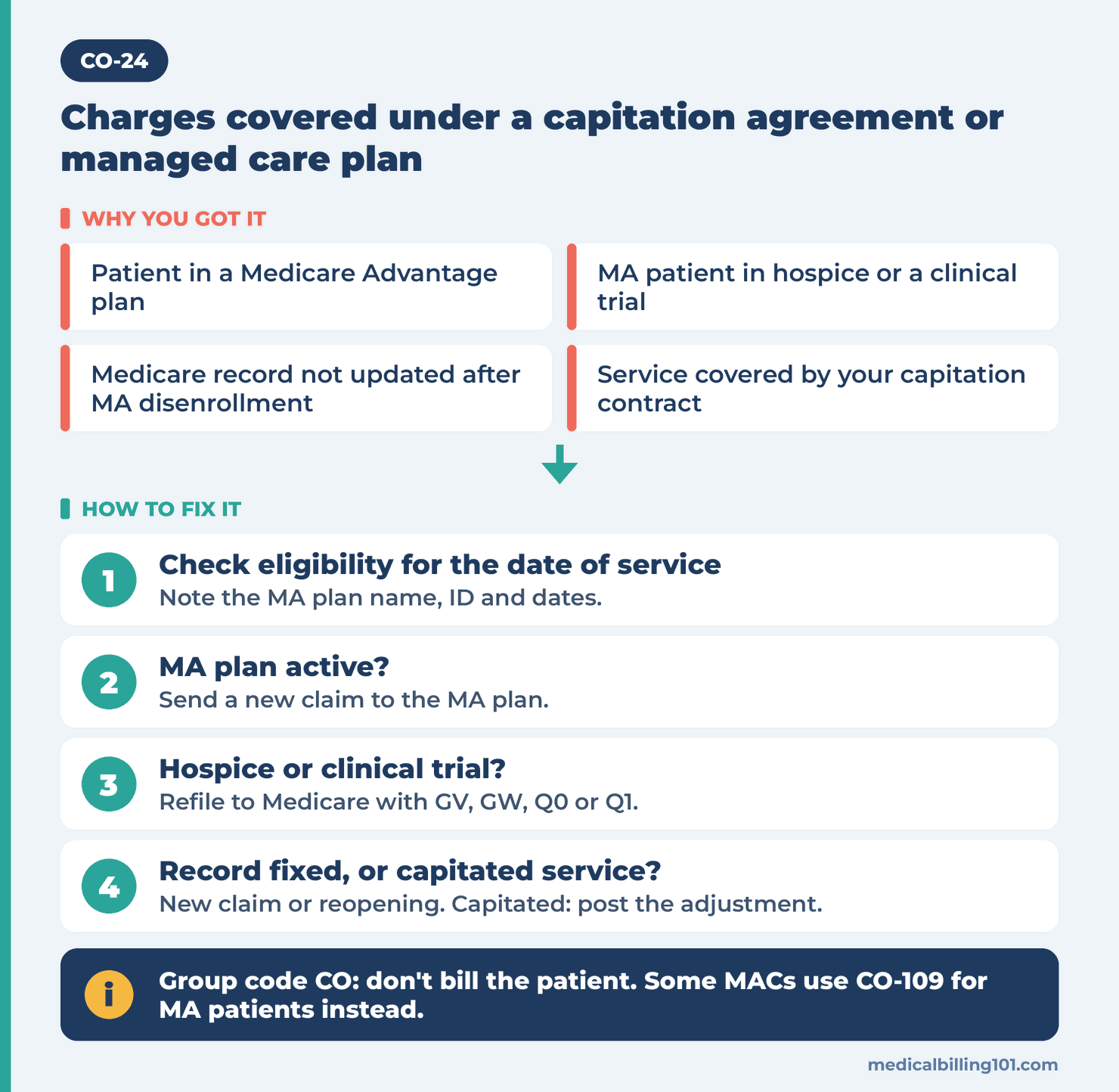
- Run eligibility for the date of service. Use the MAC portal or a 270/271 inquiry. Note any MA plan name, ID and effective dates. Noridian’s first step is to “verify patient’s eligibility via the Noridian Medicare Portal.”
- MA plan valid on that date: “bill services to appropriate insurer” (Noridian). Find the plan’s payer ID and claims address on the member card, the 271 response or the CMS MA Plan Directory.
- Patient elected hospice or is in a clinical trial: refile to Medicare with GV or GW (hospice), or with Q0 or Q1 (clinical trial routine costs), as Noridian lists.
- MA record was wrong and has been fixed: Noridian says “submit new claim.” If the filing limit has passed, it lists a reopening request as the route. First Coast says to “resubmit the claim to First Coast” once CMS records show no MA enrollment on that date.
- Commercial capitated patient: check your contract’s capitation service list. If the service is included, post CO-24 as a contractual adjustment. If it’s carved out of capitation (for example, a contract that pays certain labs, injectables or procedures fee-for-service), appeal with the contract section.
- Don’t bill the patient under CO-24. If the right plan assigns cost sharing, collect that amount.
Medicare and major payer notes
Medicare Advantage (Part C). First Coast says: “If a Medicare beneficiary enrolls in an MA plan, the MA plan replaces the beneficiary’s original Medicare plan. Medicare claims must be submitted to the MA plan.” Patients often still carry their red, white and blue Medicare card, so ask about plans such as Medicare Advantage HMOs and PPOs at every visit and scan every card.
Contractors differ on 24 vs 109. Noridian and First Coast use CO-24 for MA patients. National Government Services describes the same situation under CO-109 (“This denial is received when your Medicare patient is enrolled in an MA plan”). If your practice bills more than one MAC, train staff to treat both codes as an eligibility check.
Hospice under MA. Noridian lists “Patient is enrolled in an MA plan and also elected hospice” as a CO-24 cause, and says Original Medicare covers “attending physician services and all care unrelated to terminal illness.” Our CO-B9 guide explains GV and GW.
ESRD capitation. First Coast’s CO-24 page says: “Prior to seeing a patient for ESRD-related dialysis, verify eligibility. If the patient is covered under a capitation agreement, contact the capitation provider before rendering the service.” It cites CMS IOM Pub. 100-09, Chapter 6, section 50.1.
Commercial HMOs and IPAs. When a practice is capitated, the payer still wants encounter data, so claims are sent and lines come back at $0 with CO-24. Reconcile those lines against the monthly capitation report instead of working them as denials. When a non-capitated provider gets CO-24, the patient’s HMO may route that service to a capitated entity, such as a medical group or IPA. Check the member card or 271 response for the delegated entity that pays claims.
Worked example (illustrative)
A 70-year-old patient has been seen for years under Original Medicare. In August she joins a Medicare Advantage plan effective 1 September but brings only her Medicare card to a 2 September visit. The practice bills the MAC. The remit shows:
CAS*CO*24*165.00, no remark code
Reading it: Medicare’s records show MA enrollment on 2 September. The MAC returned the claim as unprocessable.
Fix: check eligibility, get the MA plan’s details from the portal, and submit a new claim to the MA plan under its own filing limit. If the practice is out of network for that plan, check the plan’s out-of-network rules before you rebill.
Prevention: run eligibility at check-in for every Medicare patient, at least monthly, because MA enrollment changes usually take effect on the 1st of the month.
CO-24 reprocessing request template
Use this when the patient’s MA enrollment was wrong on Medicare’s record and has since been corrected, or when a capitated payer denied a service your contract carves out. Replace the bracketed text.
[Date]
To: [MAC name / payer name], [Reopenings / Provider Disputes]
Via: [portal / fax / mail address]

Re: Request to reprocess claim [ICN / claim #], CARC 24
Patient: [Name]   [MBI / Member ID]: [ID]   DOB: [MM/DD/YYYY]
Date of service: [MM/DD/YYYY]   Line(s): [CPT/HCPCS, billed $]

The line(s) above were denied with CARC 24 ("Charges are covered under a
capitation agreement/managed care plan"). We request reprocessing because:

[Choose one]
- Medicare's enrollment record now shows the patient was not enrolled in
  a Medicare Advantage plan on the date of service (eligibility response
  dated [date] enclosed).
- The service is [attending physician care for a hospice patient /
  unrelated to the terminal condition / routine cost in a qualifying
  clinical trial] and is billed with modifier [GV / GW / Q1].
- [Commercial] Our agreement, section [x], carves [service] out of
  capitation and pays it fee-for-service (excerpt enclosed).

[Name, title]  [Practice, NPI, Tax ID]  [Phone / email]
CO-24 prevention checklist
- Run eligibility for every Medicare patient at every visit, especially in the first week of a month.
- Ask, “Have you joined a Medicare Advantage or other health plan?” and scan all cards.
- Set your PM system to block Original Medicare claims when the 271 shows an MA plan.
- For MA patients in hospice or clinical trials, add GV, GW, Q0 or Q1 before billing Original Medicare.
- Keep each capitated contract’s included and carved-out service lists where billers can find them.
- Post expected capitation CO-24 lines to a separate adjustment code so they don’t inflate denial reports.
- For ESRD patients, verify any capitation arrangement before dialysis-related services.
Related denial codes
- CO-109: claim sent to the wrong payer or contractor. Some MACs use it for MA patients.
- CO-B9: patient enrolled in hospice.
- CO-22: another payer may be primary under coordination of benefits.
- CO-45: charges exceed the fee schedule or contracted amount.
- MA130: unprocessable claim, no appeal rights. Submit a new claim.
- CO-16: missing or invalid claim information.
FAQ
What is the CO 24 denial code description?
X12 describes CARC 24 as “Charges are covered under a capitation agreement/managed care plan.” With CO, the provider carries the amount. A managed care plan or a capitation payment covers the service instead of this fee-for-service claim.
What does denial code CO 24 mean in Medicare?
It usually means the patient was enrolled in a Medicare Advantage plan on the date of service, so Original Medicare won’t process the claim. First Coast returns these claims as unprocessable. Bill the MA plan instead.
How do I fix a CO 24 denial?
Check eligibility for the date of service. If an MA plan was active, bill it. If the patient is in hospice or a clinical trial, refile with GV, GW, Q0 or Q1. If the MA record was wrong and has been corrected, submit a new claim or request a reopening.
Can I appeal a CO-24 denial?
For Medicare, usually not. First Coast says unprocessable claims “cannot be appealed.” Use a new claim or a reopening instead. For commercial plans, appeal only if the service is carved out of capitation or the plan’s eligibility was wrong.
What is the difference between CO-24 and CO-109?
Both can mean the claim belongs to another plan. CO-24 points to a capitation or managed care arrangement. CO-109 says the payer or contractor isn’t responsible at all. MACs differ: some send CO-24 for MA patients, others send CO-109.
Is CO-24 always a denial I need to work?
No. If your practice is capitated for the patient and service, a $0 line with CO-24 is how the payer records the encounter. Reconcile it against your capitation report.
Sources
- X12, Claim Adjustment Reason Codes (CARC 24). Start 01/01/1995, Last Modified 09/30/2007. Accessed 6 Oct 2026.
- X12, Remittance Advice Remark Codes (MA130). Accessed 6 Oct 2026.
- CMS, Medicare Claims Processing Manual (IOM 100-04), Ch. 22, §60.1 Group Codes
- Noridian JE Part B, Medicare Advantage Plan (CO-24), last updated Apr 30, 2025
- First Coast Service Options, Tips to prevent RUC CO 24 (June 29, 2026)
- First Coast Service Options, Top claim errors
- National Government Services, Top Claim Errors (CO-109 entry)
- CMS, MA Plan Directory
Last reviewed: 6 October 2026 · This page is educational and doesn’t replace payer-specific instructions.