

CO-B9 is a Claim Adjustment Reason Code that means the patient was in hospice on the date of service. The payer denied the line, most often because nothing on the claim showed it could be paid outside the hospice benefit. (Primary sources: X12 Claim Adjustment Reason Codes · CMS Medicare Claims Processing Manual, Ch. 11 · Noridian JE Part B, Patient Enrolled in Hospice)
Quick answer: CO-B9 means the patient was in a hospice election period on the date of service. Medicare Part B pays only for care unrelated to the terminal condition (add GW) or for the patient’s independent attending physician (add GV). If the service is related and you aren’t the attending physician, bill the hospice instead.
Part of our denial codes library. Written by Manikandan, a revenue cycle management specialist with more than 10 years of US medical billing experience. Last reviewed: 6 October 2026. Official code wording is quoted word for word from X12; Medicare rules link to their CMS or Medicare contractor source.
CO-B9 denial code description (official X12 wording)
X12 Claim Adjustment Reason Code B9, verbatim:
“Patient is enrolled in a Hospice.”
Source: X12 Claim Adjustment Reason Codes, checked 6 October 2026. Start: 01/01/1995 | Last Modified: 09/30/2007.
It’s one of the shortest CARC descriptions, and that’s why the denial confuses people. The code tells you about the patient’s status, not what was wrong with your claim. The fix depends on how your service relates to the hospice diagnosis and who you are in the patient’s care.
What CO-B9 means in plain English
When a Medicare patient chooses hospice, they give up Part B payment for doctor services “related to the treatment and management of his/her terminal illness” (CMS Ch. 11, §40.1.3). There is one exception: the attending physician they chose, if that doctor isn’t paid by the hospice. All other care tied to the terminal illness is paid through the hospice.
CMS tells A/B MACs that “for beneficiaries enrolled in hospice, A/B MACs (B) shall deny any services on professional claim that are submitted without either the GV or GW modifier” (Ch. 11, §40.2). Most CO-B9 denials on doctor claims come from that one rule.
- CO (Contractual Obligation) means the provider carries the amount. Don’t bill the patient for it.
- CARC B9 means Medicare’s record shows the patient in hospice on that date.
CO-B9 vs PR-B9 vs OA-B9 vs PI-B9
| Group + B9 | Who carries the amount | Can you bill the patient? | Notes |
|---|---|---|---|
| CO-B9 | Provider | No | The usual form. Add the right modifier or bill the hospice |
| PR-B9 | Patient, per the payer | Not before checking | First Coast lists “PR B9” among its top Part B denials. Confirm the service wasn’t the hospice’s responsibility, and check whether GV or GW should have been on the claim |
| OA-B9 | Neither group fits | Check first | Used “when no other group code applies” (CMS Ch. 22, §60.1) |
| PI-B9 | Payer-initiated | No | Non-Medicare remits only. Medicare remittances use CO, OA and PR |
Modifiers and codes that clear a B9
For CO-B9, the codes that matter are on your claim, not on the remit. We found no MAC that lists a standard remark code for B9. First Coast and Noridian both point to modifiers instead.
| Code | Official meaning | Use it when | Source |
|---|---|---|---|
| GV | “Attending physician not employed or paid under arrangement by the patient’s hospice provider” | You are the attending physician the patient chose, the hospice doesn’t pay you, and the visit is tied to the terminal illness | CMS Ch. 11, §40.2 |
| GW | “service not related to the hospice patient’s terminal condition” | Any provider, on a CMS-1500, for care not tied to the terminal illness | CMS Ch. 11, §50 |
| Condition code 07 | “Treatment of Non-terminal Condition for Hospice” | The UB-04 (837I) version of GW | CMS Ch. 11, §50 |
| MA130 (RARC) | “Your claim contains incomplete and/or invalid information, and no appeal rights are afforded because the claim is unprocessable…” | May show up if the line was returned, not denied. Send a new claim | X12 RARC list |
On UB-04 claims, National Government Services rejects a claim that overlaps a hospice stay and has no condition code 07 (its edit C7010). It tells providers, “If services are unrelated to hospice stay, resubmit with condition code 07” (NGS top claim errors).
Where CO-B9 shows up in the 835
A trimmed, illustrative 835 line for an orthopedic visit billed without GW for a hospice patient:
SVC*HC:28470*420.00*0.00**1~
DTM*472*20260910~
CAS*CO*B9*420.00~
CAS*CO*B9carries the adjustment. Expect no remark code, or a general one.SVC01shows no modifier. That’s usually the problem.
How to fix CO-B9: decision path
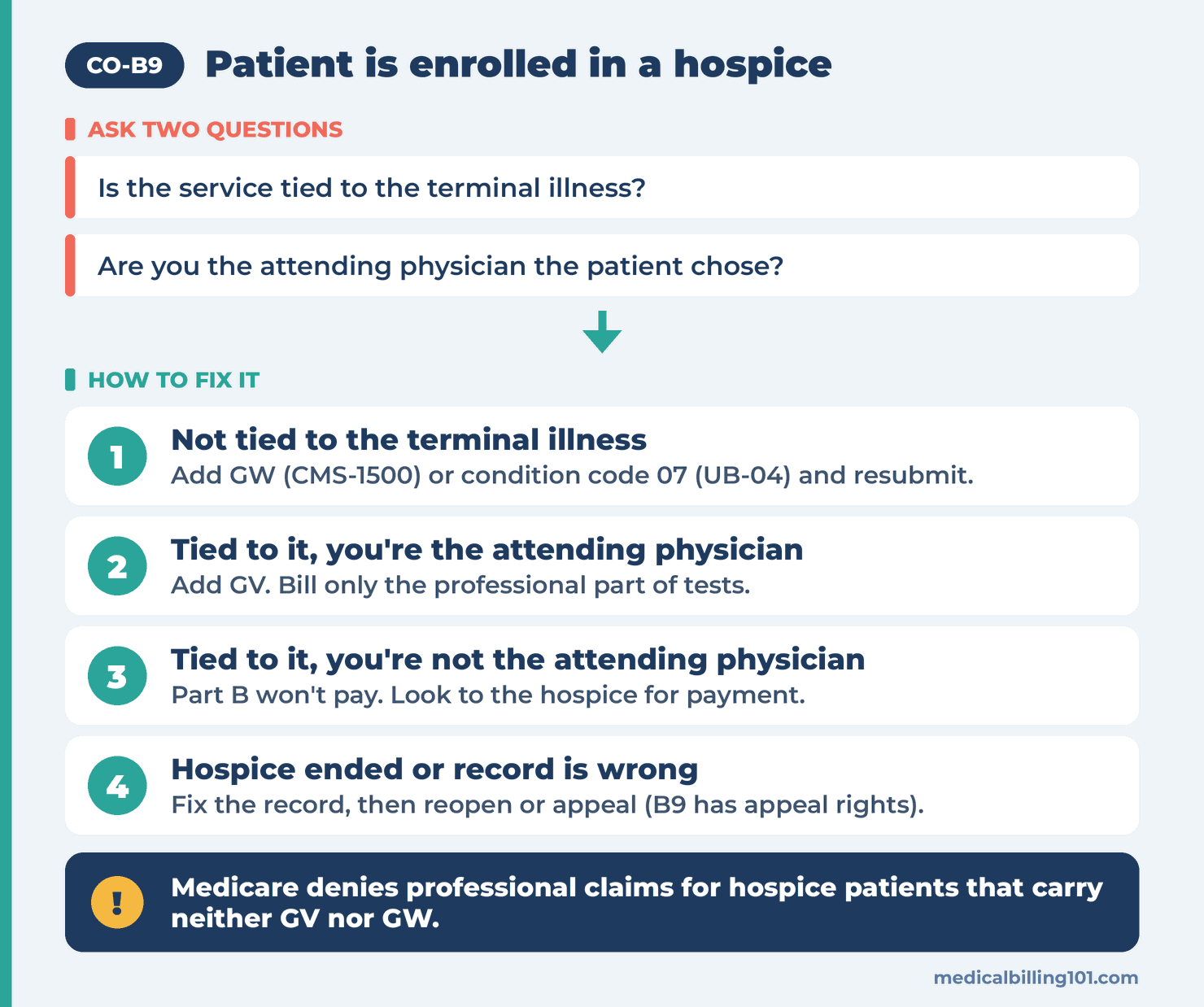
- Confirm the hospice dates. Check the MAC portal or HETS for the start date and any end date, such as a revocation or discharge. Noridian lists an outdated record as a cause: the CWF “has not been updated to show Hospice election has been revoked.”
- Ask: is the service tied to the terminal illness? Read the hospice diagnosis and your note side by side. For example, a foot broken in a fall is often not related to lung cancer, unless the cancer has spread to the bone.
- Not tied to the terminal illness: add GW on a CMS-1500, or condition code 07 on a UB-04. Put the diagnosis that shows why first. First Coast says, “If claim was submitted without the appropriate modifier, apply modifier, and resubmit claim.”
- Tied to it, and you’re the attending physician: add GV. For tests with a technical part, such as x-rays, bill only your reading to Part B. The hospice pays the technical part (CMS Ch. 11, §40.1.3).
- Tied to it, and you’re not the attending physician: Part B won’t pay. CMS says the provider “must look to the hospice for payment.” Call the hospice to set up payment.
- Hospice ended or the record is wrong: ask the hospice to fix the record, then reopen or resubmit. Noridian notes that “items or services with this message have appeal rights.” So you can ask for a reopening or appeal if the denial was wrong.
Medicare and major payer notes
Medicare Part B (professional). The GV/GW rule in §40.2 is strict. With an active election, a professional claim without either modifier is denied. DME MACs decide relatedness “based entirely on the presence of the GW modifier and not based on diagnosis coding” (§40.2). Adding a hospice-unrelated diagnosis won’t help without the modifier.
Medicare Part A (institutional). Hospitals, SNFs and outpatient units use condition code 07 for care that isn’t tied to the terminal illness (§50). Care that is tied to it, including inpatient care, stays with the hospice.
After revocation. “Upon revocation… an individual resumes Medicare coverage of the benefits waived when hospice care was elected” (§40.2.1). Once Medicare’s file shows the end date, bill later services the normal way.
Medicare Advantage patients in hospice. When an MA member chooses hospice, Original Medicare pays for the attending physician and for care not tied to the terminal illness. Noridian lists this under its CO-24 guidance and says to refile with GV or GW (Noridian JE, Medicare Advantage Plan). See our CO-24 guide.
Commercial and Medicaid hospice. Rules outside Medicare vary by plan and state. Many follow Medicare’s lead. Still, read the plan’s hospice policy before you rely on GV or GW.
Worked example (illustrative)
A patient in hospice for metastatic lung cancer trips at home and fractures a metatarsal. An orthopedist who has no arrangement with the hospice treats the closed fracture (CPT 28470) and bills Part B without a modifier. The remit shows CAS*CO*B9*420.00.
Reading it: the MAC saw the hospice election and no GV or GW, so it denied the line under §40.2.
Fix: the fracture is unrelated to the lung cancer. Submit a new claim with 28470-GW and the fracture diagnosis first. Keep the visit note, which shows the fall and the injury.
Prevention: add an eligibility check at scheduling that flags any active hospice election, so the coder sees it before the claim goes out.
CO-B9 reopening or appeal letter template
Use this when the claim already had the right modifier, or the hospice election had ended, and the B9 still came back. Replace the bracketed text.
[Date]
To: [MAC name], Redeterminations / Reopenings
Via: [MAC portal / fax / mail address]

Re: Request for [reopening / redetermination], CARC B9
Beneficiary: [Name]   MBI: [MBI]   Claim number (ICN): [ICN]
Date of service: [MM/DD/YYYY]   Line(s): [CPT/HCPCS + modifier, billed $]

The line(s) above were denied with CARC B9 (patient enrolled in hospice).
We request reconsideration because:

[Choose one]
- The service is not related to the terminal condition ([hospice
  diagnosis]). It treated [condition, ICD-10 code], documented in the
  enclosed note. The claim [carried / should carry] modifier GW.
- [Provider name, NPI] is the beneficiary's designated attending
  physician, is not employed by and receives no compensation from
  [hospice name], and billed with modifier GV.
- The hospice election was revoked on [date], before the date of service.
  Enclosed is [revocation statement / hospice confirmation].

Enclosures: [visit note], [hospice election or revocation record], [remit].

[Name, title]  [Practice, NPI, PTAN]  [Phone / email]
Medicare redeterminations are due within 120 days of the initial determination (CMS, First Level of Appeal). For a simple missing modifier, a new claim or a reopening is usually faster than a redetermination. Our Medicare appeal guide walks through each level.
CO-B9 prevention checklist
- Ask every Medicare patient, or their family, if they are in hospice.
- Check hospice dates before every visit, not just the first one.
- Note the patient’s chosen attending physician in the chart and the PM system.
- Train coders: not related means GW, or condition code 07 on a UB-04. The attending physician uses GV.
- For GV tests with a technical part, bill only the doctor’s part (modifier 26) to Part B.
- If you aren’t the attending physician, call the hospice before you give related care.
- Write notes that show why the visit isn’t tied to the hospice diagnosis.
Related denial codes
- CO-24: charges covered under a capitation agreement or managed care plan, including MA enrollees who elected hospice.
- CO-109: claim sent to the wrong payer or contractor.
- CO-4: procedure code inconsistent with the modifier, or a required modifier is missing.
- CO-50: not medically necessary.
- MA130: unprocessable claim. Submit a new claim.
- CO-16: missing or invalid claim information.
FAQ
What is the CO B9 denial code description?
X12 describes CARC B9 as “Patient is enrolled in a Hospice.” With CO, the provider carries the amount. The payer saw the patient was in hospice, and nothing on the claim showed the service could be paid outside it.
What does denial code B9 mean?
It means the patient was in hospice on the date of service. Under Medicare, Part B pays only for care not tied to the terminal illness (GW) or for the attending physician (GV). The hospice pays for the rest.
How do I fix a CO B9 denial?
Check the hospice dates. Then decide if the service is tied to the terminal illness. If not, resubmit with GW, or condition code 07 on a UB-04. If you’re the attending physician, use GV. If it’s tied to it and you’re not, bill the hospice.
What is the difference between GV and GW modifiers?
GV is for the attending physician the patient chose, when the hospice doesn’t pay that doctor and the care is tied to the terminal illness. GW is for any care that isn’t tied to the terminal illness, no matter who gives it.
Can I appeal a CO-B9 denial?
Yes, when the denial was wrong. Noridian says items with this message “have appeal rights.” If the claim was only missing a modifier, a new claim or a reopening is usually quicker.
Can I bill the patient for a CO-B9?
Not under CO. For related services, payment comes from the hospice, so contact the hospice. For unrelated services, add GW and rebill Medicare.
Sources
- X12, Claim Adjustment Reason Codes (CARC B9). Last Modified 09/30/2007. Accessed 6 Oct 2026.
- X12, Remittance Advice Remark Codes (MA130). Accessed 6 Oct 2026.
- CMS, Medicare Claims Processing Manual (IOM 100-04), Ch. 11 Processing Hospice Claims, §40.1.3, §40.2, §40.2.1, §50
- CMS, Medicare Claims Processing Manual (IOM 100-04), Ch. 22, §60.1 Group Codes
- CMS, First Level of Appeal: Redetermination by a Medicare Contractor
- First Coast Service Options, Tips to prevent CARC CO B9 (February 16, 2026)
- First Coast Service Options, Top claim errors
- Noridian JE Part B, Patient Enrolled in Hospice (last updated Apr 30, 2025)
- Noridian JE Part B, Medicare Advantage Plan (last updated Apr 30, 2025)
- National Government Services, Top Claim Errors (C7010)
Last reviewed: 6 October 2026 · This page is educational and doesn’t replace payer-specific instructions.