
CO-27 is a Claim Adjustment Reason Code that means the payer’s records show the patient’s coverage had already ended on the date of service. Job changes, unpaid premiums, a COBRA election that hasn’t been made yet and Medicare Part B terminations are the usual causes. The CO group code puts the amount on the provider for now. (Primary sources: X12 Claim Adjustment Reason Codes · WPS, Common Claim Denials · 45 CFR 156.270)
Quick answer: CO-27 means the payer says the patient’s coverage had ended before the date of service. Check the termination date and any remark code, such as N619 for unpaid premiums. Then bill the patient’s new coverage, wait for a COBRA election or reinstatement, or dispute a wrong date with proof. Check your contract before billing the patient.
Part of our denial codes library. Written by Manikandan, a revenue cycle management specialist with more than 10 years of US medical billing experience. Last reviewed: 7 October 2026. Official code wording is quoted word for word from X12; Medicare rules link to their CMS or Medicare contractor source.
CO-27 denial code description (official X12 wording)
X12 Claim Adjustment Reason Code 27, verbatim:
“Expenses incurred after coverage terminated.”
Source: X12 Claim Adjustment Reason Codes, checked 7 October 2026. Start: 01/01/1995. No usage note.
The key word is after. The payer knows the patient and had coverage on file, but the date of service falls after the end date. Its mirror image is CO-26, where the service came before coverage started. X12 retired the older catch-all, CARC 28, in 2003 with the note “Redundant to codes 26&27.”
What CO-27 means in plain English
Each part of the code answers a different question:
- CO (Contractual Obligation) is the payer’s classification of who carries the amount. CMS says these adjustments are “Generally… considered a write off for the provider and are not billed to the patient” (Medicare Claims Processing Manual, Ch. 22, §60.1).
- CARC 27 tells you why: the coverage end date on file is earlier than the date of service.
Termination isn’t always final. COBRA coverage can be elected late in the election window and then applies back to the date coverage was lost. Marketplace plans have premium grace periods. Payers can also reinstate a member whose coverage was ended in error. So the first job with CO-27 is to find out why coverage ended.
CO-27 vs CO-26, CO-31 and CO-22
| Code | Official X12 text | What it tells you |
|---|---|---|
| 27 | “Expenses incurred after coverage terminated.” | Coverage existed but ended before the date of service |
| 26 | “Expenses incurred prior to coverage.” | Coverage hadn’t started yet. See CO-26 |
| 31 | “Patient cannot be identified as our insured.” | The payer can’t match the patient at all. See CO-31 |
| 22 | “This care may be covered by another payer per coordination of benefits.” | Coverage is active, but another payer may be primary. See CO-22 |
CO-27 vs PR-27 vs OA-27 vs PI-27
CARC 27 can come with any group code. The group code changes who the payer says owes the money:
| Group + 27 | Who carries the amount | Can you bill the patient? | When you’ll typically see it |
|---|---|---|---|
| CO-27 | Provider | Not under the payer’s classification. Check your contract first | Contracted commercial and managed care plans |
| PR-27 | Patient | Yes, the payer assigned it to the patient | WPS lists Medicare entitlement denials as “CO/PR 27” |
| OA-27 | Neither group fits | Check the remark codes and your contract | Used “when no other group code applies” (CMS Ch. 22, §60.1) |
| PI-27 | Payer-initiated reduction | No | Non-Medicare remits only. CMS lists just CO, OA and PR as valid on Medicare remittances |
Remark codes that explain why coverage ended
The remark code often tells you whether the termination can be undone. These are the X12 codes written for premium and enrollment problems:
| RARC | Official X12 text | What it adds |
|---|---|---|
| N619 | “Coverage terminated for non-payment of premium.” | Coverage ended because premiums weren’t paid |
| N617 | “This enrollee is in the second or third month of the advance premium tax credit grace period.” | A Marketplace enrollee is in months 2 or 3 of the grace period. Claims can be pended |
| N618 | “Alert: This claim will automatically be reprocessed if the enrollee pays their premiums.” | Don’t resubmit. Wait for the premium payment |
| N698 | “Alert: This reversal is due to non-payment of the health insurance premiums (Health Insurance Exchange or other) by the end of the premium payment grace period, resulting in loss of coverage.” | A paid claim was reversed after the grace period ran out |
| N687 | “Alert: This reversal is due to a retroactive disenrollment.” | A paid claim was reversed after a back-dated end date |
RARC wording is quoted from the X12 RARC list, checked 7 October 2026. WPS lists Medicare’s CO/PR 27 with “Remark Code: None”, so a Medicare remit may carry no RARC.
Where CO-27 shows up in the 835
Here’s a trimmed, illustrative example for a $185.00 office visit line:
SVC*HC:99214*185.00*0.00**1~
DTM*472*20260915~
CAS*CO*27*185.00~
LQ*HE*N619~
CAS*CO*27*185.00is the group code, reason code and adjusted amount.LQ*HE*N619says coverage ended for non-payment of premium.DTM*472is the date of service. Compare it with the end date in the eligibility response.
How to fix CO-27: decision path
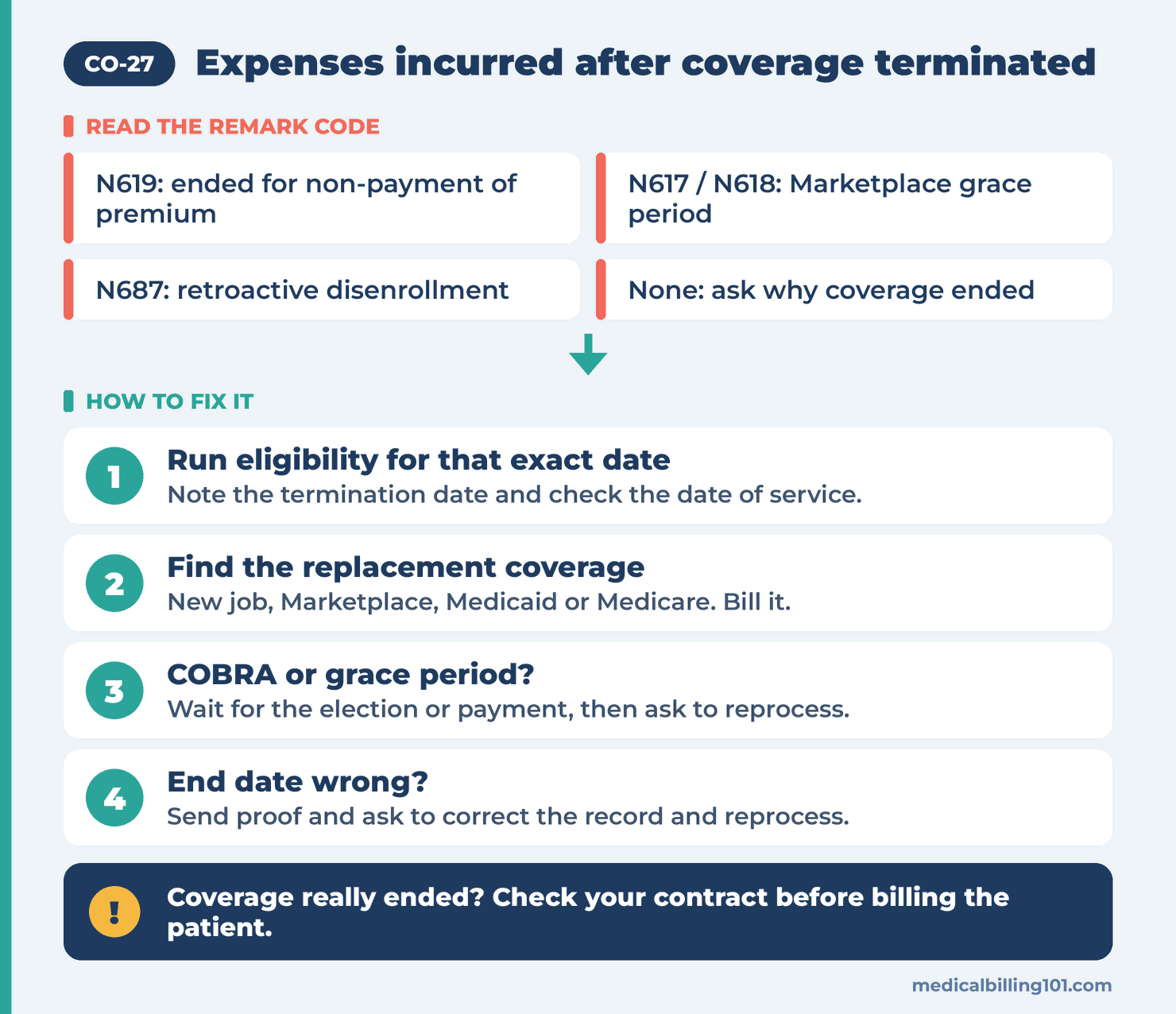
- Run eligibility for the exact date of service. Note the termination date the payer returns, and check that the date of service on the claim is correct.
- Read the remark code. N619, N617, N618 or N698 point to premiums. N687 points to a retroactive disenrollment. No remark code means you’ll need to ask the payer or the patient why coverage ended.
- Find the coverage that replaced it. Ask the patient about a new employer plan, Marketplace plan, Medicaid or Medicare, and run eligibility with that payer. If it covered the date, bill it as primary.
- Check for COBRA. A qualified beneficiary generally has 60 days after the later of the coverage-loss date or the election notice to elect COBRA. If they elect in time, “coverage must be provided from the date that coverage would otherwise have been lost” (26 CFR 54.4980B-6, Q&A-3). Once the plan reinstates the patient, ask it to reprocess.
- Check for a Marketplace grace period. Enrollees receiving advance premium tax credits get “a grace period of 3 consecutive months” (45 CFR 156.270(d)). If the patient pays, N618 claims are reprocessed automatically.
- If the termination date is wrong, dispute it. Send proof such as a premium receipt, employer letter or reinstatement notice and ask the payer to correct the record and reprocess.
- If coverage really had ended, close it out. Follow the group code and your contract. For Medicare, WPS says that if the date of service is outside the dates of Medicare coverage, “bill the patient or their appropriate insurance for the services in question.”
Medicare and major payer notes
Medicare Part B. WPS explains CO/PR 27 on Medicare claims as “Our records show that the patient did not have Part B coverage on the date of service billed.” It notes that “Medicare Part B entitlement and termination is determined by the Social Security Administration (SSA)” and “Termination may take place due to non-payment of premiums or other reasons.” WPS recommends checking the patient’s Medicare card before each appointment and checking entitlement dates in its portal (WPS, Common Claim Denials). If the dates differ, “the beneficiary should contact 1-800-MEDICARE for assistance.”
Marketplace (ACA exchange) plans. During the 3-month grace period, the issuer must “Pay all appropriate claims for services rendered to the enrollee during the first month of the grace period and may pend claims for services rendered to the enrollee in the second and third months.” It must also “Notify providers of the possibility for denied claims” in months 2 and 3. If the grace period runs out, the last day of enrollment “will be the last day of the first month of the 3-month grace period” (45 CFR 155.430(d)(4)). That’s why services in months 2 and 3 can end up as CO-27.
COBRA. For indemnity or reimbursement plans, the regulation lets a plan that “allows retroactive reinstatement” end coverage during the election period and reinstate it once COBRA is elected. It also says that “Claims incurred by a qualified beneficiary during the election period do not have to be paid before the election (and, if applicable, payment for the coverage) is made.” If you call to confirm coverage, the plan must give “a complete response to the health care provider about the qualified beneficiary’s COBRA continuation coverage rights during the election period.”
Medicare Advantage and Medicaid. Their enrollment end dates come from their own records. A patient can leave a Medicare Advantage plan and return to Original Medicare, so check both before billing.
Worked example (illustrative)
A patient buys a Marketplace plan with advance premium tax credits. She pays for July but not for August or September. She’s seen on August 12 and September 15, 2026.
- August 12 claim (month 1 of the grace period): paid. The issuer must pay month-1 claims.
- September 15 claim (month 2): pended with N617. At the end of October, the 3-month grace period runs out unpaid. The claim then comes back
CAS*CO*27*185.00withLQ*HE*N619.
Reading it: under 45 CFR 155.430(d)(4), her last day of enrollment is the last day of month 1, August 31. The September visit is after coverage terminated.
Fix: ask the patient whether she has other coverage, such as Medicaid or a new employer plan, for September 15, and bill it if so. If she has none, follow your contract and financial policy before billing her.
Prevention: run eligibility at every visit, not just the first one. A “grace period” flag on the 271 response or portal is your warning.
CO-27 reprocessing request template
Use this when coverage was in force on the date of service, such as after a COBRA election, reinstatement or a corrected end date. Replace the bracketed text.
[Date]
[Payer name] Provider Disputes / Reconsiderations
[Address or portal reference]

Re: Request to reprocess claim denied CO-27 (expenses incurred
after coverage terminated)
Patient: [Name]   Member ID: [ID]   DOB: [MM/DD/YYYY]
Claim number: [Claim #]   Date(s) of service: [MM/DD/YYYY]
Provider: [Name, NPI]   Remit codes: CO-27, [N619 / none]

Coverage was in effect on the date of service:
[ ] COBRA continuation coverage was elected on [date] and applies
    from [coverage-loss date].
[ ] Coverage was reinstated on [date] with no break in coverage.
[ ] Your eligibility record shows the wrong end date. The correct
    termination date is [date].

Please update the eligibility record if needed and reprocess
the claim.

Enclosed: remittance advice, claim copy, [COBRA election /
reinstatement notice / premium receipt / employer letter].

[Name, credentials]  [Practice, NPI]  [Phone / email]
CO-27 prevention checklist
- Run eligibility at every visit, not only for new patients.
- Ask “Has your insurance changed?” at check-in, including job changes.
- Record termination dates and grace-period flags from the 271 response.
- For pended claims with N617 or N618, wait. Don’t resubmit duplicates.
- When a patient mentions COBRA, note the election deadline and recheck later.
- Check Medicare patients’ Part B dates when billing a new year.
- Rebill the replacement payer promptly. Timely filing still applies (see CO-29).
- Track CO-27 by payer and front-desk user to find gaps in eligibility checks.
Related denial codes
- CO-26: coverage hadn’t started on the date of service.
- CO-31: the payer can’t identify the patient as a member.
- CO-22: another payer may be primary.
- CO-109: the claim went to the wrong payer or contractor.
- CO-29: the timely filing limit has passed.
FAQ
What is the CO-27 denial code description?
X12 describes CARC 27 as “Expenses incurred after coverage terminated.” With the CO group code, the payer says the provider carries the amount. It means the date of service was after the patient’s coverage end date.
What does CO-27 with N619 mean?
N619 is “Coverage terminated for non-payment of premium.” The patient’s coverage ended because premiums weren’t paid. Ask about other coverage for that date, and check whether the payer will reinstate coverage if the premium is paid.
Can COBRA fix a CO-27 denial?
Yes, if the patient elects COBRA in time. The election window generally runs at least 60 days, and timely elected coverage applies from the date coverage would otherwise have been lost. Once the plan reinstates the patient, ask it to reprocess the claim.
Can I bill the patient for a CO-27 denial?
Not right away. First look for a COBRA election, reinstatement or new coverage for that date. CO puts the amount on the provider, so check your contract before billing. For Medicare, WPS says to bill the patient or their other insurance if Part B coverage had ended.
Why was a claim paid and then reversed for CO-27?
The payer changed its enrollment dates after paying. N687 means a retroactive disenrollment. N698 means coverage ended after a premium grace period ran out. Check eligibility for that date, then bill the right payer.
What is the difference between CO-27 and CO-26?
Both mean no coverage on the date of service. CO-27 means coverage had already ended. CO-26 means coverage hadn’t started yet. The fixes are similar: confirm the dates, find the payer that did cover that date, and correct the record if it’s wrong.
Sources
- X12, Claim Adjustment Reason Codes (CARC 27, 26, 28, 31, 22). CARC 27 Start 01/01/1995. Accessed 7 Oct 2026.
- X12, Remittance Advice Remark Codes (N619, N617, N618, N698, N687). Accessed 7 Oct 2026.
- WPS Government Health Administrators, Common Claim Denials (last updated Dec 23, 2024)
- eCFR, 45 CFR 156.270, Termination of coverage or enrollment for qualified individuals
- eCFR, 45 CFR 155.430, Termination of Exchange enrollment or coverage
- eCFR, 26 CFR 54.4980B-6, COBRA electing continuation coverage
- CMS, Medicare Claims Processing Manual (IOM 100-04), Ch. 22, §60.1 Group Codes
Last reviewed: 7 October 2026 · This page is educational and doesn’t replace payer-specific instructions.