
CO-197 is a Claim Adjustment Reason Code that means the payer expected a precertification, authorization or notification for the service and found none that fits the claim. The CO group code puts the amount on the provider, not the patient. (Primary sources: X12 Claim Adjustment Reason Codes · 42 CFR 419.82 · CMS OPD prior authorization guide)
Quick answer: CO-197 means the payer required precertification, authorization or notification and found none on file for this service. Because the group code is CO, you can’t bill the patient. If an approval exists, correct the claim with the right authorization number or UTN. If none was obtained, check for an exception, then appeal or write it off.
Part of our denial codes library. Written by Manikandan, a revenue cycle management specialist with more than 10 years of US medical billing experience. Last reviewed: 6 October 2026. Official code wording is quoted word for word from X12; Medicare rules link to their CMS or Medicare contractor source.
CO-197 denial code description (official X12 wording)
X12 Claim Adjustment Reason Code 197, verbatim:
“Precertification/authorization/notification/pre-treatment absent.”
Source: X12 Claim Adjustment Reason Codes, checked 6 October 2026. Start: 10/31/2006 | Last Modified: 05/01/2018.
The text has no usage note and doesn’t require a remark code, so many CO-197 lines arrive with nothing else to explain them. The four words in the code cover four different payer requirements. Precertification and authorization are approvals before care. Notification is a notice the plan wants by a deadline, even when it doesn’t review the service. Pre-treatment usually means a review of a treatment plan before care starts, a term common in dental plans.
What CO-197 means in plain English
Each part of the code answers a different question:
- CO (Contractual Obligation) means the provider carries the amount. CMS describes CO adjustments as amounts “generally… considered a write off for the provider and are not billed to the patient” (Medicare Claims Processing Manual, Ch. 22, §60.1).
- CARC 197 means the payer’s system didn’t match an approval to this line. It doesn’t always mean nobody asked. An approval for a different code, date range, site or provider looks the same to the claim system.
- The remark code, when there is one, narrows it down. N54, for example, says the claim doesn’t match what was authorized.
That second point matters most. Before anyone writes off a CO-197, someone should search the portal, the fax log and the scheduling notes for an approval. A large share of these denials are matching problems that a corrected claim fixes.
CO-197 vs CO-198, CO-39 and CO-288
Authorization problems use several codes. Reading the right one saves a wasted appeal:
| Code | Official X12 text | What it tells you |
|---|---|---|
| 197 | “Precertification/authorization/notification/pre-treatment absent.” | No approval on file that fits this line |
| 198 | “Precertification/notification/authorization/pre-treatment exceeded.” | An approval exists, but you billed more visits, units or days than it allows |
| 39 | “Services denied at the time authorization/pre-certification was requested.” | The payer said no before the service. Appeal the medical necessity decision |
| 288 | “Referral absent” | A referral, not an authorization, was missing |
| 15 | “The authorization number is missing, invalid, or does not apply to the billed services or provider.” | Stopped by X12 on 05/01/2018. It shouldn’t appear on current remits |
CO-197 vs PR-197 vs OA-197 vs PI-197
CARC 197 can come with any group code. The group code changes who owes the money:
| Group + 197 | Who carries the amount | Can you bill the patient? | When you’ll typically see it |
|---|---|---|---|
| CO-197 | Provider | No | The usual form. The provider’s contract makes getting the approval the provider’s job |
| PR-197 | Patient | Yes, if the plan assigns the penalty to the member | Less common. Some plans make the member responsible for precertification, for example on out-of-network care. Check the EOB and plan documents first |
| OA-197 | Neither group fits | Check your contract and the payer’s notes | Rare. Used “when no other group code applies” (CMS Ch. 22, §60.1) |
| PI-197 | Payer-initiated reduction | No | Non-Medicare remits only. CMS lists just CO, OA and PR as valid on Medicare remittances |
Remark codes that come with CO-197
X12 doesn’t require one, but these are the pairings worth knowing:
| RARC | Official X12 text | What it points to | Published by |
|---|---|---|---|
| N210 | “Alert: You may appeal this decision.” | The 14-byte UTN wasn’t on the claim, or a required bypass modifier was missing | Noridian JA DME (197/N210) |
| N54 | “Claim information is inconsistent with pre-certified/authorized services.” | An approval exists, but the code, date, units or provider differ from it | X12 RARC list (general use) |
| M62 | “Missing/incomplete/invalid treatment authorization code.” | The authorization number on the claim is missing or wrong | X12 RARC list (general use) |
RARC wording is quoted from the X12 RARC list, checked 6 October 2026. N54 and M62 are listed for reference only. We didn’t find a Medicare contractor table pairing them with 197.
Where CO-197 shows up in the 835
On an electronic remittance (835), the denial sits in the service line loop. Here’s a trimmed, illustrative example for a $2,400.00 MRI line:
SVC*HC:70553*2400.00*0.00**1~
DTM*472*20260908~
CAS*CO*197*2400.00~
LQ*HE*N54~
CAS*CO*197*2400.00is the group code, reason code and adjusted amount.LQ*HE*N54is the remark code. Here it says the claim doesn’t match the approval on file.- On the claim side (837), the authorization number travels in
REF*G1. CMS and Noridian both point to loop 2300 REF02 with REF01 = G1 for the Medicare UTN, and Noridian’s DME page also accepts loop 2400. On a paper CMS-1500, it goes in Item 23.
How to fix CO-197: decision path
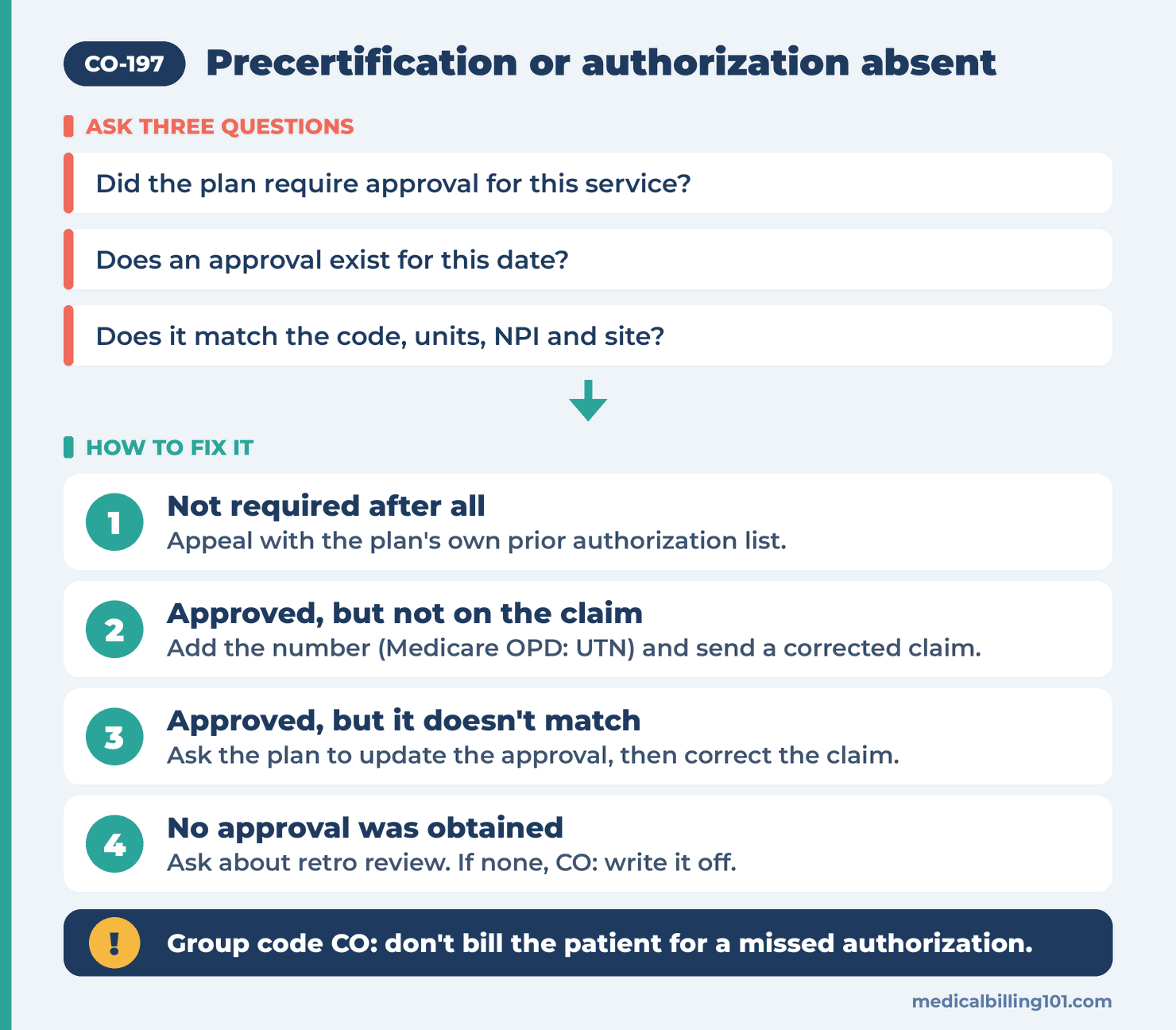
- Confirm the rule for that date of service. Check the payer’s authorization list for the plan, the code and the place of service on the date the care happened, not today.
- Look for an approval before anything else. Search the payer portal, fax confirmations and scheduling notes. Compare the approval’s codes, units, dates, site and rendering provider with the claim.
- If an approval exists, correct the claim. Add or fix the number in Item 23 or
REF*G1. If the approval covers a different code than the one performed, ask the payer whether its policy allows an update first. For other payers, follow the corrected claim process. Noridian’s DME instruction is to “Correct claim and rebill with the 14-byte UTN.” - If no approval exists, check for an exception. Emergency care, a retro review window in the provider manual, a payer system outage, or coverage that changed after scheduling can all reopen the door. Request the retro review in writing and keep the reference number.
- Appeal when the care was necessary and the payer allows it. Send the records, the reason no approval was obtained, and proof of any attempt. Medicare redeterminations are due within 120 days of receiving the initial determination (CMS).
- Otherwise, write it off and fix the front end. CO-197 isn’t the patient’s bill. Add the service to your authorization checklist so it doesn’t go out again.
Medicare and major payer notes
Original Medicare, hospital outpatient departments. Under 42 CFR 419.82(b)(1), CMS “will deny a claim for a service that requires prior authorization if the provider has not received a provisional affirmation.” The program covers blepharoplasty, botulinum toxin injection, rhinoplasty, panniculectomy, vein ablation, implanted spinal neurostimulators, cervical fusion with disc removal, and facet joint interventions (added for dates of service from July 1, 2023). CMS’s guide, updated March 2, 2026, says claims “submitted without a PA determination and a corresponding UTN will be automatically denied” (§8.3). Related anesthesia, physician and facility claims are denied too when the main service isn’t paid (§8.4). A non-affirmed request isn’t appealable, but the denied claim is (First Coast). CMS also exempts hospitals that submit at least 10 requests and reach a provisional affirmation rate of at least 90 percent in its annual assessment (§5).
Where the UTN goes. For electronic institutional claims, CMS says the UTN “must be in positions 1 through 18” of the treatment authorization field at loop 2300 REF02 (REF01=G1). For other submissions, a UTN keyed into the first field turns into zeros, and the claim then “will edit for the OPD UTN” (§8.1).
Medicare DMEPOS. Noridian JA DME lists 197 with N210 when the “Prior authorization 14-byte Unique Tracking Number (UTN) was not appended to claim” or a required bypass modifier was left off. The fix is to rebill with the UTN from the affirmative decision letter.
WISeR Model states. In Arizona, New Jersey, Ohio, Oklahoma, Texas and Washington, selected Original Medicare services with dates of service on or after January 15, 2026 need prior authorization or face pre-payment medical review. Claims sent without a decision are “routed to the WISeR Participant for pre-payment medical review” rather than paid. An affirmed UTN is valid for 120 calendar days (CMS WISeR guide, version 7.0, July 24, 2026).
Medicare Advantage, Medicaid and Marketplace plans. Under the CMS Interoperability and Prior Authorization final rule (CMS-0057-F), from January 1, 2026 impacted payers must give “a specific reason for denied prior authorization decisions.” Impacted payers other than QHP issuers on the federal exchanges must decide expedited requests within 72 hours and standard requests within seven calendar days. The rule doesn’t apply to drugs. Use those dates in your appeal when a request sat without an answer.
UnitedHealthcare, Cigna and Aetna. Retro authorization windows, grace periods and appeal documents differ by payer. We compared each one’s written policy with what their provider service reps said in CO-197 at UnitedHealthcare, Cigna and Aetna.
Worked example (illustrative)
A commercial plan approves a brain MRI without contrast, CPT 70551. During the scan, the radiologist adds contrast, and the facility bills CPT 70553 at $2,400.00. The remit comes back:
CAS*CO*197*2400.00withLQ*HE*N54
Reading it: an approval exists, but for a different code. N54 says the claim “is inconsistent with pre-certified/authorized services.” Nothing was wrong with the scan itself.
Fix: check the plan’s provider manual for a post-service authorization update window. If it has one, ask for the approval to be changed to 70553 with the radiologist’s note. Then send a corrected claim with the updated number. If the plan has no update process, appeal with the order, the report and the reason contrast was medically needed.
Prevention: for imaging approvals, ask the ordering office to request the “with and without contrast” code when the radiologist may decide during the scan, if the plan’s policy allows it.
CO-197 appeal letter template
Use this when the service was medically necessary and either an approval existed or an exception applies. Replace the bracketed text.
[Date]
[Payer name] Appeals / Reconsideration Unit
[Address or portal reference]

Re: Request for reconsideration of CO-197 denial
Patient: [Name]   Member ID: [ID]
Claim number: [ICN / claim #]   Date of service: [MM/DD/YYYY]
Service: [CPT/HCPCS + modifiers]   Billed amount: [$]
Remit codes: CO-197, [RARC if any]

We request reconsideration of the denial above.
[Choose one:]
- Authorization [number] was approved on [date] for [codes, dates].
  It covers this service; a copy is enclosed.
- Authorization could not be obtained before the service because
  [emergency / payer system outage / coverage changed on (date)].
  We requested it on [date], reference [#].

The service was medically necessary, as documented in the enclosed
[order, office note, operative or imaging report].

Enclosed: remittance advice, claim copy, authorization record or
request log, medical records. Please reprocess the line for payment.

[Name, credentials]  [Practice, NPI]  [Phone / email]
If the approval simply wasn’t on the claim, don’t appeal. Send a corrected claim.
CO-197 prevention checklist
- Check the payer’s authorization list by code, plan and place of service at scheduling, and again when the order changes.
- Match every approval to the claim before it goes out: code, units, date range, site and rendering provider.
- Put the number in Item 23 or
REF*G1, and for Medicare, use the 14-byte UTN in the right positions. - Track approval end dates and request extensions before they lapse.
- Hold claims for affirmed Medicare services until the UTN arrives.
- Log every request with date, time and reference number for later appeals.
- Report CO-197, CO-198 and CO-39 separately. They have different fixes.
Related denial codes
- CO-197 by payer: what UnitedHealthcare, Cigna and Aetna reps said about retro authorization and appeals.
- CO-50: not deemed a medical necessity. Often follows a non-affirmed request.
- CO-16: claim lacks information. Fix and resubmit.
- CO-198: an approval exists but the units or visits were exceeded.
- CO-39: the payer denied the request before the service.
- CO-288: a required referral was missing.
For a step-by-step front-end process, see our prior authorization checklist for surgical procedures.
FAQ
What is the CO 197 denial code description?
X12 describes CARC 197 as “Precertification/authorization/notification/pre-treatment absent.” With the CO group code, the provider carries the amount. The payer found no approval on file that matches the billed service.
What does denial code CO 197 mean in medical billing?
It means the plan needed an approval or notice before the service and couldn’t match one to the claim line. Either no approval was obtained, or the one on file covers a different code, date, site or provider.
How do I fix a CO 197 denial?
Search for an existing approval first. If one exists, correct the claim with the right number or Medicare UTN. If none exists, check for a retro review or emergency exception. Appeal with records when the care was necessary; otherwise write it off.
Can I bill the patient for a CO-197 denial?
No. CO means the amount is the provider’s responsibility under the contract. Only a PR-197 line, which some plans use when the member had to get the precertification, can go to the patient.
What is the difference between CO-197 and CO-198?
CO-197 means no approval fits the service. CO-198 means an approval exists but was exceeded, for example more therapy visits or units than approved. A 198 usually needs an extension or a corrected unit count, not a new request.
Can you get retro authorization after a CO-197?
Sometimes. It depends on the payer’s written policy and the reason no approval was obtained. Emergency care and payer errors are the usual grounds. Original Medicare’s outpatient program requires the request before the service (42 CFR 419.82(c)), so there’s no retro review there, but the denied claim can be appealed.
Sources
- X12, Claim Adjustment Reason Codes (CARC 197, 198, 39, 288, 15). CARC 197 Start 10/31/2006, Last Modified 05/01/2018. Accessed 6 Oct 2026.
- X12, Remittance Advice Remark Codes (N210, N54, M62). Accessed 6 Oct 2026.
- 42 CFR 419.82, Prior authorization for certain covered hospital outpatient department services
- CMS, Prior Authorization Process for Certain Hospital Outpatient Department Services: Operational Guide (March 2, 2026)
- First Coast Service Options, OPD prior authorization claim submission guidelines
- Noridian JA DME, Reason Code 197 | Remark Code N210 (last updated Oct 3, 2025)
- CMS, WISeR Model Provider and Supplier Operational Guide, version 7.0 (July 24, 2026)
- CMS, Interoperability and Prior Authorization Final Rule (CMS-0057-F) fact sheet
- CMS, Medicare Claims Processing Manual (IOM 100-04), Ch. 22, §60.1 Group Codes
- CMS, First Level of Appeal: Redetermination by a Medicare Contractor
Last reviewed: 6 October 2026 · This page is educational and doesn’t replace payer-specific instructions.