Table of Contents
Why Surgical Prior Authorization Failures Cost More Than Any Other Denial Type
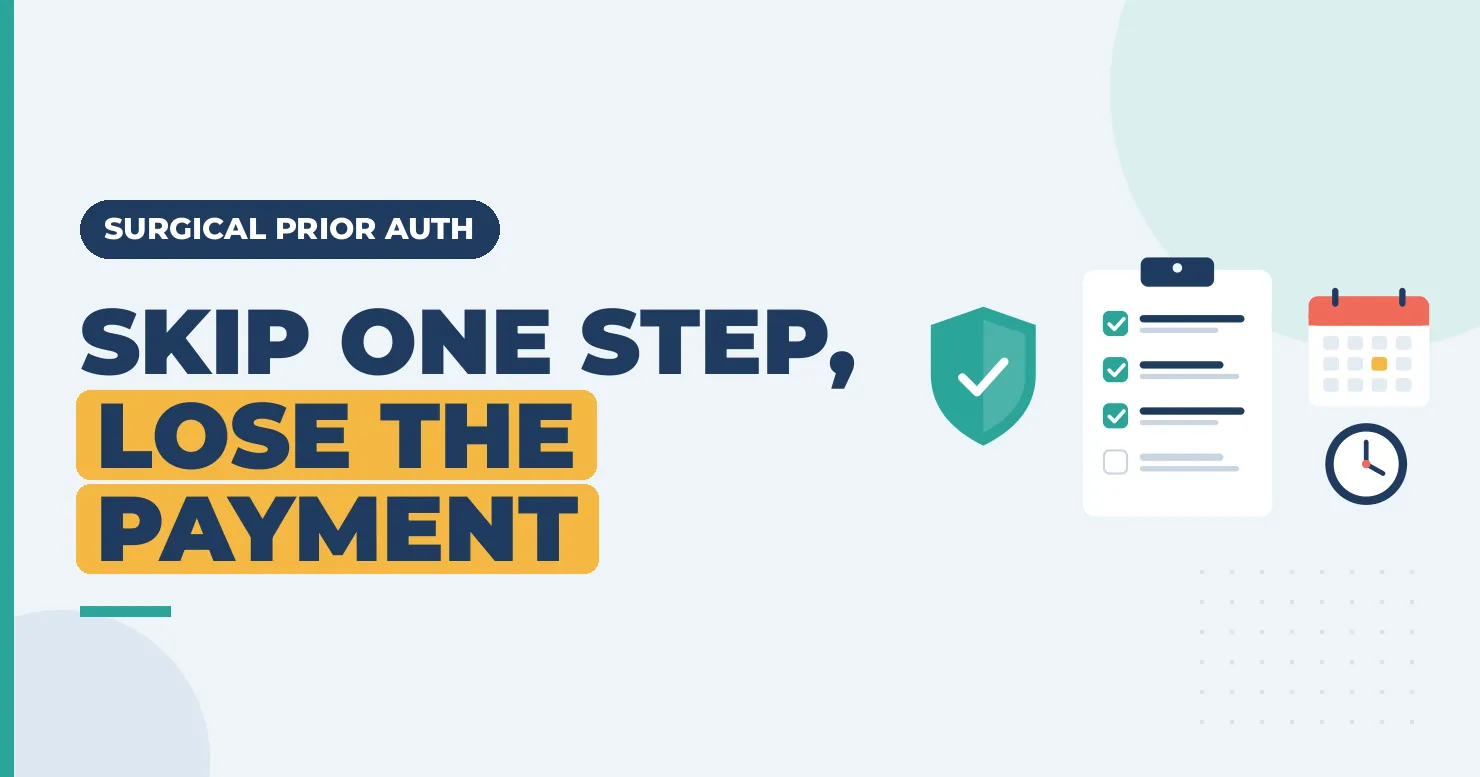
Prior authorization denials for surgical procedures are the most expensive denial category in medical billing, not because individual claims are larger than other service types, but because the downstream consequences compound quickly. A surgical claim denied for missing or invalid prior authorization typically cannot be corrected and resubmitted the way a coding error can. Authorization must be obtained before the service. When it is not, the practice faces the choice between writing off the claim entirely, absorbing the cost as a courtesy adjustment, or billing the patient directly for a service the payer would have covered if authorization had been obtained.
Most prior authorization failures are preventable workflow errors, not clinical coverage disputes. The authorization was never requested, was requested for the wrong code, was requested from the wrong department, or expired before the procedure was performed. Each of those failures has a specific checkpoint in the workflow where it can be caught before the surgical date. This checklist organizes those checkpoints in sequence, with particular attention to non-standard procedures that are especially critical for unlisted CPT codes because payer policies for unlisted procedures are less predictable than for standard surgical codes and the documentation requirements are significantly more demanding.
Step One: Insurance Verification Before Scheduling
The prior authorization workflow begins at scheduling, not at billing. By the time a claim reaches the billing team, it is too late to obtain authorization retroactively for most payers. The first checkpoint is a benefit verification that confirms three things: whether the procedure requires prior authorization for this specific payer and plan, which department or portal accepts authorization requests for this service category, and what clinical documentation the payer requires to support the request.
Payer authorization requirements are not uniform across plans within the same carrier. A UnitedHealthcare commercial plan may require authorization for a procedure that a UnitedHealthcare Medicare Advantage plan does not, and vice versa. Building a payer-specific reference matrix that captures authorization requirements by procedure category for your top payers, updated quarterly, is one of the highest-value administrative investments a surgical practice can make.
For procedures that have no specific CPT code, verify with the payer whether an unlisted code requires authorization and what clinical materials must accompany the request. Some payers require a procedure description narrative, a comparable code reference, and a letter of medical necessity before they will process an authorization request for an unlisted code. Others accept the operative plan description in the authorization form fields. Discovering this requirement the day before surgery is too late.
Step Two: Submitting the Authorization Request
Submit the authorization request as early as possible after the procedure is scheduled. For elective surgical procedures, a lead time of at least five to seven business days provides the buffer needed to handle requests for additional information without delaying the surgical date.
The authorization request must include the correct CPT or HCPCS code for the planned procedure, all associated ICD-10 diagnosis codes that support medical necessity, the anticipated date of service, the performing provider’s NPI, and the facility where the procedure will be performed. For procedures with multiple planned components, each CPT code that requires separate authorization should be listed individually. Omitting a component code from the authorization request and assuming it is covered under the primary authorized code is a common source of post-service denials.
For services requiring documentation of failed conservative treatment before authorization will be granted, such as surgical interventions for musculoskeletal conditions, the prior authorization submission should include a summary of the conservative treatments attempted, the duration of each treatment, the outcomes achieved, and the clinical rationale for escalation to surgical intervention. Many payers require evidence that conservative treatment was attempted and failed before authorizing surgical procedures. Submitting this documentation with the initial request rather than waiting for the payer to request it speeds up the approval timeline significantly.
Step Three: Confirming Authorization Details
When authorization is received, verify four specific details before marking the authorization as complete in the practice management system.
The first detail is that the authorized CPT code matches the planned procedure code exactly. Authorization for a similar but different code does not transfer. If the surgical plan changes between authorization and the procedure date, the authorization must be updated before the procedure is performed.
The second detail is the authorization effective date and expiration date. Most surgical authorizations are valid for 90 days from the date of approval, though this varies by payer. A procedure performed after the authorization expiration date is treated by the payer as an unauthorized service regardless of whether the authorization was valid at the time it was obtained. Set a calendar reminder to renew expiring authorizations at least two weeks before they lapse.
The third detail is the number of units authorized. An authorization for one unit of a procedure code that is performed twice, or at two anatomic sites, may result in the second unit being denied as unauthorized. Confirm that the authorized unit count matches the planned service scope.
The fourth detail is the authorized facility. Most authorizations are facility-specific. A procedure performed at a different location than the one listed on the authorization may not be covered even if the code, date, and provider are all authorized.
Document the authorization number, the approving payer representative’s name if obtained by phone, the call date and time, and the authorization validity period in the patient’s account. This documentation is the billing team’s defense if the payer later claims no authorization exists on file.
Step Four: Following Up on Pending Requests
Do not wait for payers to contact you about pending authorization requests. Build a follow-up schedule into the workflow that checks on every pending authorization at 48 hours after submission and again at five calendar days. Assign follow-up tasks to specific team members with system reminders so no request falls through the cracks.
When following up, confirm that the payer received the request, that no additional documentation is needed, and what the expected decision timeline is. Many authorization delays result from incomplete submissions that the payer’s intake team identified but never communicated to the provider. A 48-hour follow-up call catches these situations before they become surgical scheduling conflicts.
For urgent or expedited authorizations where the procedure cannot be delayed by days, most payers are required to respond within 24 to 72 hours for urgent requests depending on the plan type and applicable state or federal regulations. Clearly label urgent authorization requests as urgent at the time of submission and include a brief clinical statement explaining why delay would jeopardize the patient’s health or functional recovery.
Step Five: Handling Cases Where No Authorization Was Obtained
When a surgical procedure is performed without prior authorization in an emergency or urgent situation, the billing pathway is different from an elective case but not necessarily a write-off. Most payers have a retroactive authorization process for genuine emergencies. Submit the retroactive authorization request within the payer’s specified timeframe, which is typically 24 to 72 hours after an emergency service.
The retroactive authorization request must include the operative report, the clinical documentation supporting the emergency determination, and an explanation of why authorization could not be obtained before the procedure. A procedure described as urgent in the billing team’s language but not supported by emergency clinical documentation in the operative record will not qualify for retroactive authorization.
For non-emergency cases where authorization was simply not obtained due to a workflow failure, the options depend on the payer’s policies and the state in which the service was rendered. Some states require payers to cover services that met medical necessity criteria even without prior authorization in certain circumstances. Others do not. Some payers will grant retroactive authorization on first appeal for providers with a strong prior authorization compliance history. Document the circumstances and escalate to payer relations before writing off the claim.
The Unlisted Code Authorization Requirement
Unlisted procedure codes require specific handling in the prior authorization workflow because payer policies for these codes are less standardized than for specific procedure codes. Some payers require prior authorization for all unlisted codes regardless of specialty. Others require it only for codes in specific anatomic categories or above specific dollar thresholds. Others handle unlisted codes on a case-by-case basis without a stated authorization requirement.
Before scheduling any procedure that will be coded with an unlisted code, contact the payer directly to confirm their authorization requirement for that procedure. Use the comparable CPT code as a reference point in the conversation. Saying you are planning to perform a procedure comparable to code 49215 but using a laparoscopic approach that no specific code describes, and asking whether prior authorization is required and what documentation to submit with the request, gives the payer representative enough context to give you an accurate answer.
When authorization for an unlisted code is obtained, document the authorization number alongside the comparable code reference that was used to obtain it. Billing teams that submit the unlisted code claim with the authorization number will have cleaner adjudication than those who submit without it, even for payers that technically do not require the number to appear on the claim form. For Medicare-specific review scenarios, see our guide on how to handle a Medicare MAC prepayment review.
Conclusion
Prior authorization failures for surgical procedures are preventable in the vast majority of cases. Practices that want to understand the broader audit landscape should also review the 2026 OIG audit triggers in medical billing to ensure prior auth documentation meets enforcement standards. A workflow that begins at scheduling, submits requests early with complete medical necessity documentation, confirms authorization details upon receipt, follows up on pending requests within 48 hours, and maintains payer-specific reference materials eliminates the most common failure modes before the surgical date. For unlisted procedure codes, adding a direct payer contact step to confirm authorization requirements and documentation expectations is the additional layer that prevents the most expensive and difficult-to-recover denials in surgical billing.
This article is for educational purposes for healthcare billing professionals. Consult your payer contracts and state insurance regulations for jurisdiction-specific authorization requirements.
Frequently Asked Questions: Surgical Prior Authorization
What information is required for a surgical prior authorization request?
Five items: the planned CPT or HCPCS code, the ICD-10 codes that support medical necessity, the expected date of service, the surgeon’s NPI and the facility. For procedures requiring documentation of failed conservative treatment, include a summary of conservative treatments attempted with outcomes. For unlisted codes, include a procedure description narrative and comparable code reference.
What happens if surgery is performed without prior authorization?
If surgery is performed without prior authorization in an emergency, submit a retroactive authorization request within the payer’s specified timeframe (typically 24 to 72 hours after an emergency service), including the operative report and emergency clinical documentation. For non-emergency cases where authorization was missed due to a workflow failure, options depend on payer policy and state law. Some payers grant retroactive authorization on first appeal; others do not. Document all circumstances before any write-off decision.
Do unlisted CPT codes require prior authorization?
Authorization requirements for unlisted CPT codes vary by payer. Some payers require prior authorization for all unlisted codes. Others require it only for specific anatomic categories or above certain dollar thresholds. Before scheduling any procedure that will be billed with an unlisted code, contact the payer directly to confirm their authorization requirement and what documentation to submit with the request.
Have a denial question or a topic you want covered?
Send me the details. I read every message and use them to decide what to write next.