
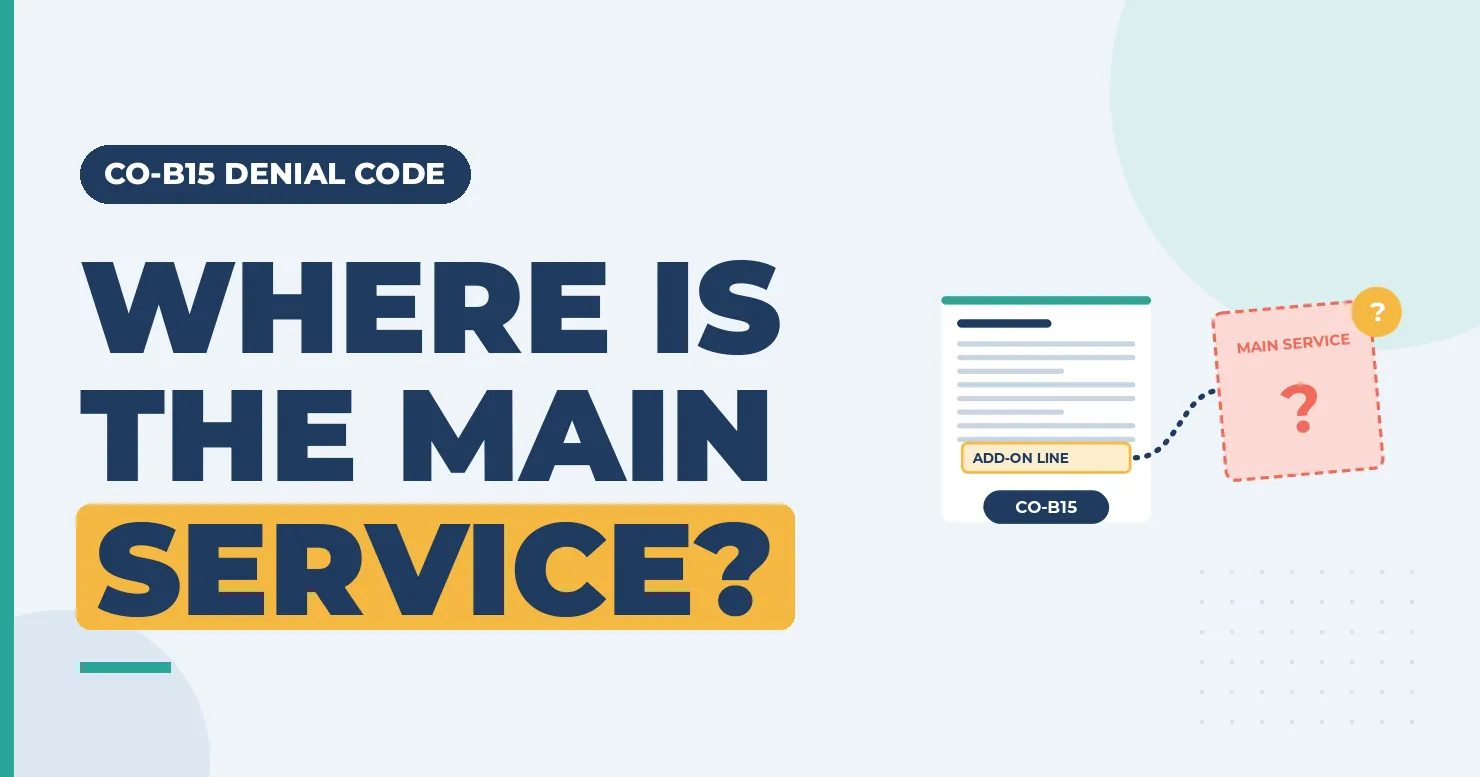
CO-B15 is a Claim Adjustment Reason Code that means the line is payable only alongside another qualifying service, and the payer hasn’t received, processed or covered that service. The CO group code keeps the amount off the patient’s bill. (Primary sources: X12 Claim Adjustment Reason Codes · Noridian JE Part B top denials, Q4 2025 · Novitas JL top claim denials)
Quick answer: CO-B15 means the denied line depends on a qualifying service the payer hasn’t received, processed or covered. The CO group code means you can’t bill the patient. Find the qualifying service in claim history. If it’s missing, bill it. If it was denied or billed on another date, fix that first, then resubmit or appeal.
Part of our denial codes library. Written by Manikandan, a revenue cycle management specialist with more than 10 years of US medical billing experience. Last reviewed: 6 October 2026. Official code wording is quoted word for word from X12; Medicare rules link to their CMS or Medicare contractor source.
CO-B15 denial code description (official X12 wording)
X12 Claim Adjustment Reason Code B15, verbatim:
“This service/procedure requires that a qualifying service/procedure be received and covered. The qualifying other service/procedure has not been received/adjudicated. Usage: Refer to the 835 Healthcare Policy Identification Segment (loop 2110 Service Payment Information REF), if present.”
Source: X12 Claim Adjustment Reason Codes, checked 6 October 2026. Start: 01/01/1995 | Last Modified: 07/01/2017.
Read the first sentence closely. The qualifying service has to be received and covered. So B15 can fire in four situations: the qualifying service was never billed, it’s billed but still in process, it was processed and denied, or it was billed under a date or provider the payer couldn’t link. Each one has a different fix. The usage note sends you to loop 2110 REF, which may name the payer policy that ties the two services together.
What CO-B15 means in plain English
Each part of the code answers a different question:
- CO (Contractual Obligation) means the provider carries the amount. CMS describes CO adjustments as amounts “generally… considered a write off for the provider and are not billed to the patient” (Medicare Claims Processing Manual, Ch. 22, §60.1).
- CARC B15 means this line has a prerequisite, and the payer’s records don’t show it paid.
- The remark code tells you which kind of prerequisite. M80 points to another service on the same date. N674 says a “pre-requisite procedure/service” is missing. M51 can mean the date or code on the line doesn’t line up with the service it depends on.
B15 is about order and linkage, not medical necessity. The service may be fully justified and still deny because the payer looked for its partner and didn’t find it.
CO-B15 vs CO-107, CO-97 and CO-236
These four codes all involve one service’s relationship to another. They aren’t interchangeable:
| Code | Official X12 text | What it tells you |
|---|---|---|
| B15 | “…requires that a qualifying service/procedure be received and covered…” | The qualifying service isn’t on file as paid yet |
| 107 | “The related or qualifying claim/service was not identified on this claim.” | The related service wasn’t reported on this claim. Noridian uses it when an add-on code arrives without its primary code |
| 97 | “The benefit for this service is included in the payment/allowance for another service/procedure that has already been adjudicated.” | The service is bundled into one already paid |
| 236 | “This procedure or procedure/modifier combination is not compatible with another procedure…” | An NCCI procedure-to-procedure edit stopped the pair |
Noridian’s guidance for CO-107 reads: “Primary CPT has not been billed” or “Primary CPT was not billed on same claim,” and “If not, add-on code cannot be billed” (Noridian JE Part B, CO-107). CMS defines an add-on code as one “rarely eligible for payment if it is the only procedure reported by a practitioner” (CMS transmittal 13701, Ch. 23, §20.9). For add-on problems, see our guide to primary code not submitted denials.
CO-B15 vs PR-B15 vs OA-B15 vs PI-B15
CARC B15 can come with any group code. The group code changes who owes the money:
| Group + B15 | Who carries the amount | Can you bill the patient? | When you’ll typically see it |
|---|---|---|---|
| CO-B15 | Provider | No | The usual form. Medicare contractors publish B15 as CO-B15 |
| PR-B15 | Patient | Only if the payer assigns it to the patient | Rare. Read the remark code and the plan’s notes before you bill anyone |
| OA-B15 | Neither group fits | Check the remark code and your contract first | Rare. Used “when no other group code applies” (CMS Ch. 22, §60.1) |
| PI-B15 | Payer-initiated reduction | No | Non-Medicare remits only. CMS lists just CO, OA and PR as valid on Medicare remittances |
Remark codes that come with CO-B15
These are the pairings Medicare contractors publish:
| RARC | Official X12 text | What it points to | Published by |
|---|---|---|---|
| M80 | “Not covered when performed during the same session/date as a previously processed service for the patient.” | Another service for the patient on the same date controls payment | Noridian JE Part B (top five, Q4 2025); Novitas JL (#12, Jul to Sep 2026) |
| N674 | “Not covered unless a pre-requisite procedure/service has been provided.” | No Part B practitioner claim on the same date as an off-the-shelf brace from a non-contract practitioner | Noridian JA DME |
| M114 | “This service was processed in accordance with rules and guidelines under the DMEPOS Competitive Bidding Program or a Demonstration Project…” | Same brace scenario, under competitive bidding rules | Noridian JA DME |
| M51 | “Missing/incomplete/invalid procedure code(s).” | An administration fee billed with no drug in the required time frame, or a bad “from” date | Noridian JA DME |
RARC wording is quoted from the X12 RARC list, checked 6 October 2026. The DME pairings come from competitive bidding rules, so check whether a bidding program applies to your dates of service.
Where CO-B15 shows up in the 835
On an electronic remittance (835), the denial sits in the service line loop. Here’s a trimmed, illustrative example for a $95.00 off-the-shelf knee brace line:
SVC*HC:L1833*95.00*0.00**1~
DTM*472*20260914~
CAS*CO*B15*95.00~
LQ*HE*N674~
CAS*CO*B15*95.00is the group code, reason code and adjusted amount.LQ*HE*N674is the remark code. It says a prerequisite service is missing.- If the payer sends
REF*0Kin loop 2110, it identifies the policy that links the two services, as X12’s usage note describes.
How to fix CO-B15: decision path
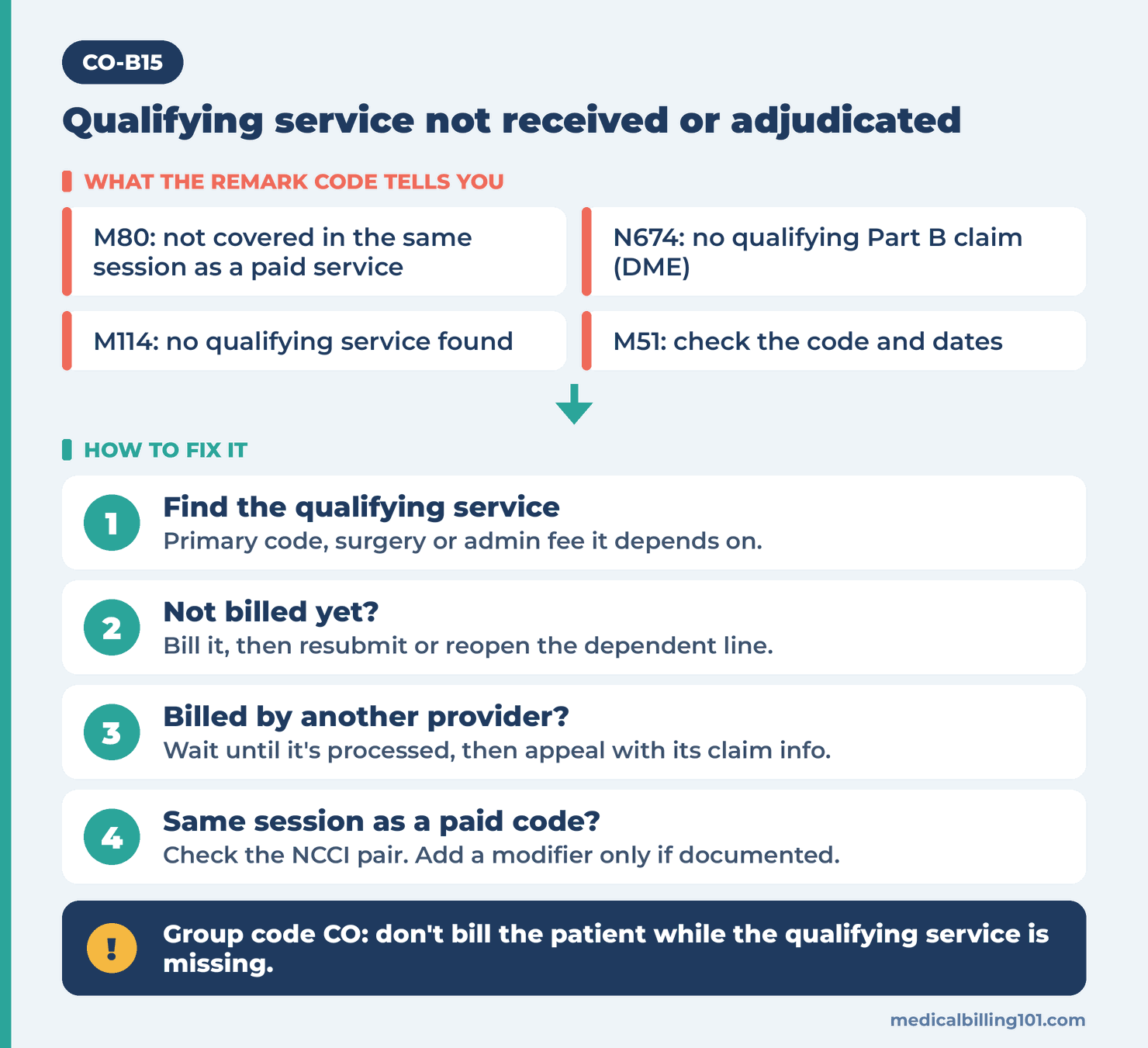
- Read the remark code and the policy reference. M80, N674, M114 and M51 each point to a different prerequisite.
- Find the qualifying service in claim history. Check the same patient, date and rendering provider. Novitas’s advice for B15/M80 is to “Review all of the services billed on the date of service for the rendering physician.”
- If it was never billed, bill it. If the qualifying service was done and documented, submit it. If it wasn’t done, the dependent line usually can’t be paid.
- If it’s billed but pending, wait for it to pay. Noridian’s June 2023 JA DME bulletin puts it simply: “Ensure Part B practitioner claim has processed and paid prior to appealing.”
- If it was denied, fix that denial first. The dependent line follows the qualifying line. Work the root denial, then reopen or appeal the B15 line.
- Check the pair against NCCI. Novitas also says to “Review the NCCI PTP Coding edits” and “Determine if a modifier is appropriate with the code pair.” Use a modifier only when the documentation supports it. Our CO-236 guide explains modifier indicators.
- Fix dates and narratives, then resubmit or appeal. For Medicare, a corrected line or a reopening handles clerical errors. Redeterminations are due within 120 days of receiving the initial determination (CMS). See our Medicare appeals guide.
Medicare and major payer notes
Medicare Part B. CO-B15 with M80 was one of Noridian JE Part B’s top five denials for October to December 2025. Novitas JL lists the same pair at #12 for July to September 2026, with the fix: review every service billed that day for the rendering physician, check the NCCI PTP edits, and decide whether a modifier fits the code pair.
Add-on codes. When an add-on code arrives without its primary code, Noridian’s guidance uses CO-107, not B15. Both share the same fix: confirm the primary code was billed and paid, and bill the add-on with it.
Medicare DMEPOS. Noridian JA DME publishes three B15 pairings. With N674 or M114, “There was not a Part B practitioner claim on file with the same date of service as this claim for DME item” for a brace from a non-contract practitioner. The claim “must have same date of service (DOS) as surgery,” or a narrative such as “Brace associated with surgery DOS 05/01/2023” in Item 19 or the 2400 NTE segment. Practitioners “must append KV modifier” in these cases. With M51, the usual causes are an “Administration fee billed with no drug billed within required time frame” or a bad “from” date.
Commercial and Medicaid plans. Payers use B15 for their own pairing rules. The policy ID in loop 2110 REF, or the plan’s payment policy, tells you which service the line depends on. If the remit has no policy reference, call the payer and ask which qualifying service it looked for.
Worked example (illustrative)
An orthopedic practice that isn’t a contract supplier fits an off-the-shelf knee brace, HCPCS L1833, at a post-op visit inside the 90-day global period. The visit isn’t separately billable, so the only line on the claim is the brace, billed with the visit date at $95.00. The DME MAC remit shows:
CAS*CO*B15*95.00withLQ*HE*N674
Reading it: the MAC looked for a Part B practitioner claim on the same date and found none, because the post-op visit is part of the global surgical package.
Fix: following Noridian’s DME guidance, bill the brace with the surgery date of service, or keep the visit date and add a narrative such as “Brace associated with surgery DOS 09/02/2026” in Item 19 or the 2400 NTE segment. Append the KV modifier, and appeal with the records if the claim still denies.
Prevention: add a scrubber rule that flags DME lines with no billable practitioner service on the same date.
CO-B15 reopening or appeal letter template
Use this when the qualifying service was provided and has now been billed and paid, or when the payer failed to link it. Replace the bracketed text.
[Date]
[Payer name] Reopenings / Appeals Unit
[Address or portal reference]

Re: Request to reprocess CO-B15 denial
Patient: [Name]   Member ID: [ID]
Denied claim: [ICN / claim #]   Date of service: [MM/DD/YYYY]
Denied service: [CPT/HCPCS + modifiers]   Billed amount: [$]
Remit codes: CO-B15, [RARC]

The denied service depends on [qualifying service, CPT/HCPCS], which
was performed on [date] by [provider, NPI]. That service was billed on
claim [ICN / claim #] and processed on [date] (copy enclosed).
[If applicable: The date of service on the denied line has been
corrected to [date] to match the qualifying service.]

Enclosed: both remittance advices, claim copies, [operative note /
visit note / order]. Please reprocess the denied line for payment.

[Name, credentials]  [Practice, NPI]  [Phone / email]
If the qualifying service was never done, don’t appeal. The dependent line usually can’t be paid on its own.
CO-B15 prevention checklist
- Map which of your services depend on another service, and keep the list in your scrubber.
- Bill dependent lines on the same claim as their qualifying service whenever the payer allows it.
- Hold dependent claims from a second provider until the qualifying claim pays, if your workflow can.
- Check NCCI PTP edits for every same-day pair before the claim goes out.
- For DME from a practitioner’s office, match the date of service to the billable visit or surgery, and add the narrative and KV when they apply.
- Read the loop 2110 REF policy ID on every B15 and keep a log by payer.
- Track CO-B15 apart from CO-107 and CO-97 in your denial reports.
Related denial codes
- CO-236: an NCCI procedure-to-procedure edit stopped the code pair.
- CO-97: the service is bundled into another one already paid.
- M51: missing, incomplete or invalid procedure code.
- CO-107: the related or qualifying service wasn’t identified on this claim.
- CO-B20: “Procedure/service was partially or fully furnished by another provider.”
FAQ
What is the CO B15 denial code description?
X12 describes CARC B15 as a service that “requires that a qualifying service/procedure be received and covered,” adding that the qualifying service “has not been received/adjudicated.” With CO, the provider carries the amount.
What does denial code B15 mean in medical billing?
It means the payer won’t pay the line until a related qualifying service is on file and covered. The partner service might be missing, still in process, denied, or billed under a date or provider the payer couldn’t match.
How do I fix a CO B15 denial?
Find the qualifying service in claim history. Bill it if it’s missing, wait for it to pay if it’s pending, or fix its denial first. Then correct any date or narrative problem and resubmit, reopen or appeal the dependent line.
What is the difference between CO-B15 and CO-107?
Both involve a related service. CO-107 says the related service “was not identified on this claim,” and Noridian uses it for add-on codes without their primary code. CO-B15 says the qualifying service hasn’t been received or covered at all.
What does B15 with M80 mean?
M80 means “Not covered when performed during the same session/date as a previously processed service for the patient.” Novitas tells providers to review every service billed that day, check the NCCI PTP edits and decide whether a modifier fits.
Can I bill the patient for CO-B15?
No. CO means the provider absorbs it under the contract. Fix the qualifying service or the claim data, and the payer can then reprocess the line.
Sources
- X12, Claim Adjustment Reason Codes (CARC B15, 107, 97, 236, B20). CARC B15 Start 01/01/1995, Last Modified 07/01/2017. Accessed 6 Oct 2026.
- X12, Remittance Advice Remark Codes (M80, N674, M114, M51). Accessed 6 Oct 2026.
- Noridian JE Part B, Top Denials and Solutions, Q4 2025 (last updated Mar 9, 2026)
- Novitas Solutions JL, Top Claim Denials, July to September 2026
- Noridian JE Part B, Related or Qualifying Claim/Service Not Identified on Claim (CO-107)
- Noridian JA DME, Reason Code B15 | Remark Code N674
- Noridian JA DME, Reason Code B15 | Remark Code M114
- Noridian JA DME, Reason Code B15 | Remark Code M51
- Noridian JA DME Happenings, June 2023 (B15/M114 resolution)
- CMS, Transmittal 13701 (Medicare Claims Processing Manual, Ch. 23, §20.9), June 16, 2026
- CMS, Medicare Claims Processing Manual (IOM 100-04), Ch. 22, §60.1 Group Codes
- CMS, First Level of Appeal: Redetermination by a Medicare Contractor
Last reviewed: 6 October 2026 · This page is educational and doesn’t replace payer-specific instructions.