
CPT codes are five-character codes from the American Medical Association’s Current Procedural Terminology code set, meaning a standard shorthand that providers put on claims to report the services and procedures they performed.
On a claim, the diagnosis code says why the patient was seen. The CPT code says what was done. This guide covers who owns CPT, how codes are built, the four code types, update timing and denials.
Key Takeaways – The AMA maintains CPT, and an independent CPT Editorial Panel decides what goes in it. – CMS treats CPT as HCPCS Level I, and HIPAA names it a national code set for physician and other health care services. – Every CPT code has five characters. Category I codes are numeric; Category II, III and PLA codes end in a letter. – Most changes take effect on January 1, but some categories are released during the year. – A CPT code says what was done. It does not guarantee coverage or payment.
How this guide was checked: every quote below comes from the AMA, CMS or the HIPAA code-set rule, linked where it is used. The guide does not reproduce any CPT code descriptor, because the AMA holds the copyright. Last reviewed: 3 October 2026.
The official definition
The AMA maintains the code set and defines it this way: “The Current Procedural Terminology (CPT®) code set is a listing of terms and five-digit codes that primarily describe medical services and procedures performed by physicians and other qualified health care professionals.”
The AMA adds that the codes “now describe algorithm or AI-enabled services, and services provided by clinical staff and other care team providers.” It is used nationwide “to report procedures, tests and evaluation and management (E/M) services under public and private health insurance programs.”
Where CPT fits: HCPCS Level I and HIPAA
CMS treats CPT as the first level of the Healthcare Common Procedure Coding System (HCPCS). On its HCPCS page, CMS splits HCPCS into two main subsystems, Level I and Level II:
| HCPCS Level I | HCPCS Level II | |
|---|---|---|
| What it is | CPT | A separate national code set |
| Who maintains it | The AMA | CMS |
| CMS description | “Comprised of Current Procedural Terminology (CPT®), a numeric coding system maintained by the American Medical Association (AMA).” | “used primarily to identify products, supplies, and services not included in the CPT® codes, such as ambulance services or durable medical equipment” |
| Code format | Five characters | “a single alphabetical letter followed by 4 numeric digits” |
So if a claim line carries a code made of a letter and four digits, it is a HCPCS Level II code, not CPT. Codes on a claim line may also carry modifiers that add detail, such as the GY modifier on Medicare claims.
CPT is also a legal standard. Under HIPAA, 45 CFR 162.1002 adopts “Current Procedural Terminology, Fourth Edition (CPT-4), as maintained and distributed by the American Medical Association,” together with HCPCS. The rule applies it “for physician services and other health care services.” That is why commercial payers, Medicaid and Medicare all expect CPT codes on electronic professional claims.
How a CPT code is structured
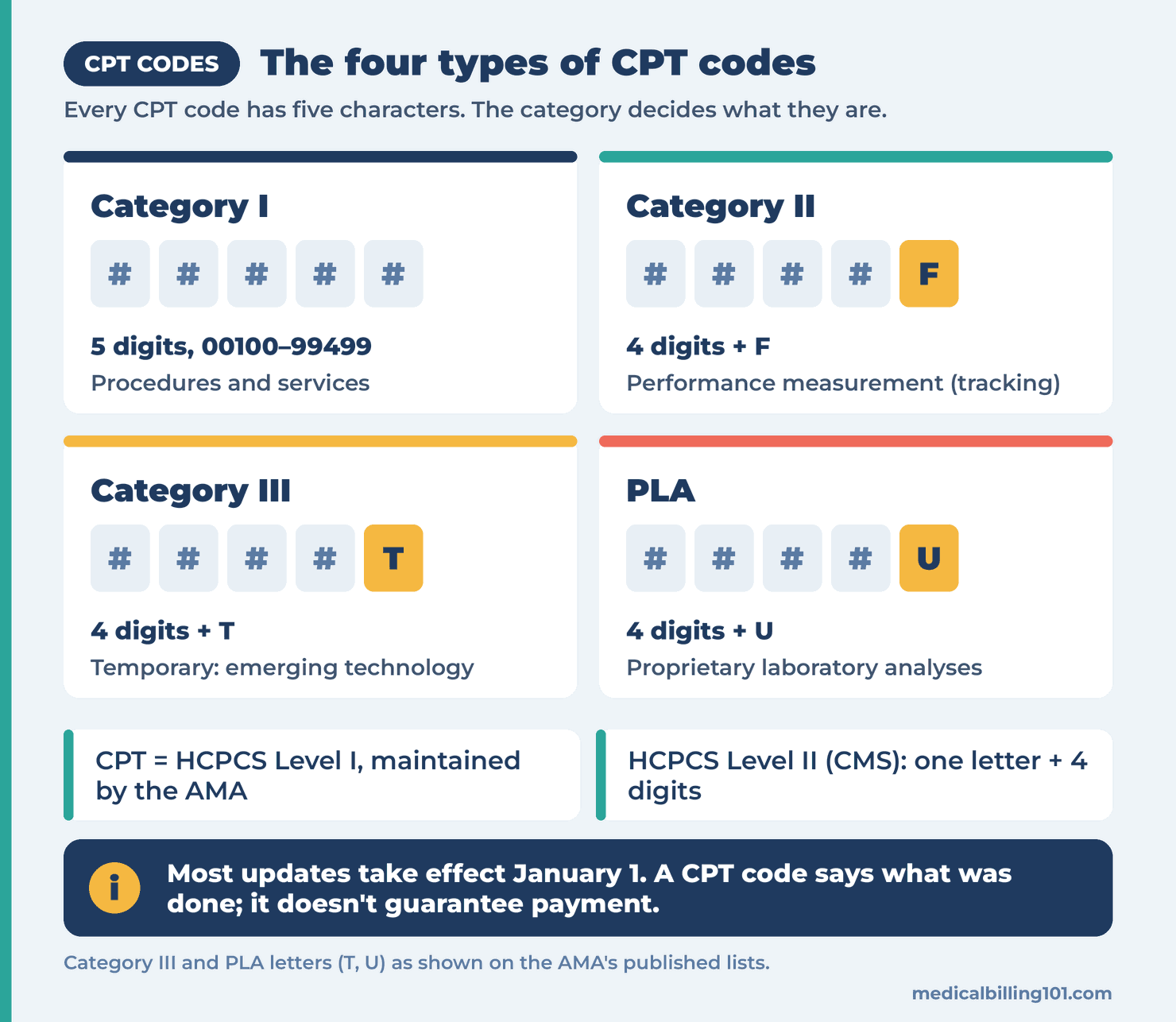
Every CPT code is five characters long. The category decides what those characters are. The AMA says: “All CPT codes are five-digits and can be either numeric or alphanumeric, depending on the category.”
| Type | Format | What it’s for |
|---|---|---|
| Category I | Five digits, in the range 00100–99499 | Procedures and services |
| Category II | Four digits followed by the letter F | Performance measurement (tracking) |
| Category III | Four digits followed by a letter (T on the AMA’s published list) | Temporary codes for emerging technology and services |
| PLA | Four digits followed by a letter (U on the AMA’s published list) | Proprietary laboratory analyses |
CMS describes CPT codes as “5 numeric digits.” That fits the main Category I codes. The alphanumeric categories are still CPT codes.
The code number itself does not explain the service. Each code has a descriptor, the official wording of what it covers. Guidelines and instructions then decide when it applies. That descriptor text is what the AMA licenses.
The four types of CPT codes
Category I: the main procedure and service codes
These are the codes most people mean when they say “CPT code.” According to the AMA, Category I codes “have descriptors that correspond to a procedure or service. Codes range from 00100–99499 and are generally ordered into sub-categories based on procedure/service type and anatomy.”
A service does not get a Category I code just because it exists. The AMA’s code criteria set the bar. Any devices and drugs the service needs must have FDA clearance or approval where required. The service must be “performed by many physicians or other qualified healthcare professionals across the United States.” It must be “consistent with current medical practice,” and its clinical efficacy must be documented in the literature.
When no specific code describes a service, coders may need an unlisted code. The AMA’s general criteria refer to “unlisted codes” as part of the code set. Unlisted codes need extra documentation. See when to use unlisted CPT codes without getting audited.
Category II: performance measurement codes
The AMA describes Category II codes as “alphanumeric tracking codes” that “are supplemental codes used for performance measurement.” They are “intended to facilitate data collection on the quality of care rendered by coding certain services and test results that support nationally established performance measures.”
The AMA’s Category II page sets out the format. These codes “make use of an alphabetical character as the 5th character in the string (i.e., 4 digits followed by the letter F).”
In practice, Category II codes report quality data rather than describe a billable service on their own. Each payer’s quality program decides how it handles them, so check its rules.
Category III: temporary codes for emerging technology
Category III codes “are temporary alphanumeric codes for new and developing technology, procedures and services,” the AMA says. They let clinicians, insurers and researchers “identify emerging technology, services, procedures, and service paradigms for clinical efficacy, utilization and outcomes.”
The bar is lower than for Category I. The procedure must be “currently or recently performed in humans.” It must also meet one more criterion, such as support from a CPT Advisor, peer-reviewed literature or an approved study protocol. On the AMA’s current Category III list, every code ends in the letter T.
A Category III code does not mean a payer will cover the service. If you are choosing between a Category III code and an unlisted Category I code, see our comparison of Category III CPT codes vs. unlisted codes.
PLA codes: proprietary laboratory analyses
Proprietary Laboratory Analyses (PLA) codes “describe proprietary clinical laboratory analyses and can be either provided by a single (‘solesource’) laboratory or licensed or marketed to multiple providing laboratories.” The AMA’s PLA page says they have “an alphanumeric structure to expand the code number capacity in the CPT code set and to distinguish these codes from other CPT codes.” The PLA codes shown on the AMA’s site end in the letter U.
PLA codes “are not required to fulfill Category I CPT code criteria,” and “Tests that have a physician work component do not meet eligibility for a PLA code.”
Who maintains CPT codes?
The AMA owns the code set, and an independent panel decides what goes in it. The AMA describes the CPT Editorial Panel as “an independent group of clinical expert volunteers appointed by the AMA Board of Trustees” that “is responsible for maintaining and updating the CPT code set.”
CPT Advisors give the Panel clinical input. They are “nominated by the national medical specialty societies represented in the AMA House of Delegates and the AMA Health Care Professionals Advisory Committee (HCPAC).”
Anyone can ask for a change through a formal code change application. The AMA’s code process page lists “Medical specialty societies, physicians and other qualified health care professionals, hospitals, laboratories, medical device and technology companies, payers, and other interested parties” as possible requesters. The Panel “meets three times each year,” and anyone can register to attend.
One point matters a lot for billers. Per the AMA, “The Panel does not consider payment or coverage policy as part of this process.” A CPT code tells the payer what was done. Each payer, such as Medicare under its fee schedules and coverage rules, decides separately whether to cover it and how much to pay.
How often CPT codes are updated
CPT changes on a set yearly cycle, with a few faster tracks:
- Annual update. CMS says “The AMA annually republishes and updates CPT® codes.” According to the AMA, “Most changes are incorporated into the annual CPT code set and become effective on Jan. 1, with code books released in advance to support implementation.”
- Faster schedules for some categories. The AMA says “Category I immunization codes, Category III codes, Proprietary Laboratory Analyses (PLA) codes and Administrative Multianalyte Assays With Algorithmic Analyses Codes (MAAA) codes, follow alternative release schedules.”
- Category III codes come out in a “triannual electronic release” on the AMA website, each with a later effective date.
- New immunization product codes follow an early release schedule of “April 1, July 1 and Oct. 1 in a given CPT cycle.”
- PLA codes “are released and posted online on a quarterly basis,” and “New codes are effective in the quarter following their publication.”
Practical takeaway: load the new CPT files into your PM system and claim scrubber before January 1 each year. If you bill vaccines, emerging technology or proprietary lab tests, also watch the AMA’s early release pages during the year. A deleted code, or a new code billed before its effective date, invites rejections and denials.
CPT codes and claim denials
Many denials trace back to the CPT code on the claim line. Common patterns include:
- Bundling edits. CMS’s NCCI procedure-to-procedure edits pair codes that should not usually be billed together. See denial code CO-97.
- Global periods. A surgery’s global package includes some related services. See our global surgical package guide.
- Non-covered services. A valid CPT code can still be non-covered under the patient’s plan. See CO-96.
- Diagnosis mismatch. The ICD-10-CM code must support medical necessity for the service. See medical necessity documentation.
When a remittance advice explains a CPT-related denial, the group code and reason code tell you where to start. Our denial codes hub covers the common ones. For the full claim cycle, read What is medical billing?
Using CPT codes legally
CPT is a registered trademark of the AMA. The AMA’s licensing FAQ states: “CPT is copyrighted by the AMA and as such must be licensed to be used in electronic products or other forms.” It adds that “Organizations license CPT content from the AMA directly or through a vendor.” If you are unsure whether your use is covered, ask your software vendor.
For questions about how to apply a CPT code, CMS points people to the AMA. For “Billing or coding issues,” CMS says to “Contact the insurer(s) in the jurisdiction(s) where you’ll file the claim.” For Medicare, that means your Medicare Administrative Contractor (MAC).
Frequently asked questions
What are CPT codes in simple terms? They are standard five-character codes that describe what a provider did, such as a visit, test or procedure. Insurers use them to process the claim.
Who creates CPT codes? The American Medical Association maintains the code set. The CPT Editorial Panel, an independent group of clinical expert volunteers appointed by the AMA Board of Trustees, decides on changes. Anyone can submit a code change application.
What are the categories of CPT codes? There are four types. Category I covers procedures and services (00100–99499). Category II holds performance measurement codes ending in F. Category III holds temporary codes for emerging technology. PLA codes cover proprietary laboratory analyses.
How often are CPT codes updated? Most changes take effect on January 1 each year. Category III, PLA, immunization product and administrative MAAA codes follow faster release schedules during the year.
Are CPT codes the same as HCPCS codes? CPT is HCPCS Level I. HCPCS Level II is a separate CMS code set for supplies, equipment and services not in CPT.
Does having a CPT code guarantee payment? No. The CPT Editorial Panel “does not consider payment or coverage policy.” Each payer decides coverage and payment separately.
What is the difference between CPT and ICD-10 codes? CPT codes describe the service performed. ICD-10-CM codes describe the diagnosis, the reason for the service. Claims need both.
Sources
- AMA, CPT® code set overview
- AMA, The CPT® code process
- AMA, Criteria for CPT® codes
- AMA, Category I codes
- AMA, Category II codes
- AMA, Category III codes
- AMA, CPT® PLA codes
- AMA, CPT® licensing FAQs
- CMS, Healthcare Common Procedure Coding System (HCPCS)
- CMS, HCPCS Level I & II contacts
- 45 CFR 162.1002, Medical data code sets

Manikandan is a Revenue Cycle Management (RCM) specialist with over 10 years of hands-on experience in US healthcare billing. He has worked extensively with commercial payers, Medicare, and Medicaid across multiple specialties including surgery, orthopedics, and radiology. Manikandan founded Medical Billing 101 to provide free, accurate denial code guides, CPT coding references, and Medicare billing resources for US medical billing professionals.
2 thoughts on “What Are CPT Codes? Categories, Structure and How They’re Updated”
Comments are closed.