

Medical billing is the process of turning a patient visit into a paid claim, meaning the provider’s services and diagnoses are coded, sent to the insurer in a standard format, tracked, and matched against what the insurer pays.
Medical billing looks like one task, but it is a chain of steps. A mistake early on, such as a wrong insurance ID at check-in, often shows up weeks later as a denial. This guide walks through each step, the forms and code sets behind it, and where it breaks.
Key Takeaways – Medical billing turns coded care into a claim, follows it through payment, and bills the patient for their share. – HIPAA sets the code sets (ICD-10-CM, CPT and HCPCS) and the electronic formats (X12 837 claims, X12 835 remittances). – Medicare generally requires electronic claims, filed within 12 months of the date of service. – Every payment or denial comes back with group codes, reason codes and remark codes that explain the result.
How this guide was checked: every rule quoted below links to its official source, mostly CMS (the Centers for Medicare & Medicaid Services) and the HIPAA rules in 45 CFR Part 162. Last reviewed: 3 October 2026.
Medical billing vs. medical coding
The two jobs overlap, but they are not the same:
- Medical coding turns the clinical record into standard codes. Diagnoses become ICD-10-CM codes. Procedures and services become CPT and HCPCS codes. Our companion guide, What are CPT codes?, explains CPT in detail.
- Medical billing adds the patient, provider and insurance details to those codes. The biller builds the claim, sends it and follows it until it is paid or closed. Then the biller collects any balance the patient owes.
In a small practice one person may do both. Either way, a coding error becomes a billing problem as soon as the claim is denied.
Why medical billing uses standard codes and formats
The US health system runs on standard claims. CMS puts the scale plainly on its HCPCS page: “Each year in the U.S., health care insurers process over 5 billion claims for payment. Standardized coding systems are essential so Medicare and other health insurance programs can process claims in an orderly and consistent manner.”
HIPAA turned that standard into law for electronic transactions. Under 45 CFR 162.1002, HHS adopted specific code sets as “the standard medical data code sets.” For services on or after October 1, 2015, the list includes:
- ICD-10-CM for diagnoses;
- ICD-10-PCS for hospital inpatient procedures;
- HCPCS and CPT together “for physician services and other health care services.”
CMS adds on its ICD-10 page that ICD-10 “applies to all parties covered by the Health Insurance Portability and Accountability Act (HIPAA), not just providers who bill Medicare or Medicaid.”
HIPAA also sets the format of the electronic messages. The table lists the ones a billing team uses most. The X12 numbers are the names you will see in clearinghouse and practice management (PM) software.
| Step | HIPAA standard transaction | Regulation |
|---|---|---|
| Check insurance eligibility | X12 270/271 Health Care Eligibility Benefit Inquiry and Response | 45 CFR 162.1202 |
| Request prior authorization or referral | X12 278 (referral certification and authorization) | 45 CFR 162.1302 |
| Send the claim | X12 837 Health Care Claim: Professional, Institutional or Dental | 45 CFR 162.1102 |
| Check claim status | X12 276/277 Health Care Claim Status Request and Response | 45 CFR 162.1402 |
| Receive payment and remittance details | X12 835 Health Care Claim Payment/Advice | 45 CFR 162.1602 |
These transactions name each provider by its National Provider Identifier. Under 45 CFR 162.406, “The NPI is a 10-position numeric identifier, with a check digit in the 10th position, and no intelligence about the health care provider in the number.”
The medical billing process, step by step
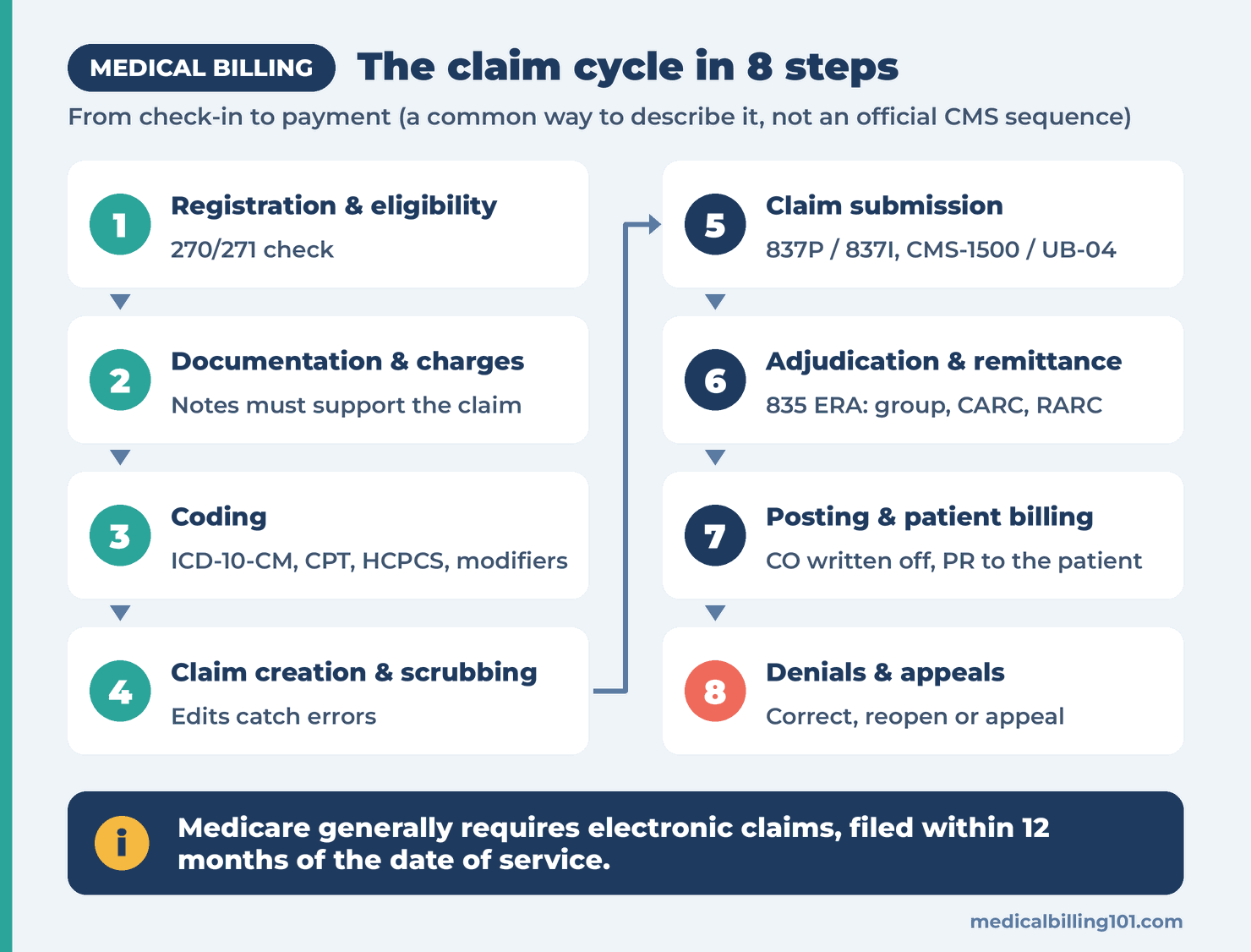
Organizations name these stages differently. The order below is a common way to describe the cycle, not an official CMS sequence.
1. Patient registration and insurance verification
Billing starts before the visit. The front desk records the patient’s details and insurance. The practice then checks eligibility and benefits, often with an electronic 270 inquiry and the payer’s 271 response. This is also when the team spots services that need prior authorization. Our prior authorization checklist for surgical procedures covers that step.
2. Documentation and charge capture
After the visit, the clinician records what was done and why. Billing can only claim what the record supports. Payers expect the record to show medical necessity, the subject of our guide to medical necessity documentation.
3. Coding
Coders assign:
- ICD-10-CM diagnosis codes, which explain why the service was needed. CDC and CMS update ICD-10-CM each year. CMS says the current files apply “for patient encounters occurring from October 1, 2026 – September 30, 2027.”
- CPT codes (HCPCS Level I) for procedures and services. The American Medical Association (AMA) maintains them.
- HCPCS Level II codes for items and services that CPT does not cover. CMS describes them as “a single alphabetical letter followed by 4 numeric digits.” They cover things like “ambulance services or durable medical equipment, prosthetics, orthotics, and supplies (DMEPOS) when used outside a physician’s office.”
- Modifiers, where needed, to add detail to a procedure code.
4. Claim creation and scrubbing
The billing system combines codes, charges, patient, provider and payer data into a claim. Many teams then run automated edits, often called claim scrubbing. These edits catch missing data and coding conflicts such as NCCI procedure-to-procedure edits. Our clearinghouse NCCI scrubbing setup guide shows how to turn them on.
5. Claim submission
There are two main claim types. Each has an electronic and a paper version:
| Claim type | Who uses it | Electronic standard | Paper form |
|---|---|---|---|
| Professional | Physicians, other practitioners, suppliers | X12 837 Professional (837P) | Form CMS-1500 |
| Institutional | Hospitals and other facilities | X12 837 Institutional (837I) | Form CMS-1450 (UB-04) |
Chapter 26 of the Medicare Claims Processing Manual says “The ASC X12N 837 professional is the standard to be used for transmitting health care claims electronically.” It adds that the CMS-1500 “is maintained by the National Uniform Claim Committee (NUCC), an industry organization in which CMS participates.” Chapter 25 says the CMS-1450 is “also known as the UB-04, is a uniform institutional provider bill suitable for use in billing multiple third party payers.”
For Medicare, electronic is the default. Chapter 24 states that the Administrative Simplification Compliance Act (ASCA) and 42 CFR 424.32 “require that all initial claims for reimbursement under Medicare, except from small providers, be submitted electronically as of October 16, 2003, with limited exceptions.” For physicians and suppliers, a “small provider” means “a physician, practitioner, facility or supplier that is not otherwise a provider under section 1861(u) with fewer than 10 FTEs.” On paper claims, small details matter, such as what goes in Box 19 of the CMS-1500.
Deadlines apply too. For Medicare fee-for-service, Chapter 1 §70 says claims “must be filed to the appropriate Medicare claims processing contractor no later than 12 months, or 1 calendar year, after the date the services were furnished.” Section 70.7 lists the exceptions. Each commercial contract or state Medicaid program sets its own deadline, so check the payer’s rules.
6. Adjudication and the remittance advice
The payer checks the claim against eligibility, coverage, coding edits and contract terms. Then it decides what to pay. The answer comes back as a remittance advice: an X12 835 electronic remittance advice (ERA) or a paper version. Chapter 22 describes the Medicare Remittance Advice (RA) as a notice sent “as a companion to claim payments.” It says “RAs explain the payment and any adjustment(s) made during claim adjudication.”
Three kinds of codes explain each adjustment on the RA:
- Group codes say who is responsible for the adjusted amount. CO (Contractual Obligations) adjustments “are considered a write off for the provider and are not billed to the patient.” PR (Patient Responsibility) is “an amount that may be billed to the patient or insured.”
- Claim Adjustment Reason Codes (CARCs) say why the amount changed. CMS notes that “These codes were developed for use by all U.S. health payers.”
- Remittance Advice Remark Codes (RARCs) add detail to the reason.
A group code plus a CARC gives you the familiar “denial codes,” such as CO-16 or PR-1. Our denial codes hub explains the common ones in plain English, with the official X12 wording.
7. Payment posting and patient billing
The team posts payments and adjustments from the 835 to the patient account. Contractual write-offs (group code CO) come off the balance. Patient-responsibility amounts (group code PR) go to the patient or to a secondary insurer. Secondary billing has its own rules. Our guide to billing Medicare as secondary payer works through one case.
8. Denial management and appeals
Not every claim pays on the first pass. For each denial, the team reads the group code, CARC and RARC and fixes what it can. Then it picks a path: a corrected claim, a reopening or an appeal. Our corrected claim resubmission guide covers the first route.
For Original Medicare, CMS says on its appeals page that “There are five levels in the Medicare Part A and Part B appeals process.” The first is “Redetermination by a Medicare Administrative Contractor (MAC).” The appellant “has 120 days from the date of receipt of the initial claim determination to file a redetermination request.” Each commercial plan sets its own appeal steps and deadlines.
Where medical billing usually goes wrong
These problems map to the cycle above. The list is not ranked by how often each one happens.
- Front-end data errors. Wrong patient or insurance details lead to rejections and eligibility denials.
- Missing authorization. A service needed prior authorization, but none was on file.
- Coding conflicts. Examples include procedure pairs that NCCI edits bundle and services inside a global surgical period. Our global surgical package guide explains the periods.
- Documentation gaps. The record does not support the code billed or medical necessity.
- Missed deadlines. The claim or appeal went in after the payer’s limit.
- Compliance risk. Billing patterns that draw audits. See our list of OIG audit triggers.
Key medical billing terms
- Clearinghouse: a company that receives claims from providers, checks and formats them, and forwards them to payers. It also returns payer responses.
- EOB: explanation of benefits, the patient’s statement from a commercial plan. Medicare’s version for patients is the Medicare Summary Notice (MSN).
- Revenue cycle management (RCM): all the financial steps around patient care, from scheduling to a zero balance. Medical billing is a large part of it.
Frequently asked questions
What is medical billing in simple terms? It is how a provider gets paid. The services in the record become a coded claim. The claim goes to the insurer in a standard format. The team follows up until it is paid, then bills the patient for their share.
What is the difference between medical billing and medical coding? Coding turns the clinical record into standard codes: ICD-10-CM for diagnoses, CPT and HCPCS for services. Billing uses those codes to build and send claims, post payments, work denials and collect patient balances.
What form is used for medical billing? Professional services use the X12 837P or the paper CMS-1500. Facilities use the X12 837I or the paper CMS-1450 (UB-04). Medicare requires electronic claims unless an ASCA exception applies.
How long do providers have to submit a Medicare claim? For Medicare fee-for-service, claims generally must be filed “no later than 12 months, or 1 calendar year, after the date the services were furnished,” according to CMS’s Claims Processing Manual, Chapter 1 §70. Section 70.7 lists exceptions. Other payers set their own limits.
What is a remittance advice? It is the payer’s explanation of a claim’s payment and each adjustment. A group code, a CARC and often a RARC explain every adjustment. Electronic versions use the X12 835 standard.
What are denial codes? “Denial codes” usually means the group code plus Claim Adjustment Reason Code on a remittance advice, for example CO-16 or PR-2. They explain why a claim or line was not paid in full. The denial codes hub linked above covers the common ones.
Sources
- CMS, Healthcare Common Procedure Coding System (HCPCS)
- CMS, ICD-10 codes
- 45 CFR 162.1002, Medical data code sets
- 45 CFR 162.406, National Provider Identifier
- 45 CFR Part 162 transaction standards (162.1102 claims, 162.1202 eligibility, 162.1302 authorization, 162.1402 claim status, 162.1602 remittance advice)
- CMS Medicare Claims Processing Manual, Chapter 1 (§70 timely filing)
- CMS Medicare Claims Processing Manual, Chapter 22 (remittance advice, group codes, CARCs)
- CMS Medicare Claims Processing Manual, Chapter 24 (ASCA electronic claims, small providers)
- CMS Medicare Claims Processing Manual, Chapter 25 (Form CMS-1450 / UB-04)
- CMS Medicare Claims Processing Manual, Chapter 26 (Form CMS-1500 and 837P)
- CMS, Medicare Fee-for-Service appeals
- CMS, First level of appeal: redetermination by a Medicare contractor
- X12, Claim Adjustment Reason Codes

Manikandan is a Revenue Cycle Management (RCM) specialist with over 10 years of hands-on experience in US healthcare billing. He has worked extensively with commercial payers, Medicare, and Medicaid across multiple specialties including surgery, orthopedics, and radiology. Manikandan founded Medical Billing 101 to provide free, accurate denial code guides, CPT coding references, and Medicare billing resources for US medical billing professionals.
2 thoughts on “What Is Medical Billing? A Plain-English Guide to the Claim Cycle”
Comments are closed.