

The CO-280 denial code means the medical plan received the claim, but the benefit sits under the patient’s pharmacy plan. The service is not denied as unneeded. It went to the wrong benefit. The fix is to send the drug through the pharmacy benefit, usually as a pharmacy claim, and stop billing it on medical claims for that plan. (Primary source: X12 Claim Adjustment Reason Codes)
In brief: CARC 280 tells you to submit to the pharmacy plan yourself. The plan did not forward the claim. If it had, X12 says to use CARC 292 instead. Self-injected drugs, such as many biologic pens, are the most common trigger.
Part of our denial codes library. Written by Manikandan J, CPC, CRCR, who has sorted medical versus pharmacy benefit denials for rheumatology and infusion clinics. Published 10 November 2026. Last updated: 10 November 2026. Code wording quoted word for word from X12. Read about the author and our editorial policy, or contact us to report an error.
What does denial code CO-280 mean?
Denial code CO-280 means the medical plan will not pay because the item belongs to the pharmacy benefit. Many plans split drugs this way. Drugs given by staff in the office stay medical, and drugs patients take on their own go to pharmacy. CO keeps the denied amount off the patient.
| Field | Value |
|---|---|
| Code | 280 |
| Description | “Claim received by the medical plan, but benefits not available under this plan. Submit these services to the patient’s Pharmacy plan for further consideration.” |
| X12 note | Use CARC 292 if the claim was forwarded. |
| Start | 03/01/2017 |
| Last modified | 11/01/2017 |
Source: X12 Claim Adjustment Reason Codes, checked 10 November 2026.
Key terms: The medical benefit pays services and drugs billed on medical claims. The pharmacy benefit pays drugs dispensed by a pharmacy, often run by a pharmacy benefit manager. CO means contractual obligation, so the provider cannot bill the patient for this line.
Methodology: the code wording is copied from the X12 list, and the Medicare drug rule comes from the CMS manual cited below.
CO-280 vs OA-280: what is the difference?
CO-280 means your contract with the medical plan puts the denied line on you until you bill the right benefit. OA-280 means the same routing problem without a contract claim, for example from a plan you are not contracted with. In both cases the answer is the pharmacy plan, not the patient.
| Version | What the plan says | Your next step |
|---|---|---|
| CO-280 | Contracted plan: this belongs to pharmacy, and you cannot bill the member | Bill the pharmacy benefit; write off the medical line |
| OA-280 | Same routing, no contract basis stated | Bill the pharmacy benefit; check your payer agreement |
Why do medical plans send drugs to the pharmacy plan?
Medical plans send drugs to the pharmacy plan when the drug is usually self-administered. For example, an injectable pen the patient uses at home is a pharmacy item under many plans. Medicare Part B also excludes most drugs that are usually self-administered (CMS Benefit Policy Manual, chapter 15, section 50.2).
Commercial plans publish their own lists. A drug can be medical for one plan and pharmacy for another. So check the member’s plan, not only the drug.
Example scenario (fictional names), part 1
CO-280 Denial Example: What Happened
Grace Okafor bills for Summit Rheumatology Associates. Dr. Leon Marsh started a patient with rheumatoid arthritis, M05.79 (entered as M0579), on adalimumab. The nurse taught the first self-injection in the office with a pen from clinic stock.
- Billed to a fictional commercial plan: J0135 (adalimumab, 20 mg), 2 units, plus 96372.
- 835 result:
CAS*CO*280on the J0135 line. - Remark: N426, “No coverage when self-administered.”
The clinic had paid for the pen out of its own stock.
Can Grace recover the drug cost, and from whom? Keep reading, or jump to how it was resolved. Keep reading, or jump to how the CO-280 denial was resolved.
How do I fix a CO-280 denial?
To fix a CO-280 denial, send the drug to the patient’s pharmacy benefit and stop sending it on medical claims for that plan. Check the member’s pharmacy card and the plan’s medical versus pharmacy drug list. A clinic that is not an enrolled pharmacy usually cannot bill the pharmacy plan itself.
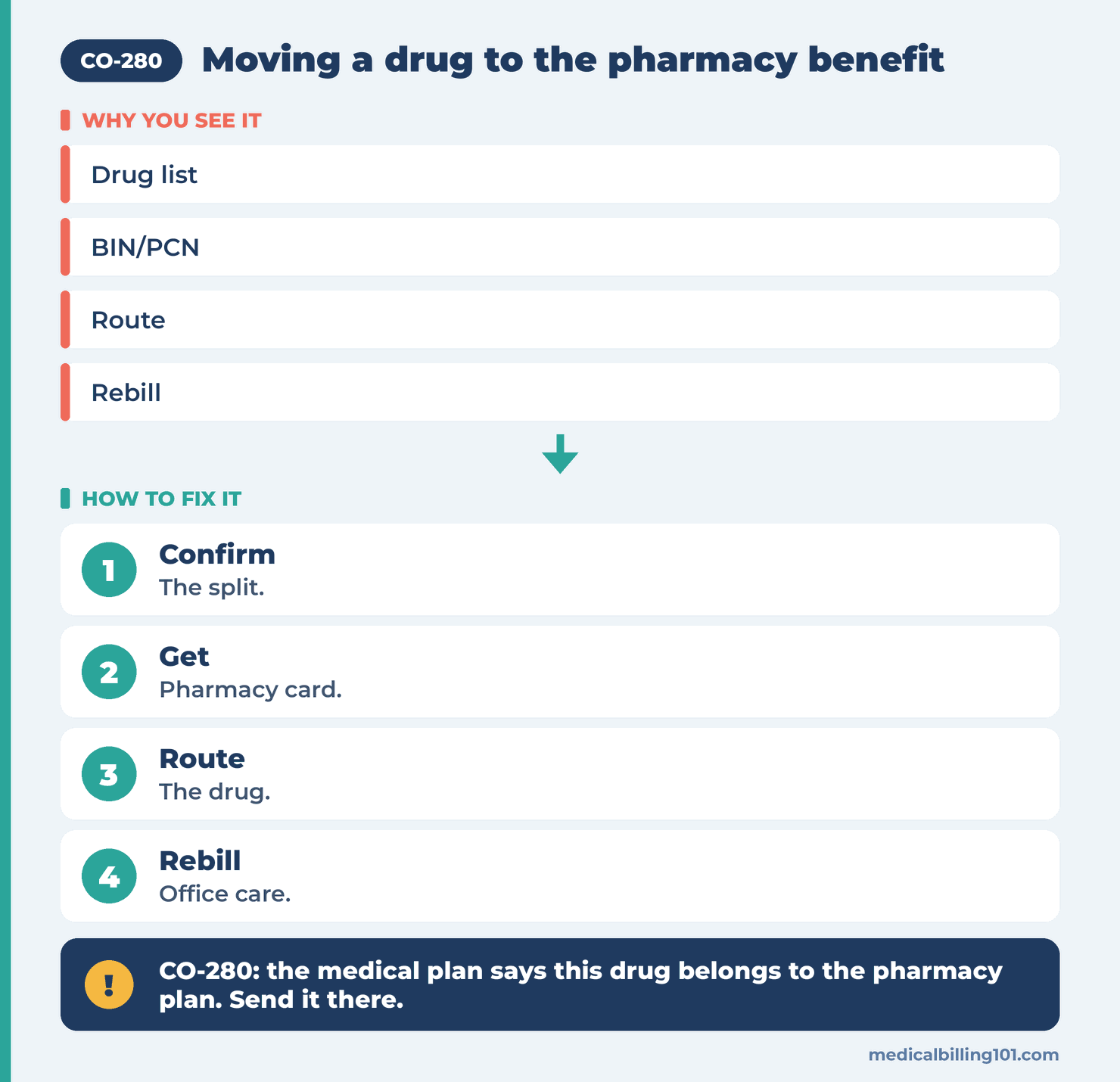
- Confirm the benefit split. Read the plan’s drug list for medical versus pharmacy.
- Get the pharmacy details. Collect the member’s pharmacy plan card and its BIN and PCN numbers.
- Route the drug. Send the prescription to a network specialty pharmacy, or bill through your own enrolled pharmacy.
- Rebill what stays medical. Office services, such as injection training, may still pay on the medical claim.
- Update your rules. Flag the drug and plan so future doses go to pharmacy first.
Claim form note
No claim form visual is shown here. The fix for CO-280 is a change of benefit, sent on an NCPDP pharmacy claim. No CMS-1500 box or UB-04 form locator gets corrected for the drug line.
Example scenario (fictional names), part 2
How the CO-280 Denial Was Resolved
Grace checked the plan’s drug list. Adalimumab pens were pharmacy only for this plan. The clinic owned an enrolled specialty pharmacy, so she had a path.
Fix: the clinic pharmacy billed the starter pen on an NCPDP claim to the member’s pharmacy benefit, with the prescription on file. Grace wrote off the medical J0135 line, as CO required, and kept the 96372 line on the medical claim.
Outcome: the pharmacy plan paid the pen less the member’s copay. Grace set a scheduling rule to send future starter doses to the pharmacy benefit first.
Names and details are illustrative; no real patient data.
Names and details are illustrative; no real patient data.
Can I bill the patient for a CO-280 denial?
No, you cannot bill the patient for a CO-280 line. CO means the contract with the medical plan keeps that amount off the member. The patient may owe a pharmacy copay once the pharmacy plan processes the drug. That copay comes from the pharmacy claim, not this denial.
Is CO-280 the same as CO-292?
No. CO-280 and CO-292 both point to the pharmacy plan, but who sends the claim differs. With CARC 280 you must submit it yourself. With CARC 292 the medical plan says it already forwarded the claim. Check pharmacy status before you resubmit a CARC 292 claim.
Related codes
| Code | Meaning |
|---|---|
| CO-270 | Submit to the patient’s dental plan instead |
| CO-254 | Dental plan claim, submit to the medical plan |
| CO-96 | Non-covered charge |
FAQ
What does CO-280 mean?
The medical plan says the drug or service belongs to the patient’s pharmacy plan.
Did the plan forward my claim to the pharmacy plan?
No. CARC 280 means you submit it. CARC 292 is used when the claim was forwarded.
Which drugs trigger CO-280 most often?
Self-administered drugs, such as biologic pens patients inject at home.
Can a clinic bill the pharmacy plan directly?
Only if it is an enrolled pharmacy. Otherwise send the prescription to a network pharmacy.
Can the office visit still be paid?
Often yes. Services such as injection training can stay on the medical claim.
Sources
How we checked: the CARC 280 quote and note were matched word for word with the X12 CARC list on 10 November 2026, and N426 with the X12 RARC list.
- X12, Claim Adjustment Reason Codes (CARC 280, 292). Accessed 10 Nov 2026.
- X12, Remittance Advice Remark Codes (N426). Accessed 10 Nov 2026.
- CMS, Medicare Benefit Policy Manual, chapter 15 (section 50.2, self-administered drugs). Accessed 10 Nov 2026.
- X12, Claim Adjustment Group Codes. Accessed 10 Nov 2026.
Last updated: 10 November 2026 · Educational content; not legal advice.