
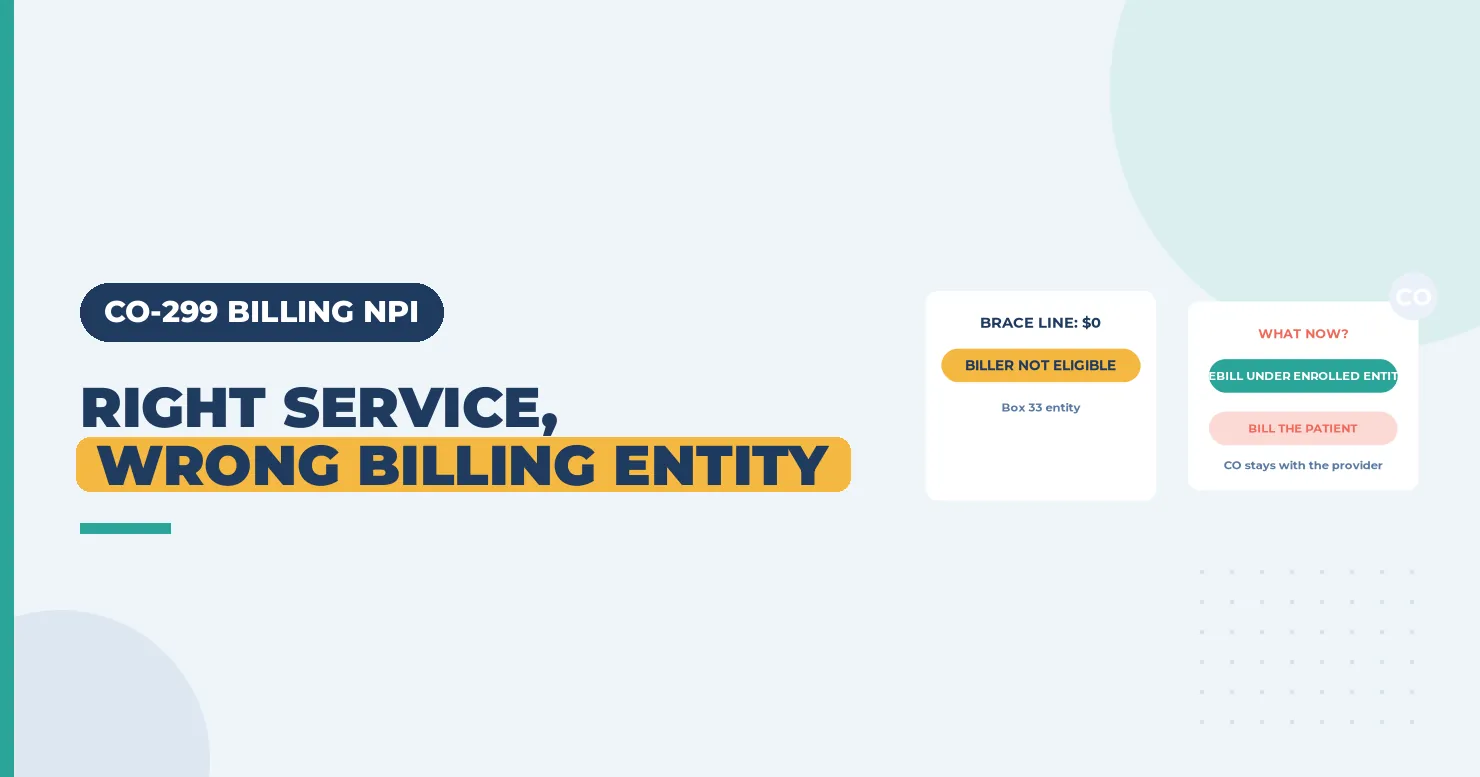
The CO-299 denial code means the billing provider on your claim is not eligible to receive payment for the service billed. The care may be covered, but not when this entity bills it. Find out which enrolled entity the plan will pay, then rebill under that billing provider. (Primary source: X12 Claim Adjustment Reason Codes)
In brief: CARC 299 is about the billing provider in Box 33 or FL 1 and FL 56. It is not about the doctor who performed the service. That is CARC 185. Fix the enrollment or the billing entity, and do not bill the patient.
Part of our denial codes library. Written by Manikandan J, CPC, CRCR, who has untangled billing-entity and enrollment denials for orthopedic groups and hospital outpatient departments. Published 15 November 2026. Last updated: 15 November 2026. Code wording quoted word for word from X12. Read about the author and our editorial policy, or contact us to report an error.
What does denial code CO-299 mean?
Denial code CO-299 means the plan will not pay this billing entity for this kind of service. Reason code 299 looks at the organization or person named as the billing provider. Its enrollment, contract or provider type does not include the billed service.
| Field | Value |
|---|---|
| Code | 299 |
| Description | “The billing provider is not eligible to receive payment for the service billed.” |
| Group codes | No X12 group restriction; CO is the common choice |
| Start | 07/01/2019 |
| Compare | CARC 185 covers the rendering provider instead |
Source: X12 Claim Adjustment Reason Codes, checked 15 November 2026.
Methodology: the code wording is copied from the X12 list, and the claim form steps follow the NUCC instructions cited below.
Key terms: The billing provider is the entity that receives payment, shown in Box 33. A taxonomy code describes the provider type, such as a medical supply company. CO is the contractual obligation group code.
CO-299 vs OA-299: what is the difference?
CO-299 assigns the unpaid amount to the provider under its contract. The provider adjusts it unless the claim is rebilled correctly. OA-299 reports the same eligibility problem but names no owner for the balance. In practice, you research both the same way, starting with enrollment.
| Version | Balance owner | Typical cause |
|---|---|---|
| CO-299 | Provider, per contract | Wrong billing entity for a contracted service |
| OA-299 | Not stated | Enrollment or eligibility gap reported without liability |
Why is my billing provider not eligible?
A billing provider fails CARC 299 when its enrollment does not cover the service. For example, a physician group may bill braces that the plan pays only to an enrolled supplier. A hospital may bill therapy under its main NPI when the plan credentialed a separate unit. Expired or pending enrollment causes the same result.
Each entity has its own NPI in NPPES, and plans enroll that NPI for specific services. The NUCC taxonomy list shows the provider types that plans check, such as 332B00000X for medical supply companies.
Example scenario (fictional names), part 1
CO-299 Denial Example: What Happened
Marisol Grant bills for Northline Orthopedic Group. The practice also owns Northline Bracing, a supply company with its own NPI and plan contract.
Dr. Kenji Watts fitted a right knee brace for a patient with knee instability. Marisol billed 99213 and L1833-RT with M2351 under the orthopedic group’s NPI in Box 33.
The fictional commercial plan paid 99213. The 835 showed CAS*CO*299 on the brace line, with remark code N761. That remark reads “This provider is not authorized to receive payment for the service(s).”
Which entity should have billed the brace? Keep reading, or jump to how it was resolved. Keep reading, or jump to how the CO-299 denial was resolved.
How do I fix a CO-299 denial?
To fix a CO-299 denial, bill the service under an entity the plan will pay. Check the provider contract and the enrollment record for the billing NPI. If another owned entity holds the right contract, send a new claim under it. If no entity is enrolled, start enrollment before rebilling.
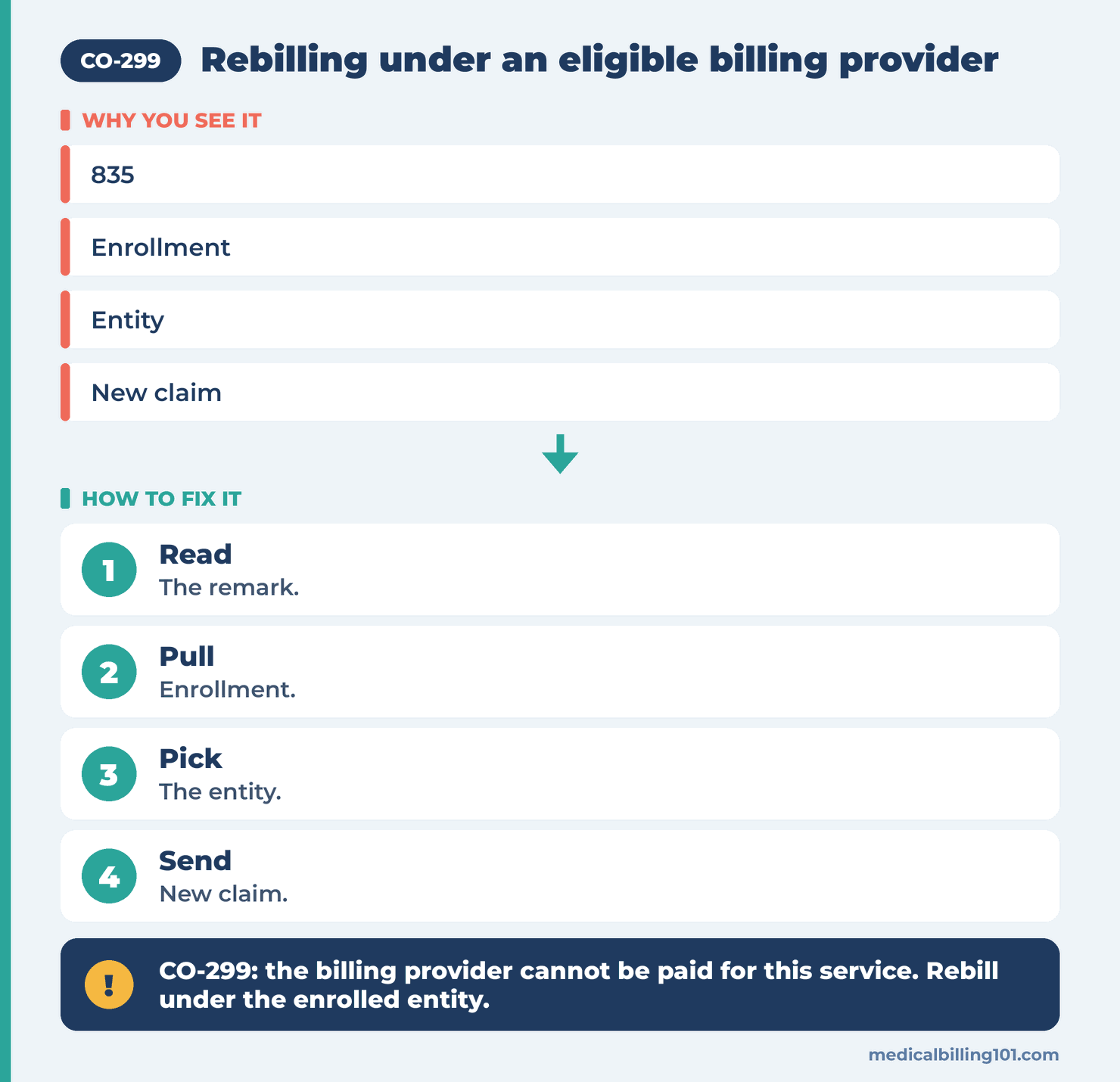
Work it in this order:
- Read the remark code on the 835 and note the denied lines.
- Pull the plan’s enrollment record for the billing NPI and its taxonomy.
- Pick the entity contracted for the service, or start enrollment.
- Send a new claim with that entity in Box 33, 33a and 33b.
- Add a scrubber rule for the service type and the billing NPI.
Example scenario (fictional names), part 2
How the CO-299 Denial Was Resolved
Marisol checked the plan’s provider portal. The orthopedic group was contracted for office visits and surgery, not supplies. Northline Bracing held the supply contract.
Fix: she sent a new claim for L1833-RT under Northline Bracing. Box 33 named the supply company, Box 33a carried its NPI, and Box 33b carried ZZ with taxonomy 332B00000X. The diagnosis and the order from Dr. Watts stayed the same.
Outcome: the plan paid the brace to Northline Bracing. Marisol now routes every brace code to the supply company before claims go out.
Names and details are illustrative; no real patient data.
Names and details are illustrative; no real patient data.
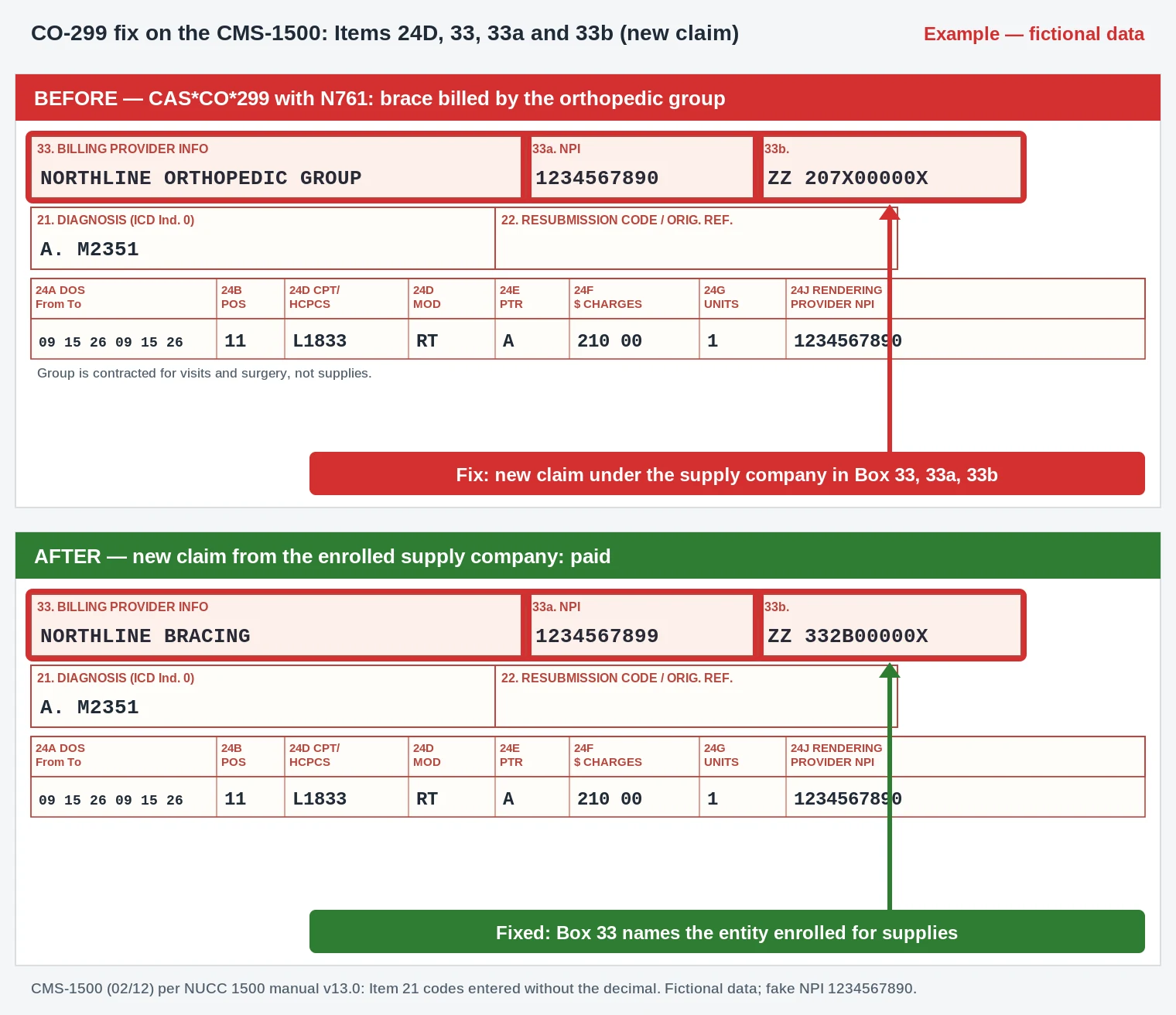
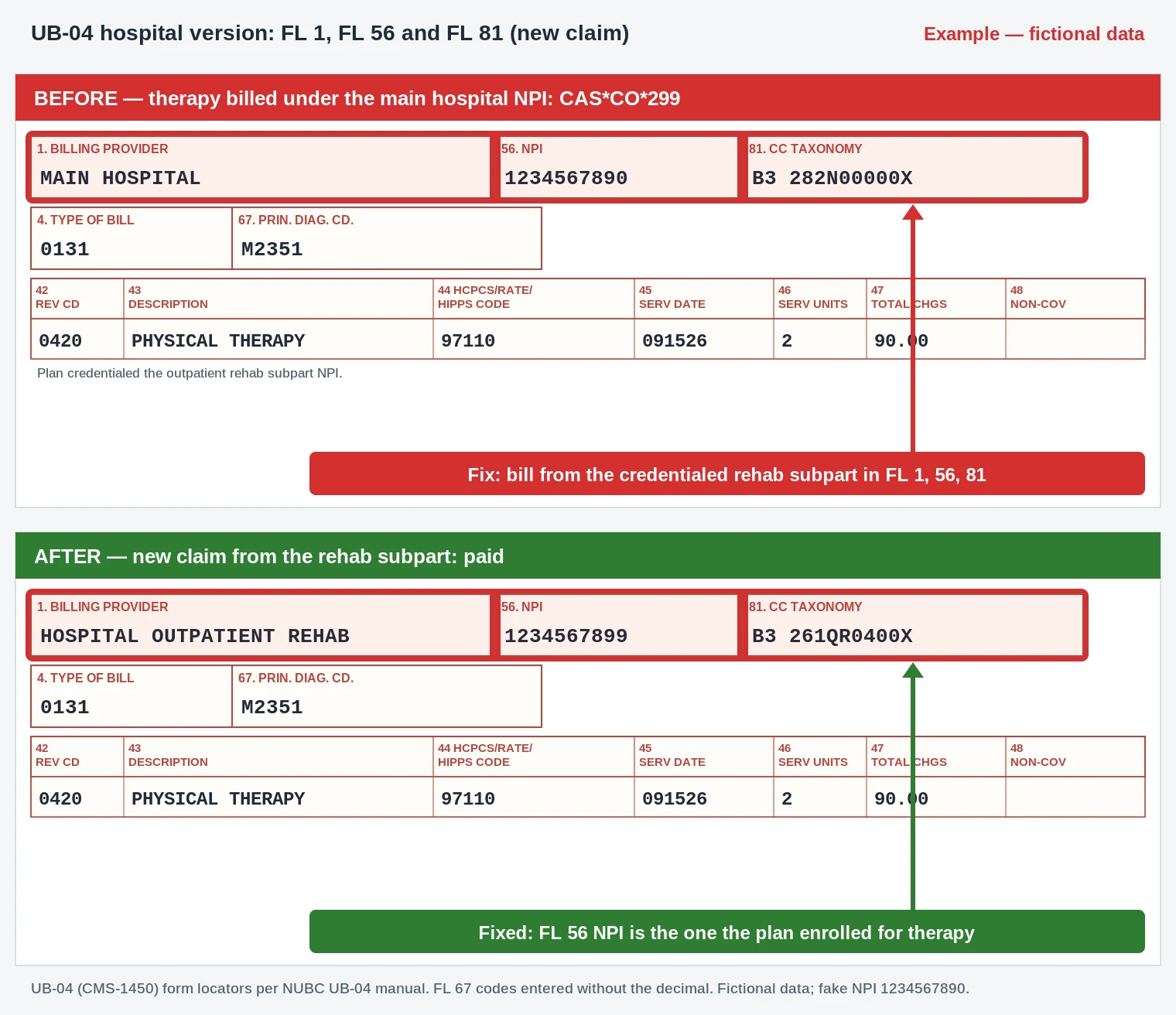
- Box 33 / FL 1: the billing provider changed to the entity the plan enrolled for the service (the supply company; the rehab subpart on the UB-04).
- Box 33a / FL 56: that entity’s own NPI replaced the group or main hospital NPI.
- Box 33b / FL 81: taxonomy with qualifier ZZ (CMS-1500) or B3 (UB-04) now matches the enrolled provider type.
- Box 22: left blank; a change of billing provider goes on a new claim. L1833-RT and M23.51 (entered as M2351) are unchanged.
Can I bill the patient for CO-299?
No. A CO-299 balance comes from the provider side, so the contract keeps it off the patient. Fix the billing entity or the enrollment instead. The NUCC 1500 instructions explain Box 33, 33a and 33b.
Is CO-299 the same as CO-185 or CO-B7?
No. CO-299 targets the billing provider. CO-185 targets the rendering provider, who performed the service. CO-B7 says the provider was not certified for the service on that date. Read the remark code to see which entity the plan flagged. Medicare’s enrollment pages explain how suppliers enroll separately.
Related codes
| Code | Meaning |
|---|---|
| CO-185 | Rendering provider not eligible to perform the service |
| CO-B7 | Provider not certified or eligible for this service on this date |
| CO-170 | Payment denied when performed or billed by this type of provider |
| CO-8 | Procedure code inconsistent with the provider type or specialty |
FAQ
What does CO-299 mean?
The billing provider on the claim cannot be paid for the billed service.
Is CO-299 about the doctor who did the service?
No. It is about the billing entity. CARC 185 covers the rendering provider.
Can I send a corrected claim with a new billing NPI?
Most plans want a new claim under the right billing provider. Check the plan’s rules first.
Which group code comes with CARC 299?
X12 sets no restriction. CO is common, because the contract governs eligibility.
Does the patient owe a CO-299 amount?
No. It is a provider-side issue, so fix the billing entity instead.
Sources
How we checked: the CARC 299 quote was matched word for word with the X12 CARC list on 15 November 2026, and N761 with the X12 RARC list.
- X12, Claim Adjustment Reason Codes (CARC 299, 185, B7). Accessed 15 Nov 2026.
- X12, Remittance Advice Remark Codes (N761). Accessed 15 Nov 2026.
- NUCC, 1500 claim form instructions. Accessed 15 Nov 2026.
- NUCC, health care provider taxonomy. Accessed 15 Nov 2026.
- CMS, NPPES NPI registry. Accessed 15 Nov 2026.
- CMS, Medicare enrollment for providers and suppliers. Accessed 15 Nov 2026.
Last updated: 15 November 2026 · Educational content; not legal advice.