
The CO-P19 denial code means the code you billed has a relative value of zero in the jurisdiction fee schedule, so the payer owes nothing for it. It typically affects workers’ compensation and automobile claims for bundled supplies, special reports and similar miscellaneous codes. Sometimes the zero is correct; other times a more specific procedure code exists that the schedule actually reimburses. (Primary source: X12 Claim Adjustment Reason Codes)
In brief: reason code P19 is a pricing result, not a coverage decision. Look up the code’s value in the schedule the payer uses. If it is truly zero and bundled, write it off. If a specific HCPCS code describes the item, such as a brace, bill that code instead within the filing rules.
Part of our denial codes library. Written by Manikandan J, CPC, CRCR, who has cleaned up supply and report coding for urgent care and occupational health clients and has audited comp remits for zero-paid lines. Published 24 November 2026. Last updated: 24 November 2026. Code wording quoted word for word from X12. Read about the author and our editorial policy, or contact us to report an error.
What does denial code CO-P19 mean?
Denial code CO-P19 tells you the payer looked up your code in the jurisdiction fee schedule and found a relative value of zero. Because reimbursement equals the relative value multiplied by the conversion factor, a zero value always produces a zero payment. X12 limits the code to property and casualty claims, which covers workers’ comp and auto.
| Field | Value |
|---|---|
| Code | P19 |
| Description | “Procedure has a relative value of zero in the jurisdiction fee schedule, therefore no payment is due. To be used for Property and Casualty only.” |
| Use | Property and Casualty only |
| Group codes | No X12 group restriction; CO is the usual pairing |
| Start | 11/01/2013; replaces code W8 |
| Common remark | N448 or N56 |
Source: X12 Claim Adjustment Reason Codes, checked 24 November 2026.
Methodology: the code wording is copied from the X12 list. Code values were checked in the 2026 Medicare relative value file, because many state comp schedules are built on it.
Key terms: A relative value unit (RVU) is the number a fee schedule uses to set a code’s price. A bundled code is one whose payment is included in another service. A conversion factor is the dollar amount each RVU is worth.
CO-P19 vs OA-P19: who takes the zero?
With CO-P19, the provider absorbs the line, and comp rules bar billing the worker for it. OA-P19 is rare. It may appear when a secondary payer passes on the first payer’s zero pricing without assigning the amount. In both cases, ask the same question: was the code right for the item or service?
| Group | Who absorbs it | Your next step |
|---|---|---|
| CO-P19 | Your practice | Check whether a specific code exists |
| OA-P19 | Not assigned | Read the first payer’s remit first |
Example scenario (fictional names), part 1
CO-P19 Denial Example: What Happened
Darnell Hughes bills for Peachtree Ridge Urgent Care in Macon, Georgia. A warehouse packer sprained his right wrist at work, S63.501A. Dr. Simone Clarke examined him, billed 99203, and fitted an off-the-shelf cock-up wrist brace from clinic stock. The brace went on the claim as supply code 99070.
The visit paid. The brace line came back with CAS*CO*P19 and remark N448, “This drug/service/supply is not included in the fee schedule or contracted/legislated fee arrangement.” The payment was zero.
Was the brace really unpaid by the schedule, or was it billed under the wrong code? Keep reading, or jump to how the CO-P19 denial was resolved.
Which codes usually get CARC P19?
Codes with zero value are mostly bundled supplies, administrative reports and incidental materials. In the 2026 Medicare file, for example, these all show status B and zero RVUs.
| Code | What it is | Medicare 2026 status |
|---|---|---|
| 99070 | Supplies and materials beyond those usually included | B, zero RVUs |
| 99071 | Patient education materials | B, zero RVUs |
| 99080 | Special reports or forms | B, zero RVUs |
You can check any code in the CMS PFS relative value files. Status B means the payment is bundled into other services. A state may still pay some of these by its own rule, such as a state report fee, so check your state’s schedule too.
How do I fix a CO-P19 denial?
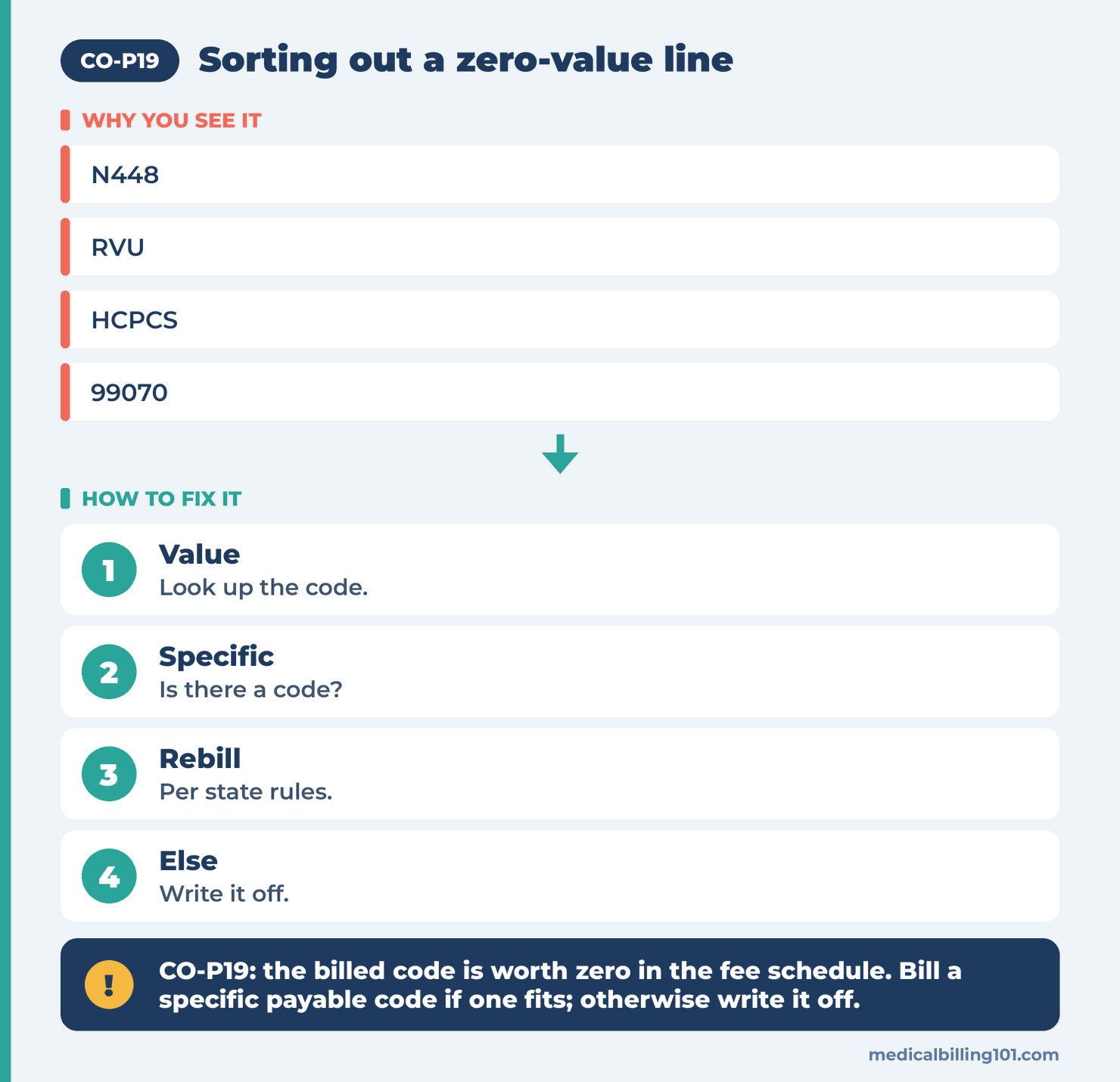
To fix a CO-P19 denial, first determine whether a specific, separately payable code accurately describes the item or service you provided. If it does, bill that code; if it does not, the zero valuation is correct and the line becomes a contractual write-off.
| Step | Action | Where to check |
|---|---|---|
| 1 | Look up the code’s value | The schedule the payer uses for that date |
| 2 | Ask if a specific code exists | HCPCS Level II for supplies, braces and devices |
| 3 | Code the item from the chart | Brand, type and side from the note or invoice |
| 4 | Follow your state’s rebill rule | Corrected bill or reconsideration |
| 5 | If no code fits, write it off | Stop billing the zero-value code |
| 6 | Fix the charge master | So the next brace bills right |
Watch the state rule in step 4. In Texas, for example, 28 TAC 133.250 says a reconsideration must use the same billing codes as the original bill. A code change there needs a new, timely bill rather than a reconsideration.
Example scenario (fictional names), part 2
How the CO-P19 Denial Was Resolved
Darnell checked the chart and the supply invoice. The brace was a prefabricated, off-the-shelf wrist hand orthosis with a cock-up design. That item has its own HCPCS code, L3908, which the carrier’s schedule prices. The clinic’s charge master still mapped every brace to 99070.
Fix: he sent a corrected claim with L3908 and modifier RT in Box 24D in place of 99070, code 7 and the original claim number in Box 22, and the brace invoice.
Outcome: the carrier paid the brace at its schedule rate. Darnell then mapped each brace in stock to its own HCPCS code.
Names and details are illustrative; no real patient data.
Names and details are illustrative; no real patient data.
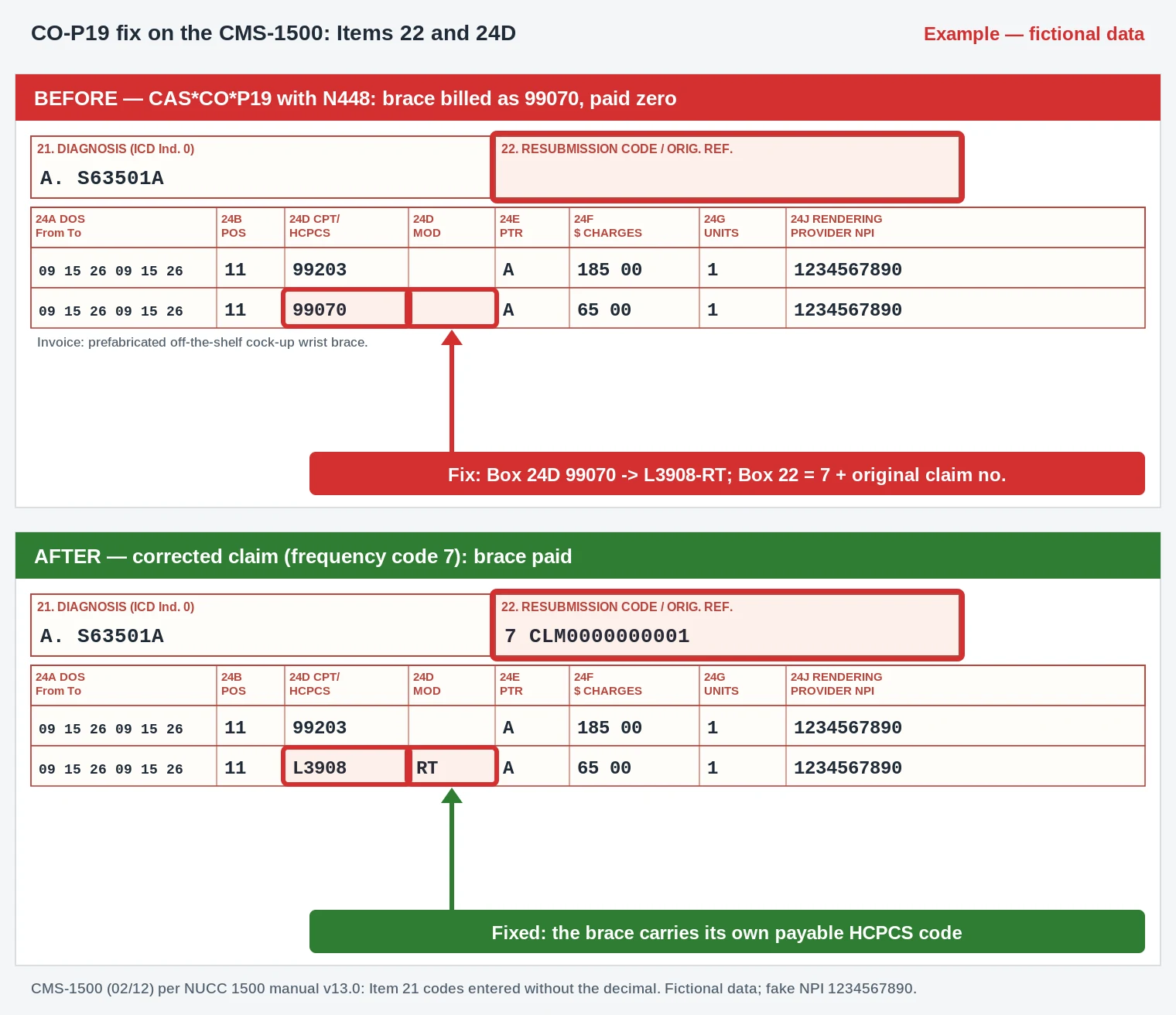
- Box 24D: 99070, a bundled supply code with zero relative value, replaced with L3908 (prefabricated off-the-shelf cock-up wrist hand orthosis) and modifier RT for the right side.
- Box 22: frequency code 7 with the original claim number; the brace invoice goes with the claim.
- Box 21 / visit line: S63.501A (entered as S63501A) and 99203 are unchanged.
- UB-04: not shown; the urgent care is a physician office that bills on the CMS-1500.
Can I bill the worker for a P19 line?
No. A CO-P19 line is the provider’s loss, and workers’ compensation rules generally prohibit billing the injured employee. If the code was accurate and the value is zero, reimbursement for the item is considered part of another service. The solution is more precise coding next time, not a statement to the patient.
Related codes
| Code | Meaning |
|---|---|
| CO-P18 | Code not in the schedule; paid as a comparable service |
| CO-P7 | Billed code is not in the fee schedule; resubmit with a listed code |
| CO-P12 | Line priced at the state comp fee schedule rate |
| CO-P9 | No CPT or HCPCS code matches the billed service |
| CO-P14 | Service bundled into another P&C service the same day |
FAQ
What does CO-P19 mean?
The billed code has a relative value of zero in the state fee schedule, so the payer pays nothing for that line.
Is CARC P19 the same as CARC 97?
No. CARC 97 says the benefit is included in the payment for another service already decided. P19 says the schedule itself values the code at zero.
Can I appeal a P19 denial?
Only if the payer used the wrong schedule or a wrong value. If the code truly has zero value, an appeal will not change the result.
Should I stop billing 99070?
Bill a specific HCPCS code when one describes the supply, such as a brace or splint. Keep 99070 only where no specific code fits and the payer asks for it.
What code did CARC P19 replace?
X12 lists P19 as the replacement for deactivated code W8 from 11/01/2013.
Sources
How we checked: the CARC P19 quote was matched word for word with the X12 CARC list on 24 November 2026. N448 and N56 were checked on the X12 RARC list. Status and RVUs for 99070, 99071 and 99080 come from the CMS 2026 relative value file (October release).
- X12, Claim Adjustment Reason Codes (CARC P19, P18, P7, P12, P9, P14, 97). Accessed 24 Nov 2026.
- X12, Remittance Advice Remark Codes (N448, N56). Accessed 24 Nov 2026.
- CMS, PFS relative value files (2026). Accessed 24 Nov 2026.
- Texas Administrative Code, title 28, section 133.250, reconsideration for payment of medical bills. Accessed 24 Nov 2026.
Last updated: 24 November 2026 · Educational content; not legal advice.