
PR-157 means the plan believes the care was needed because of an act of war. Many health plans exclude war injuries in their documents. Most practices see this code for one reason: an external cause code for war operations lands on a claim for a condition that has nothing to do with the war. Veterans and service members are the patients most often affected. The PR group puts the balance on the patient, so check the coding before anyone gets a bill. (Primary source: X12 Claim Adjustment Reason Codes)
In brief: CARC 157 reads “Service/procedure was provided as a result of an act of war.” Check whether a Y36 (operations of war) code is on the claim. If the condition treated isn’t from the war, remove it with a corrected claim. If it is, look to VA or TRICARE coverage.
Part of our denial codes library. Written by Manikandan J, CPC, CRCR, who has coded and billed visits for veterans seen in community practices. Published 21 October 2026. Last updated: 21 October 2026. Code wording quoted word for word from X12.
Reason code 157 in the X12 list
| Field | X12 text |
|---|---|
| Code | 157 |
| Description | “Service/procedure was provided as a result of an act of war.” |
| Start | 09/30/2003 |
| Last modified | 09/30/2007 |
Source: X12 Claim Adjustment Reason Codes, checked 21 October 2026.
How war codes reach a claim
An external cause code tells the payer how an injury happened, not what the injury is. Category Y36 covers operations of war, including injuries to service members and civilians from war, civil insurrection and peacekeeping. Category Y37 covers peacetime military operations, such as training exercises. Y99.1 is a status code that means the patient was on military duty at the time.
These codes belong on a claim only when the injury being treated came from that event. CMS posts the yearly ICD-10-CM files and guidelines on its ICD-10 codes page.
| How a war code slips in | Example |
|---|---|
| Problem list carried to the claim | Old blast injury listed for a knee visit |
| Sequela code used for a new problem | War code on age-related arthritis |
| Y36 picked instead of Y37 | Training injury coded as war |
| Coding tool suggests codes from history | Every visit gets the same cause code |
Example scenario (fictional names), part 1
PR-157 Denial Example: What Happened
Marcus Bell is a coder at Oakridge Orthopedics. A 58-year-old veteran came in for pain in his right knee, diagnosed as primary osteoarthritis of the right knee (M17.11). The visit was billed as 99214.
Bluehaven Health Plan, a fictional employer plan, denied the visit with CAS*PR*157 and remark LQ*HE*N130, “Consult plan benefit documents/guidelines for information about restrictions for this service.” The claim also carried a Y36 sequela code.
Where did the war code come from, and does the plan’s war exclusion really apply to this knee? Keep reading, or jump to how the PR-157 denial was resolved.
Remark codes you may see with CARC 157
| RARC | X12 wording |
|---|---|
| N130 | “Consult plan benefit documents/guidelines for information about restrictions for this service.” |
| N425 | “Statutorily excluded service(s).” |
| N576 | “Services not related to the specific incident/claim/accident/loss being reported.” |
See the X12 RARC page for others.
How to handle a PR-157 denial
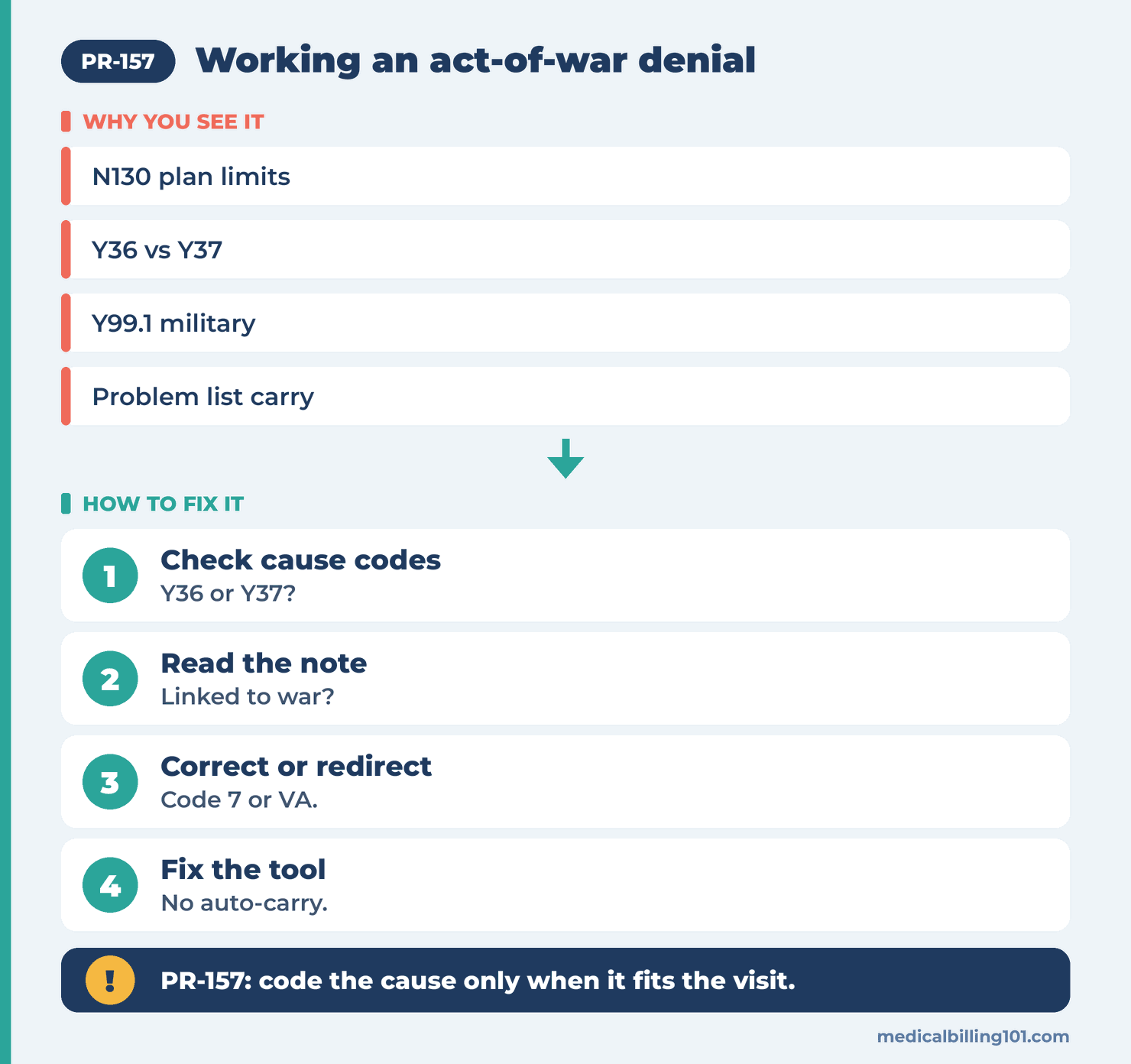
- Look at every diagnosis on the claim. Find any Y36 or Y37 code and see which line it points to.
- Read the note. Does the doctor link the problem treated to a war injury?
- Remove codes that don’t fit. If the condition isn’t from the event, send a corrected claim with frequency code 7.
- Fix Y36 versus Y37 errors. For example, a training injury in peacetime belongs in Y37, not Y36.
- If the war link is real, check other coverage. Service-connected conditions may be covered by VA, and active duty members by TRICARE.
- Ask about VA community care. VA can authorize outside care through its community care program.
- Fix the coding tool. Stop it from carrying history codes onto every visit.
Example scenario (fictional names), part 2
How the PR-157 Denial Was Resolved
Marcus pulled the chart. The patient had a blast injury to his left leg during deployment years ago, and the problem list carried a Y36 sequela code. The coding tool copied it onto every claim. The note said the right knee pain was wear and tear, with no link to the old injury.
Fix: no appeal. Marcus sent a corrected claim, frequency code 7, with M17.11 alone and the Y36 code removed.
Outcome: the plan paid the visit. The practice turned off auto-carry for external cause codes, so coders now add them only when the note ties the visit to the event.
Names and details are illustrative; no real patient data.
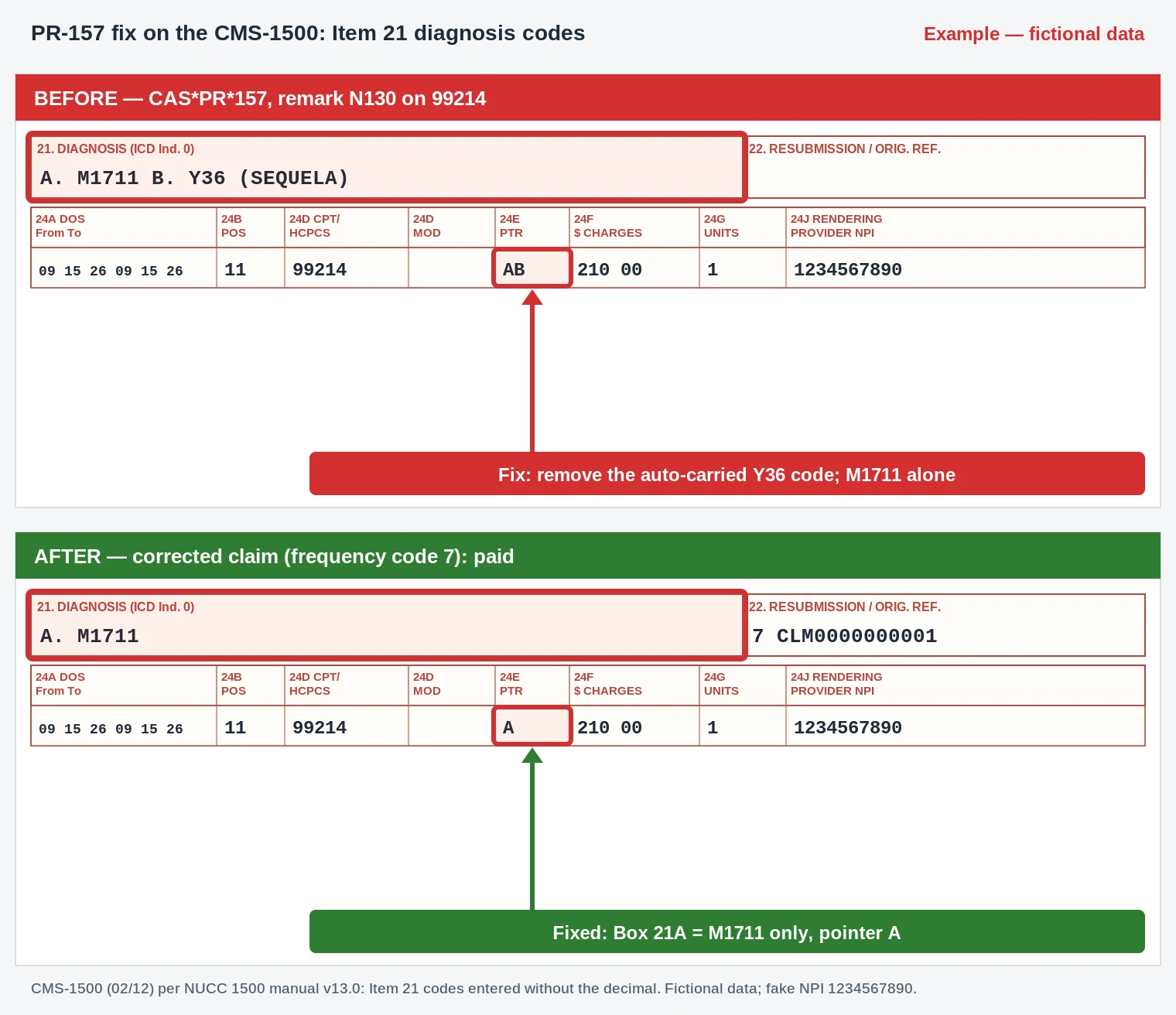
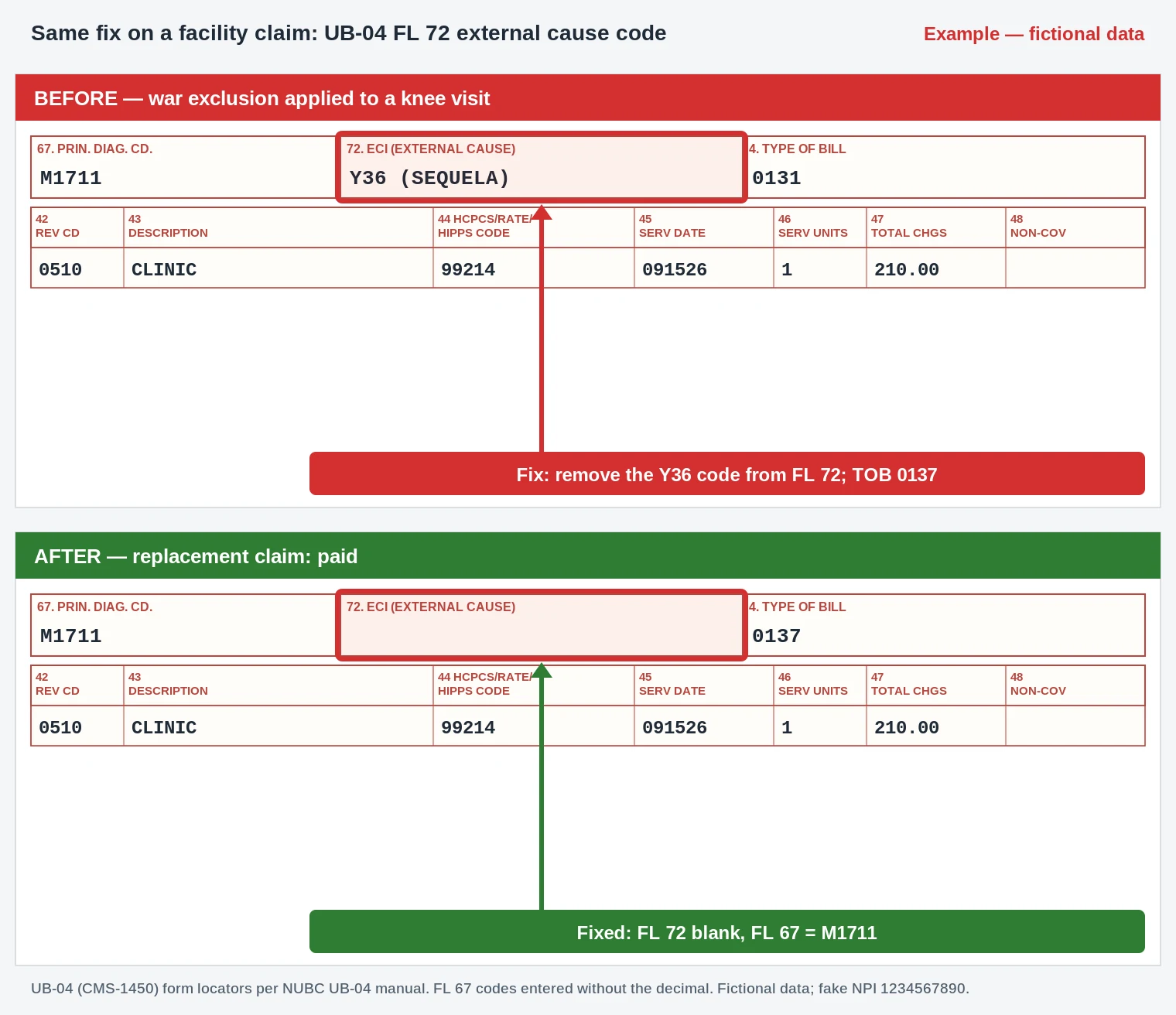
- Box 21B / FL 72: the Y36 sequela code removed. The note ties the knee pain to wear and tear, not the old injury. On the UB-04, external cause codes go in FL 72.
- Box 21A / FL 67: M17.11, entered as M1711, stays alone; Box 24E pointer becomes A.
- Box 22 / FL 4 + FL 64: frequency code 7 with the original claim number (type of bill 0137).
Worked example (illustrative)
Consider a reservist who returns from deployment and sees a local doctor for a shoulder wound from combat. The war code is correct, and the employer plan excludes war injuries. The clinic doesn’t fight the denial. It asks the patient about VA or TRICARE coverage. For later visits, it helps him get a VA community care referral and bills VA under that authorization.
When PR-157 is wrong
| Sign | What to do |
|---|---|
| The condition isn’t from the war | Remove the code with a corrected claim |
| The injury came from peacetime training | Recode with Y37 and ask for review |
| No war code was on the claim | Appeal with the note and ask what triggered it |
Related codes
- CO-96: non-covered charges, with a remark code.
- PR-204: not covered under the patient’s current benefit plan.
- CO-109: claim not covered by this payer or contractor.
- CO-11: diagnosis is inconsistent with the procedure.
Recap
PR-157 means the plan thinks the care came from an act of war. Most of the time a war external cause code was copied onto an unrelated claim, so remove it with a corrected claim. When the war link is real, look to VA, TRICARE or VA community care instead of billing the patient right away.
FAQ
What does denial code PR-157 mean?
The plan says the care came from an act of war. It reads “Service/procedure was provided as a result of an act of war.”
Which ICD-10 codes trigger CARC 157?
Usually Y36 codes for operations of war. Some plans also react to Y37 military operations codes.
How do I fix a PR-157 denial?
If the condition isn’t from the war, remove the war code with a corrected claim. If it is, check VA or TRICARE.
Can I bill the patient for PR-157?
Only after you confirm the war link is real and no other coverage applies. Explain the denial first.
Should external cause codes go on every claim?
No. Add them only when the injury being treated came from that event.
What is the difference between Y36 and Y37?
Y36 is for war, insurrection and peacekeeping. Y37 is for peacetime military operations and training.
Sources
How we checked: each code quote on this page was matched word for word with the X12 CARC and RARC lists on 21 October 2026.
- X12, Claim Adjustment Reason Codes (CARC 157, 11, 96, 109, 204). Accessed 21 Oct 2026.
- X12, Remittance Advice Remark Codes (N130, N425, N576). Accessed 21 Oct 2026.
- CMS, ICD-10 codes and guidelines. Accessed 21 Oct 2026.
- VA, Community care. Accessed 21 Oct 2026.
Last updated: 21 October 2026 · Educational content; not legal advice.