
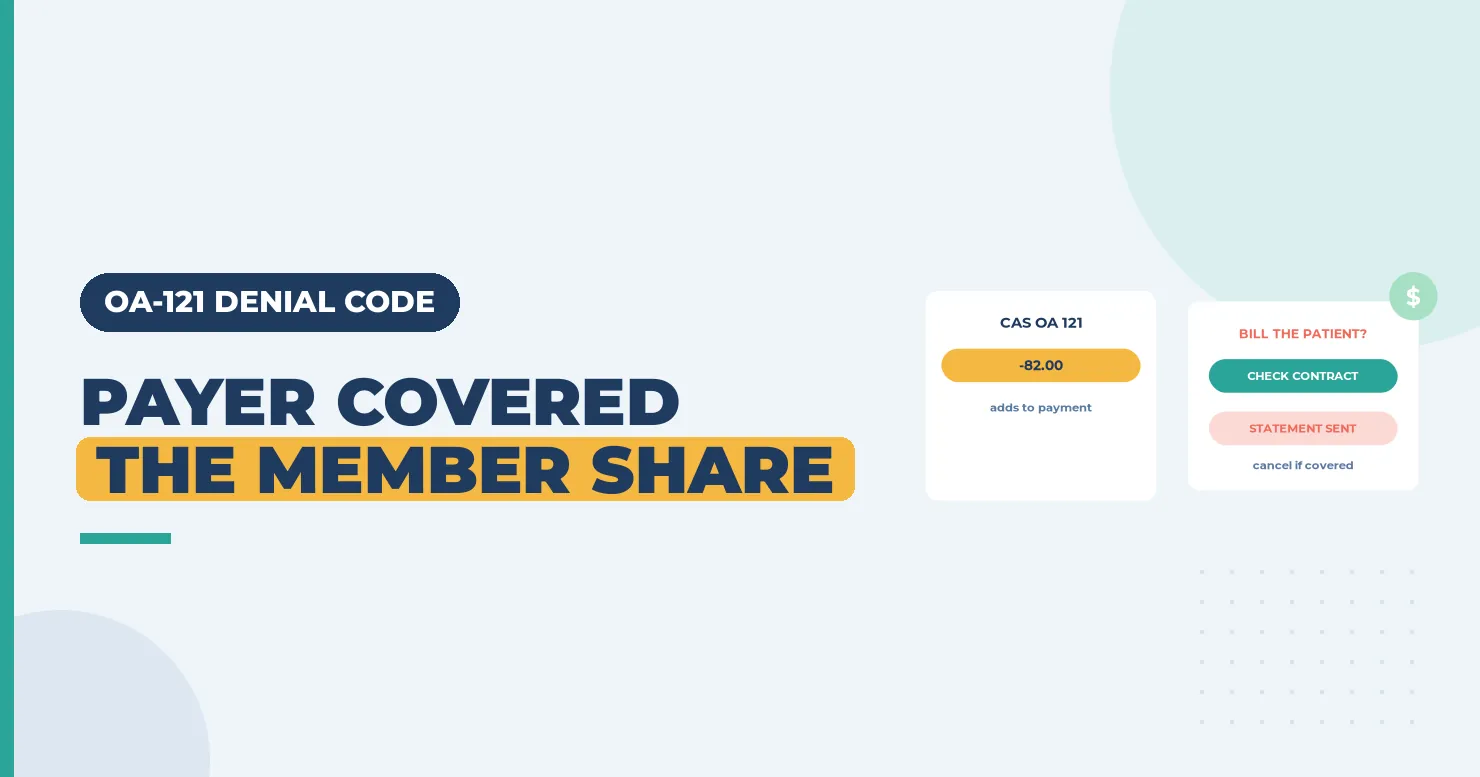
OA-121 is less a denial than a bookkeeping signal. It tells you the payer made an indemnification adjustment linked to money the member still owes, such as a deductible or coinsurance balance. Depending on your contract, the adjustment may add to the payment (the payer covers the member’s share) or take it back later. The OA group means neither the contract write-off rule nor the patient bill applies by default. Your contract decides. (Primary source: X12 Claim Adjustment Reason Codes)
In brief: CARC 121 reads “Indemnification adjustment – compensation for outstanding member responsibility.” Find the contract clause that created it, check the sign and size of the amount against the member’s PR share, and post it to its own adjustment code. Don’t bill the patient for a share the payer already covered.
Part of our denial codes library. Written by Manikandan J, CPC, CRCR, who has reconciled 835 files for hospital and physician cash-posting teams. Published 22 October 2026. Last updated: 22 October 2026. Code wording quoted word for word from X12.
Official CARC 121 description
| Field | X12 text |
|---|---|
| Code | 121 |
| Description | “Indemnification adjustment – compensation for outstanding member responsibility.” |
| Start | 01/01/1995 |
| Last modified | 09/30/2007 |
Source: X12 Claim Adjustment Reason Codes, checked 22 October 2026.
Key terms behind CARC 121
Indemnification is a promise by one party to cover a loss for another. In payer contracts it often means the plan pays the provider an amount the member would otherwise owe. Member responsibility is the deductible, copay and coinsurance the remit lists under group PR. A negative adjustment is a CAS amount below zero, which raises the payment instead of lowering it.
The federal glossary entry for coinsurance and the deductible entry explain the member shares that CARC 121 is tied to.
Where CARC 121 shows up
- Cost-share programs. For example, a plan may cover the member’s coinsurance at a partner hospital and report it with CARC 121.
- Settlement after collection efforts. Some contracts let the payer compensate the provider for a member balance that stayed unpaid after a set period.
- Reversals. If the payer later finds the member paid you directly, it may reverse the earlier 121 amount on a new 835.
Example scenario (fictional names), part 1
OA-121 Denial Example: What Happened
Marcus Bell posts payments at Riverstone Community Hospital. An outpatient MRI of the lumbar spine (72148) for low back pain (M54.50) went to Prairie Gate Health, a fictional plan. The 835 showed $410.00 allowed, $328.00 paid, CAS*PR*2*82 for coinsurance and a second line CAS*OA*121*-82. The payment was $410.00 instead of $328.00.
The patient account system read the -82 as an error and kicked the claim to a work queue. A biller had already queued an $82 statement to the patient.
Should Marcus let the statement go, or does CARC 121 change who owes the $82? Keep reading, or jump to how the OA-121 denial was resolved.
Remark codes that can appear with CARC 121
| RARC | X12 wording | What it tells you |
|---|---|---|
| N381 | “Alert: Consult our contractual agreement for restrictions/billing/payment information related to these charges.” | The contract explains the adjustment |
| N695 | “Alert: This reversal is due to incorrect patient financial responsibility information on the initial adjudication.” | A later 835 is undoing the first PR or 121 amount |
See the X12 RARC list for the full set.
How to post and check an OA-121 adjustment
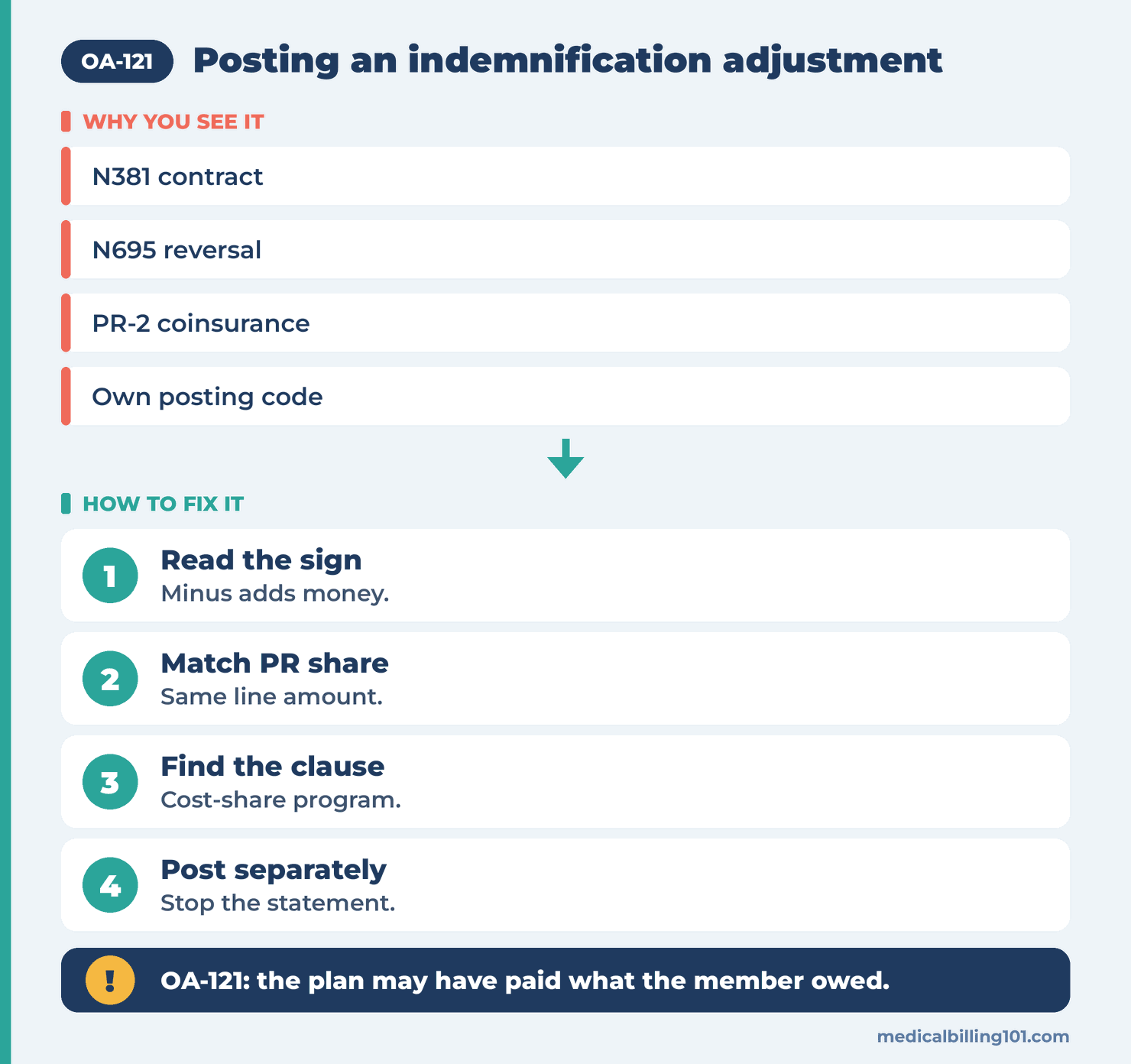
- Read the sign. A negative 121 amount adds to the payment. A positive one takes money back.
- Match it to the PR share. In most programs the 121 amount equals some or all of the coinsurance or deductible on the same line.
- Find the contract clause. Look for a cost-share, indemnification or member-balance program in the payer agreement or its amendments.
- Post it to a dedicated code. Don’t net it into the contractual write-off. Keep it visible so you can match reversals later.
- Stop patient billing for the covered share. Cancel any statement for the amount the payer already paid.
- Question it if no clause supports it, or if the amount doesn’t match the PR share. Ask the payer’s provider relations team for the program terms.
Example scenario (fictional names), part 2
How the OA-121 Denial Was Resolved
Marcus pulled the Prairie Gate agreement. Its second amendment set up a member cost-share program at Riverstone: the plan pays the member’s coinsurance on outpatient imaging and reports it with CARC 121.
Fix: he posted the -82 to a new payer-funded cost-share code, zeroed the patient balance and cancelled the queued statement. He asked IT to map OA-121 to that code so future remits post on their own.
Outcome: the account closed at $0. Three weeks later a reversal 835 for a different patient showed a positive 121 with N695. Because the codes were mapped, Marcus found the original posting in minutes and moved the balance back to the patient correctly.
Names and details are illustrative; no real patient data.
Worked example (illustrative)
A physician group is in a plan’s collection-guarantee program. A member owes $150 in deductible for a visit and hasn’t paid after 120 days. The payer’s monthly 835 includes the claim again with CAS*OA*121*-150 and pays the group $150. The group posts it to the program code and closes the patient balance. If the patient later pays the group, the contract says to refund the plan, and the plan may send a positive 121 to recover the amount.
OA-121 vs similar adjustments
| Code | What it means | Who is billed |
|---|---|---|
| OA-121 | Indemnification for outstanding member responsibility | Depends on the contract; often no one |
| CO-45 | Charge exceeds fee schedule or contracted amount | Provider write-off |
| PR-2 | Coinsurance amount | The patient, unless a 121 covers it |
| CO-143 | Portion of payment deferred | Provider tracks until settlement |
Common posting mistakes with CARC 121
- Treating a negative 121 as an overpayment and refunding it.
- Billing the patient for coinsurance the 121 already covered.
- Netting 121 into the contractual write-off, which hides reversals.
- Missing the reversal on a later 835 because it posted to a generic code.
Recap
OA-121 is an indemnification adjustment tied to the member’s unpaid share. Check the sign, match it to the PR amount, confirm the contract clause and post it to its own code. Cancel patient billing for any share the payer covered, and watch for reversals.
FAQ
What does OA-121 mean on a remittance?
The payer made an indemnification adjustment that compensates for member responsibility, such as coinsurance or a deductible.
Is a negative CARC 121 amount an overpayment?
Usually not. A negative CAS amount increases the payment. Check the contract before you refund anything.
Can I bill the patient after an OA-121?
Not for the share the payer already covered. Bill only any PR amount the 121 didn’t offset.
Why did a later 835 reverse the 121 amount?
The payer may have learned the member paid you directly, or it corrected the patient share. Look for remark N695.
How should OA-121 be posted?
Use a dedicated adjustment code, not the contractual write-off, so reversals and audits are easy to trace.
Which group codes appear with CARC 121?
OA is common. Some payers report it under CO, depending on the program.
Sources
How we checked: each code quote on this page was matched word for word with the X12 CARC and RARC lists on 22 October 2026.
- X12, Claim Adjustment Reason Codes (CARC 121, 2, 45, 143). Accessed 22 Oct 2026.
- X12, Remittance Advice Remark Codes (N381, N695). Accessed 22 Oct 2026.
- HealthCare.gov, Coinsurance and Deductible (glossary). Accessed 22 Oct 2026.
Last updated: 22 October 2026 · Educational content; not legal advice.