

CO-213 is one of the few denial codes that should go to your compliance officer before it goes back to the payer. It means the payer believes the referral behind the service broke the physician self-referral law, often called the Stark Law, or the payer’s own self-referral policy. You cannot fix it by changing a box on the claim. (Primary source: X12 Claim Adjustment Reason Codes)
In brief: CARC 213 reads “Non-compliance with the physician self referral prohibition legislation or payer policy.” Do not resubmit. Find the referring doctor, map their financial ties to the billing entity, check whether an exception applies, and bring in compliance or legal counsel before any appeal.
Part of our denial codes library. Written by Manikandan J, CPC, CRCR, who has supported compliance reviews of referral denials for imaging and lab billing teams. Published 23 October 2026. Last updated: 23 October 2026. Code wording quoted word for word from X12.
The official text
| X12 field | Value |
|---|---|
| Code | 213 |
| Description | “Non-compliance with the physician self referral prohibition legislation or payer policy.” |
| Start | 01/27/2008 |
Source: X12 Claim Adjustment Reason Codes, checked 23 October 2026.
What self-referral rules cover
The physician self-referral law is a federal law that bars a doctor from referring Medicare patients for certain services to an entity the doctor, or a close family member, has a financial relationship with, unless an exception applies. CMS calls these services designated health services (DHS). They include, for example, clinical lab work, imaging, physical therapy, DME and hospital services. CMS lists the rules on its physician self-referral page.
A financial relationship is any ownership stake or pay arrangement, such as a lease, a medical director fee or a loan. The OIG gives a plain overview in its guide to fraud and abuse laws.
Commercial plans can write their own version. That is why X12 added “or payer policy” to the code.
Example scenario (fictional names), part 1
CO-213 Denial Example: What Happened
Daniel Okafor manages billing at Brightwater Imaging, an outpatient MRI center. Three months of lumbar MRI claims from one orthopedic surgeon came back with CAS*CO*213. Claims from other referrers paid as usual.
Daniel asked around. The surgeon’s group rented two exam rooms inside the imaging building. Nobody in billing had ever seen the lease.
Was this a billing error, or something bigger? Keep reading, or jump to how the CO-213 denial was resolved.
What to check before you respond
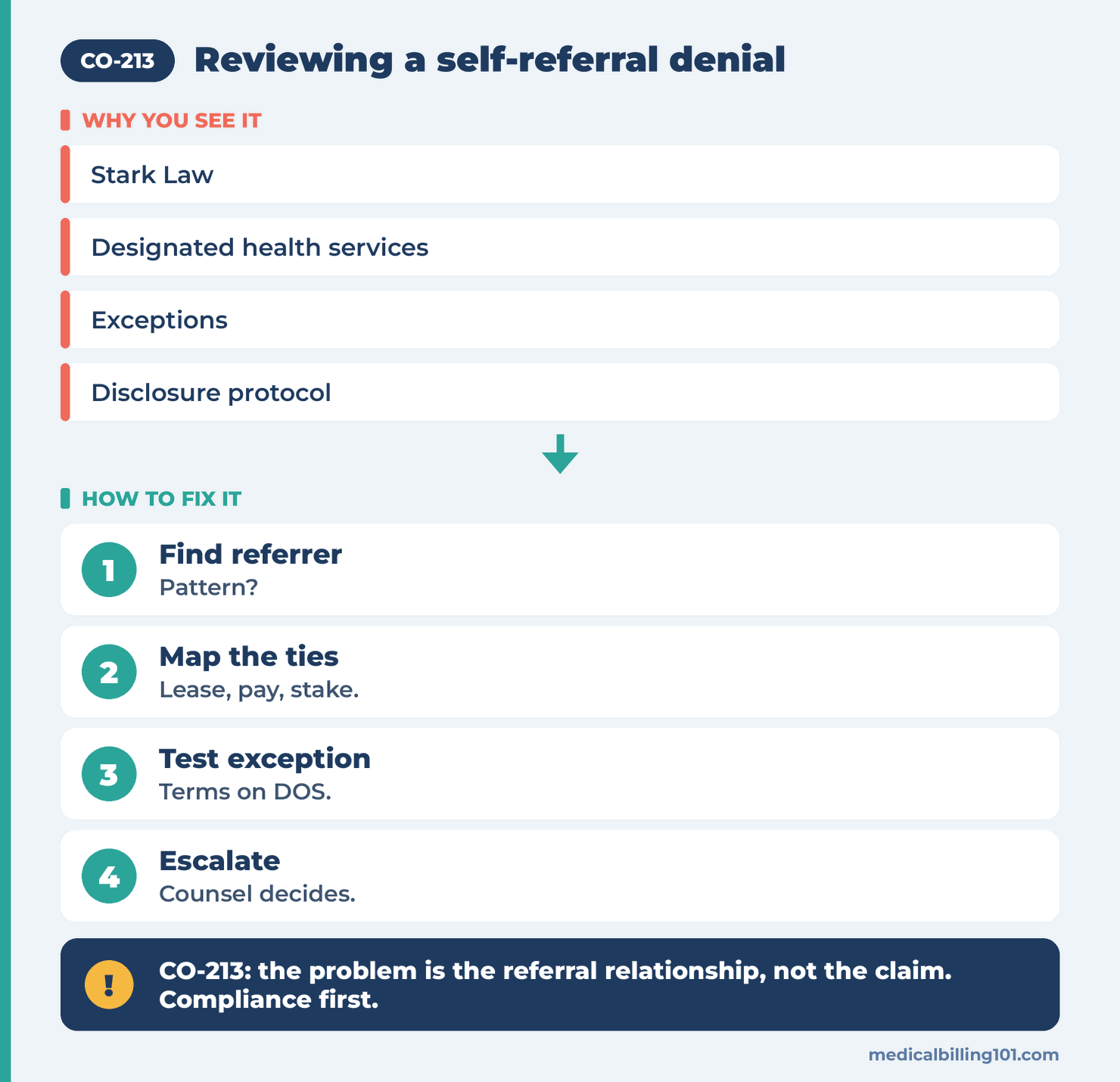
- Who referred? Pull the referring provider on the denied claims and look for a pattern.
- What ties exist? List any ownership, lease, salary, consulting or family link between that doctor and your entity.
- Is there an exception? Many arrangements fit an exception, such as a signed, fair-market-value lease. Each has strict terms.
- Were the terms met on the date of service? A lease that expired, a missing signature or rent below fair market value can push it outside the exception.
- Escalate. Send the facts to compliance or counsel. They decide whether to appeal, refund or disclose.
There is no claim form correction for CO-213. Changing the referring provider on the claim to get it paid would be a false claim.
Appeal or refund?
| Finding | Usual path |
|---|---|
| Exception met, payer missed it | Appeal with the signed agreement and proof of terms |
| Payer misread the referrer | Appeal with the referral order |
| Exception not met | Counsel reviews refund or disclosure options |
| Commercial policy breach | Read the contract and the plan’s policy |
CMS runs a Self-Referral Disclosure Protocol for providers who find an actual or potential violation. Your counsel decides if it applies.
Example scenario (fictional names), part 2
How the CO-213 Denial Was Resolved
Compliance pulled the lease. It had been signed three years earlier for a two-year term, and nobody had renewed it. For the months in question, the arrangement had no signed agreement.
Fix: Brightwater did not rebill or appeal those claims. Counsel reviewed the gap and handled the refund question through the proper process, and a new lease at fair market value was signed.
Outcome: Claims from new dates of service paid. Compliance now tracks every lease end date in a shared calendar with 90-day alerts.
Names and details are illustrative; no real patient data.
CO-213 compared with nearby codes
| Code | Plain meaning |
|---|---|
| CO-213 | Self-referral rule or policy broken |
| CO-B7 | Provider not certified for this service |
| CO-185 | Rendering provider not eligible |
| CO-170 | Payment denied for this provider type |
| CO-197 | Authorization absent |
For a broader view of audit risk, read our page on OIG audit triggers in medical billing.
FAQ
What does CO-213 mean?
The payer found non-compliance with the physician self-referral law or with its own self-referral policy.
Can I fix CO-213 with a corrected claim?
No. The issue is the financial relationship behind the referral, not a field on the claim.
Should billing appeal a CO-213 denial alone?
No. Bring in compliance or legal counsel first, because the response may affect other claims.
What is a designated health service?
A service type covered by the federal self-referral law, such as lab, imaging, therapy or hospital services.
Can I bill the patient?
No. Group code CO places the amount on the provider.
Sources
How we checked: each code quote on this page was matched word for word with the X12 CARC list on 23 October 2026.
- X12, Claim Adjustment Reason Codes (CARC 213). Accessed 23 Oct 2026.
- CMS, Physician Self-Referral. Accessed 23 Oct 2026.
- HHS OIG, A Roadmap for New Physicians: Fraud and Abuse Laws. Accessed 23 Oct 2026.
Last updated: 23 October 2026 · Educational content; not legal advice.