
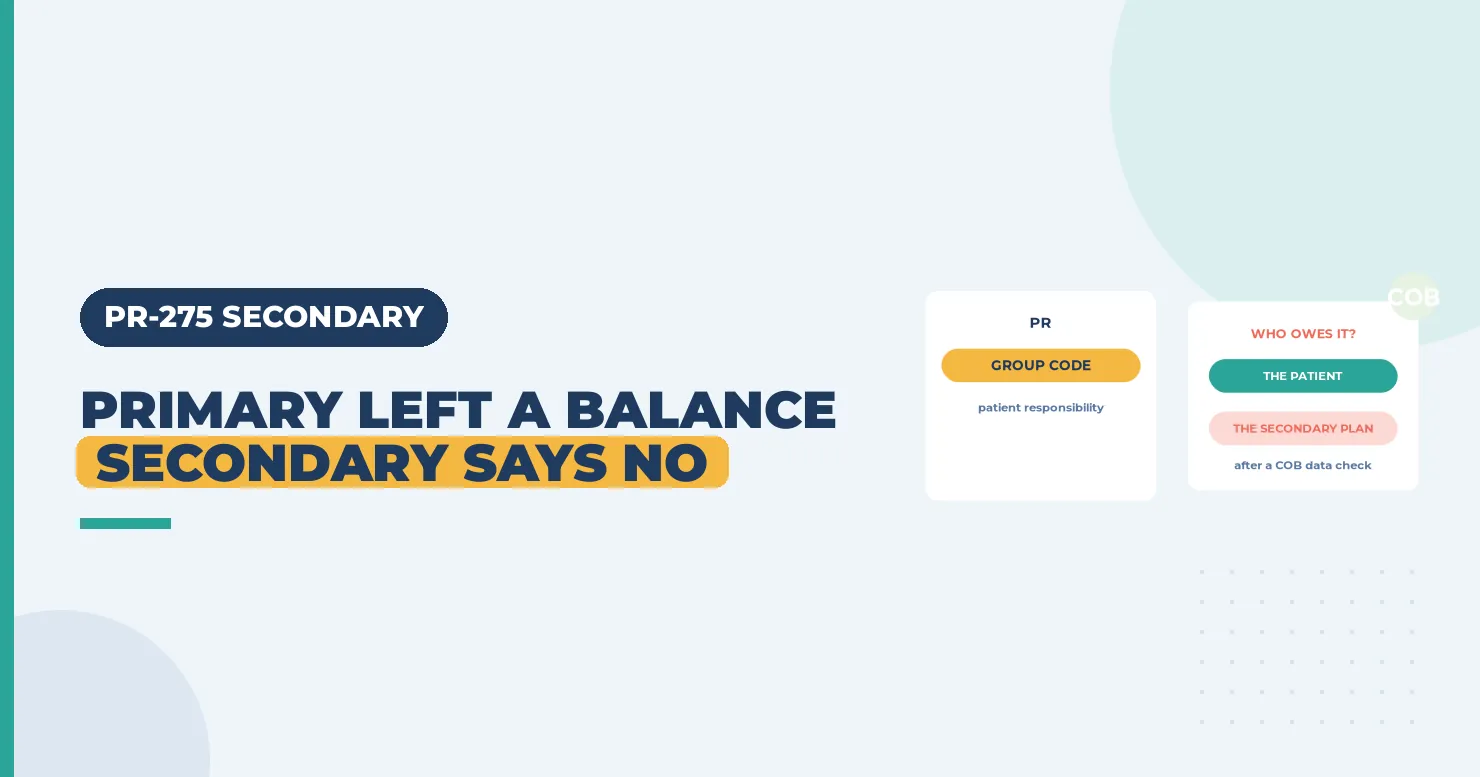
PR-275 comes from a secondary plan. The primary plan paid its part and left a deductible, coinsurance or copay. The secondary plan looked at that leftover and said its benefits don’t cover it. Because the group code is PR, the balance moves to the patient. (Primary source: X12 Claim Adjustment Reason Codes)
In brief: CARC 275 reads “Prior payer’s (or payers’) patient responsibility (deductible, coinsurance, co-payment) not covered.” X12 says to use it only with group code PR. Check that the primary payment was sent right, then bill the patient for the balance.
Part of our denial codes library. Written by Manikandan J, CPC, CRCR, who has worked secondary claims and coordination of benefits for large billing teams. Published 26 October 2026. Last updated: 26 October 2026. Code wording quoted word for word from X12. Read about the author and our editorial policy, or contact us to report an error.
Wording and group code
| Field | Value |
|---|---|
| Code | 275 |
| Description | “Prior payer’s (or payers’) patient responsibility (deductible, coinsurance, co-payment) not covered. (Use only with Group Code PR)” |
| Group code | PR only |
| Start | 11/01/2015 |
Source: X12 Claim Adjustment Reason Codes, checked 26 October 2026.
Key terms: A CARC is a Claim Adjustment Reason Code from the X12 list, and it says why a line was paid differently than billed. A RARC is a Remittance Advice Remark Code that adds detail to the CARC. The group code is the two-letter prefix on the adjustment; PR means patient responsibility: the balance may be billed to the patient under the plan terms.
Methodology: the code wording above is copied from the X12 list, and each fix step below links to the payer or CMS page it comes from.
Example scenario (fictional names), part 1
PR-275 Denial Example: What Happened
Sofia Mendes bills for Lakeview Family Medicine, a fictional clinic in Michigan. A patient with type 2 diabetes (E119) and high blood pressure (I10) came in for a follow-up visit, billed as 99214. She has two fictional plans: her own employer plan as primary and her spouse’s employer plan as secondary.
The primary allowed $160, paid $120 and left $40 coinsurance as CAS*PR*2*40. Sofia sent the secondary claim with those amounts. It came back with CAS*PR*275*40 and $0 paid. That is a PR-275 denial code.
Does Sofia bill the patient, or is something wrong with the secondary claim? Keep reading, or jump to how the PR-275 denial was resolved.
Why secondary plans do this
- Non-duplication rules. For example, some secondary plans pay only up to what they would have paid as primary. If the primary already paid that much, nothing is left.
- Plan design. Some secondary plans don’t cover another plan’s cost share at all.
- Service not covered by the secondary. If the secondary plan wouldn’t cover the service, it won’t cover the leftover either. RARC N536 says this outright: “We are not changing the prior payer’s determination of patient responsibility, which you may collect, as this service is not covered by us.” (X12 RARC list)
- Wrong COB data on the claim. The primary paid amount or the patient share was sent wrong.
Check before you bill the patient
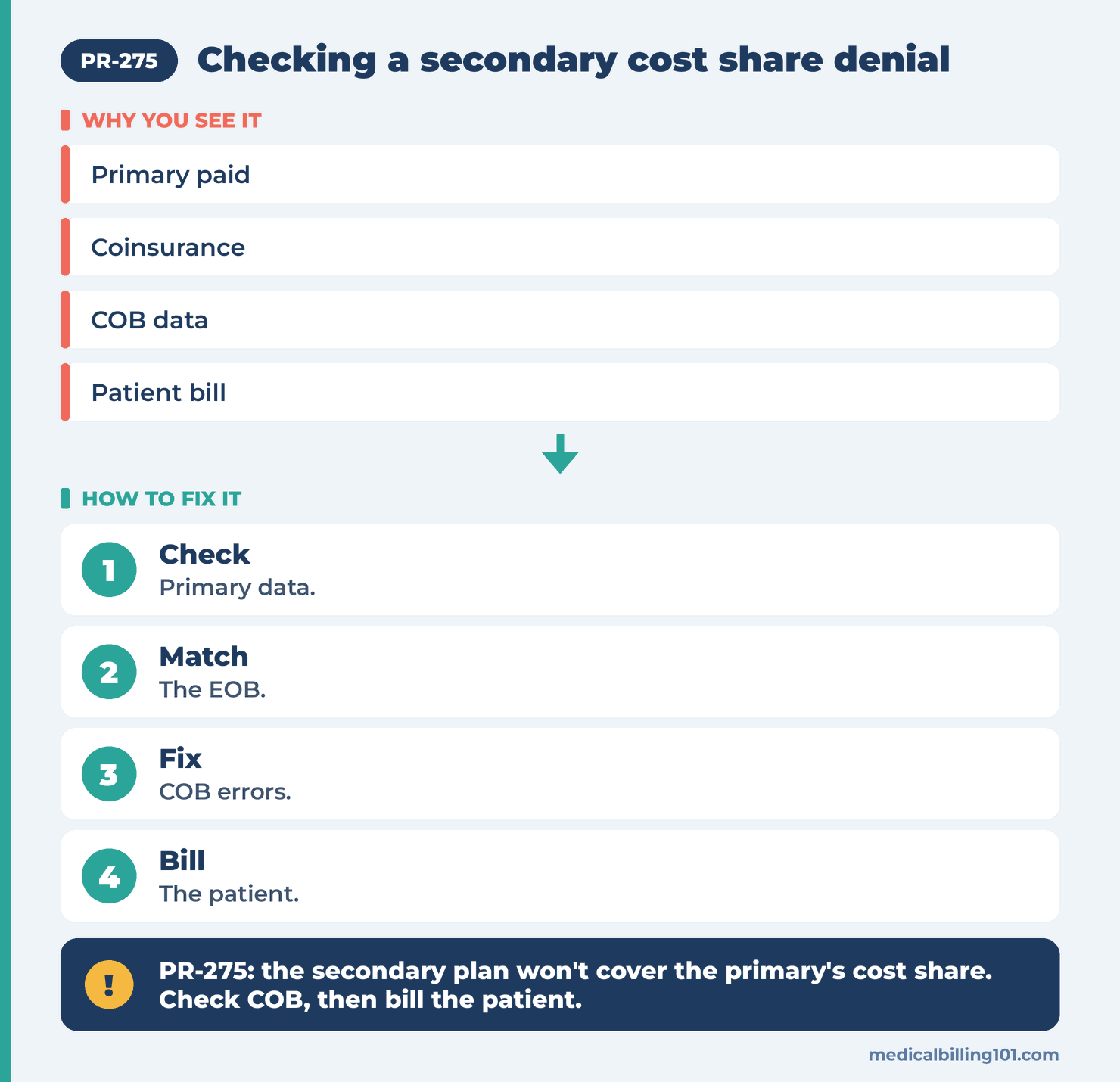
- Check the primary data. The secondary claim should carry the primary’s paid amount and its PR adjustments.
- Read the secondary’s EOB. Make sure the PR-275 amount matches the primary’s patient share.
- Fix any COB errors first. If the amounts were wrong, send a corrected secondary claim.
- Check for QMB status first. If Medicare is primary and the patient is in the Qualified Medicare Beneficiary group, federal law bars billing them for Medicare deductibles, coinsurance or copays (CMS QMB program page). Remark codes N781, N782 and N783 flag this on the remit.
- Bill the patient. If the data was right and no billing protection applies, the balance is the patient’s.
- Explain it. Tell the patient their second plan doesn’t pick up the first plan’s cost share.
Coordination order is covered in our CO-22 coordination of benefits guide. For Medicare as secondary, see the CMS Coordination of Benefits overview.
Claim form note
No claim form visual is shown. When the COB data is right, PR-275 needs no claim change, and the balance goes to the patient.
Example scenario (fictional names), part 2
How the PR-275 Denial Was Resolved
Sofia checked two things before billing anyone.
- The secondary claim carried the primary’s $120 paid amount and the PR-2 line for $40, matching the primary’s 835.
- The spouse’s plan booklet used a non-duplication rule: it pays only up to what it would have paid as primary. Its own benefit for this visit was $120, and the primary had already paid $120.
Fix: No claim change was needed. CARC 275 was correct, and group code PR made the $40 the patient’s share. The patient has no Medicare, so QMB rules didn’t apply.
Outcome: Sofia billed the patient $40 with a short note explaining the second plan’s rule. The patient paid at the next visit, and the front desk now flags non-duplication plans at check-in.
Names and details are illustrative; no real patient data.
Related codes
| Code | Meaning | Who owes |
|---|---|---|
| PR-275 | Secondary won’t cover prior cost share | Patient |
| CO-276 | Secondary won’t cover what primary denied | Depends on contract |
| CO-22 | Other coverage may be primary | Bill the right payer |
| OA-23 | Prior payer adjudication impact | Check the math |
FAQ
What does PR-275 mean?
The secondary plan won’t pay the deductible, coinsurance or copay that the primary plan left.
Can I bill the patient for PR-275?
Yes, once you confirm the COB data on the claim was right. PR means patient responsibility.
Is PR-275 an error?
Not usually. It reflects the secondary plan’s rules. Check the claim data anyway.
Can PR-275 come with group code CO?
X12 says to use it only with group code PR.
How is PR-275 different from OA-23?
OA-23 explains how the primary payment changed what the secondary paid. PR-275 says the leftover cost share is the patient’s.
Sources
How we checked: the code quote on this page was matched word for word with the X12 CARC list on 26 October 2026, the N536 quote with the X12 RARC list, and the QMB rule with the CMS program page.
- X12, Claim Adjustment Reason Codes (CARC 275). Accessed 25 Oct 2026.
- CMS, Coordination of Benefits overview. Accessed 25 Oct 2026.
- X12, Remittance Advice Remark Codes (RARC N536, N781 to N783). Accessed 25 Oct 2026.
- CMS, Qualified Medicare Beneficiary (QMB) Program Group. Accessed 25 Oct 2026.
Last updated: 26 October 2026 · Educational content; not legal advice.