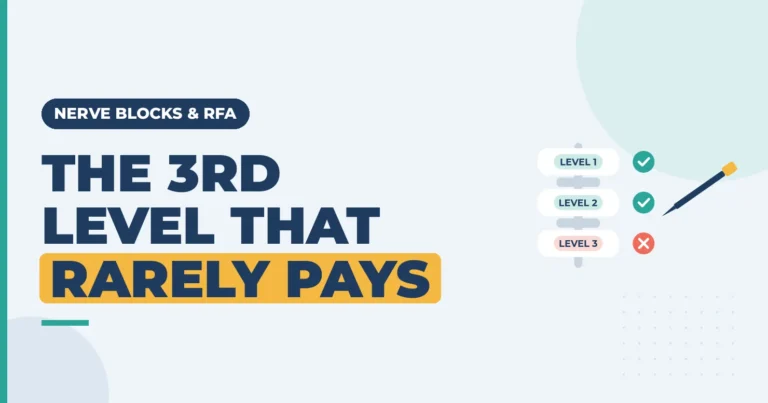
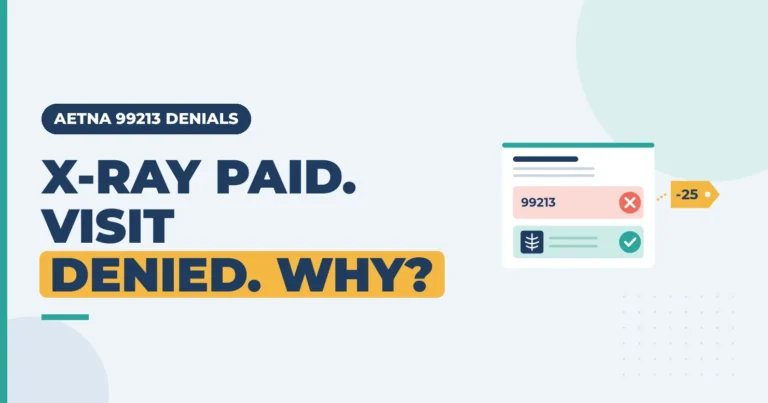
Nerve block ASC denials from Blue Cross usually mean the block code hit a bundling edit against the surgery. For 27447 with 64445 or 64448, modifier 59 cannot override that edit, so fix who bills the block and prove it was for postoperative pain.
The knee pays, but the femoral and sciatic block lines deny as bundled. This guide shows the edit, the 2026 ASC pay rules, and how to fix the claim.
TL;DR: CMS NCCI edits pair 27447 with 64445, 64447 and 64448 at modifier indicator 0. No modifier bypasses an indicator 0 edit. Blocks placed by the surgeon are never separate. Blocks placed by anesthesia for postoperative pain belong on the anesthesia claim with modifier 59 or XU.
Written by Manikandan J, CPC, CRCR, a certified coder and revenue cycle specialist. Published 10 November 2026. Last updated: 10 November 2026.
Table of Contents
Why is Blue Cross denying ASC nerve block codes?
Blue Cross is denying ASC nerve block codes because a bundling edit treats the block as part of the surgery. Medicare NCCI pairs 27447 with the femoral and sciatic block codes. The edit treats routine pain care after surgery as part of the surgeon’s global fee.
For example, a typical claim looks like this. The ASC bills 27447-RT for a total knee. It adds 64448-59-RT for a femoral catheter and 64445-59-RT for a sciatic block. The knee pays. The block lines deny as bundled.
A bundling edit is a code-pair rule. It pays the main code and denies the smaller one. On the remit, this often shows as CO-97, payment included in another service. Some plans also add a CO-236 code-pair denial.
Blue Cross commercial plans set their own rules. Many payers still model their edits on NCCI. So the CMS NCCI PTP edit files are the best first clue for a commercial denial.
Why doesn’t modifier 59 fix the nerve block denial?
Modifier 59 doesn’t fix the nerve block denial because the edit allows no modifier. In the October 2026 NCCI practitioner file, 27447 with 64445, 64447 and 64448 carries modifier indicator 0. An indicator 0 pair never pays, even with 59 or XU.
A modifier indicator is the NCCI flag that says if a modifier can split a code pair. Indicator 1 allows a modifier. Indicator 0 does not. CMS states that practitioner PTP edits apply to physician claims and to ASC claims.
| Column 1 code | Column 2 code | Modifier indicator | What it means |
|---|---|---|---|
| 27447 | 64445 (sciatic, single) | 0 | Bundled. Modifier 59 cannot unbundle it. |
| 27447 | 64447 (femoral, single) | 0 | Bundled. Modifier 59 cannot unbundle it. |
| 27447 | 64448 (femoral, catheter) | 0 | Bundled. Modifier 59 cannot unbundle it. |
| 27447 | 64473 (lower extremity fascial plane) | 1 | A modifier may apply when the record supports it. |
This table explains the “sporadic” payments many ASCs see. The 64473 line, often an IPACK block, sits on an indicator 1 pair. The femoral and sciatic lines sit on indicator 0 pairs. One claim can pay one block and deny the others.
Our guide on searching NCCI PTP tables shows how to check any code pair yourself.
Who can bill a postoperative pain block?
An anesthesia practitioner can bill a postoperative pain block when the surgeon asks for it. The NCCI Policy Manual says the surgeon owns routine postoperative pain care. A block placed by the surgeon is not separately reportable on any claim.
The anesthesia claim can carry the block with modifier 59 or XU. Three rules apply under Chapter II of the manual:
- The main anesthetic was general, spinal, or epidural.
- The surgery did not need the block to work.
- A separate procedure note for the block is in the record.
For instance, the block is not separate when it was the main anesthetic. It is also not separate with MAC or moderate sedation. On the anesthesia claim, 01402 with 64448 is an indicator 1 pair, so modifier 59 works there.
In my AR work, I pull the anesthesia record before I appeal any block denial. The block note, the surgeon’s request, and the anesthesia type decide the case. They work faster than any letter.
Does the ASC get paid for 64445, 64448 and 64473?
Under Medicare, the ASC gets paid for 64445 and 64448 but not for 64473. The October 2026 ASC Addendum AA lists 64445 at indicator P3 and 64448 at J8. It lists 64473 and 64474 at N1, which means packaged with no separate payment.
You can check any code in the CMS ASC payment rate addenda. So a Medicare ASC claim with 64473 will never pay that line on its own. Blue Cross commercial pay follows its own contract and fee schedule. Blue Cross Blue Shield of Michigan tells facilities to check its HCPCS payment rule display in the provider portal.
| Code | Block type | 2026 Medicare ASC indicator |
|---|---|---|
| 64445 | Sciatic nerve, single injection | P3, separately paid |
| 64448 | Femoral nerve, continuous catheter | J8, separately paid |
| 64473 | Lower extremity fascial plane, single injection | N1, packaged |
How do you fix Blue Cross nerve block bundling denials?
Fix Blue Cross nerve block bundling denials by matching each block to the person who placed it. Remove surgeon-placed blocks. Move anesthesia-placed blocks to the anesthesia claim with modifier 59 or XU. Then appeal only the lines your records support.
- Pull the block procedure note and the anesthesia record for each denied date.
- Confirm the surgical anesthetic was general, spinal, or epidural anesthesia.
- Find the surgeon’s written or verbal request for postoperative pain control.
- Keep block time out of anesthesia time if it was placed before start or after end.
- Ask Blue Cross which edit denied the line. Note the call reference number.
- Send a corrected claim or a written appeal with the notes attached.
Upheld appeals often mean the edit works as built. A new letter will not change an indicator 0 pair. Ask your contract manager to raise it with the plan.
Our appeal letter generator helps with the letter. The timely filing calculator checks the appeal deadline. For general rules, read how to appeal a denied claim.
3-step checklist
- Check the NCCI modifier indicator for each surgery and block pair.
- Confirm who placed the block, the anesthesia type, and the surgeon’s request.
- Rebill or appeal only the blocks the anesthesia record supports.
FAQ
Can modifier 59 unbundle 64448 from 27447?
No. The NCCI practitioner edit for 27447 and 64448 has modifier indicator 0. No modifier can bypass an indicator 0 edit, including 59 and XU.
Can a surgeon bill a nerve block for postoperative pain?
No. NCCI says the surgeon’s postoperative pain care is part of the global surgical package. A block placed by the surgeon is not separately reportable.
When can anesthesia bill a postoperative pain block?
When the surgeon requests it, the surgery used general, spinal or epidural anesthesia, and the surgery did not depend on the block. Append modifier 59 or XU and keep a separate procedure note.
What is CPT 64473?
CPT 64473 is a unilateral lower extremity fascial plane block by injection, including imaging guidance when performed. It was added in 2025 and covers blocks such as IPACK and fascia iliaca.
Does Medicare pay the ASC for 64473?
No. The October 2026 ASC Addendum AA lists 64473 with payment indicator N1. That means the service is packaged and gets no separate ASC payment.
Sources
My methodology was simple. I checked each code pair in the CMS NCCI edit file, then compared the rules with the NCCI manual and the ASC addenda. Edits change every quarter, so confirm the current version before you bill.
- CMS, Medicare NCCI Policy Manual 2026, Chapter II, Anesthesia Services (postoperative pain blocks). Accessed 10 Nov 2026.
- CMS, Medicare NCCI Practitioner PTP Edits, version 32.3 (October 2026). Accessed 10 Nov 2026.
- CMS MLN901346, How to Use the Medicare NCCI Tools (practitioner PTP edits apply to ASC claims). Accessed 10 Nov 2026.
- CMS, ASC Payment Rates Addenda, October 2026 Addendum AA. Accessed 10 Nov 2026.
- American Society of Anesthesiologists, New and Updated Fascial Plane Block CPT Codes (64473, 64474). Accessed 10 Nov 2026.
- Blue Cross Blue Shield of Michigan, The Record, February 2022 (HCPCS payment rule display for ASC claims). Accessed 10 Nov 2026.
Read about the author, or contact us with a question. See our editorial policy.
Last updated: 10 November 2026 · Educational content for U.S. billers. Payer policies vary by plan, so check the plan’s current policy.