Aetna denying 99213 billed with an x-ray usually means the E/M line is missing modifier 25. Fix it by appending 99213-25 when the note shows a separate visit, then send a corrected claim.
The x-ray and lab lines pay, but the office visit drops to zero. This guide explains why, what NCCI says, and how to rework the claim.
TL;DR: Aetna treats the E/M and the x-ray as one service unless modifier 25 tells it otherwise. Put 25 on the E/M, never on the x-ray. Bill it only when the documentation supports a separate visit.
Written by Manikandan J, CPC, CRCR, a certified coder and revenue cycle specialist. Published 3 November 2026. Last updated: 3 November 2026.
Table of Contents
Why is Aetna denying 99213 with an x-ray?
Aetna is denying 99213 with an x-ray because its claim edit sees two services on one date. The x-ray has an XXX global indicator. Without modifier 25, the edit assumes the visit was only the work of ordering and reading the film.
The denial often shows on Aetna Medicare Advantage claims. The x-ray, flu test, and COVID test pay. Only the E/M line denies. The rep may say “a modifier is required.”
Modifier 25 is the CPT modifier for a significant, separately identifiable E/M service on the same day as another service. It tells the payer the provider did a significant, separately identifiable E/M service. Aetna Better Health of New Jersey describes this same rule in its XXX-global E/M payment policy notice.
A missing modifier is not the only cause. Check eligibility and the place of service too. Our CO-4 denial code guide covers modifier-related denials in general.
What does NCCI say about an E/M with an XXX procedure?
NCCI says XXX procedures include their own pre-, intra-, and post-procedure work. That work cannot be billed as a separate E/M. A separate, significant E/M on the same day can be billed with modifier 25.
The rule sits in Chapter I of the Medicare NCCI Policy Manual. It states that the E/M may relate to the same diagnosis as the XXX procedure. It cannot include time spent interpreting the result.
A global indicator is the fee schedule flag that shows which post-procedure days are bundled. Global indicators come from the Medicare Physician Fee Schedule. You can check any code in the CMS PFS Look-Up Tool. Radiology codes like 71101 carry the XXX indicator. That means the global surgery concept does not apply.
Medicare NCCI does not list a PTP edit for every E/M paired with every x-ray. So this denial is usually a payer policy edit, not a federal NCCI edit. Our guide on searching NCCI PTP tables shows how to confirm that.
| Claim line | Correct billing | Why |
|---|---|---|
| Office visit | 99213-25 | Separate problem-focused visit documented |
| X-ray (example 71101) | 71101, no modifier 25 | XXX service; modifier 25 is for E/M codes only |
| Flu and COVID tests | Test codes as normal | Usually pay without a modifier |
When should you add modifier 25 to 99213?
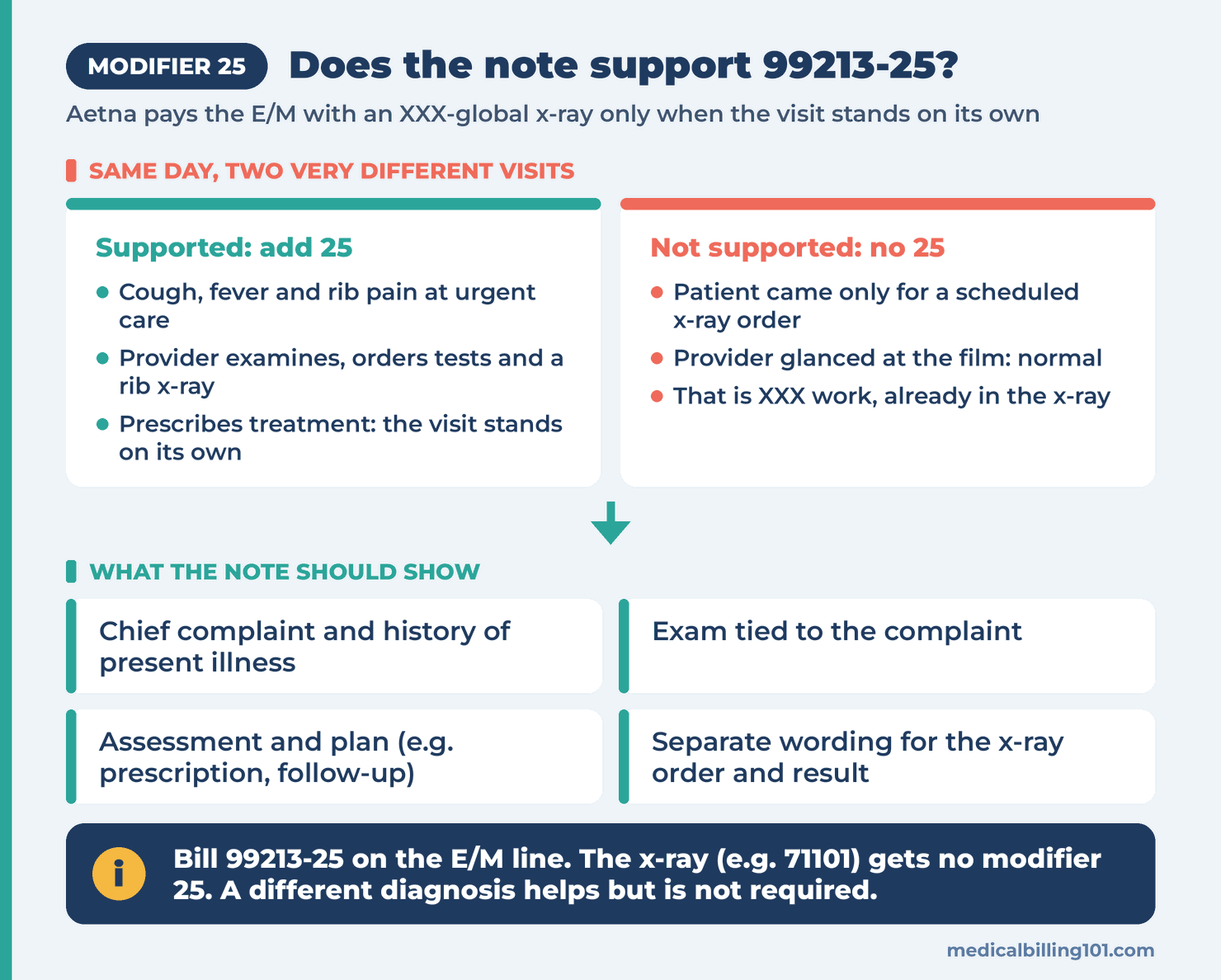
Add modifier 25 to 99213 when the provider evaluated a problem beyond the x-ray itself. The note should show a history, an exam, and medical decision making for the visit. A different diagnosis is helpful but not required.
Here is a clear example. A patient comes to urgent care with cough, fever, and rib pain. The provider examines the patient, orders tests and a rib x-ray, and prescribes treatment. That visit stands on its own.
Here is a weak example. The patient came only for a scheduled x-ray order. The provider glanced at the film and said it was normal. That is XXX work. Modifier 25 is not supported.
In my experience on AR work, I read the note before I touch the modifier. I have seen an unsupported 25 turn a simple denial into a records request.
How do you fix the denied 99213?
Fix the denied 99213 by sending a corrected claim with modifier 25 on the E/M line. Use claim frequency code 7 and the original claim number. Keep every other line the same so paid lines do not reprocess wrong.
This fix is quick. Most claims need one change. Check the note first. Then add the modifier. Then send it.
- Pull the visit note and confirm a separate E/M service.
- Append 25 to 99213. Leave the x-ray code unchanged.
- Submit a replacement claim (frequency 7) within the plan’s filing limit.
- If Aetna still denies, file a reconsideration with the note attached.
Our corrected claim resubmission guide covers frequency codes by payer. The timely filing calculator helps you check the deadline. For a written appeal, try the appeal letter generator.
What documentation supports 99213-25?
Documentation that supports 99213-25 shows a problem the provider assessed and managed. It should read as a full visit even if you removed the x-ray. Low-complexity medical decision making fits 99213.
- Chief complaint and history of the present illness.
- An exam tied to the complaint.
- Assessment and plan, such as a prescription or follow-up.
- Separate wording for the x-ray order and result.
Payers look for this split. Our page on medical necessity documentation explains what reviewers check.
3-step checklist
- Confirm the note shows a separate, significant E/M service.
- Bill 99213-25 and the x-ray code without modifier 25.
- Send a frequency 7 corrected claim, then appeal with notes if needed.
FAQ
Does Aetna require modifier 25 on 99213 with an x-ray?
Many Aetna plans apply an edit that pays an E/M with an XXX-global service only when the E/M carries modifier 25. Add it only when the note shows a significant, separately identifiable visit.
Does modifier 25 go on the x-ray code?
No. Modifier 25 goes on the E/M code only, such as 99213-25. The x-ray code, for example 71101, is billed without modifier 25.
Do I need a different diagnosis for modifier 25?
No. NCCI says the separate E/M may share the diagnosis that led to the x-ray. The note must still show work beyond ordering and reading the film.
Can I just add modifier 25 and resubmit?
Only if the record supports it. Send a corrected claim with frequency code 7 and 99213-25. Do not add the modifier when the visit was only for the x-ray.
Is this an NCCI edit or an Aetna edit?
Medicare NCCI does not auto-bundle every E/M with an x-ray. Aetna applies its own payment policy that mirrors NCCI XXX language. Ask the rep for the policy name.
Sources
My methodology was simple. I compared each rule with the CMS NCCI manual, the fee schedule, and an Aetna policy notice. Codes and policies change, so confirm the current version before you bill.
- CMS, Medicare NCCI Policy Manual, Chapter I, General Correct Coding Policies (XXX procedures and modifier 25). Accessed 3 Nov 2026.
- Aetna Better Health of New Jersey, E&M Services With XXX-Day Global Procedure Code Payment Policy notice. Accessed 3 Nov 2026.
- CMS, Physician Fee Schedule Look-Up Tool (global surgery indicators). Accessed 3 Nov 2026.
- American Medical Association, CPT overview. Accessed 3 Nov 2026.
Read about the author, or contact us with a question. See our editorial policy.
Last updated: 3 November 2026 · Educational content for U.S. billers. Payer policies vary by plan, so check the plan’s current policy.