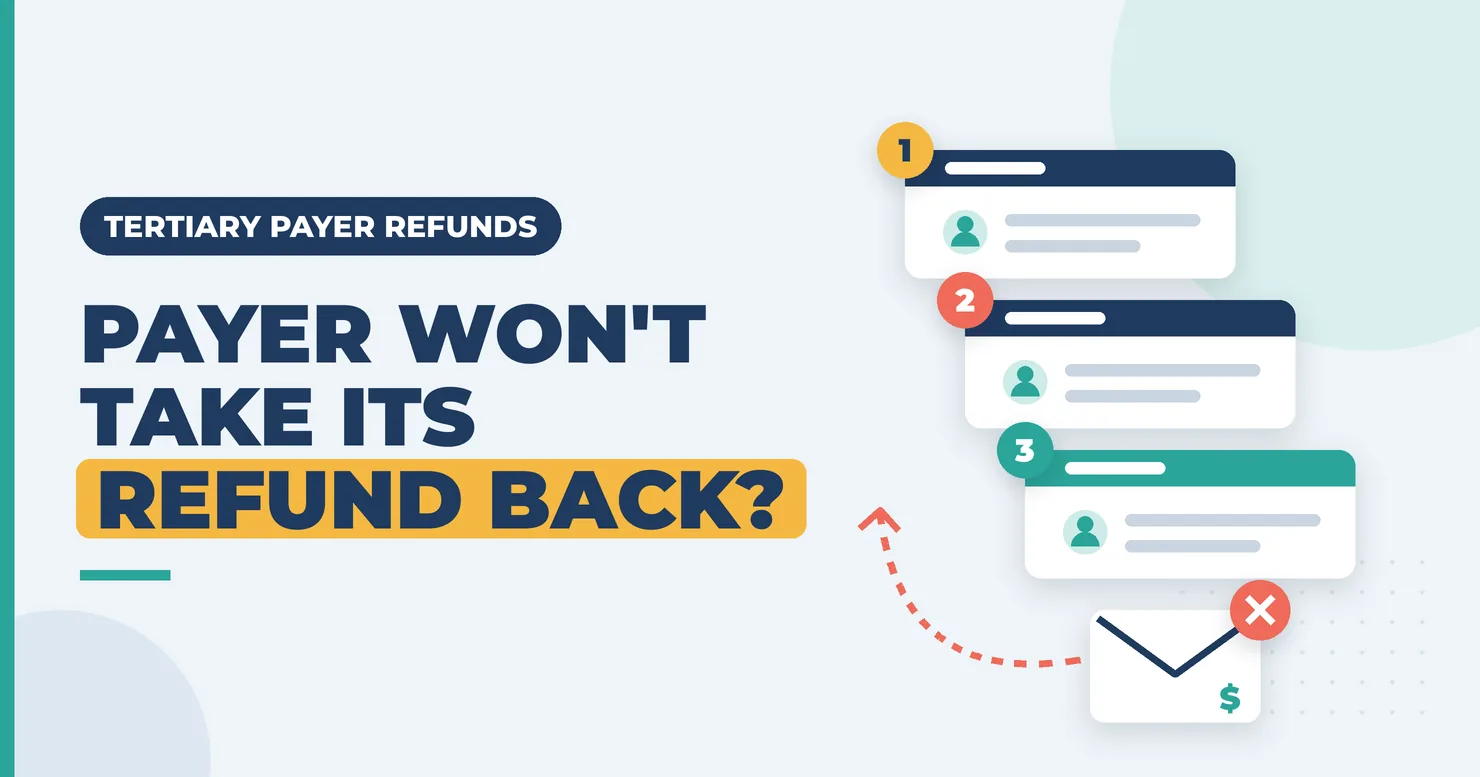
No, you can’t keep it. When a tertiary payer like Aetna pays as if it were secondary, the extra money is still an overpayment, even if every payment is below your billed charge. Hold it as a credit balance. Keep pushing Aetna through channels that don’t need the patient, and document every attempt. If nobody claims it, it becomes unclaimed property you report to the state, not income you keep.
Coordination of benefits (COB) is the set of rules that decides which plan pays first, second and third when a patient has more than one. A tertiary payer is the third plan in that order, and it generally pays only what the first two leave unpaid.
This post answers a real question from the AAPC forums. A South Carolina biller has a patient with Medicare (primary), BCBS (secondary, through Medicare crossover) and Aetna (tertiary). Aetna paid every claim as secondary. The biller mailed refunds with both EOBs and a letter, but Aetna keeps returning the checks, and the patient won’t answer the phone.
Key Takeaways
- Your billed charge is not the limit. On assigned Medicare Part B claims, the most you can collect from all sources is the Medicare-approved amount (42 CFR 424.55).
- Aetna can verify coordination of benefits (COB) with the other plan itself, and Aetna says this can take up to 45 days. You don’t have to wait for the patient.
- South Carolina’s 18-month limit (S.C. Code § 38-59-250) only limits when an insurer can start recovery. It doesn’t give the provider the money.
- Unclaimed credit balances are reportable unclaimed property in South Carolina after five years. Writing them off to income doesn’t remove that duty.
How this guide was checked: every rule below comes from the source linked where it’s used. The sources are the eCFR, the South Carolina Code of Laws, the SC State Treasurer, CMS, X12 and Aetna’s provider pages. Where a source doesn’t answer the question, the post says so. Last reviewed: 4 October 2026. This is educational content, not legal advice.
Table of Contents
Why “it’s under our billed amount” doesn’t make it yours
The article the forum poster read mixes up two different things: a legitimate payment and an overpayment. Your billed charge is just your list price. What you’re allowed to keep is set by your contracts and by each plan’s coordination of benefits rules.
Medicare sets the ceiling first
Start with Medicare. When a supplier accepts assignment on a Medicare Part B claim, 42 CFR 424.55(b) says it agrees “to accept, as full charge for the service, the amount approved by the carrier.” It also agrees “to limit charges to the beneficiary or any other source” to the difference between the Medicare-approved amount and Medicare’s payment. That gap is the deductible and coinsurance. “Any other source” includes BCBS and Aetna.
So, on an assigned Part B claim, once Medicare and BCBS together have paid the full Medicare-approved amount, there is nothing left for Aetna to pay. Anything Aetna sends after that goes over the limit you agreed to. That’s true even when the total is still far below your billed charge. Hospitals and other institutional providers work under different Medicare billing rules, so they should check the rules for their own setting with their compliance team.
Commercial COB rules say the same thing
South Carolina’s COB regulation, S.C. Code Regs. 69-43, covers group plans. It lets a secondary plan cut its benefits so that all plans together pay no more than the “total Allowable Expenses” for the claim period. When there is more than one secondary plan, the regulation’s order rules decide which one pays first. The regulation’s model contract language also gives the overpaying plan a “right of recovery.” The plan can recover from the people it paid, from other insurance companies, or from other organizations. Note that the regulation covers group contracts; it excludes individual policies.
Legitimate payment or overpayment? A quick test
| Situation | Can you keep it? |
|---|---|
| A correct contractual or allowed payment, with patient responsibility applied | Yes. This is a legitimate payment. |
| A payment the plan made under its own maintenance of benefits (MOB) provision, calculated correctly | On commercial claims, usually yes, once the payer confirms it. On assigned Medicare Part B claims, the total from all payers still can’t go over the Medicare-approved amount. |
| A payer paid out of order (Aetna paid as secondary when it is tertiary) | No. This is an overpayment owed back to that payer. |
| A duplicate payment for the same service | No. This is an overpayment. |
| The patient paid coinsurance that a payer later covered | No. Refund the patient for their share. |
| Total collected is below your billed charge but above the allowed or approved amount | No. Your billed charge is not the test. |
Check this first: Some Aetna plans have a maintenance of benefits (MOB) provision. Aetna’s refunding overpayments page warns that MOB can pay “higher than what you’d get with 100% allowable COB.” It says: “Before sending a refund, confirm that the overpayment isn’t due to an MOB provision.” Ask about this on your first call. If Aetna’s payment really is correct as the tertiary payer, there’s nothing to refund. On assigned Medicare claims, though, the 424.55 limit still applies.
Is this a Medicare overpayment with a 60-day deadline?
Probably not, but check. The 60-day rule in 42 CFR 401.305 requires a provider to report and return an overpayment within 60 days after it’s identified. The definitions in 42 CFR 401.303 limit “overpayment” to funds received “under title XVIII,” which means Medicare money.
In this case, Medicare paid correctly as primary. The extra money came from Aetna, a non-Medicare plan, so the federal 60-day clock doesn’t apply to it. Your obligation to return it comes from Aetna’s plan terms, your provider contract and state law. Two exceptions are worth checking:
- If the Aetna coverage is a Medicare Advantage plan, the setup doesn’t fit at all, because Medicare wouldn’t also be paying as primary. Check the patient’s Aetna ID card.
- If anything shows that Medicare’s own payment was wrong, that part is a Medicare overpayment and does fall under the 60-day rule.
Holding on to known overpayments, whoever paid them, is a common compliance risk. See our guide to OIG audit triggers in medical billing.
What South Carolina law actually says
Three South Carolina rules apply here. None of them lets a provider keep a known overpayment.
The 18-month recovery limit only applies to the insurer
Under S.C. Code § 38-59-250(B), “an insurer may not initiate overpayment recovery efforts more than eighteen months after the initial payment was received by the provider.” There are three exceptions. The limit doesn’t apply when the recovery is “required by a self-insured plan” or “required by a state or federal government program.” It also doesn’t apply when the insurer reasonably believes there was fraud. Insurers must usually give 30 business days’ written notice before recovery. The same section lets them skip that notice when the provider “has received payment for the same services from another payor whose obligation is primary.”
The section limits when an insurer can start recovery. It says nothing about the provider gaining the right to the money. Many employer plans administered by Aetna are self-insured, and the 18-month limit expressly doesn’t apply to recovery they require. Section 38-59-260 also excludes some national account claims. The verified text doesn’t say whether a provider may keep money after 18 months, so don’t rely on this section for that.
Unclaimed credit balances are reportable property
The SC Uniform Unclaimed Property Act defines intangible property to include “credit balances, customer overpayments, security deposits, refunds” (S.C. Code § 27-18-20(10)(b)). Under § 27-18-30, property that “has remained unclaimed by the owner for more than five years after it became payable or distributable is presumed abandoned.”
The SC Treasurer’s holder FAQ answers two questions billers often ask:
- Money owed to a business counts. The law “requires holders to report all unclaimed property belonging to another. This includes property owed to another business.”
- Writing it off doesn’t end the duty. “Past obligations that have been written off or taken to income are reportable.”
South Carolina’s reporting rules for credit balances
| Requirement | What the source says |
|---|---|
| Dormancy period for credit balances | 5 years (§ 27-18-30. The Treasurer’s holder guide lists “Credit Balances” under 5 years.) |
| Report due date | “before November first of each year as of June thirtieth, next preceding” (§ 27-18-180(D)). You can ask in writing for a postponement. |
| Due diligence letter | Send written notice to the apparent owner at their last known address “not more than one hundred twenty days before filing,” if the property is $50 or more (§ 27-18-180(E)) |
| Minimum amount | “There is no reporting exemption based on a minimum amount” (Treasurer FAQ) |
| Reporting code | MS09, “Credit Balance-Accounts Receivable,” is on the Treasurer’s reporting code list. Confirm the code with the Treasurer before you file. |
| After you remit | A holder who pays the money to the state in good faith “is relieved of all liability to the extent of the value of the property” (§ 27-18-210(A)) |
| Record keeping | Keep the owner’s name and last known address for 10 years after the property becomes reportable (§ 27-18-320) |
Which state gets the money?
This depends on who the “apparent owner” is in your records. Under § 27-18-40, South Carolina takes custody when the apparent owner’s last known address is in South Carolina. It also takes custody in a few backup cases, for example when the owner’s state doesn’t claim that kind of property. If your ledger lists Aetna, with an out-of-state address, as the owner, the money may need to be reported to that state instead. Before you file, ask the SC Treasurer’s unclaimed property team which state to report to.
Step-by-step: how to clear a refund the payer keeps returning
Follow these steps in order. Most of these balances clear by step 3 or 4.
1. Re-check the math and the crossover trail
Work out what Aetna should have paid as the third payer. That’s usually whatever patient responsibility is left after both Medicare and BCBS. Then look at the remark codes on the Medicare remittance:
- MA18 means “The claim information is also being forwarded to the patient’s supplemental insurer.”
- N89 means the payment information “has been forwarded to more than one other payer, but format limitations permit only one of the secondary payers to be identified.”
Aetna’s COB page says MA18 or N89 on the Medicare remittance means Medicare automatically sent Aetna the claim. If you see N89, Medicare probably crossed the claim to both BCBS and Aetna. That would explain why Aetna paid without seeing BCBS’s payment.
Also find out which Aetna product the patient has: a group or retiree plan, a commercial plan, or Aetna Senior Supplemental (Medigap). The refund route is different for each. For example, the Aetna Senior Supplemental refund page says that line “does not recoup, retract, or offset refunds.” Instead, it asks providers to fill out an online refund request form before mailing a check.
2. Ask Aetna for a COB investigation instead of waiting for the patient
Call the provider services number on the patient’s Aetna ID card or EOB. Give them BCBS’s name, the member ID and the effective date, and ask them to update or investigate COB. Aetna says that when it gets COB information that “doesn’t match what’s in our system… we must verify coverage with the other plan. This may take up to 45 days.” It checks coverage through COB Smart, a tool from the Council for Affordable Quality Healthcare (CAQH). Write down the call reference number, the rep’s name and the date.
3. Ask Aetna to reprocess and recoup instead of taking a check
After COB is updated, ask Aetna to reprocess the claims with Aetna as tertiary. If its plan allows it, ask Aetna to take the money back by offset (deducting it from future payments) rather than through a mailed check. This step depends on the plan, so get the answer in writing. If the reprocessed claims come back with CO-22 adjustments, our CO-22 coordination of benefits guide explains how to read them. If a claim was billed to Aetna with the wrong payer order, use the corrected claim resubmission guide.
4. Resend the refund the way Aetna asks, by certified mail
Aetna’s refunding overpayments page asks for these items:
- A check for the overpaid amount
- The member’s name and ID number
- The dates of service
- A letter explaining the refund
- Your EOB, and the primary plan’s EOB “if the COB isn’t correct”
Mail it to the address on the EOB or ID card, or send the refund online through InstaMed. Send paper refunds by certified mail with a return receipt. When a check comes back, read the cover letter. A note like “no overpayment on file” usually means Aetna’s member file still shows Aetna as secondary, so go back to step 2.
5. Write to the patient, don’t just call
Mail the patient a short letter. Tell her that Aetna has her plans in the wrong order. Ask her to update her “other health plans” information on the Aetna member website, or to fill out Aetna’s COB questionnaire, and enclose a copy. Aetna’s COB page also suggests telling patients to contact each of their plans. Keep a copy of every letter, and use certified mail for at least one of them.
6. Hold it as a credit balance and log everything
Keep the money in a patient-level credit balance or unapplied-cash account. Don’t post it to income or move it to the patient’s account. Keep a log with:
- Each call: date, rep name and reference number
- Each letter and certified-mail receipt
- Each returned check and the reason Aetna gave
That log protects you in an audit. You’ll also need it if you report the balance as unclaimed property later.
7. Report it as unclaimed property after the dormancy period
If the balance sits untouched for five years, add it to that year’s unclaimed property review. Send the due-diligence letter within 120 days before you file. Then report and remit by November 1, after confirming which state gets it (see the previous section).
Sample letter to the patient
You can adapt this letter. Keep it free of clinical details.
Dear [Patient name],
Our records show that you have three health plans: Medicare, [BCBS plan] and Aetna. Medicare’s records list [BCBS plan] as your second plan. Aetna has paid some of your claims as if it were your second plan, so Aetna overpaid us. We have tried to return this money, but Aetna’s records need to be updated first.
Please call Aetna Member Services at the number on your Aetna ID card, or go to your Aetna member website, and update your “other health plans” information. We have enclosed a coordination of benefits form you can use. This will not increase what you owe us.
If you have questions, please call our billing office at [phone].
Sincerely, [Name], [Practice]
Frequently asked questions
Can I keep an insurance overpayment if the total is less than my billed charge?
No. Your billed charge doesn’t decide what you can keep. On assigned Medicare Part B claims, 42 CFR 424.55 limits what you collect “from the beneficiary or any other source” to the Medicare-approved amount. Commercial COB rules also cap combined payments at the allowable expense.
Do I need the patient’s permission or cooperation to fix Aetna’s COB?
Not always. Aetna says it verifies COB with the other plan when it gets information that doesn’t match its records, and that this can take up to 45 days. Start that process yourself with provider services. Patient letters help, but your refund doesn’t have to wait for them.
Does the 18-month rule in South Carolina mean I can keep the money?
No. S.C. Code § 38-59-250 limits when an insurer can start recovery, and it doesn’t apply to recovery required by self-insured plans or government programs. It doesn’t give the money to the provider. The SC Treasurer also says that written-off obligations are still reportable as unclaimed property.
Should I refund the tertiary payer’s money to the patient instead?
No. Refund the patient only for amounts the patient paid that a payer later covered. You can review patient responsibility codes PR-1, PR-2 and PR-3 to check what she actually owed. Aetna’s overpayment belongs to Aetna.
How long do I hold the credit balance before escheating it in South Carolina?
Five years after it became payable, under S.C. Code § 27-18-30. Then report it by November 1, based on your June 30 records, after sending the due-diligence letter for amounts of $50 or more. Confirm which state should receive it before you file.
The bottom line
- Don’t keep it. Being under your billed charge isn’t the test. The allowed or approved amount and the COB rules are.
- Make Aetna fix COB from the payer side, ask for a recoupment, and send refunds by certified mail.
- Hold the money, document every attempt and report it as unclaimed property after five years.
For other remittance codes you’ll see while you work this account, see the denial codes hub.
Disclaimer: This article is for education only and is not legal, tax or compliance advice. Overpayment, contract and unclaimed property rules depend on your payer contracts, the type of plan (insured or self-insured), your provider type and the facts of each case. Check with your compliance officer or a healthcare attorney before you write off, keep or escheat any credit balance. Rules and payer procedures can change, so check each linked source before you rely on it.
Written by Manikandan, RCM specialist at Medical Billing 101.
Sources
- eCFR, 42 CFR 424.55, Payment to the supplier, retrieved 4 Oct 2026.
- eCFR, 42 CFR 401.305, Requirements for reporting and returning of overpayments, and 42 CFR 401.303, Definitions, retrieved 4 Oct 2026.
- South Carolina Code of Laws, Title 38, Chapter 59 (§§ 38-59-210, -250, -260), retrieved 4 Oct 2026.
- South Carolina Code of Laws, Title 27, Chapter 18, Uniform Unclaimed Property Act, retrieved 4 Oct 2026.
- S.C. Code Regs. 69-43, Group Health Insurance Coordination of Benefits (via Cornell LII), retrieved 4 Oct 2026.
- SC State Treasurer, Reporting Unclaimed Property FAQ, Guide to Reporting Unclaimed Property and Reporting Codes, retrieved 4 Oct 2026.
- CMS, Coordination of Benefits, retrieved 4 Oct 2026.
- X12, Remittance Advice Remark Codes (MA18, N89), retrieved 4 Oct 2026.
- Aetna, Refunding Overpayments and Claims Coordination & Review, retrieved 4 Oct 2026.
- Aetna Senior Supplemental Insurance, Overpayment Refund Request, retrieved 4 Oct 2026.

Manikandan is a Revenue Cycle Management (RCM) specialist with over 10 years of hands-on experience in US healthcare billing. He has worked extensively with commercial payers, Medicare, and Medicaid across multiple specialties including surgery, orthopedics, and radiology. Manikandan founded Medical Billing 101 to provide free, accurate denial code guides, CPT coding references, and Medicare billing resources for US medical billing professionals.