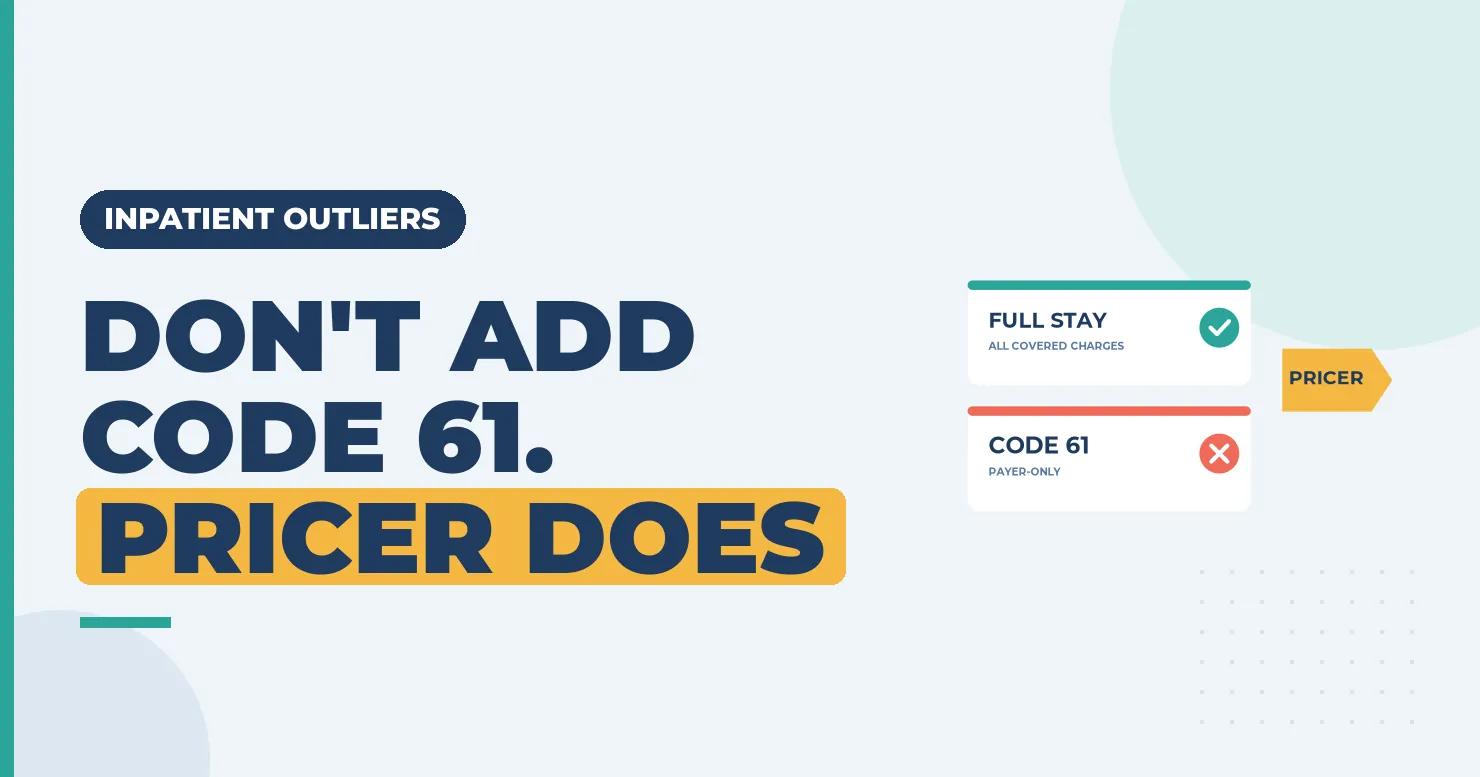
Inpatient outlier claims under Medicare do not need condition code 61, and you should not add it. Code 61 is a payer-only code that Medicare’s system sets itself. Bill the full stay once, with all covered charges, and Pricer pays any cost outlier automatically.
So a first claim without code 61, followed by a replacement claim with it, is not the Medicare process. It delays cash and adds a second claim for no gain. Commercial plans are different, because their outlier or stop-loss terms come from your contract.
TL;DR: For Medicare inpatient (IPPS) claims, never report condition code 61. CMS lists it as a payer-only code. Pricer decides the cost outlier from the covered charges on the claim. Use a replacement claim (type of bill 117) only for real corrections, such as missed charges or a coding error.
Written by Manikandan J, CPC, CRCR, a certified coder and revenue cycle specialist. Published 13 November 2026. Last updated: 13 November 2026.
Table of Contents
Do you add condition code 61 to an inpatient outlier claim?
No, you do not add condition code 61 to a Medicare inpatient outlier claim. CMS lists code 61, “Operating Cost Outlier,” as a payer-only code. Providers shall not submit payer-only codes on their claims. Medicare’s shared system puts code 61 on the claim after Pricer finds a cost outlier.
The MAC then reports the operating outlier amount paid in value code 17. You will see both on the processed claim. Neither one is something the hospital enters. See the payer-only code list in CMS Transmittal 11807, Chapter 1, section 190.
Condition code 61 is the UB-04 code for an operating cost outlier, set by Medicare. Value code 17 is the operating outlier amount the MAC paid. The table shows who reports each code on an outlier stay.
| UB-04 code | Meaning | Who reports it |
|---|---|---|
| Condition code 61 | Operating cost outlier | Medicare system only (payer-only) |
| Value code 17 | Operating outlier amount paid | Medicare contractor only (payer-only) |
| Occurrence code 47 | First full day of cost outlier status | Hospital, only when benefit days run out |
| Type of bill 117 | Replacement of a prior inpatient claim | Hospital, for real corrections |
So the answer to “why can’t we put 61 on the first claim?” is simple. You don’t put it on any claim. The first claim gets the outlier on its own if the charges support it.
How does Medicare pay an inpatient cost outlier?
Medicare pays an inpatient cost outlier when a case’s estimated cost goes above a fixed-loss threshold. The MAC’s Pricer program makes this decision on the claim. It turns covered charges into cost with the hospital’s cost-to-charge ratios. The hospital does not request the outlier.
Per the Medicare Claims Processing Manual, Chapter 3, section 20.1.2, the steps are:
- Pricer multiplies total covered charges by the operating and capital cost-to-charge ratios.
- It compares that cost with the MS-DRG payment plus the fixed-loss threshold, adjusted by wage index.
- It pays 80 percent of the cost above that line, or 90 percent for burn MS-DRGs.
CMS publishes the fixed-loss threshold each year in the IPPS final rule. The regulations sit at 42 CFR 412.80 through 412.86. The outlier is added on top of the MS-DRG payment, plus any DSH, IME and new technology add-on.
For example, take a simplified case with illustrative numbers. Covered charges are $400,000 and the combined cost-to-charge ratio is 0.25, so cost is $100,000. If the DRG payment plus threshold is $70,000, the excess is $30,000. Medicare pays 80 percent of it, or $24,000.
Is billing first without code 61 and then a replacement claim correct?
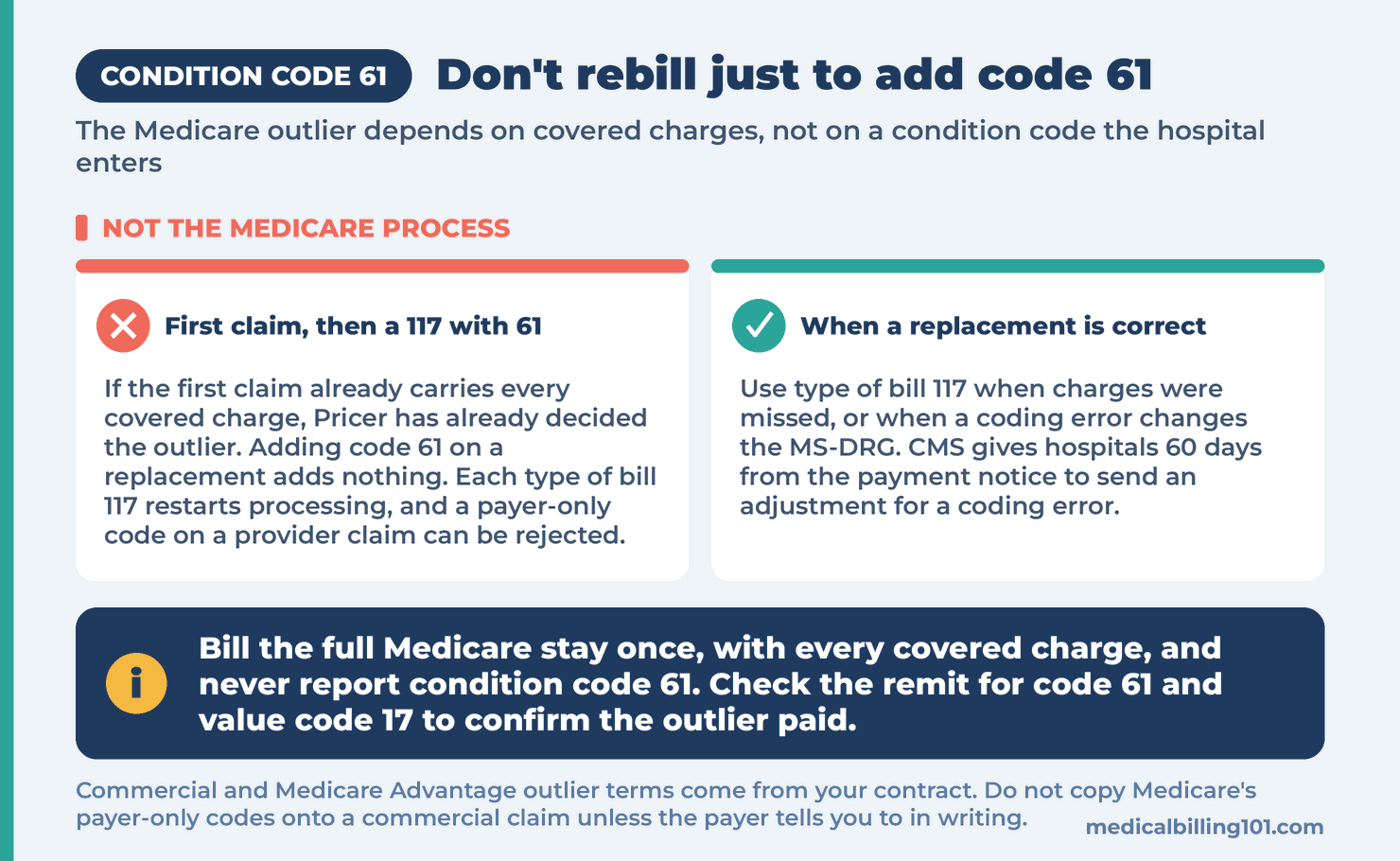
No, billing first without code 61 and then sending a replacement claim is not the Medicare process. The outlier depends on covered charges, not on a condition code. If the first claim carries every covered charge, Pricer already decides the outlier. A replacement with code 61 adds nothing.
The two-claim habit also costs time. Each replacement claim (type of bill 117) restarts processing. It also invites edits, because a payer-only code on a provider claim can be rejected. Ask the team to show the remits side by side before they keep doing it.
Replacement claims still have real uses. Use one when charges were missed, or when a coding error changes the MS-DRG. CMS gives hospitals 60 days from the payment notice to send an adjustment for a coding error. Our corrected claim guide walks through the bill types.
When I review hospital billing, the “bill twice for the outlier” habit usually traces back to one old remit. Someone saw a low first payment, added a code on the rebill, and the rebill paid more. The real fix that time was missing charges, not code 61.
What about long stays and interim bills for outlier cases?
For long stays, Medicare lets a PPS hospital send an interim bill 60 days after admission. It can then bill every 60 days after that if it chooses. At discharge, the hospital cancels the interim bills and rebills the whole stay. That final claim is where the outlier is decided.
This is the one common case where a stay is billed more than once. It is driven by length of stay, not by condition code 61. If your facility is not doing 60-day interim bills, it has no Medicare reason to split the claim.
Benefit days also matter on very long stays. If the patient runs out of covered days, Chapter 3, section 20.7.4 explains when to report occurrence code 47. That code marks the first full day of cost outlier status.
Do commercial payers and Medicare Advantage plans pay outliers the same way?
Not always. Commercial and Medicare Advantage outlier payments come from your contract, not from Medicare’s Pricer. Many contracts use a stop-loss or outlier clause with their own threshold and percentage. Some ask for an itemized bill or records before they pay the outlier portion.
Read the contract and the payer’s provider manual for the exact steps. Do not copy Medicare’s payer-only codes onto a commercial claim unless the payer tells you to in writing. If a payer underpays an outlier, appeal with the contract clause attached. Our appeal letter generator drafts that letter.
Track the appeal date with our timely filing calculator. For another payer-rule answer in this series, see our 93306 LCD denial post.
3-step checklist
- Bill the full Medicare stay once, with every covered charge, and never report condition code 61.
- Check the remit for condition code 61 and value code 17 to confirm the outlier paid.
- Send a type 117 replacement only for missed charges or a coding error that changes the MS-DRG.
FAQ
What is condition code 61 on a UB-04?
Condition code 61 means operating cost outlier. CMS lists it as a payer-only code, so hospitals do not report it. Medicare’s system adds it after Pricer finds the claim is a cost outlier, and the operating outlier amount shows in value code 17.
Does a hospital have to request a Medicare cost outlier payment?
No. The MAC’s Pricer program decides whether a case qualifies for a cost outlier, using the covered charges on the claim and the hospital’s cost-to-charge ratios. The hospital only needs to bill all covered charges correctly.
What percentage does Medicare pay for an inpatient outlier?
Medicare pays 80 percent of the estimated cost above the MS-DRG payment plus the fixed-loss threshold. For burn MS-DRGs the marginal cost factor is 90 percent, per the Medicare Claims Processing Manual, Chapter 3, section 20.1.2.
When should a replacement claim be sent for an inpatient stay?
Send a replacement claim, type of bill 117, when charges were missed or a coding error changes the MS-DRG. CMS allows 60 days from the payment notice for adjustments due to coding errors.
Is value code 17 reported by the hospital?
No. Value code 17 is a payer-only code. The Medicare contractor uses it to record the operating outlier amount paid. It does not include any capital outlier payment.
Sources
My methodology was simple. I read the Medicare Claims Processing Manual chapter on inpatient hospital billing, the CMS payer-only code list, and the outlier regulations in the eCFR. Commercial contracts differ, so confirm each payer’s own outlier terms.
- CMS, Medicare Claims Processing Manual, Chapter 3 (sections 20.1.2 and 20.7.4, and the adjustment and long-stay billing rules). Accessed 13 Nov 2026.
- CMS Transmittal 11807, Payer Only Codes Utilized by Medicare (condition code 61, value code 17). Accessed 13 Nov 2026.
- Noridian JE Part A, Condition Codes (codes assigned by payer). Accessed 13 Nov 2026.
- eCFR, 42 CFR Part 412, Subpart F: Payment for outlier cases. Accessed 13 Nov 2026.
Read about the author, or contact us with a question. See our editorial policy.
Last updated: 13 November 2026 · Educational content for U.S. billers. Payer contracts vary, so check the plan’s current policy.