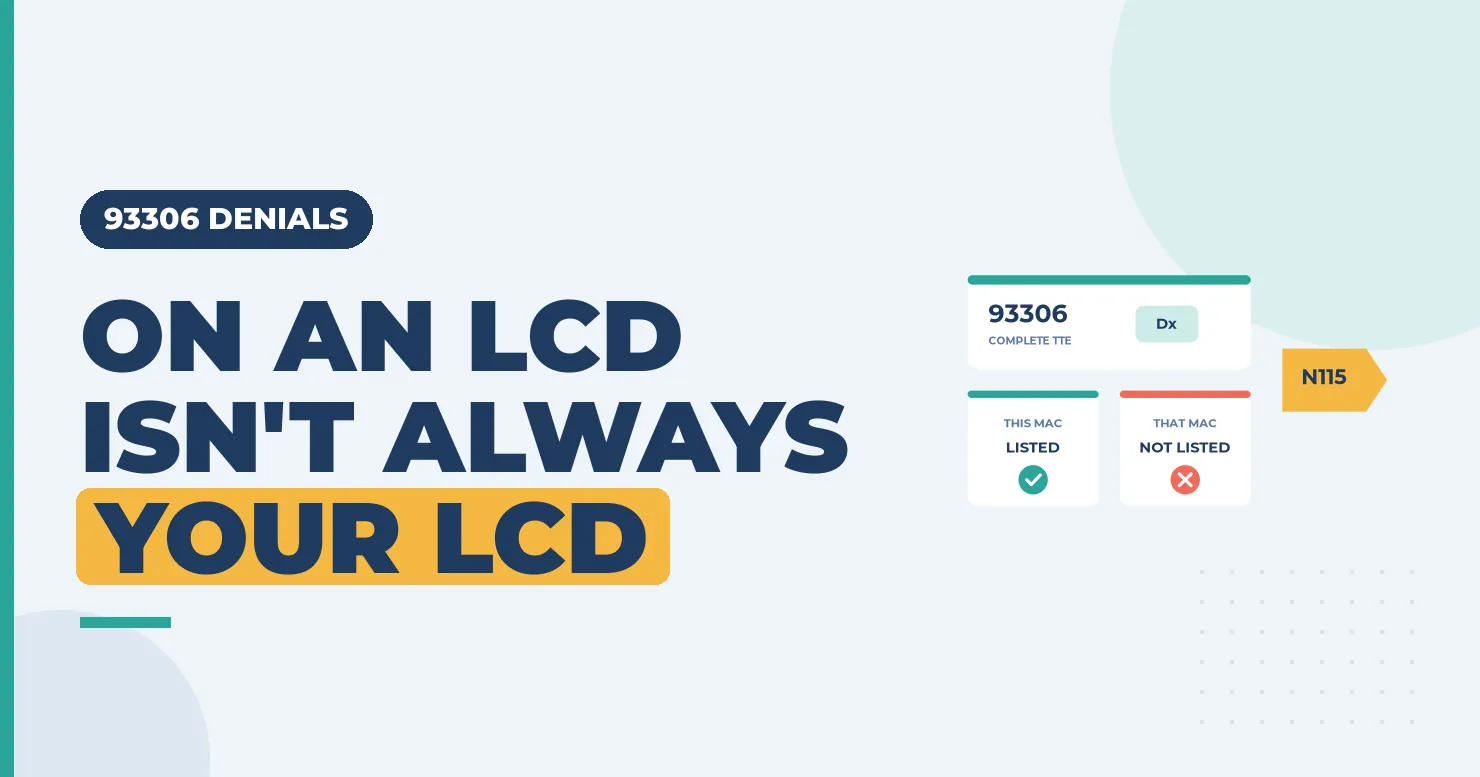
A CPT 93306 denial for a diagnosis not covered under the policy usually means the code on the line does not match your Medicare contractor’s own covered list. A “policy 115” note on the remit is most likely remark code N115, which says an LCD drove the decision.
The fix starts with the right list. Pull your MAC’s TTE billing article for the date of service, match the exact ICD-10 code, point it to the 93306 line, and check the screening and frequency limits.
TL;DR: Each Medicare contractor publishes its own 93306 diagnosis list. A code covered by one MAC can be missing from another. Unspecified codes, a wrong pointer, screening use, and repeat studies without a change in condition cause most of these denials.
Written by Manikandan J, CPC, CRCR, a certified coder and revenue cycle specialist. Published 13 November 2026. Last updated: 13 November 2026.
Table of Contents
Why is 93306 denied as diagnosis not covered when the code is on the LCD?
93306 is usually denied as diagnosis not covered because the code billed is not on your own contractor’s list for that date of service. Medicare TTE lists differ by MAC. They also change each October. A code that looks right on one article can fail on another.
CPT 93306 is a complete transthoracic echocardiogram with spectral and color flow Doppler. N115 is a remark code that points to an LCD.
The remark code tells you where to look. X12 defines N115 as a decision based on a Local Coverage Determination. So the payer checked the line against an LCD and its billing article. It did not find a match it accepts.
The denial often pairs N115 with a medical necessity code. Our CO-50 denial guide covers that code. If the remit shows CO-11, diagnosis inconsistent with procedure, the fix steps are the same.
Do all Medicare contractors cover the same diagnoses for 93306?
No, each Medicare contractor covers its own diagnosis list for 93306. CGS, Wellpoint Federal, and Palmetto GBA each publish a separate TTE billing article. Some common codes are covered by one MAC and missing from another, so a shared “LCD list” from the internet can mislead you.
I compared the current 93306 groups in three articles. Here is what changes between them:
| ICD-10 code | Wellpoint Federal (A56781) | CGS (A57306) | Palmetto GBA (A56625) |
|---|---|---|---|
| I10 essential hypertension | Listed | Not listed | Listed |
| I48.91 unspecified atrial fibrillation | Listed | Not listed | Listed |
| I50.9 heart failure, unspecified | Listed | Not listed | Listed |
| R00.2 palpitations | Listed | Listed | Not listed |
| Z01.818 other preprocedural exam | Listed | Listed | Not listed |
The CGS gaps are about specificity. CGS lists I48.0, I48.11, I48.19, I48.20, I48.21, I48.3 and I48.4 instead of I48.91. It lists specific I50 codes like I50.22 and I50.32 instead of I50.9. Its article says the provider must code to the highest level in ICD-10-CM.
So “we used a code from the policy” is not enough. It must be your MAC’s policy, the version for that date of service, and the exact code, not its parent.
Can the diagnosis pointer cause a 93306 denial?
Yes, a wrong diagnosis pointer can deny 93306 even when the covered code is on the claim. The payer reads only the codes linked to that line. If box 24E on the CMS-1500 points 93306 to a non-covered code, the line denies.
Put the covered code first in the pointer for the echo line. The CGS and Wellpoint articles also say the diagnosis must best describe the condition. For a diagnostic test, report the result if known. Otherwise, report the symptom that prompted the test.
In my denial audits, a common 93306 fix was the pointer. The covered heart code sat on the claim, but it only pointed to the office visit line.
Which 93306 uses are not covered even with a listed code?
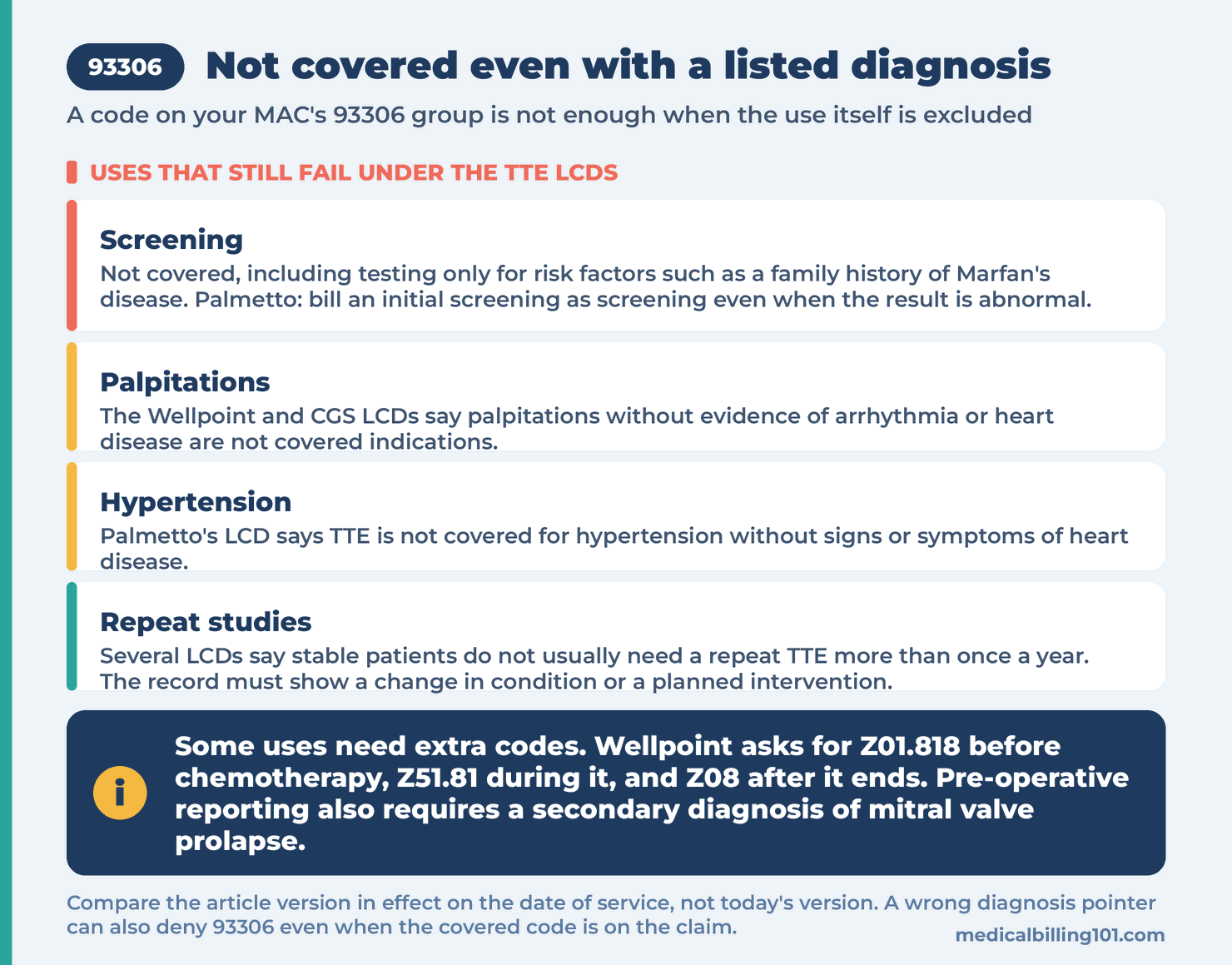
Screening echoes, some repeat studies, and a few soft indications are not covered even with a listed code. The Medicare TTE LCDs say echo for screening is not covered. That includes patients tested only for risk factors, such as a family history of Marfan’s disease.
- Screening: Palmetto’s article says an initial screening test must be billed as screening, even when the result is abnormal.
- Palpitations: The Wellpoint and CGS LCDs say palpitations without evidence of arrhythmia or heart disease are not covered indications.
- Hypertension: Palmetto’s LCD says TTE is not covered for hypertension without signs or symptoms of heart disease.
- Repeat studies: Several LCDs say stable patients do not usually need a repeat TTE more than once a year. The record must show a change in condition or a planned intervention.
Some uses need extra codes. Wellpoint’s article asks for Z01.818 for a baseline before chemotherapy, Z51.81 for monitoring during it, and Z08 after it ends. For pre-operative reporting, it also requires a secondary diagnosis of mitral valve prolapse.
Should Doppler codes be billed with 93306?
No, do not add 93320, 93321 or 93325 to a complete 93306. CPT 93306 is the complete TTE with spectral and color flow Doppler. The CGS LCD says 93306 should be used when Doppler is combined with a complete echo, since January 1, 2009.
A limited follow-up study is different. Palmetto’s article says to use 93308 and 93321 for a less than complete exam of one specific problem. Check any pair in our NCCI edit checker before you resubmit.
How do you fix a 93306 diagnosis-not-covered denial?
You fix a 93306 diagnosis-not-covered denial by matching the claim to your own MAC’s article for that date of service. Confirm the exact ICD-10 code and the pointer. Then check the report, and correct or appeal the claim based on what you find.
- Find the MAC for the place of service and open its TTE article on the CMS Medicare Coverage Database.
- Pick the article version in effect on the date of service, not today’s version.
- Search the 93306 group for the exact code. Replace unspecified codes with the specific code the notes support.
- Fix the pointer so 93306 links to the covered code first.
- Read the echo report. It needs a signed interpretation, measurements, and the reason for any repeat test.
For Medicare, a coding or pointer error is usually handled as a reopening or corrected claim, per your MAC’s process. If the coding was right and the MAC still denied it, file a redetermination within 120 days of the notice. Our appeal letter generator builds the letter.
For future cases, use an ABN when you expect a medical necessity denial. The CGS article says to add GA with a signed ABN, or GZ without one. Read what payers look for in medical necessity notes before you appeal.
Do Medicare Advantage and commercial plans use the same 93306 rules?
Medicare Advantage plans generally follow the LCDs in their service area, but commercial plans use their own policies. Under 42 CFR 422.101(b), an MA plan follows national and local coverage decisions. A commercial “policy 115” could be the plan’s own policy number.
So read the remit closely. If it cites a plan policy, download that policy and its diagnosis list. For a similar payer-specific case, see our Aetna office visit and X-ray denial answer.
3-step checklist
- Open your own MAC’s TTE article for the date of service and find the exact ICD-10 code.
- Point 93306 to that covered code first, and drop Doppler add-ons from a complete study.
- Check the report for a non-screening reason and any repeat-test reason, then correct or appeal.
FAQ
What does N115 mean on a 93306 denial?
N115 is a remittance remark code. It means the decision was based on a Local Coverage Determination (LCD). The payer checked the 93306 line against an LCD and its billing article and did not find a covered match.
Is I10 covered for 93306?
It depends on the Medicare contractor. As of the articles effective October 1, 2026, I10 is listed in the Wellpoint Federal and Palmetto GBA 93306 groups but not in the CGS group. Palmetto’s LCD also says TTE is not covered for hypertension without signs of heart disease.
Can you bill 93320 or 93325 with 93306?
No. 93306 is a complete transthoracic echo with spectral and color flow Doppler. The CGS LCD says 93306 should be used when Doppler is combined with a complete echo, so separate Doppler add-ons do not belong on the same study.
Is a screening echocardiogram covered by Medicare?
No. The Medicare TTE LCDs say echocardiography for screening is not covered, including testing for risk factors such as family history. Palmetto says an initial screening test must be billed as screening even when the result is abnormal.
How often can 93306 be repeated?
There is no single fixed limit, but several LCDs say stable patients do not usually need a repeat TTE more than once a year. More frequent studies need documented changes in condition, a response to treatment, or a planned intervention.
Sources
My methodology was simple. I pulled the current TTE LCDs and billing articles from the CMS Medicare Coverage Database, compared the 93306 diagnosis groups code by code, and checked the N115 definition with X12. Contractors update these lists often, so confirm the version for your date of service.
- CMS Medicare Coverage Database, Billing and Coding: Transthoracic Echocardiography (TTE), Wellpoint Federal (A56781). Accessed 13 Nov 2026.
- CMS Medicare Coverage Database, Billing and Coding: Transthoracic Echocardiography (TTE), CGS (A57306). Accessed 13 Nov 2026.
- CMS Medicare Coverage Database, Billing and Coding: Echocardiography, Palmetto GBA (A56625). Accessed 13 Nov 2026.
- CMS Medicare Coverage Database, LCD L34338: Transthoracic Echocardiography (TTE), CGS. Accessed 13 Nov 2026.
- CMS Medicare Coverage Database, LCD L33577: Transthoracic Echocardiography (TTE), Wellpoint Federal. Accessed 13 Nov 2026.
- CMS Medicare Coverage Database, LCD L37379: Echocardiography, Palmetto GBA. Accessed 13 Nov 2026.
- X12, Remittance Advice Remark Codes (N115). Accessed 13 Nov 2026.
- CMS, First Level of Appeal: Redetermination by a Medicare Administrative Contractor. Accessed 13 Nov 2026.
- eCFR, 42 CFR 422.101: Requirements relating to basic benefits. Accessed 13 Nov 2026.
Read about the author, or contact us with a question. See our editorial policy.
Last updated: 13 November 2026 · Educational content for U.S. billers. Payer policies vary by plan, so check the plan’s current policy.