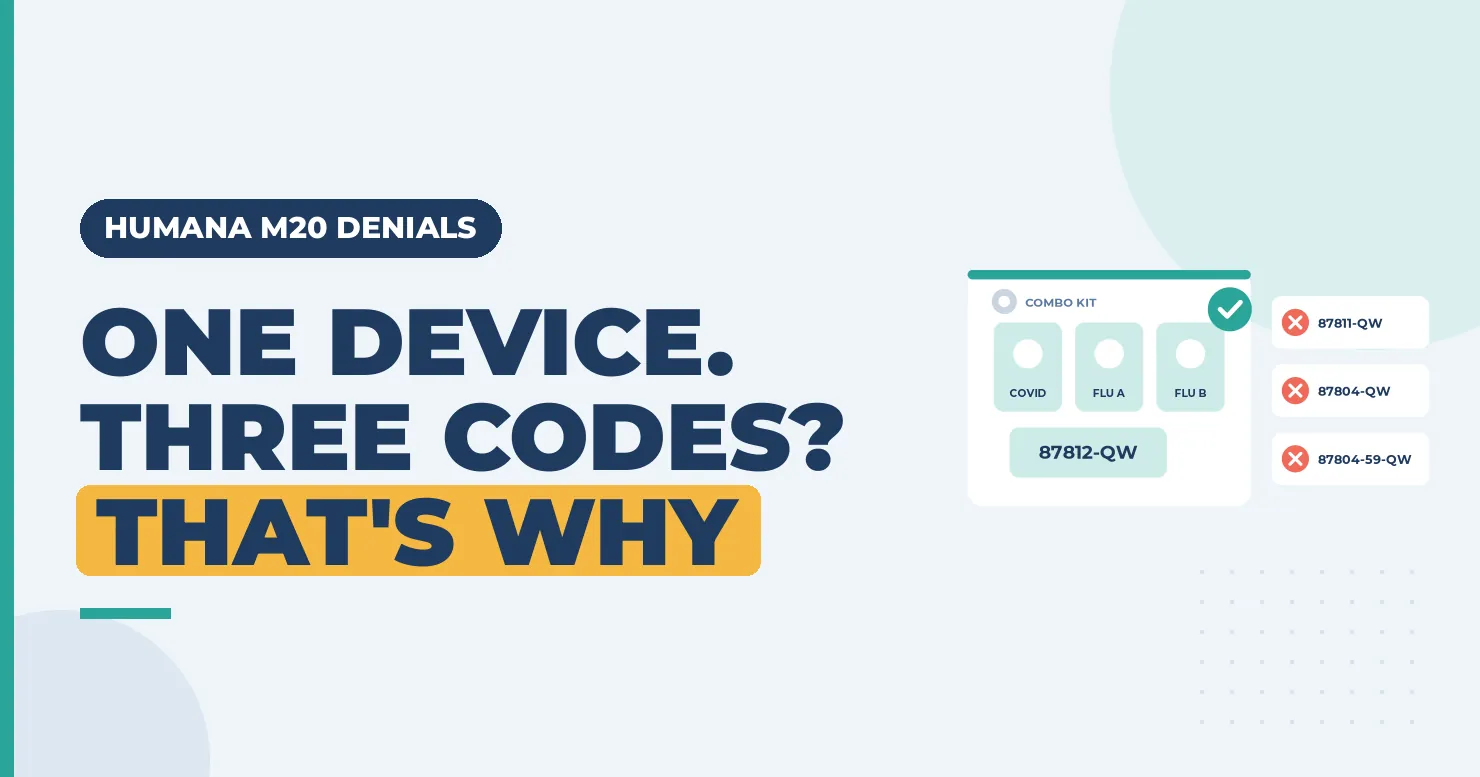
An 87811 87804 modifier QW 59 denial from Humana usually means one combo test was split into separate codes. Since January 1, 2026, a visually read COVID-19 and flu A/B test on one device is billed as one unit of 87812-QW.
If your clinic runs a single cartridge that shows COVID, flu A, and flu B, stop billing 87811-QW plus 87804-QW and 87804-59-QW. Bill 87812-QW once instead. Keep the split codes only when you truly run separate tests.
TL;DR: Humana’s remark “Missing/incomplete/invalid HCPCS” is RARC M20, usually paired with CARC 16. The most common cause in 2026 is the new combo code. CMS added 87812-QW to the CLIA waived list for dates of service on or after January 1, 2026.
Written by Manikandan J, CPC, CRCR, a certified coder and revenue cycle specialist. Published 11 November 2026. Last updated: 11 November 2026.
Table of Contents
Why is Humana denying 87811-QW and 87804-59-QW?
Humana is most likely denying 87811-QW and 87804-59-QW because the test was one combo device. For 2026 dates of service, a visually read SARS-CoV-2 plus influenza A and B test has its own code, 87812. Billing the parts separately looks like an invalid code choice.
RARC M20 is the remark code for a missing, incomplete, or invalid HCPCS code. It usually comes with CARC 16, which means the claim lacks information or has a billing error. Our CO-16 denial code guide explains that pair.
The pattern fits the clue in the remit. Humana pays 87804-QW alone but rejects the second flu line and the COVID line. That is what a combo-code edit looks like.
Original Medicare or other plans may still pay the split codes today. That does not make the split correct for a single device. Payers adopt new code edits at different speeds.
What is CPT 87812 and when do you bill it?
CPT 87812 is infectious agent antigen detection by immunoassay with direct optical (visual) observation for SARS-CoV-2 and influenza A and B. You bill it once when one visually read test reports all three targets. It became effective January 1, 2026, and is CLIA waived as 87812-QW.
CMS announced the code in its September 25, 2025 MLN Connects newsletter. It said visually read combination tests use 87812-QW from January 1, 2026. Before that date, labs could bill 87428-QW for those tests.
CMS Change Request 14273 then added 87812QW to the waived test list. It lets facilities with a valid CLIA certificate of waiver bill 87812QW for dates of service on or after January 1, 2026.
| What you ran | Code to bill | Units |
|---|---|---|
| One visual combo test: COVID, flu A, flu B | 87812-QW | 1 |
| Instrument-read combo antigen test: COVID, flu A, flu B | 87428-QW (if waived) | 1 |
| Visual COVID antigen test only | 87811-QW | 1 |
| Visual flu test only, one result | 87804-QW | 1 |
| Visual flu test with separate A and B results | 87804-QW and 87804-59-QW | 2 lines |
The device decides the code, not the order. Read the test kit’s package insert. If one cartridge gives all three results, it is a combo test.
When are 87811-QW and 87804-QW still correct?
87811-QW and 87804-QW are still correct when you run two separate tests. One device tests COVID only, and another device tests flu only. In that case, each code describes a real, distinct test, so the split is accurate and supported.
The chart must show two tests. List each kit name, each result, and who read it. Without that, the claim looks like an unbundled combo test.
Humana’s influenza payment policy also limits 87804. It says 87804 is not payable with another flu test, such as 87400, 87501, or 87502. It also lists the symptoms and diagnoses that support flu testing.
Which modifiers go on a separate flu A and flu B test?
A separate flu A and flu B test uses 87804-QW on the first line and 87804-59-QW on the second. Modifier QW marks a CLIA waived test. Modifier 59 tells the payer the second line is a distinct result, not a duplicate. This applies only to flu-only devices.
Modifier QW is the HCPCS modifier for a CLIA waived test. Medicare and plans that follow it need QW from sites with a certificate of waiver. The CLIA number must also be on the claim.
Some payers prefer 2 units on one line instead of a 59 line. Check the payer’s rule before you rebill. Never add 59 to make a combo device look like two tests.
In my AR work, I have seen clinics keep old flu and COVID charge buttons long after a new kit arrived. The denials started the week the payer loaded the new code edit.
How do you fix a Humana M20 denial on rapid tests?
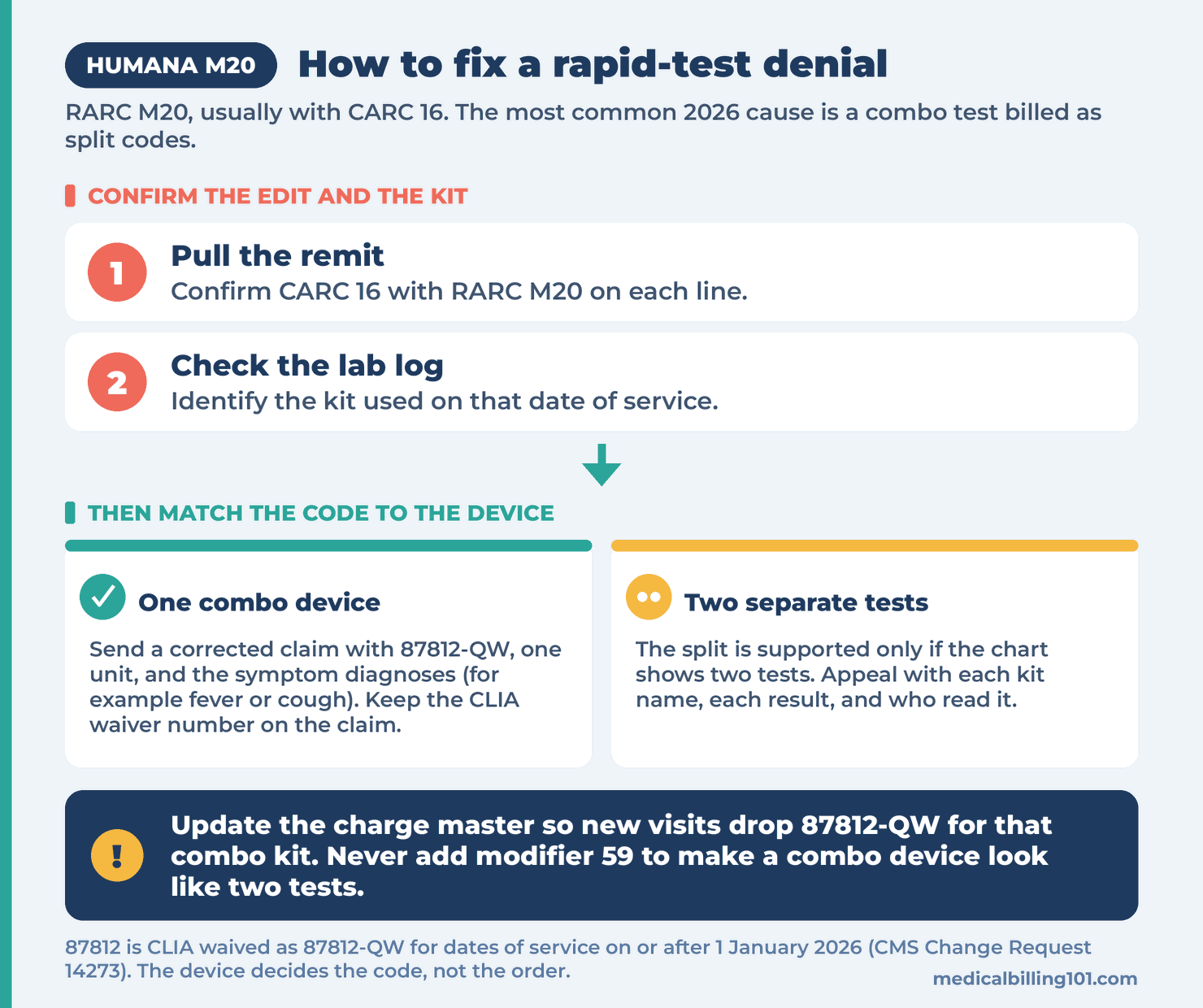
You fix a Humana M20 denial on rapid tests by matching the code to the device. If one combo device was used, send a corrected claim with 87812-QW, one unit, and the symptom diagnoses. If two separate tests were run, appeal with the kit names and results.
- Pull the remit and confirm CARC 16 with RARC M20 on each line.
- Check the lab log for the kit used on that date of service.
- For a combo kit, replace the split lines with 87812-QW, one unit.
- Keep the CLIA waiver number and a symptom diagnosis, such as fever or cough.
- Update the charge master so new visits drop 87812-QW for that kit.
Our corrected claim guide shows the frequency code to use. The CARC and RARC code list explains other remark codes. For a different lab unit problem, see our 87798 units denial guide.
3-step checklist
- Identify the test kit: one combo cartridge or two separate tests.
- Bill 87812-QW once for a combo kit; bill 87811-QW and 87804-QW lines only for separate tests.
- Send a corrected claim with the CLIA number and symptom diagnoses, then update your charge codes.
FAQ
Can you still bill 87811 and 87804 together in 2026?
Only when two separate tests were run, one for COVID and one for flu. A single visually read device that reports COVID, flu A, and flu B is billed as one unit of 87812-QW for dates of service on or after January 1, 2026.
Does 87812 need modifier QW?
Yes, when a site with a CLIA certificate of waiver performs it. CMS added 87812QW to the waived test list in Change Request 14273, effective January 1, 2026.
What does Humana’s Missing/incomplete/invalid HCPCS denial mean?
It is RARC M20, usually paired with CARC 16. It means the payer does not accept the procedure code as billed. On rapid tests, it often means a combo test was split into separate codes.
Should the second 87804 line use modifier 59?
For a flu-only test with separate A and B results, many payers accept 87804-QW plus 87804-59-QW. Some prefer 2 units on one line. Do not use 59 on a combo COVID and flu device.
What code did combo tests use before 87812?
Before January 1, 2026, CMS allowed labs to bill 87428-QW for visually read COVID and flu A/B combination tests, according to its September 2025 MLN Connects notice.
Sources
My methodology was simple. I read the CMS notices and change request line by line, then checked Humana’s flu policy and the Medicare flu billing articles. Payers load new code edits at different times, so confirm the plan’s current rule before you rebill.
- CMS, MLN Connects Newsletter, September 25, 2025: COVID-19 and Influenza Virus Types A and B Test Code. Accessed 11 Nov 2026.
- CMS, MLN Matters MM14273: New Waived Tests (87812QW, effective January 1, 2026). Accessed 11 Nov 2026.
- CMS, Transmittal 13465, Change Request 14273 (November 14, 2025). Accessed 11 Nov 2026.
- CMS Medicare Coverage Database, Billing and Coding: Influenza Diagnostic Tests (A58817). Accessed 11 Nov 2026.
- CMS Medicare Coverage Database, Billing and Coding: Influenza Diagnostic Tests (A54769). Accessed 11 Nov 2026.
- Humana, Claims Payment Policies (Laboratory – Diagnostic Testing of Influenza). Accessed 11 Nov 2026.
- X12, Remittance Advice Remark Codes (M20). Accessed 11 Nov 2026.
Read about the author, or contact us with a question. See our editorial policy.
Last updated: 11 November 2026 · Educational content for U.S. billers. Payer policies vary by plan, so check the plan’s current policy.