
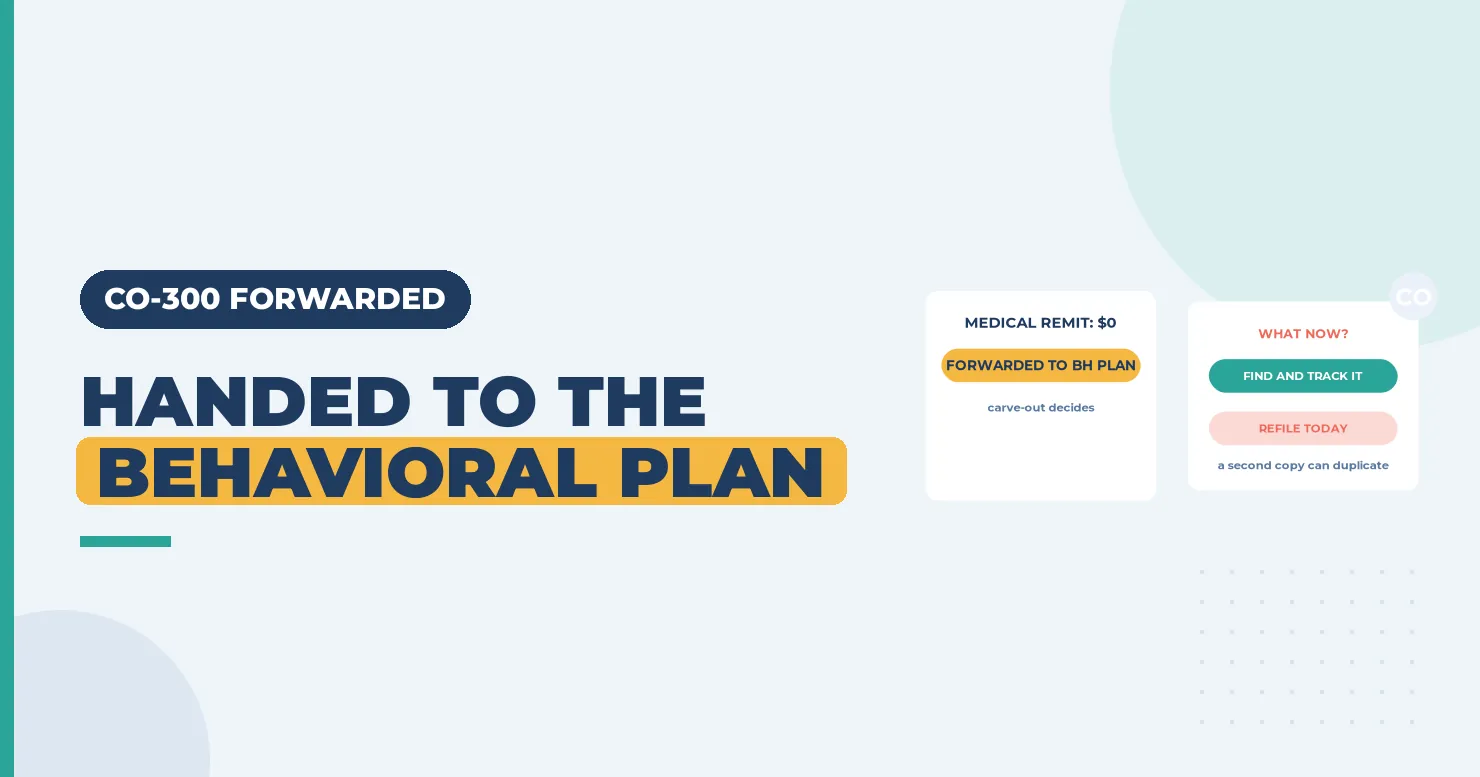
The CO-300 denial code means the medical plan has no benefit and forwarded your claim to the patient’s behavioral health plan. Do not refile right away. Post the medical zero, confirm the behavioral health plan has the claim, and track it to payment. (Primary source: X12 Claim Adjustment Reason Codes)
In brief: CARC 300 is a handoff, not a final no. Mental health or substance use care sits with a separate plan, and the medical plan sent the claim there for you. Its twin, CARC 301, means you must send it yourself.
Part of our denial codes library. Written by Manikandan J, CPC, CRCR, who has followed carve-out claims for therapy groups and psychiatry practices. Published 16 November 2026. Last updated: 16 November 2026. Code wording quoted word for word from X12. Read about the author and our editorial policy, or contact us to report an error.
What does denial code CO-300 mean?
Denial code CO-300 means the medical plan routed your claim to a behavioral health plan. Reason code 300 shows up when an employer or health plan carves out mental health and substance use benefits. A separate company, often called a behavioral health organization, then pays those claims.
| Field | Value |
|---|---|
| Code | 300 |
| Description | “Claim received by the Medical Plan, but benefits not available under this plan. Claim has been forwarded to the patient’s Behavioral Health Plan for further consideration.” |
| Group codes | No X12 group restriction; CO and OA both appear |
| Start | 07/01/2019 |
| Twin code | CARC 301 when you must submit to the behavioral health plan yourself |
Source: X12 Claim Adjustment Reason Codes, checked 16 November 2026.
Methodology: the code wording is copied from the X12 list, and the posting steps follow normal 835 practice for forwarded claims.
Key terms: A carve-out is a benefit, such as mental health, moved to a separate company. A forwarded claim is one the payer passes to that company for you. CO is the contractual obligation group code.
CO-300 vs OA-300: what is the difference?
The two versions differ only in how the medical plan labels its zero. CO-300 books it as a contract adjustment, so it can never become a patient bill. OA-300 books it as an other adjustment, with no liability named. Your work is the same: mark the balance as forwarded and watch for the behavioral health remit.
Why was my claim forwarded to a behavioral health plan?
Your claim was forwarded because the service is a mental health or substance use service under a carve-out. For example, a diagnostic interview, psychotherapy or medication management with an F-code diagnosis fits this pattern. The medical plan had the carve-out partner on file, so it sent the claim on.
Carve-outs are common in employer plans. Federal parity rules still apply to the behavioral health plan, as the CMS mental health parity page explains. So a forwarded claim should get a fair review, not a lower standard.
Example scenario (fictional names), part 1
CO-300 Denial Example: What Happened
Marisol Greer bills for Juniper Counseling Associates, a small outpatient therapy group. Dr. Anika Strand, PsyD, saw a new patient for anxiety and billed 90791 with diagnosis F411. The front desk had scanned only the medical card, so the claim went to the patient’s medical plan, a fictional commercial plan.
The 835 came back with CAS*CO*300 and a zero payment. It also carried remark code N130, which reads “Consult plan benefit documents/guidelines for information about restrictions for this service.” A month passed with no word from any other payer.
Should Marisol rebill the medical plan, the behavioral health plan, or wait? Keep reading, or jump to how it was resolved. Keep reading, or jump to how the CO-300 denial was resolved.
How do I handle a CO-300 denial?
To handle a CO-300 denial, track the forwarded claim instead of sending a new one. Look up the patient in the behavioral health plan’s portal, or call its provider line. If the claim is there, answer any request and wait. If it is missing, file it yourself with the medical remit as proof.
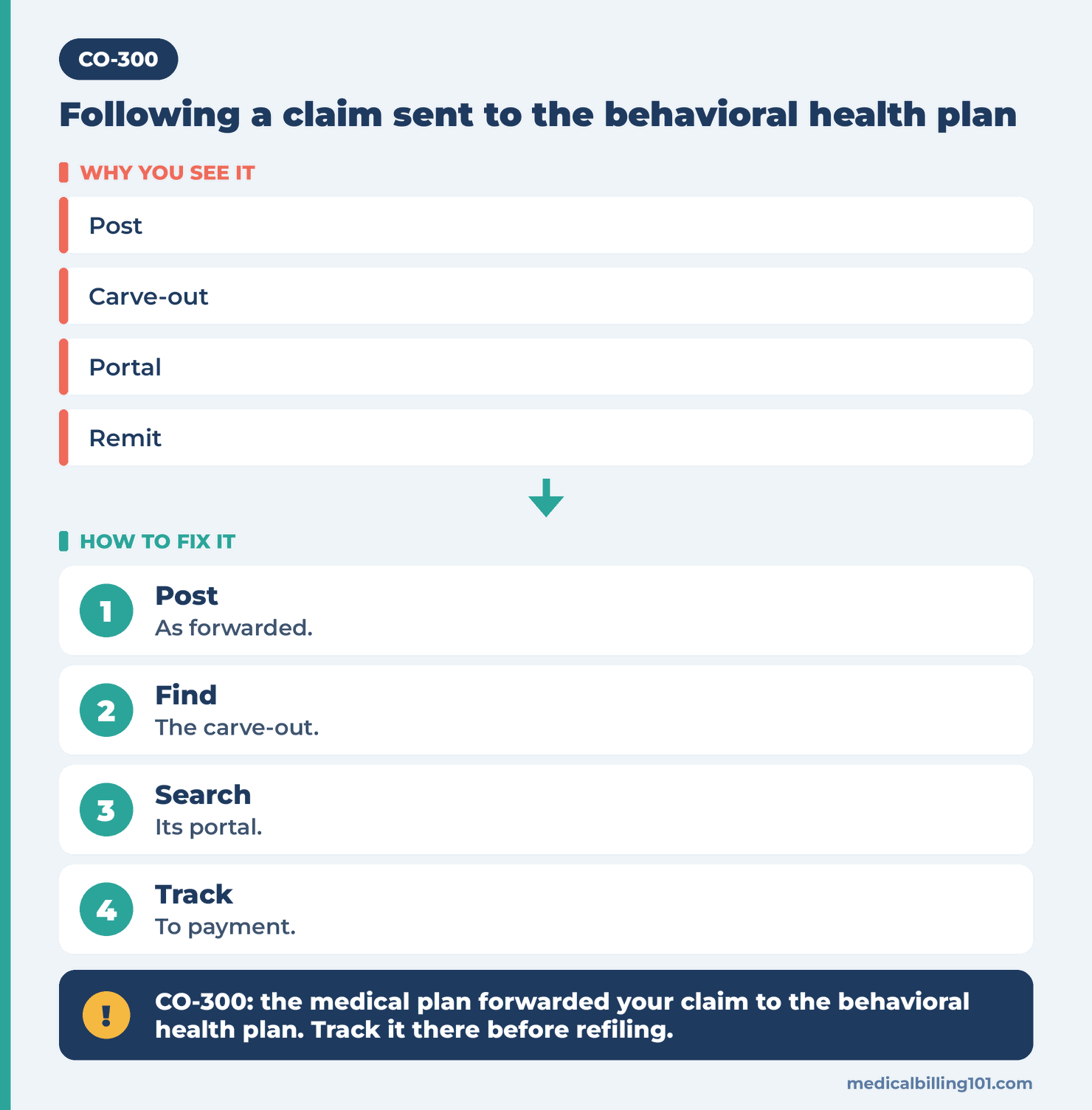
- Post the zero. Use a forwarded status, not a denial status, so nobody bills the patient.
- Find the carve-out plan. The medical plan’s phone line or the back of the card names it.
- Search its portal. Wait about two weeks, then look for the claim by date of service.
- Answer requests. Send a treatment plan or intake form only if the plan asks.
- File only if lost. Attach the medical remit so the original date counts for timely filing.
Example scenario (fictional names), part 2
How the CO-300 Denial Was Resolved
Marisol called the medical plan and asked who handled the patient’s behavioral health benefit. The rep named the carve-out company and gave the forward date. Its portal showed the claim, pending because the therapist was not yet loaded as an in-network provider.
Fix: Marisol sent the group’s contract confirmation to the behavioral health plan. She did not send a duplicate claim. She also logged the call reference and the forward date.
Outcome: the plan updated its provider file and paid 90791. Juniper now asks every new patient for both cards at intake.
Names and details are illustrative; no real patient data.
Names and details are illustrative; no real patient data.
Is a new claim needed after CO-300?
No, not as a first step. The behavioral health plan already has the claim, so a second copy can deny as a duplicate, like CO-18. Send your own claim only when that plan says it has no record. Then follow its submission rules, which the NUCC 1500 instructions support for the insurance boxes.
Can I bill the patient for CO-300?
No. The medical zero is not patient responsibility. Wait for the behavioral health plan’s remit. The patient may then owe a copayment, coinsurance or deductible, exactly as that plan reports it. Medicare patients follow different rules; see the Medicare outpatient mental health page for that benefit.
Related codes
| Code | Meaning |
|---|---|
| CO-298 | Medical plan forwarded the claim to the vision plan |
| CO-291 | Medical plan forwarded the claim to the dental plan |
| CO-292 | Medical plan forwarded the claim to the pharmacy plan |
| CO-109 | Service not covered by this payer; send to the correct payer |
FAQ
What does CO-300 mean?
The medical plan has no benefit and already forwarded the claim to the behavioral health plan.
How is CO-300 different from CO-301?
With CO-300 the plan forwarded the claim. With CO-301 you must send it yourself.
Should I refile a CO-300 claim?
Usually not. Confirm the behavioral health plan has it, then wait for its remit.
Which group code comes with CARC 300?
X12 sets no restriction. CO and OA both appear on forwarding notices.
When can I bill the patient after CO-300?
Only after the behavioral health plan’s remit shows a patient share.
Sources
How we checked: the CARC 300 quote was matched word for word with the X12 CARC list on 16 November 2026, and N130 with the X12 RARC list.
- X12, Claim Adjustment Reason Codes (CARC 300, 301, 18). Accessed 16 Nov 2026.
- X12, Remittance Advice Remark Codes (N130). Accessed 16 Nov 2026.
- CMS, Mental Health Parity and Addiction Equity Act. Accessed 16 Nov 2026.
- Medicare.gov, outpatient mental health care. Accessed 16 Nov 2026.
- NUCC, 1500 claim form instructions. Accessed 16 Nov 2026.
Last updated: 16 November 2026 · Educational content; not legal advice.