
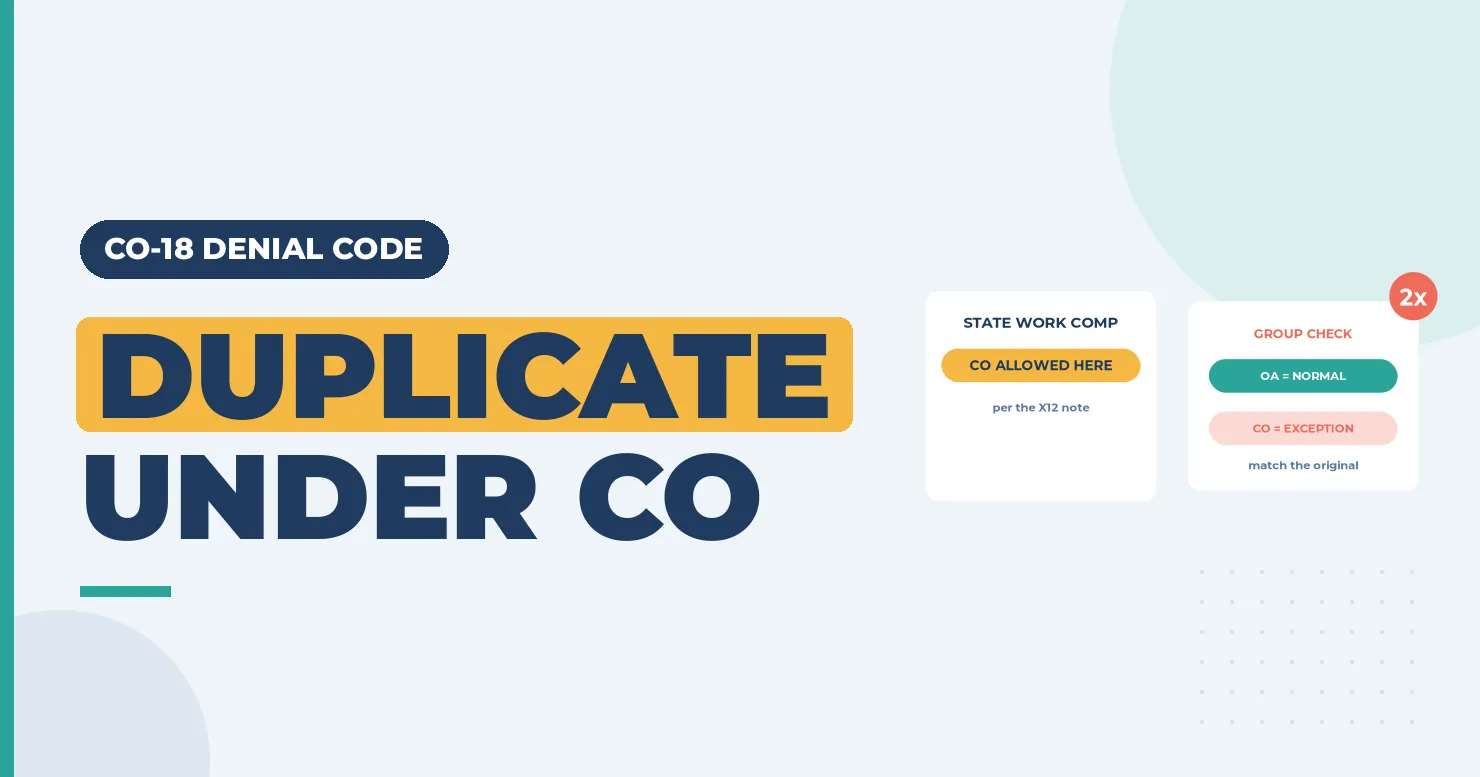
CO-18 means the payer thinks this claim or service line is an exact copy of one it already has. The odd part is the group code. X12 tells payers to send reason code 18 with group OA, and to use CO only where a state workers’ compensation rule requires it. So when you see CO-18, ask two things. Is this really a duplicate? And why did the payer put it under CO? (Primary source: X12 Claim Adjustment Reason Codes).
In brief: CO-18 is a duplicate claim denial with a contractual group. Most payers should send OA-18. CO-18 is expected mainly on workers’ comp claims in states whose rules call for it. First match the denied line to the original claim. If the original was paid, post CO-18 as a zero-pay line and move on. If the original was denied or never paid, don’t resend the same claim. Fix the original with a corrected claim or an appeal.
Part of our denial codes library. Written by Manikandan J, CPC, CRCR, who has worked denial queues for payers and billing companies. Published 20 October 2026. Last updated: 20 October 2026. Code wording is quoted word for word from X12.
Official wording for CARC 18
| Field | Official X12 text |
|---|---|
| Description | “Exact duplicate claim/service (Use only with Group Code OA except where state workers’ compensation regulations requires CO)” |
| Start | 01/01/1995 |
| Last modified | 06/02/2013 |
Source: X12 Claim Adjustment Reason Codes, checked 20 October 2026.
The note inside the description is the key to this page. It limits CO to one setting. Our OA-18 guide covers the normal OA version in full.
Two terms come up again and again on this page. A corrected claim is a replacement claim that carries frequency code 7 and the original claim number, so the payer updates the first claim instead of logging a second one. A crossover claim is a claim that Medicare or another primary payer forwards automatically to the secondary payer after it finishes processing.
Denial code 18, CARC 18 and reason code 18
These names all point to one X12 code. A payer portal may display denial code 18, an electronic remittance shows CARC 18 inside a CAS segment next to a group code, and many billing teams simply say reason code 18. The number tells you “duplicate”. The group code tells you who carries the balance, and here it also hints at the payer’s setup.
When is CO-18 correct and when is it a payer error?
| Situation | Expected group | What it tells you |
|---|---|---|
| Commercial or Medicare duplicate | OA-18 | Normal use. No patient balance. |
| Workers’ comp claim in a state that requires CO | CO-18 | Allowed by the X12 note. |
| Commercial claim, no workers’ comp | CO-18 | Likely a payer mapping error. Still a duplicate. |
| Duplicate of a crossover claim | OA-18 with N522 | The secondary already has it from the primary. |
For example, a wrong group doesn’t change the money on a true duplicate. The original claim carries the payment. But a wrong group can confuse your posting rules and your write-off reports. Log it and tell your payer rep if it keeps happening.
Why claims come back as CO-18
- A clearinghouse resend. A batch was sent twice after a timeout or a rejected acknowledgment.
- Resubmitting instead of correcting. Staff sent the same claim again to “fix” an error, not a corrected claim.
- Rebilling before the first claim finished. The first claim was still pending when a second copy went out.
- Two providers, same line. Both a group and an individual NPI billed the same service.
- Split billing in one day. The same code and date sit on two claims with no modifier to show they’re distinct.
- Work comp and health plan overlap. The carrier got the claim from both the provider and an employer bill review vendor.
Some payers add a remark code to explain the match, such as a crossover note. Two you may see are N522, “Duplicate of a claim processed, or to be processed, as a crossover claim”, and N111, which says there’s no appeal right except on the duplicate issue. Wording is from the X12 RARC list.
How to work a CO-18 line
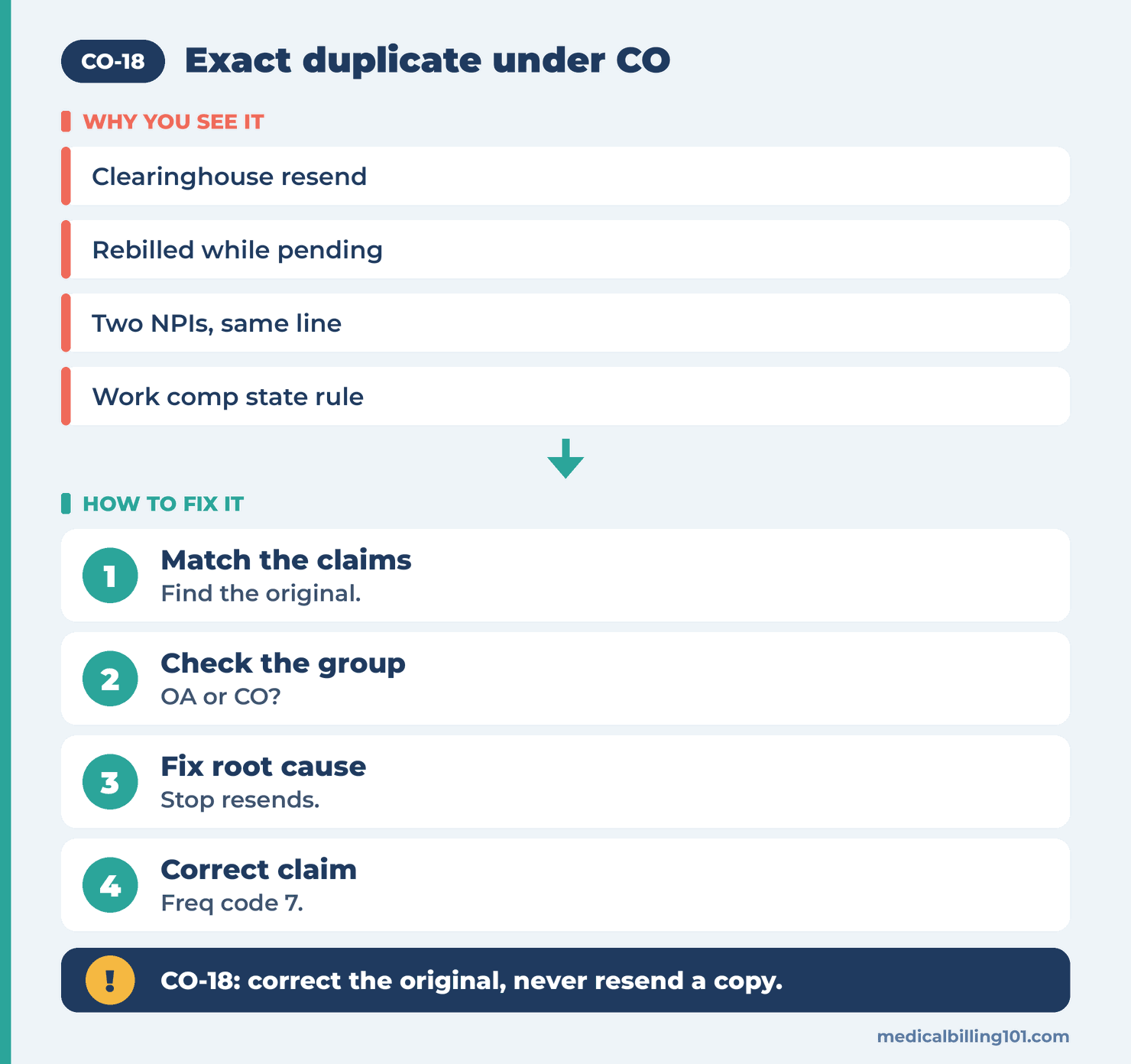
- Find the original claim. Search by patient, date of service, code and billed amount. Note its claim number and status.
- Check the original’s outcome. Paid, denied, pending or not on file. Each one leads to a different next step.
- Check the group code. If it isn’t a workers’ comp claim, note the CO as a likely payer error.
- Fix the root cause. Turn off auto-resend in the clearinghouse, or stop staff from rebilling pending claims.
- Correct, don’t resend. If the original needs a change, send a replacement claim (frequency code 7) that points to the original claim number.
- Appeal only for a false duplicate. If the two services are truly separate, send the records and the right modifier.
Is it really a duplicate? A quick test
Lay the two claim lines side by side and compare each field, because payers usually match on a combination of member, date, code, units and provider rather than on the claim number alone.
| Check | Same on both? | If different |
|---|---|---|
| Patient and member ID | Usually yes | Not a duplicate. Ask for review. |
| Date of service | Yes for a duplicate | Rebill with the right date. |
| Procedure code and modifiers | Yes for a duplicate | Add modifier 76, 77 or 59 if the service was repeated or distinct. |
| Units | Yes for a duplicate | Show the correct units on one line. |
| Rendering NPI | Yes for a duplicate | Check who really did the service. |
If every row matches, it’s a real duplicate. Close the line with no write-off beyond the zero amount. If one row is different, you may have a false duplicate.
Workers’ comp claims with CO-18
Some state workers’ comp systems use their own billing rules and their own e-billing guides. In those states, CO-18 can be the expected code. The carrier may also send a state-specific explanation code. Check the state’s medical billing guide and the carrier’s explanation of review before you dispute the group code, since the state rule may require exactly what the carrier sent. If the claim was already paid by the carrier, you’re done. If an employer vendor sent a copy, ask the carrier to note which submission is the claim of record.
Worked example (illustrative)
A clinic bills a 99214 for a commercial patient on 2 September. The clearinghouse times out and resends the batch. The payer pays the first claim and returns the second with CAS*CO*18*145.00. The biller finds the paid original and posts the second line as a zero-pay duplicate. She notes that the group should have been OA, emails the payer representative with three similar examples, and changes the clearinghouse settings so timed-out batches are no longer resent automatically.
A second case: a therapist bills two 97110 units on two claims for the same day. The second claim gets CO-18. The visits really were separate, morning and afternoon. The biller sends a corrected claim with all units on one line, as the payer’s manual asks.
How to prevent CO-18
- [ ] Check claim status before you rebill anything.
- [ ] Use a corrected claim (frequency code 7) to fix a sent claim.
- [ ] Turn off auto-resend after clearinghouse timeouts.
- [ ] Bill each service once, under one billing NPI.
- [ ] Use modifier 76 or 77 for true repeat services, with records.
- [ ] Track CO-18 and OA-18 by payer to spot mapping errors.
Related denial codes
- OA-18: the standard group for an exact duplicate.
- CO-97: service included in another service.
- CO-B13: previously paid as part of another service.
- CO-29: time limit for filing has expired.
- CO-16: claim lacks information needed for adjudication.
- Denial codes hub for every code we cover.
Key takeaways
CO-18 is a duplicate denial carrying a group code X12 reserves for some workers’ comp states. Match it to the original claim first. If the original paid, close the line. If not, fix the original with a corrected claim or an appeal, never another copy. Flag CO groups on non-work comp claims to the payer.
FAQ
What does CO-18 mean on a remit?
It means the payer matched the claim or service line to one already on file and reported the duplicate with the contractual group code instead of the usual OA group.
Should CO-18 be OA-18?
Usually yes. X12 says to use OA, except where state workers’ compensation rules require CO.
Can I bill the patient for CO-18?
No. A duplicate carries no patient balance, because the original claim holds any payment, deductible or coinsurance that applies.
How do I fix a CO-18 denial?
Find the original claim. If it paid, close the line. If it needs changes, send a corrected claim with frequency code 7.
Can I appeal CO-18?
Yes, if the services were truly separate. Send records and the right modifier, such as 76 or 59.
Why do clearinghouse resends cause CO-18?
A timeout can make the system send the same batch twice. The payer then treats the second copy as a duplicate.
Sources
How we checked: every code quote on this page was compared word for word with the X12 CARC and RARC lists on 20 October 2026.
- X12, Claim Adjustment Reason Codes (CARC 18). Accessed 20 Oct 2026.
- X12, Remittance Advice Remark Codes (N522, N111). Accessed 20 Oct 2026.
- CMS, Medicare Claims Processing Manual, Ch. 1, General Billing Requirements. Accessed 20 Oct 2026.
Last updated: 20 October 2026 · This page is educational and doesn’t replace payer contracts, state rules or coding guidance.