
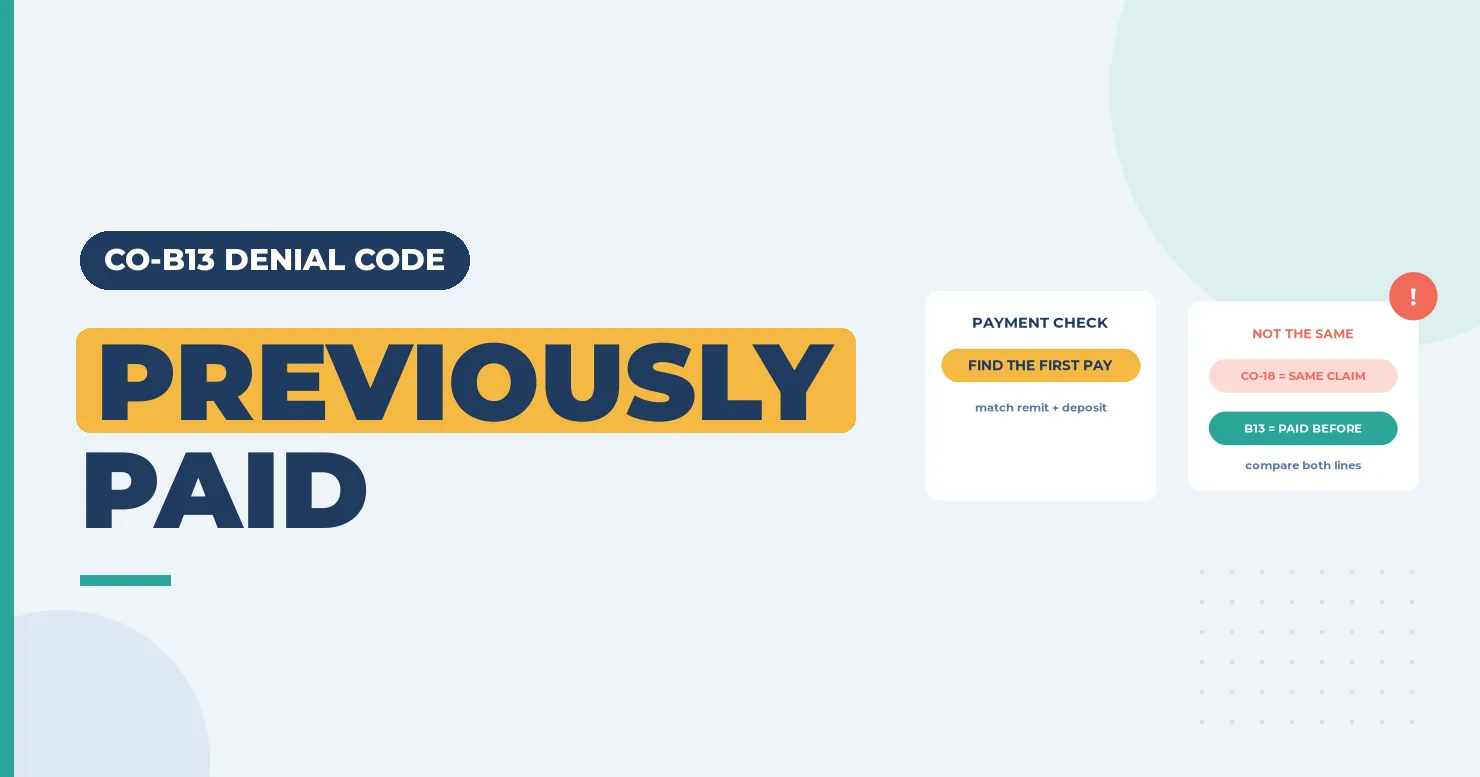
CO-B13 is Claim Adjustment Reason Code B13 with group code CO. CARC B13 says “Previously paid.” A previous payment is money the payer already issued for the same claim or service. Here the payer is telling you not to expect a second payment, because it believes the first one already covered this line. Many people search for “co b13 denial code”, and that is the phrase this page answers. (Primary sources: X12 Claim Adjustment Reason Codes · X12 RFI 2186 · CMS Claims Processing Manual, Ch. 22, §60.1)
Quick answer: CO-B13 means the payer thinks this claim or service was paid in a previous payment. The word “may” in the official wording matters, so do not assume it is right. Find the earlier payment, compare it line by line with this one, and check that you received it. If it is a true repeat, post the adjustment. If it is a different service, correct the claim and appeal with proof. A CO group means the patient is not billed.
Part of our denial codes library. Written by Manikandan, a revenue cycle management specialist with more than 10 years of US medical billing experience. Last reviewed: 17 October 2026. Official code wording is quoted word for word from X12; Medicare rules link to their CMS source.
CO-B13 denial code description (official X12 wording)
X12 Claim Adjustment Reason Code B13, verbatim:
“Previously paid. Payment for this claim/service may have been provided in a previous payment.”
Source: X12 Claim Adjustment Reason Codes, checked 17 October 2026. Start: 01/01/1995. X12 lists no usage note and no later modification.
The CARC is B13. The group code is usually CO. In X12’s group code list, CO means Contractual Obligation. CMS Transmittal 470 (2005) lists B13 with group code CO among its group code assignments for Medicare fiscal intermediaries. CMS Ch. 22, §60.1 says CO adjustments are generally a write-off for the provider and are not billed to the patient.
What CO-B13 means in plain English
- The payer says money was already sent. It points to an earlier payment for this claim or service.
- The wording is hedged. The word “may” means the payer is not sure which payment it means.
- It is a payment check, not a coverage decision. The service may be fully covered.
- The proof is in your records. Look for the earlier remit, the check or EFT trace, and your deposit.
- The patient does not owe it while the group is CO.
CO-B13 vs CO-18, CO-22, CO-97 and lookalikes
| Code | Official X12 idea | What it tells you |
|---|---|---|
| CO-B13 | Previously paid. Payment may have been provided in a previous payment | Earlier payment. This page |
| 18 | Exact duplicate claim/service | Same claim sent twice. See OA-18 |
| 22 | This care may be covered by another payer per coordination of benefits | Another payer. See CO-22 |
| 97 | The benefit for this service is included in the payment/allowance for another service/procedure that has already been adjudicated | Bundling. See CO-97 |
| 129 | Prior processing information appears incorrect | Payer says its earlier processing was wrong |
| B15 | Qualifying service not received or adjudicated | Missing prerequisite. See CO-B15 |
X12 words CARC 18 as “Exact duplicate claim/service (Use only with Group Code OA except where state workers’ compensation regulations requires CO).” B13 has no such limit, so it can appear with CO.
Remark codes that can come with CO-B13
X12 does not publish a fixed list of remarks for B13. One real X12 remark worth knowing is M86. X12 words it as “Service denied because payment already made for same/similar procedure within set time frame.” It points at a repeat service inside a time window, so read it as a clue to which earlier payment the payer means. Your payer may use other remarks, so read the line on your own remit.
Where the earlier payment can come from
X12 RFI 2186 gives one source that is easy to miss. When a provider accepted payment at the time of service, for example by card, X12 says the payment amount is reported with CARC B13. If the payer later decides the service was overpaid, X12 says the overpayment goes in with CARC 129 and RARC N199.
Other sources to check include:
- An earlier claim for the same line. It paid, and a later claim repeated it.
- A replacement or corrected claim. The payer paid the first version and treated the second as a repeat.
- A payment sent somewhere else. Another address, account or payee.
- A payment taken back and reissued. The history shows an old payment that no longer matches your posting.
- A service that looks like a repeat but is not. A second procedure or another provider on the same day.
Where CO-B13 shows up in the 835
CLP*PCN51920*4*210.00*0.00*0.00*12*CLAIM883041~
SVC*HC:99214*210.00*0.00**1~
CAS*CO*B13*210.00~
LQ*HE*M86~
- Status code 4 means the claim was denied.
- The line paid $0.
- CAS*CO*B13*210.00 took the full charge as a previously-paid adjustment.
- The LQ line, when present, carries a remark code that may give more detail.
- This sample is illustrative only. Real remits vary.
How to fix CO-B13: decision path
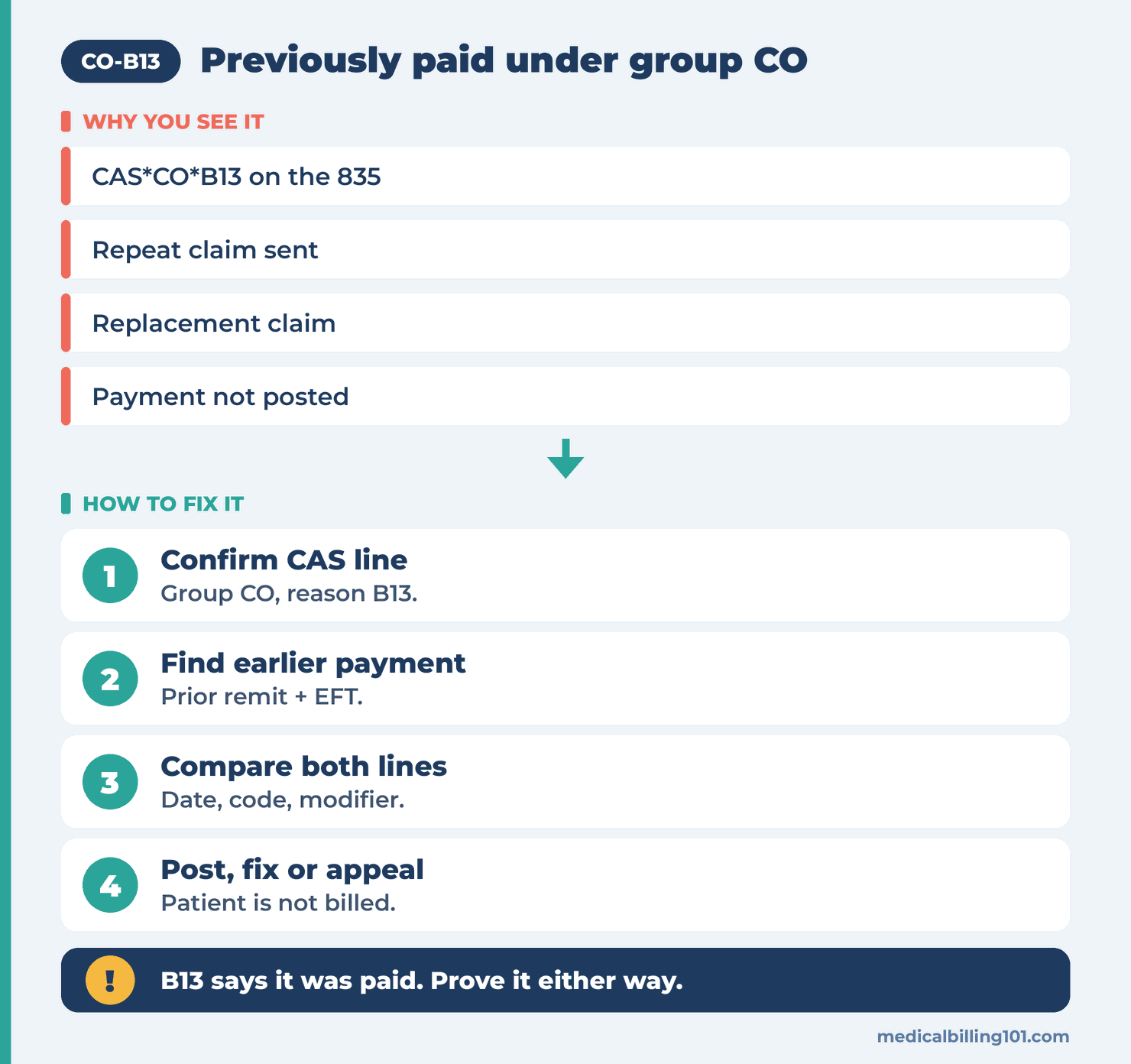
- Confirm the CAS segment. Check the group (CO), the reason (B13), and the amount. Save the remit.
- Find the earlier payment. Search the payer’s prior remits for the patient, date of service and code.
- Compare the two lines. Check patient, date, procedure code, modifier, units, rendering provider and place of service.
- Check receipt. Match the earlier payment to your EFT or check record and your posting.
- If it was paid and posted, accept the adjustment and close the line. Do not bill the patient.
- If it was paid but never posted, post it and find where it went.
- If it was not received, send the payer the proof of non-receipt and ask for a trace or reissue.
- If the services are different, correct the claim, such as a modifier that fits the coding rules, and appeal with the notes that show it was separate.
Medicare, commercial and Medicaid notes
Medicare. CMS Transmittal 470 lists B13 with CO. X12 has a separate CARC, 18, for an exact duplicate claim or service. Read which of the two the remit shows before you act.
Commercial. Plans differ on how they handle repeat and replacement claims. Check the provider manual for the corrected claim process, such as claim frequency code 7 for a replacement of a prior claim, and for the filing and appeal time limits.
Medicaid. State programs have their own history edits. For example, the New York State Medicaid 835 edit mapping lists several “previously paid” edits that return B13. Check the state manual for your program.
Worked example (illustrative)
A clinic bills 99214 for a patient seen on 9 September. The remit shows CAS*CO*B13*210.00 with remark M86.
Reading it: The payer says an earlier payment covers this service. The remark says a similar procedure was paid inside a time window.
Check: The billing team finds a claim from 11 September that paid 99214 for the same patient and date. The EFT trace matches the clinic’s deposit. The second claim was a resubmission sent after a clearinghouse rejection that the clinic did not see.
Fix: The team posts the adjustment, closes the line and does not bill the patient. It fixes the clearinghouse alert so rejections are worked the same day.
Second scenario: The earlier payment was for a different procedure, and the second claim is for a separate service done by another provider on the same day. The team sends a corrected claim with the modifier that fits the coding rules, plus the notes that show two separate services.
Prevention checklist
- [ ] Check claim status before you resubmit any claim.
- [ ] Work clearinghouse rejections the same day they arrive.
- [ ] Use the payer’s corrected claim process, not a new claim, for fixes.
- [ ] Post every payment to the right claim the day it arrives.
- [ ] Match each EFT or check trace to a posted batch.
- [ ] Track B13 by payer to see which edits repeat.
- [ ] Keep the CARC and RARC guide handy for staff training.
Related denial codes
- OA-18: exact duplicate claim or service.
- CO-22: care may be covered by another payer.
- CO-97: benefit included in another service.
- CO-B15: qualifying service not received or adjudicated.
- CARC and RARC guide.
Key takeaways
CO-B13 says the payer believes this claim or service was paid in a previous payment. Find that payment, compare it with this line and check that you received it. Post it if it is a true repeat. Correct and appeal if the service is separate. A CO group means the patient is not billed.
FAQ
What is the CO-B13 denial code description?
X12 describes CARC B13 as “Previously paid. Payment for this claim/service may have been provided in a previous payment.” CO-B13 is that reason with group code CO.
Can I bill the patient for CO-B13?
Not under the CO group. CMS says CO adjustments are generally a provider write-off. Bill the patient only for amounts on a PR adjustment.
Is CO-B13 the same as a duplicate claim denial?
Not exactly. CARC 18 is for an exact duplicate claim or service. B13 says a previous payment may have covered this claim or service.
What if I never received the earlier payment?
Check your EFT and deposit records first. If it was not received, send the payer proof and ask for a trace or a reissue.
Can I appeal a CO-B13 denial?
Yes, if the service is separate from the one already paid. Send both remits and the notes that show a different service.
Why does X12 say the payment “may” have been made?
That is the official wording of the code. It tells you to check the payment history before you accept or dispute the line.
Quick facts
| Item | Value |
|---|---|
| X12 code | B13 |
| X12 start | 01/01/1995 |
| Official wording | Previously paid. Payment for this claim/service may have been provided in a previous payment |
| Usual group | CO |
| CMS 2005 group for CARC B13 | CO |
| Common confusions | CO-18 (exact duplicate), CO-22 (other payer), CO-97 (bundled) |
| Last reviewed | 17 October 2026 |
Sources
- X12, Claim Adjustment Reason Codes (B13, 18, 22, 97, 129, B15). CARC B13 Start 01/01/1995. Accessed 17 Oct 2026.
- X12, Remittance Advice Remark Codes (M86, N199). Accessed 17 Oct 2026.
- X12, RFI 2186: payment prior claim submission. Accessed 17 Oct 2026.
- CMS, Medicare Claims Processing Manual (IOM 100-04), Ch. 22, §60.1 Group Codes. Accessed 17 Oct 2026.
- CMS, Transmittal 470 (4 Feb 2005). Accessed 17 Oct 2026.
- NYS Medicaid (eMedNY), 835 crosswalks: Edit Mapping for 835 in the Order of Edit Number. Accessed 17 Oct 2026.
Code wording and Medicare rules on this page were checked on 17 October 2026 against X12, CMS and state Medicaid sources.
Last reviewed: 17 October 2026 · This page is educational and doesn’t replace payer-specific contracts or coding rules.