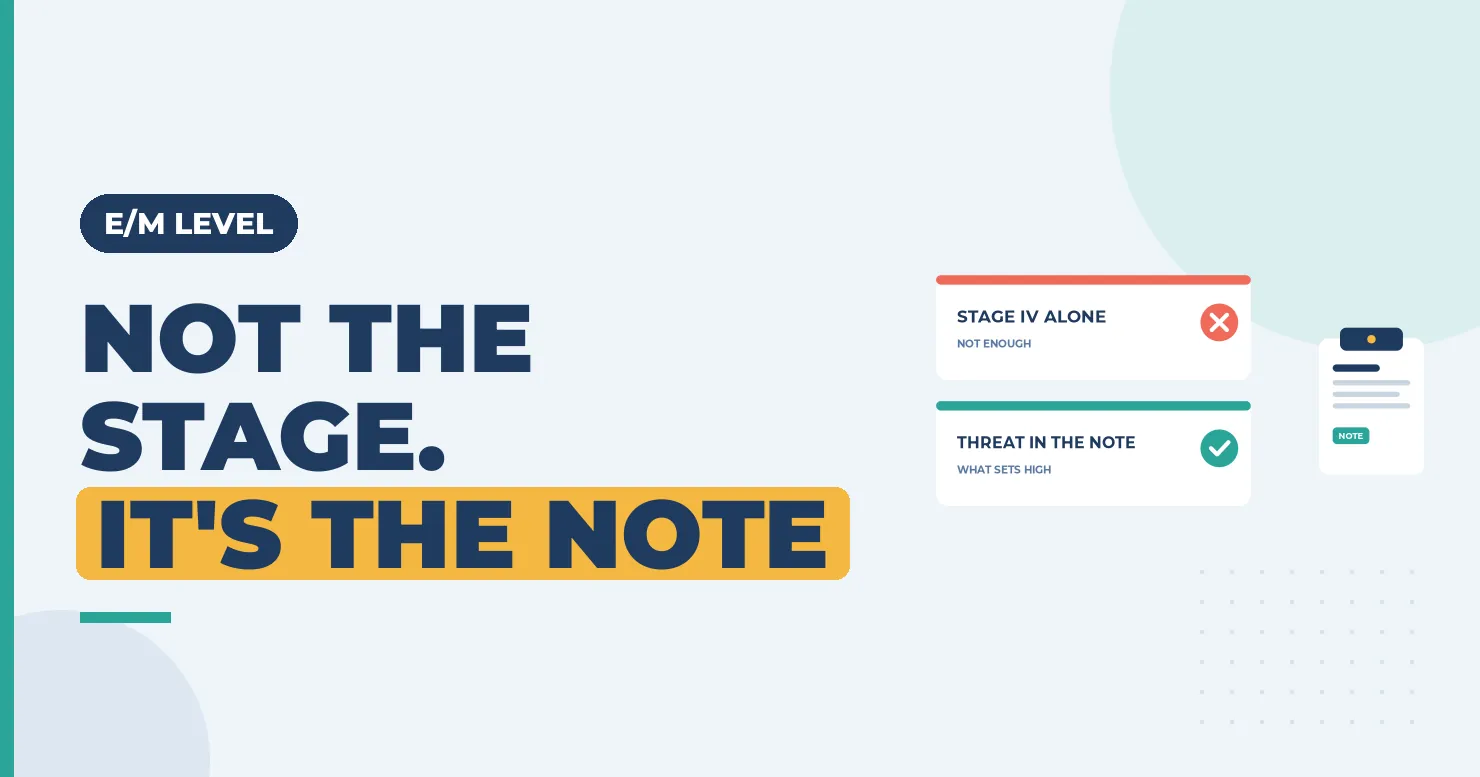
The E/M level cancer patient MDM rule is simple. Stage IV cancer alone does not make a visit high. The note must show a near-term threat to life or a severe progression.
If the note shows only progression being managed, the problem is moderate. To defend 99215 or 99205, chart the threat or a high-risk choice, such as major surgery with risk factors.
TL;DR: AMA E/M guidelines say the final diagnosis does not, by itself, set the complexity of problems addressed. A cancer follow-up is high only when the note shows severe worsening or a near-term threat to life or bodily function. Otherwise it is a chronic illness with progression, which is moderate. High MDM still needs two of three elements, so pair the problem with high risk or extensive data.
Written by Manikandan J, CPC, CRCR, a certified coder and revenue cycle specialist. Published 18 November 2026. Last updated: 18 November 2026.
Table of Contents
Does stage IV cancer count as a high-complexity problem for E/M?
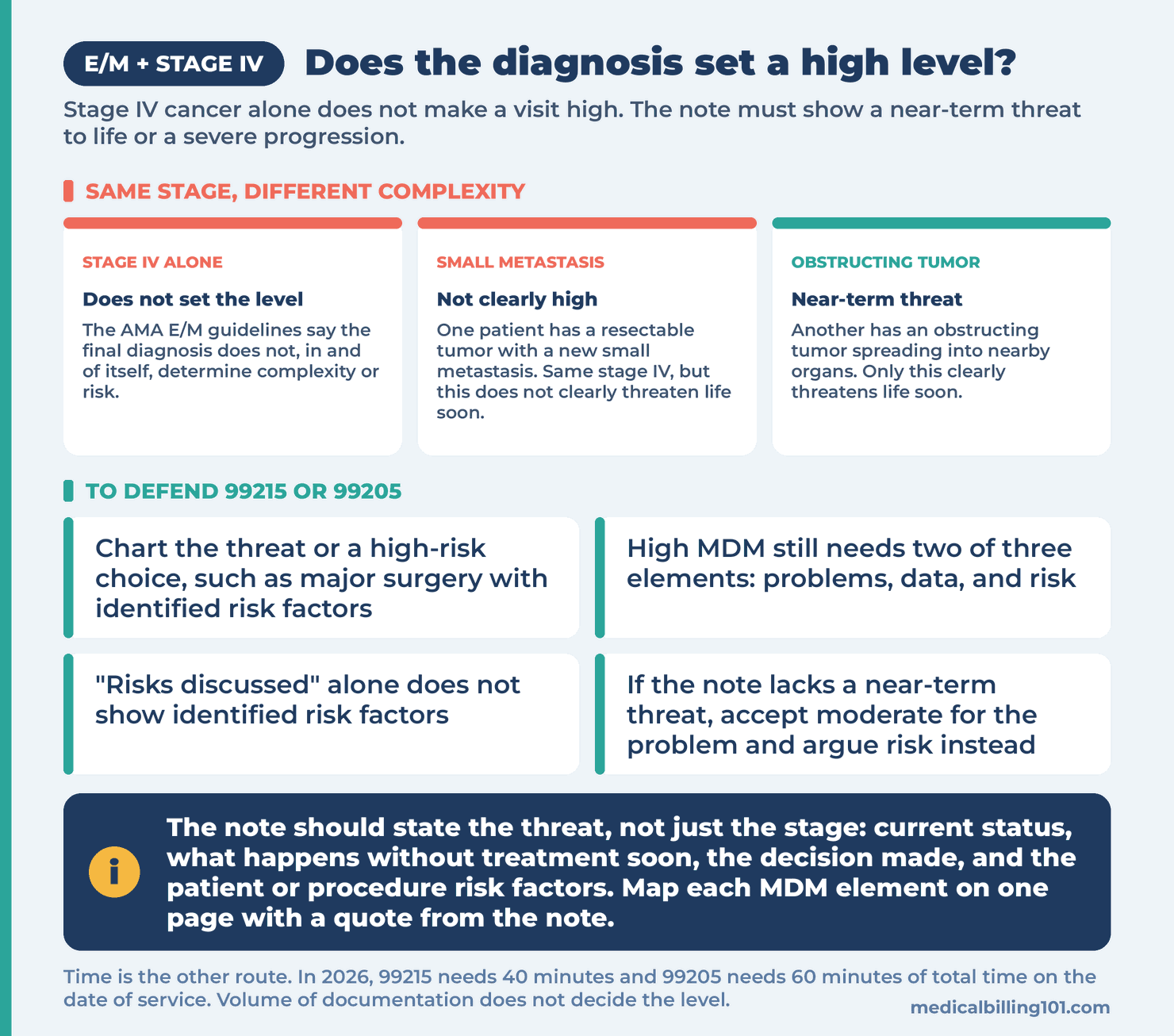
Not automatically. The AMA E/M guidelines say the final diagnosis does not, in and of itself, determine complexity or risk. The auditor in this kind of review is looking for what the note says about the patient that day.
Stage IV covers very different people. One has a resectable tumor with a new small metastasis. Another has an obstructing tumor spreading into nearby organs. Both have the same stage. Only the second clearly threatens life soon.
Medical decision making (MDM) is the level of thinking behind a visit, scored on problems, data and risk. So the label “stage IV” never sets the level. The doctor’s words about how fast things are changing and what to do next set it.
What is the difference between “exacerbation” and “threat to life”?
The difference is severity and timing. COPA is the auditor’s short name for complexity of problems addressed. A chronic illness with exacerbation, progression or side effects of treatment is a moderate problem. The AMA says this means a disease that is getting worse or poorly controlled. It needs more care or a change in treatment.
Two problem types reach high complexity. Each needs more than progression alone.
| Problem type | MDM level | What the note must show |
|---|---|---|
| Chronic illness with exacerbation, progression or side effects of treatment | Moderate | Worsening or progressing disease that needs added care or treatment changes |
| Chronic illness with severe exacerbation, progression or side effects of treatment | High | Significant risk of morbidity; may require escalation in level of care |
| Acute or chronic illness that poses a threat to life or bodily function | High | A threat to life or bodily function in the near term without treatment |
The AMA does not define “near term.” In practice, the note should show why waiting could risk death or organ loss. Examples are bowel obstruction, cord compression, rising bilirubin from a blocked bile duct, or a new rapid decline.
Does a discussion of surgery make the visit high risk?
It can. A decision about elective major surgery with identified patient or procedure risk factors is high risk in the AMA table. Without identified risk factors, the same decision is only moderate risk.
The note must name those risk factors. Examples are poor overall function, heart disease, weight loss, or a hard operation near major vessels. “Risks discussed” alone does not show identified risk factors.
The decision counts even when the patient declines. The AMA says risk includes decisions to start or forego further testing or treatment. A documented choice to skip surgery for comfort care can also qualify. Decision not to resuscitate or to de-escalate care because of poor prognosis is a high-risk example.
Chemotherapy can add high risk too. The AMA lists drug therapy requiring intensive monitoring for toxicity. Its own example is monitoring for low blood counts with an antineoplastic drug between cycles.
Can the visit be 99215 if the problem is only moderate?
Yes, if two other elements reach high. CPT 99215 is the high-level established patient office visit code. MDM needs two of three elements: problems, data, and risk. A moderate problem with high risk and high data still supports high MDM.
Most cancer follow-ups do not reach high data. So in real audits, high MDM usually needs a high problem plus high risk. Time is the other route. In 2026, 99215 needs 40 minutes and 99205 needs 60 minutes of total time on the date of service.
| Code | MDM level | Total time | 2026 Medicare national amount (office) |
|---|---|---|---|
| 99214 | Moderate | 30 minutes | About $135.61 (4.06 RVUs) |
| 99215 | High | 40 minutes | About $192.39 (5.76 RVUs) |
| 99204 | Moderate | 45 minutes | About $177.36 (5.31 RVUs) |
| 99205 | High | 60 minutes | About $236.81 (7.09 RVUs) |
A downcode from 99215 to 99214 costs about $56.78 per visit at the national rate. You can test any note’s elements in our E/M level calculator, which uses the same MDM table.
What should the note say to support high complexity?
The note should state the threat, not just the stage. Keep it short and plain. CMS says the record must support the level billed, and volume of documentation does not decide it. Its Evaluation and Management Services guide also says billing a higher level is not medically necessary when a lower level fits.
- Current status. New scan findings, labs, symptoms or decline that show severe progression.
- Near-term threat. What happens without treatment soon, such as obstruction, organ failure or loss of function.
- Decision made. Surgery, hospital admission, a chemo change with toxicity labs, or a move to hospice.
- Risk factors. The patient or procedure factors that make surgery high risk.
In my AR work, payer audits of cancer follow-ups often cut 99215 to 99214 when the note named the cancer but not the decision.
Rising 99215 rates also feed payer data checks. Our guide to OIG audit triggers shows why high-level E/M use draws review. If a Medicare contractor starts reviewing these claims, see how to handle a MAC prepayment review.
How do you dispute an auditor who downcoded the visit?
Use the AMA terms and the note’s own words. Quote the exact sentence that shows a near-term threat or severe progression. Then quote the decision and its risk factors.
Map each element on one page: problem level, data level and risk level, each with a quote. Reviewers accept a two-of-three map faster than a general complaint. If the note lacks a near-term threat, accept moderate for the problem and argue risk instead. For payer appeals, our appeal letter generator builds the letter, and our answer on billing 99221-99223 in observation covers the hospital code side.
If the same visit also included a procedure, the separate E/M needs modifier 25. Our modifier 25 and 59 helper walks through that test. Our answer on Aetna denying 99213 billed with an x-ray shows the fix in practice.
3-step checklist
- Read the note for a near-term threat or severe progression, not the cancer stage.
- Score problems, data and risk; high MDM needs two of three at high.
- If the note falls short, bill 99214 or 99204, or use total time when documented.
FAQ
Does a cancer diagnosis automatically support high MDM?
No. AMA E/M guidelines say the final diagnosis does not, in and of itself, determine complexity or risk. The note must show severe progression or a near-term threat to life or bodily function.
Is metastatic cancer a chronic illness with exacerbation or a threat to life?
It depends on the note. Progression being managed is a chronic illness with exacerbation or progression, which is moderate. A threat to life or bodily function in the near term without treatment is high.
Does discussing surgery with a cancer patient make the visit high risk?
Only for a decision about elective major surgery with identified patient or procedure risk factors, or emergency major surgery. Elective major surgery without identified risk factors is moderate risk.
Does chemotherapy count as high risk for E/M?
It can. Drug therapy requiring intensive monitoring for toxicity is high risk. The AMA example is monitoring for cytopenia with an antineoplastic agent between dose cycles.
Can a cancer follow-up be billed as 99215 by time?
Yes. In 2026, 99215 can be billed on time alone when the note shows at least 40 minutes on the visit date.
Sources
My methodology was simple. I checked the AMA E/M guideline definitions, the current CMS E/M services guide and the 2026 Medicare fee schedule file. Commercial payers and auditors may apply their own tools, so check each payer’s policy.
- AMA, CPT Evaluation and Management (E/M) Code and Guideline Changes: number and complexity of problems, risk definitions and Table 1 (linked above). Accessed 18 Nov 2026.
- CMS, MLN006764 Evaluation and Management Services, May 2026 (linked above). Accessed 18 Nov 2026.
- CMS, PFS Relative Value Files, CY 2026 October release, RVUs (CMS page). Accessed 18 Nov 2026.
Read about the author, or contact us with a question. See our editorial policy.
Last updated: 18 November 2026 · Educational content for U.S. billers. Check each payer’s current rules.