
The CO-P16 denial code means the workers’ comp payer says the provider on the line is not authorized or certified to treat injured workers in that state. Many states run a provider network or approval list for comp care. If the person named on the claim is not on it, the line is denied and the practice absorbs it. (Primary source: X12 Claim Adjustment Reason Codes)
In brief: reason code P16 is about who treated the patient, not what was done. First check which provider the claim names in Box 24J. If that is a data error, send a corrected claim with the right rendering provider. If the provider really is not approved, enroll before more visits and refer the worker to an approved provider meanwhile.
Part of our denial codes library. Written by Manikandan J, CPC, CRCR, who has worked comp denials for urgent care, occupational health and orthopedic groups and has set up provider enrollment checks for new hires. Published 24 November 2026. Last updated: 24 November 2026. Code wording quoted word for word from X12. Read about the author and our editorial policy, or contact us to report an error.
What does denial code CO-P16 mean?
Denial code CO-P16 tells you the comp payer will not pay because the treating provider is not approved for workers’ comp care in that jurisdiction. X12 limits the code to workers’ compensation and allows only the CO or OA group. You will not see CARC P16 from a health plan.
| Field | Value |
|---|---|
| Code | P16 |
| Description | “Medical provider not authorized/certified to provide treatment to injured workers in this jurisdiction. To be used for Workers’ Compensation only. (Use with Group Code CO or OA)” |
| Use | Workers’ compensation only |
| Group codes | CO or OA only (X12 rule) |
| Start | 11/01/2013; replaces code W5 |
| Common remark | N612 or N290 |
Source: X12 Claim Adjustment Reason Codes, checked 24 November 2026.
Methodology: the code wording is copied from the X12 list. The fix steps use Washington’s comp provider network as a worked example, because each state sets its own approval rules.
Key terms: A rendering provider is the person who actually performed the service, reported in Box 24J. A provider network is the list of providers a state comp system has approved to treat injured workers. An initial visit is the first office or emergency room visit for a new injury.
CO-P16 vs OA-P16: which group fits?
With CO-P16, the denied amount is your write-off. The worker cannot be billed, because comp rules make the provider follow the state’s billing rules. OA-P16 can appear when the payer wants to flag the approval problem without assigning it to the provider, such as on a crossover remit. X12 bars the PR group for P16, so a P16 line should never move to the patient.
| Group | Who absorbs it | Your next step |
|---|---|---|
| CO-P16 | Your practice | Check Box 24J, then the provider’s approval status |
| OA-P16 | Not assigned | Read the payer’s note before posting |
Example scenario (fictional names), part 1
CO-P16 Denial Example: What Happened
Jordan Pike runs billing at Riverbend Urgent Care in Spokane, Washington. A roofer hurt his left shoulder at work, S43.402A. Dr. Hana Sato saw him on the injury day. Physician assistant Leo Marsh saw him for two follow-up visits, billed as 99213.
The first visit paid. Both follow-ups came back with CAS*CO*P16 and remark N612, “Medical provider not authorized/certified to provide treatment to injured workers in this jurisdiction.” Leo has been in the comp network for two years.
So why did the payer think the follow-ups came from someone who was not approved? Keep reading, or jump to how the CO-P16 denial was resolved.
Why do providers get CARC P16?
Most P16 denials come from one of five causes. Some are real approval gaps, and some are claim data errors that only look like one.
| Cause | What you will see |
|---|---|
| Wrong rendering provider | Box 24J names someone other than the person who treated |
| New hire not enrolled yet | Visits started before the network approval date |
| Approval lapsed | Network status ended or was suspended |
| Visit beyond the initial visit | A nonnetwork provider kept treating after the first visit |
| Wrong state rules | Care given in a state where the provider is not approved |
In Washington, for example, WAC 296-20-015 says a nonnetwork provider is not authorized to treat beyond the initial office or emergency room visit. Physician assistants and nurse practitioners are on the list of provider types that must join, under WAC 296-20-01010.
How do I fix a CO-P16 denial?
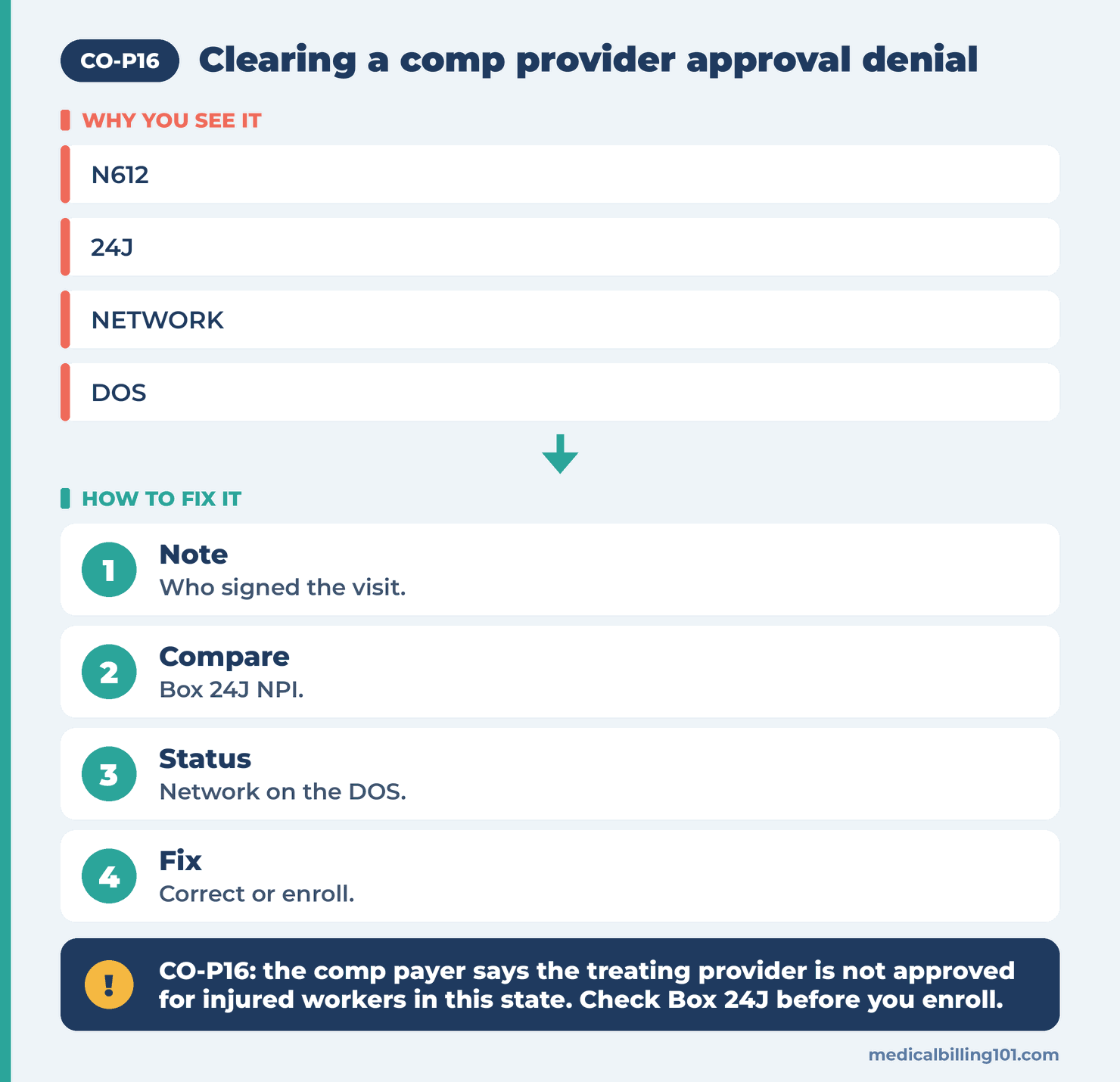
To fix a CO-P16 denial, first prove who treated the patient. Then match that person against the state’s approval list for the date of service. Do not swap in another provider’s number to get paid; the rendering provider must be the person who did the work.
| Step | Action | Where to check |
|---|---|---|
| 1 | Pull the visit note and signature | Who actually saw the patient |
| 2 | Compare with Box 24J on the claim | Rendering NPI on each line |
| 3 | Check network status for the date of service | State lookup, such as the L&I provider page |
| 4 | Data error: send a corrected claim | Box 24J right NPI; Box 22 code 7 and original number |
| 5 | Real gap: enroll and stop scheduling | Refer the worker to an approved provider |
| 6 | Track the approval date | Hold new visits until it is active |
Example scenario (fictional names), part 2
How the CO-P16 Denial Was Resolved
Jordan pulled both visit notes. Leo had seen the patient and signed each note. The claim, however, listed the clinic’s medical director in Box 24J. She works only on admin tasks and never joined the comp network. The billing system had filled her in as the default provider for that room.
Fix: Jordan sent a corrected claim with Leo’s NPI in Box 24J on both 99213 lines, code 7 and the original claim number in Box 22, and copies of the signed notes.
Outcome: both follow-ups paid at the state fee schedule rate. Jordan then removed the default rendering provider from the room setup.
Names and details are illustrative; no real patient data.
Names and details are illustrative; no real patient data.
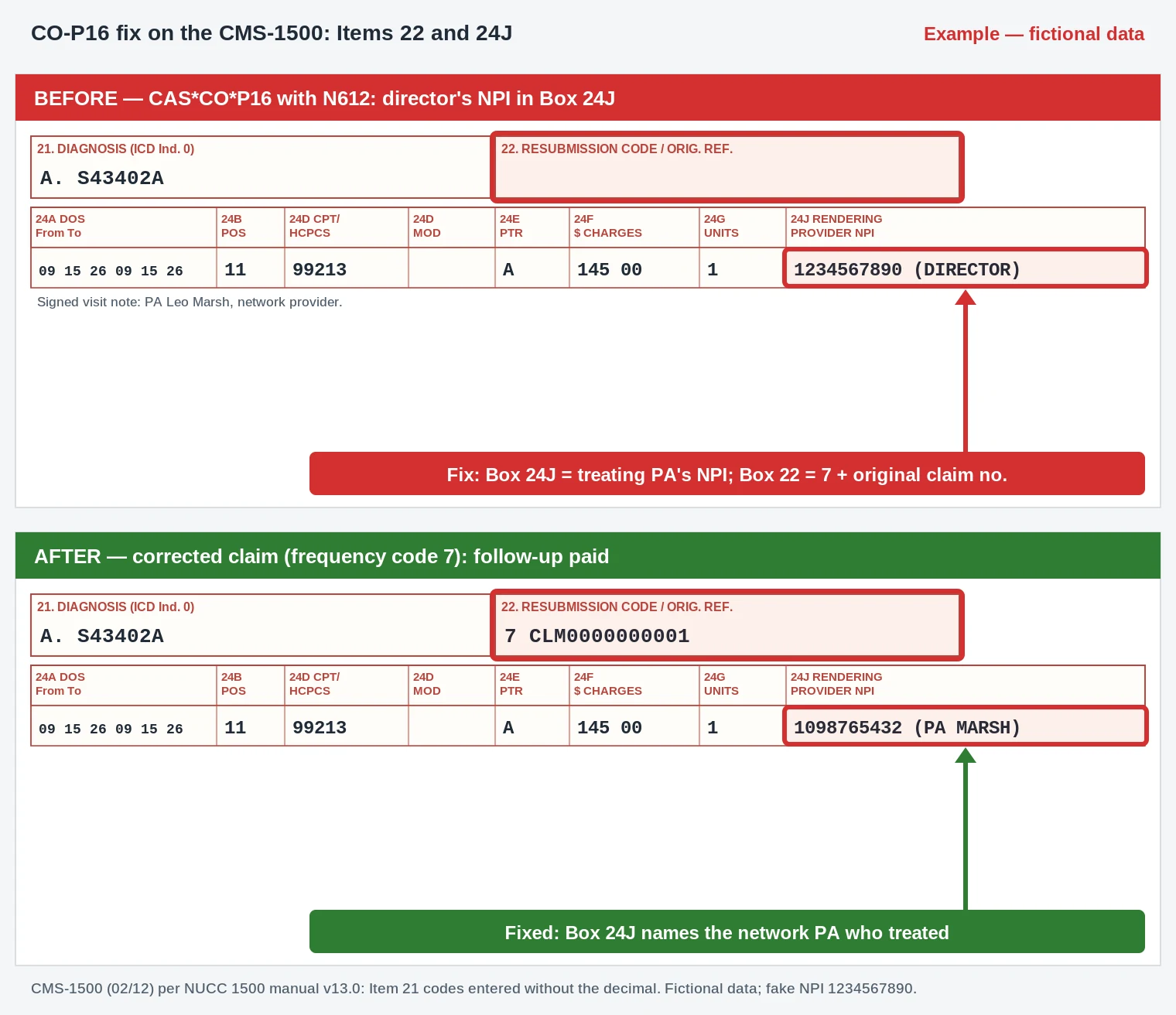
- Box 24J: the rendering NPI changed from the medical director, who never joined the comp network, to the physician assistant who saw the patient and signed the note.
- Box 22: frequency code 7 with the original claim number, so the payer replaces the denied claim.
- Box 24D / Box 21: 99213 and S43.402A (entered as S43402A) are unchanged; the signed visit notes go with the claim.
- UB-04: not shown; the urgent care bills professional visits on the CMS-1500 and the network rule applies to the practitioner.
Can I bill the injured worker for a P16 denial?
No. A CO-P16 line is the practice’s loss. Washington’s RCW 51.36.010 also makes providers accept the state fee schedule as payment in full. If the provider truly was not approved, write the visits off, enroll, and send the worker to an approved provider for ongoing care.
Related codes
| Code | Meaning |
|---|---|
| CO-P13 | Payment cut under a state comp rule or payment policy |
| CO-B7 | Provider was not certified for this service on this date |
| CO-P12 | Line priced at the state comp fee schedule rate |
| CO-185 | Rendering provider not eligible to perform the service billed |
| CO-P4 | Workers’ comp claim found non-compensable |
FAQ
What does CO-P16 mean?
The comp payer says the provider who treated the worker is not approved to treat injured workers in that state, so the line is denied.
Is CARC P16 the same as CARC B7?
No. B7 is a general code any payer can use when a provider was not certified or eligible for a service on that date. P16 is limited to workers’ comp approval in a state.
Which group codes can be used with P16?
Only CO or OA. X12 does not allow PR with P16, so the worker is never billed for it.
Can a nonnetwork provider see an injured worker in Washington?
Yes, for the initial office or emergency room visit. After that, ongoing care must come from a network provider, with limited exceptions.
What code did CARC P16 replace?
X12 lists P16 as the replacement for deactivated code W5 from 11/01/2013.
Sources
How we checked: the CARC P16 quote was matched word for word with the X12 CARC list on 24 November 2026. N612 and N290 were checked on the X12 RARC list.
- X12, Claim Adjustment Reason Codes (CARC P16, P13, B7, P12, 185, P4). Accessed 24 Nov 2026.
- X12, Remittance Advice Remark Codes (N612, N290). Accessed 24 Nov 2026.
- Washington Administrative Code 296-20-015, who may treat. Accessed 24 Nov 2026.
- Washington Administrative Code 296-20-01010, scope of the provider network. Accessed 24 Nov 2026.
- Revised Code of Washington 51.36.010. Accessed 24 Nov 2026.
Last updated: 24 November 2026 · Educational content; not legal advice.