

The CO-P31 denial code means a Property and Casualty payer denied treatment of an exacerbation because the care went beyond the time allowed for it. Comp treatment guidelines often set a window for a flare-up, such as a set number of weeks. When the payer counts your visit outside that window, it sends P31. The fix depends on whether the payer counted from the right start date. (Primary source: X12 Claim Adjustment Reason Codes)
In brief: reason code P31 is a timing denial. First check which date the payer used to start the window. If it used the old injury or the old course of care, show the real flare-up date. If the visit truly fell past the limit, ask for a variance before more care is given.
Part of our denial codes library. Written by Manikandan J, CPC, CRCR, who has tracked comp visit limits for chiropractic and therapy clients and builds visit counters for flare-up care. Published 27 November 2026. Last updated: 27 November 2026. Code wording quoted word for word from X12. Read about the author and our editorial policy, or contact us to report an error.
What does denial code CO-P31 mean?
Denial code CO-P31 says the payer denied exacerbation treatment because it ran past the allowed time. X12 limits it to Property and Casualty claims, so it appears on workers’ comp and auto remits. The code does not say how long the window is. That comes from the state guideline or the payer’s policy.
| Field | Value |
|---|---|
| Code | P31 |
| Description | “Payment denied for exacerbation when treatment exceeds time allowed. To be used for Property and Casualty only.” |
| Use | Property and Casualty only |
| Group codes | No X12 group restriction; CO is the usual pairing |
| Start | 11/01/2020 |
| Remark codes | Vary by payer; read the line-level remark |
Source: X12 Claim Adjustment Reason Codes, checked 27 November 2026.
Methodology: the code wording is copied from the X12 list. The example uses the New York Workers’ Compensation Board guideline rules on duration and variances, read on the Board’s site and in the state regulation. Other states set different windows.
Key terms: A durational limit is the longest a guideline allows for a treatment. A variance is approval to give care beyond the guideline. Box 15 qualifier 453 marks the date of an acute flare of a chronic condition on the CMS-1500.
CO-P31 vs OA-P31: the clock matters more than the group
CO-P31 is the usual form, and it keeps the denied visit off the worker’s bill. OA-P31 can appear as well, since X12 has no group limit for this code. Whichever group you see, the useful question is the start date of the window. A payer that counts from the wrong day will deny visits that were well inside the rules.
| Group | What it suggests | First move |
|---|---|---|
| CO-P31 | Provider-side denial for care past the window | Check the start date the payer used |
| OA-P31 | Other adjustment, owner unclear | Ask the adjuster how it counted |
Example scenario (fictional names), part 1
CO-P31 Denial Example: What Happened
Grant Lee bills for Mohawk Chiropractic Care in New York. Dr. Elena Ruiz, DC, treats a delivery driver with an accepted low back claim, S33.5XXD and M99.03 (entered as S335XXD and M9903). His first course of care ended in the spring, and he went back to full duty.
In September he strained his back again lifting packages at work. Dr. Ruiz restarted spinal manipulation, 98940. A week into the new care, the fictional carrier Empire Mutual Comp denied the visits with CAS*CO*P31.
How could visits in the first week of a flare-up be over the time limit? Keep reading, or jump to how the CO-P31 denial was resolved.
What causes a CARC P31 time limit denial?
A P31 denial usually comes from the way the payer counted the window. For example, the payer may count from the first course of care, not from the flare-up. Here are the usual causes.
| Cause | What it looks like |
|---|---|
| Window counted from the old course of care | Early flare-up visits denied |
| No flare-up date on the claim | Payer cannot see a new episode |
| Care truly past the limit | Visits after the allowed weeks |
| No variance requested | Extra visits given without approval |
| Gaps counted as treatment weeks | Missed weeks still use the window |
The New York Board explains that initial treatment of an exacerbation within the guideline limits needs no variance. It also says the duration time frames are consecutive, as its guideline FAQ notes. A Board panel decision quotes the back guideline: manipulation up to 3 times a week for 4 weeks, then up to 2 times a week for 4 more weeks.
How do I fix a CO-P31 denial?
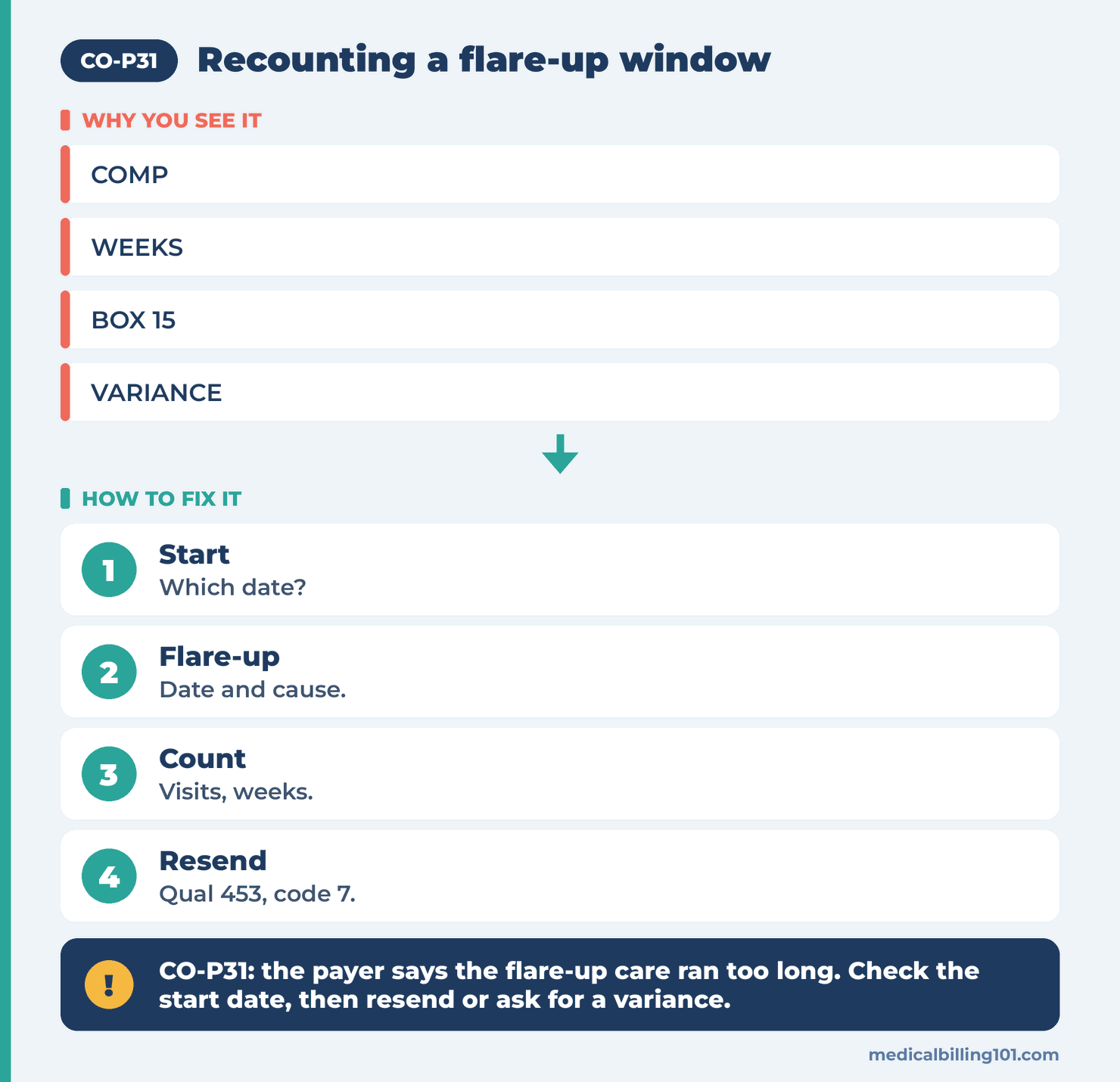
To fix CO-P31, prove when the flare-up began, then count your visits from that date. If the visits were inside the window, send a corrected claim with the date. If they were not, request a variance for further care.
| Step | Action | Where to check |
|---|---|---|
| 1 | Find the date the payer counted from | Carrier explanation of review |
| 2 | Confirm the flare-up date and cause | Treating report |
| 3 | Count visits and weeks from that date | Visit log |
| 4 | Report the flare-up date | Box 15 with qualifier 453 |
| 5 | Send a corrected claim with the report | Box 22 code 7 and original claim number |
| 6 | For care past the limit, ask for a variance | Prior approval request |
NUCC lists qualifier 453, acute manifestation of a chronic condition, for Box 15 in the 1500 instructions. In New York, care that varies from the guidelines needs a prior approval request under 12 NYCRR 324.3.
Example scenario (fictional names), part 2
How the CO-P31 Denial Was Resolved
Grant asked the adjuster how the window was counted. Bill review had started it on the first day of the spring course of care, so every new visit looked months late. The claims had no flare-up date in Box 15.
Fix: Dr. Ruiz’s report gave the date and cause of the new strain. Grant sent a corrected claim with Box 15 qualifier 453 and the flare-up date, plus code 7 and the original claim number in Box 22.
Outcome: the carrier counted from the flare-up and paid the visits. Grant set a visit counter that warns before week eight, so a variance can be asked for in time.
Names and details are illustrative; no real patient data.
Names and details are illustrative; no real patient data.
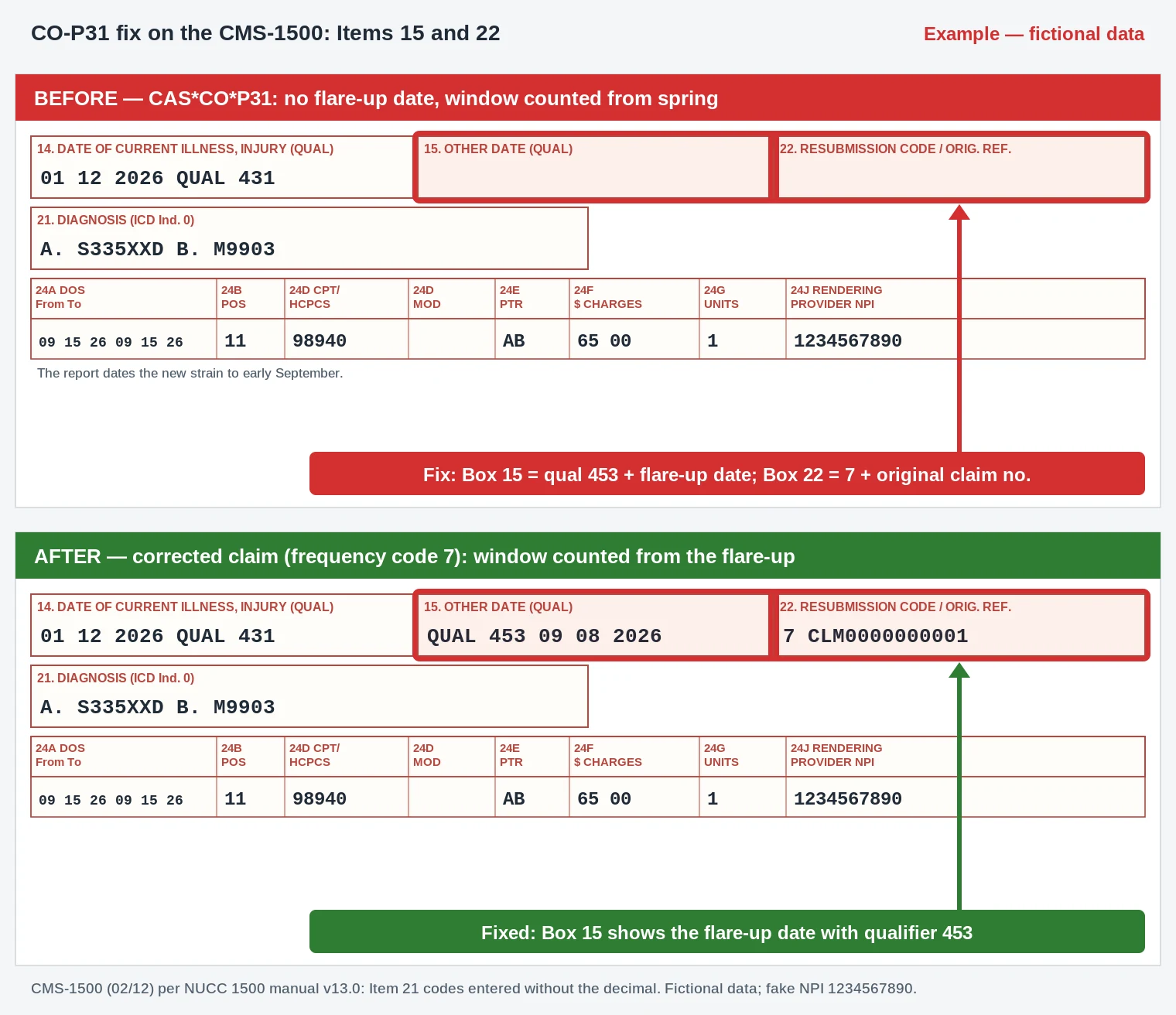
- Box 15: qualifier 453 (acute manifestation of a chronic condition) with the flare-up date, so the guideline window starts at the new strain.
- Box 22: frequency code 7 with the original claim number; the treating report with the date and cause of the flare-up goes with the claim.
- Box 14 / Box 21 / Box 24D: the original injury date (qualifier 431), S33.5XXD and M99.03 (entered as S335XXD and M9903) and 98940 are unchanged.
- UB-04: not shown; the chiropractic office bills only on the CMS-1500.
Can I bill the injured worker for a P31 denial?
No. Under CO, the denied visits are the provider’s to fix or write off. In New York, a provider who treats past the limit without an approved variance should not bill the worker for those visits.
Related codes
| Code | Meaning |
|---|---|
| CO-P30 | Exacerbation denied for incomplete records |
| CO-P15 | Workers’ comp medical treatment guideline adjustment |
| CO-P13 | Payment reduced or denied under a workers’ comp rule |
| CO-P16 | Provider not authorized to treat injured workers here |
| CO-P17 | Referral not authorized by the attending physician |
FAQ
What does CO-P31 mean?
A comp or auto payer denied flare-up treatment because it ran past the time allowed for an exacerbation.
How is CARC P31 different from P30?
P30 is a denial for incomplete exacerbation records. P31 is a denial for care that went past the allowed time.
Do New York guideline weeks have to be in a row?
Yes. The Board says the duration time frames are consecutive, so missed weeks still count.
Which box shows the flare-up date?
Box 15, with qualifier 453 for acute manifestation of a chronic condition.
Is a variance needed for every flare-up?
No. In New York, first treatment of a documented flare-up within the guideline limits needs no variance. Care past the limits does.
Sources
How we checked: the CARC P31 quote was matched word for word with the X12 CARC list on 27 November 2026. The window and variance rules come from the New York Board pages and 12 NYCRR 324.3.
- X12, Claim Adjustment Reason Codes (CARC P31, P30, P15, P13, P16, P17). Accessed 27 Nov 2026.
- New York Workers’ Compensation Board, Medical Treatment Guidelines FAQ. Accessed 27 Nov 2026.
- New York Workers’ Compensation Board, Matter of Syracuse Utilities, Board panel decision. Accessed 27 Nov 2026.
- Cornell LII, 12 NYCRR 324.3, variances. Accessed 27 Nov 2026.
- NUCC, 1500 Claim Form Instructions. Accessed 27 Nov 2026.
Last updated: 27 November 2026 · Educational content; not legal advice.