

The CO-P30 denial code means a Property and Casualty payer, most often a workers’ comp carrier, refused to pay for treatment of an exacerbation because the supporting documentation was not complete. An exacerbation is a temporary worsening of a condition the payer already covers. The carrier is not saying the flare-up did not happen. It is saying your records did not prove it. (Primary source: X12 Claim Adjustment Reason Codes)
In brief: reason code P30 is a documentation denial. Find out which proof the carrier needed, gather the report that shows when and how the flare-up began and how function changed from baseline, then send it with a request to reconsider the bill.
Part of our denial codes library. Written by Manikandan J, CPC, CRCR, who has worked comp follow-up for orthopedic practices and reviews flare-up notes before they go to carriers. Published 27 November 2026. Last updated: 27 November 2026. Code wording quoted word for word from X12. Read about the author and our editorial policy, or contact us to report an error.
What does denial code CO-P30 mean?
Denial code CO-P30 is a denial for exacerbation care with missing or incomplete proof. X12 limits it to Property and Casualty claims, which covers workers’ comp and auto. The code has no usage note about segments, so the remark code and the carrier’s letter are where the missing item is named.
| Field | Value |
|---|---|
| Code | P30 |
| Description | “Payment denied for exacerbation when supporting documentation was not complete. To be used for Property and Casualty only.” |
| Use | Property and Casualty only |
| Group codes | No X12 group restriction; CO is the usual pairing |
| Start | 11/01/2020 |
| Remark codes | Vary by payer; read the line-level remark |
Source: X12 Claim Adjustment Reason Codes, checked 27 November 2026.
Methodology: the code wording is copied from the X12 list. The example uses the New York Workers’ Compensation Board bulletin on exacerbations, read on the Board’s website. Other states define an exacerbation in their own rules.
Key terms: An exacerbation is a short-term worsening of a covered condition, after which the worker should return to baseline. Baseline is the measured function before the flare-up. Objective findings are exam results that can be measured, such as range of motion.
CO-P30 vs OA-P30: same gap, different label
A CO-P30 line tells you the carrier holds the provider responsible for completing the record, so the worker is not billed. OA-P30 is possible too, because X12 does not restrict the group. The label changes little in practice: the money stays frozen until the missing proof arrives. Ask the adjuster which item was missing before you rebuild the packet.
| Group | What it suggests | First move |
|---|---|---|
| CO-P30 | Provider must supply the missing proof | Request the list of missing items |
| OA-P30 | Other adjustment, owner unclear | Call the adjuster, then send records |
Example scenario (fictional names), part 1
CO-P30 Denial Example: What Happened
Nadia Brooks follows up comp claims at Hudson Valley Orthopedic Group in New York. Dr. Victor Lam treats a warehouse worker with an accepted right shoulder strain, S46.011D (entered as S46011D). The worker had recovered well, then felt new pain after lifting a heavy carton at work.
Dr. Lam saw him and billed 99214. The fictional carrier, Empire Mutual Comp, denied the visit with CAS*CO*P30. The report sent with the bill said only that shoulder pain had flared up.
What did the carrier expect to see that was missing? Keep reading, or jump to how the CO-P30 denial was resolved.
What causes a CARC P30 exacerbation denial?
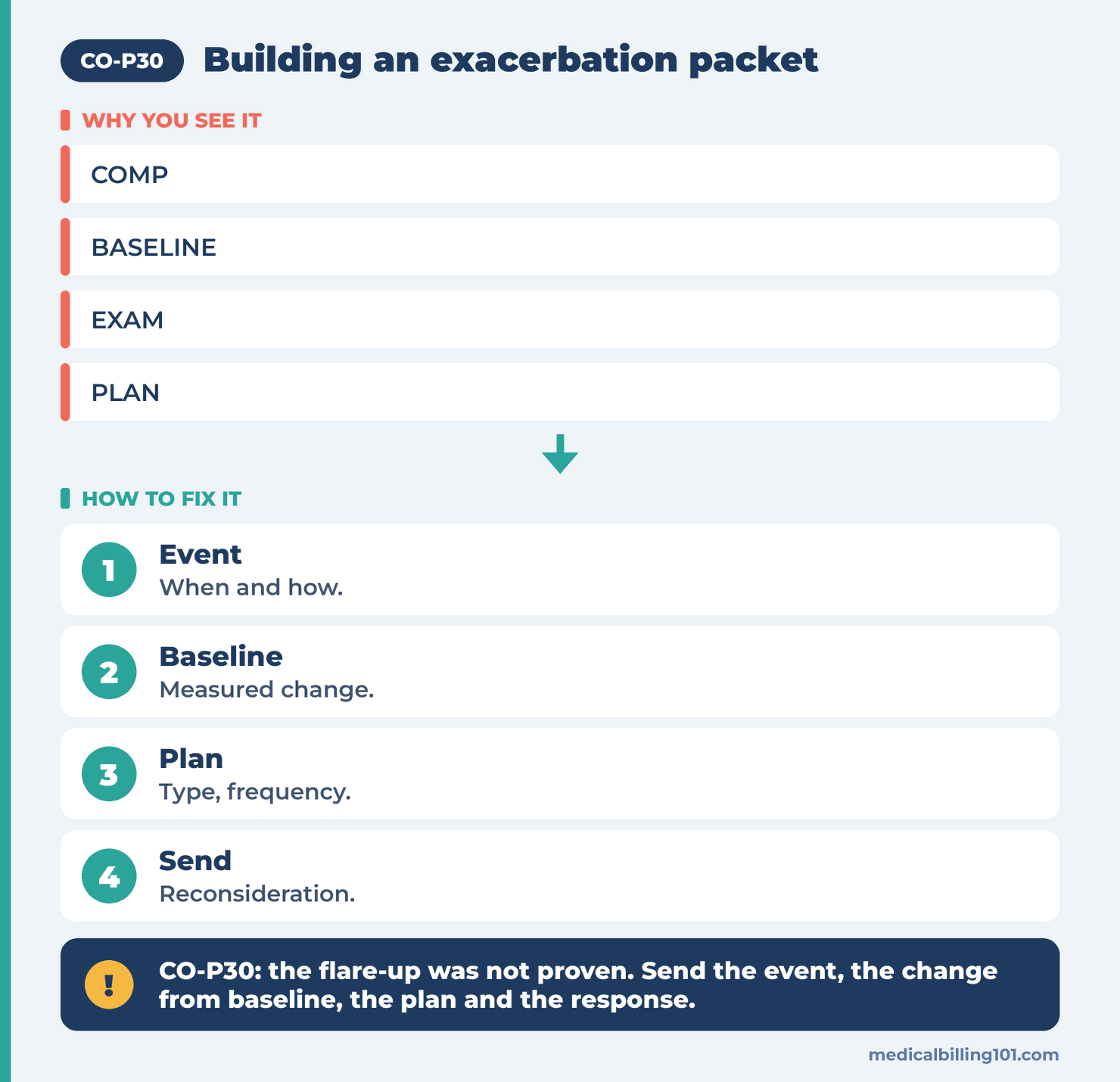
A P30 denial usually means the report told the carrier that a flare-up happened, without showing it. For example, a note that says pain increased, with no exam numbers, is a common trigger. The New York Board’s MDO bulletin on exacerbations lists four things a provider must fully document.
| Required item | What the report should show |
|---|---|
| When and how it occurred | Date and event, such as a lift or a fall |
| Objective change from baseline | Symptoms, exam findings and measured decline |
| Planned treatment | Type and frequency needed to return to baseline |
| Response to treatment | Measured functional improvement over time |
The bulletin also says a provider cannot ask for care for a flare-up that has not happened yet. A request for future exacerbations fails the test even when the history is clear.
How do I fix a CO-P30 denial?
To fix CO-P30, send the carrier the proof it did not get, built around the required items. Do not change the codes on the claim; the billed visit was correct.
| Step | Action | Where to check |
|---|---|---|
| 1 | Read the denial letter for the missing item | Carrier explanation of review |
| 2 | Find the last baseline exam | Prior progress report |
| 3 | Compare baseline and flare-up findings | Range of motion, strength, work tolerance |
| 4 | Make sure the report states date and cause | Treating provider’s report |
| 5 | Add the treatment plan and goals | Plan of care section |
| 6 | Send the packet with a reconsideration request | Carrier’s bill review channel |
Keep the timeline honest. Records must reflect what the provider found at the visit, not new findings added later to fit the rule. If care for the flare-up will run past guideline limits, New York requires a variance request under 12 NYCRR 324.3.
Example scenario (fictional names), part 2
How the CO-P30 Denial Was Resolved
Nadia pulled the chart and found two things the carrier never saw. A progress report from the spring recorded full shoulder motion and a return to full duty. The flare-up visit had measured range of motion, and flexion was well below that baseline.
Fix: Dr. Lam’s office sent both reports, with the date and cause of the lift injury and a short plan of care. The cover letter listed each of the four items and asked the carrier to reconsider the 99214 bill.
Outcome: the carrier accepted the exacerbation and paid the visit. The practice now uses a flare-up template that prompts for baseline numbers.
Names and details are illustrative; no real patient data.
Names and details are illustrative; no real patient data.
Can I bill the injured worker for a P30 denial?
No. A comp claim is the carrier’s to pay, and a missing report is a fixable provider-side gap. Most state comp laws bar billing the worker for care tied to an accepted claim.
Related codes
| Code | Meaning |
|---|---|
| CO-P15 | Workers’ comp medical treatment guideline adjustment |
| CO-P13 | Payment reduced or denied under a workers’ comp rule |
| CO-P2 | Not a work-related injury or illness |
| CO-P4 | Workers’ comp claim found non-compensable |
| CO-P17 | Referral not authorized by the attending physician |
FAQ
What does CO-P30 mean?
A comp or auto payer denied care for a flare-up because the records did not fully support it.
How is CARC P30 different from P31?
P30 is about incomplete proof. P31 is about treatment that ran past the time allowed for an exacerbation.
What should an exacerbation report include?
In New York, when and how it happened, objective change from baseline, the planned treatment and the measured response.
Do I need to send a corrected claim?
Usually not. The visit was billed correctly, so send the records with a reconsideration request.
Can a doctor request care for future flare-ups?
No, not in New York. The Board says care for a flare-up that has not occurred is not medically justified.
Sources
How we checked: the CARC P30 quote was matched word for word with the X12 CARC list on 27 November 2026. The documentation items come from the New York Board bulletin and its guideline FAQ.
- X12, Claim Adjustment Reason Codes (CARC P30, P31, P15, P13, P2, P4, P17). Accessed 27 Nov 2026.
- New York Workers’ Compensation Board, MDO bulletin 2012 number 1, exacerbations. Accessed 27 Nov 2026.
- New York Workers’ Compensation Board, Medical Treatment Guidelines FAQ. Accessed 27 Nov 2026.
- Cornell LII, 12 NYCRR 324.3, variances. Accessed 27 Nov 2026.
Last updated: 27 November 2026 · Educational content; not legal advice.