
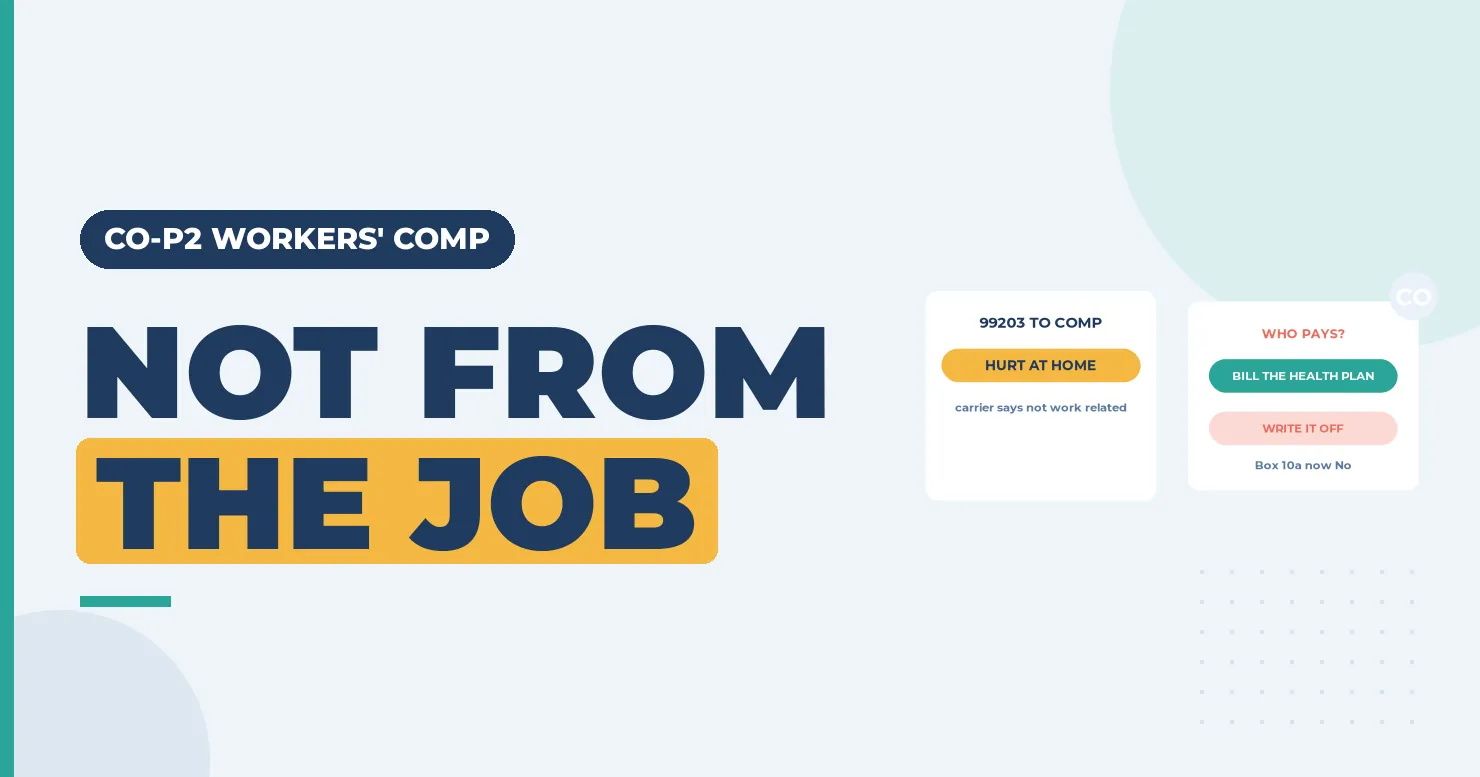
The CO-P2 denial code means the workers’ compensation carrier decided the injury or illness did not come from employment, so it will not pay the claim. The bill now belongs with the patient’s health plan, or with the patient when no other coverage exists. Rebill the correct payer, and dispute through the state process only when the medical records show the injury really happened at work. (Primary source: X12 Claim Adjustment Reason Codes)
In brief: reason code P2 is a payer-switch signal, not a coding error. Read the remark code and the carrier’s letter. If the carrier is right, send a new claim to the health plan with the work-related flags removed. If the carrier is wrong, the worker files the dispute and you hold the claim.
Part of our denial codes library. Written by Manikandan J, CPC, CRCR, who has worked workers’ comp and auto claims for urgent care, orthopedic and hospital clinic teams. Published 21 November 2026. Last updated: 21 November 2026. Code wording quoted word for word from X12. Read about the author and our editorial policy, or contact us to report an error.
What does denial code CO-P2 mean?
Denial code CO-P2 says the workers’ comp carrier reviewed the claim and concluded the condition was not caused by the patient’s employment. Only workers’ compensation carriers are allowed to send it. The adjustment can apply to the whole claim or to a single line, and the 835 should point you to the jurisdictional regulation behind the decision.
| Field | Value |
|---|---|
| Code | P2 |
| Description | “Not a work related injury/illness and thus not the liability of the workers’ compensation carrier” |
| Who may use it | Workers’ Compensation only |
| Group codes | No X12 group restriction; CO is the usual pairing |
| Start | 11/01/2013 (last modified 07/01/2017); replaces code 191 |
| Common remark | N607 |
Source: X12 Claim Adjustment Reason Codes, checked 21 November 2026.
Methodology: the code wording is copied from the X12 list, and the claim form fields come from the NUCC and CMS manuals cited below.
Key terms: A compensable injury is one that the state workers’ compensation law covers. Condition code 02 is the institutional claim indicator stating that the condition is employment related. Box 10a is the professional claim question that asks whether the condition is related to employment.
CO-P2 or OA-P2: which one did you get?
| Group | Who carries the amount | What to do |
|---|---|---|
| CO-P2 | Not the comp carrier; your office must find the right payer before writing anything off | Rebill the health plan or dispute |
| OA-P2 | No one is named; the carrier is only telling you it is not liable | Same steps; check the remark for detail |
Example scenario (fictional names), part 1
CO-P2 Denial Example: What Happened
Dana Whitfield handles billing at Cedar Ridge Urgent Care. A warehouse worker came in with low back pain, M54.50, and told the front desk he hurt it lifting boxes on his shift. Registration set the visit up as workers’ comp.
Dr. Owen Prescott billed 99203 to a fictional workers’ comp carrier, with Box 10a marked yes. The 835 came back with CAS*CO*P2 and remark code N607, “Service provided for non-compensable condition(s).” The carrier’s letter said the pain started over a weekend at home.
Is this money gone, or does someone else owe it? Keep reading, or jump to how the CO-P2 denial was resolved.
Who pays after a CO-P2?
Once the comp carrier says the condition is not work related, the patient’s own coverage becomes the primary payer, which is usually an employer group health plan. A Medicare beneficiary follows the Medicare Secondary Payer rules for work injuries. The CMS WCMSA Reference Guide says providers must bill workers’ comp first when a beneficiary has it. It also says the provider may bill Medicare when the comp claim is in dispute and the carrier will not pay promptly.
| Patient’s coverage | Next step |
|---|---|
| Group or individual health plan | New claim to that plan, with the work-related flags removed |
| Medicare | Bill Medicare; keep the carrier’s denial in the record |
| Medicaid | Bill Medicaid as the payer of last resort |
| No coverage | Bill the patient under your self-pay policy |
How do I fix a CO-P2 denial?
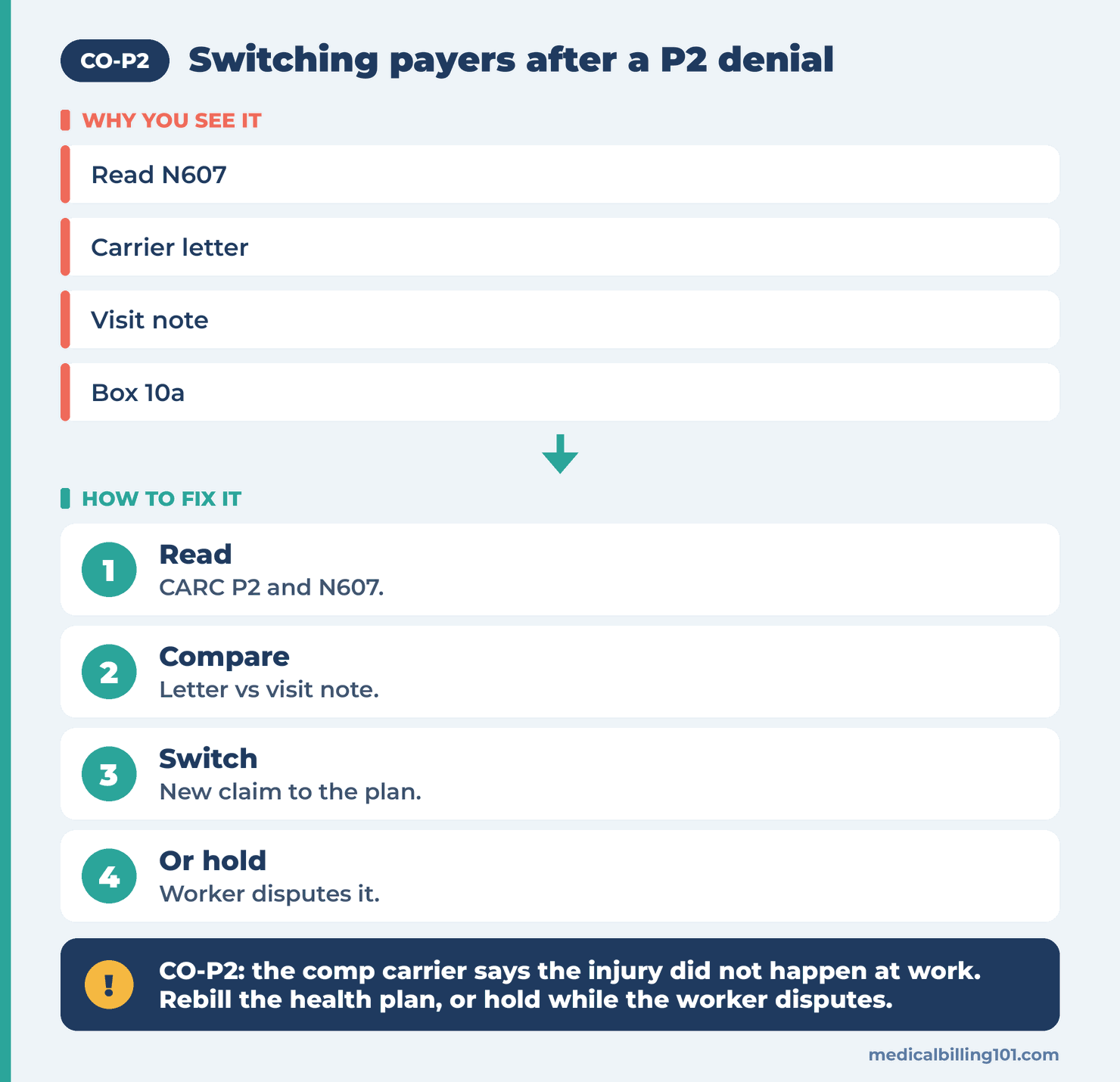
To fix a CO-P2 denial, first decide whether the carrier’s determination is correct by reading the remark code, the carrier’s letter and your own visit documentation side by side.
| Situation | Fix | What to send |
|---|---|---|
| Records agree the injury was not at work | New claim to the health plan; Box 10a = No; remove condition code 02 and occurrence code 04 | The comp denial, if the plan asks |
| Records show a work injury | The worker disputes the decision with the state comp agency | Hold the claim; send records when asked |
| Only some lines were denied | Split the lines: comp keeps the work injury, the plan gets the rest | A corrected claim to each payer |
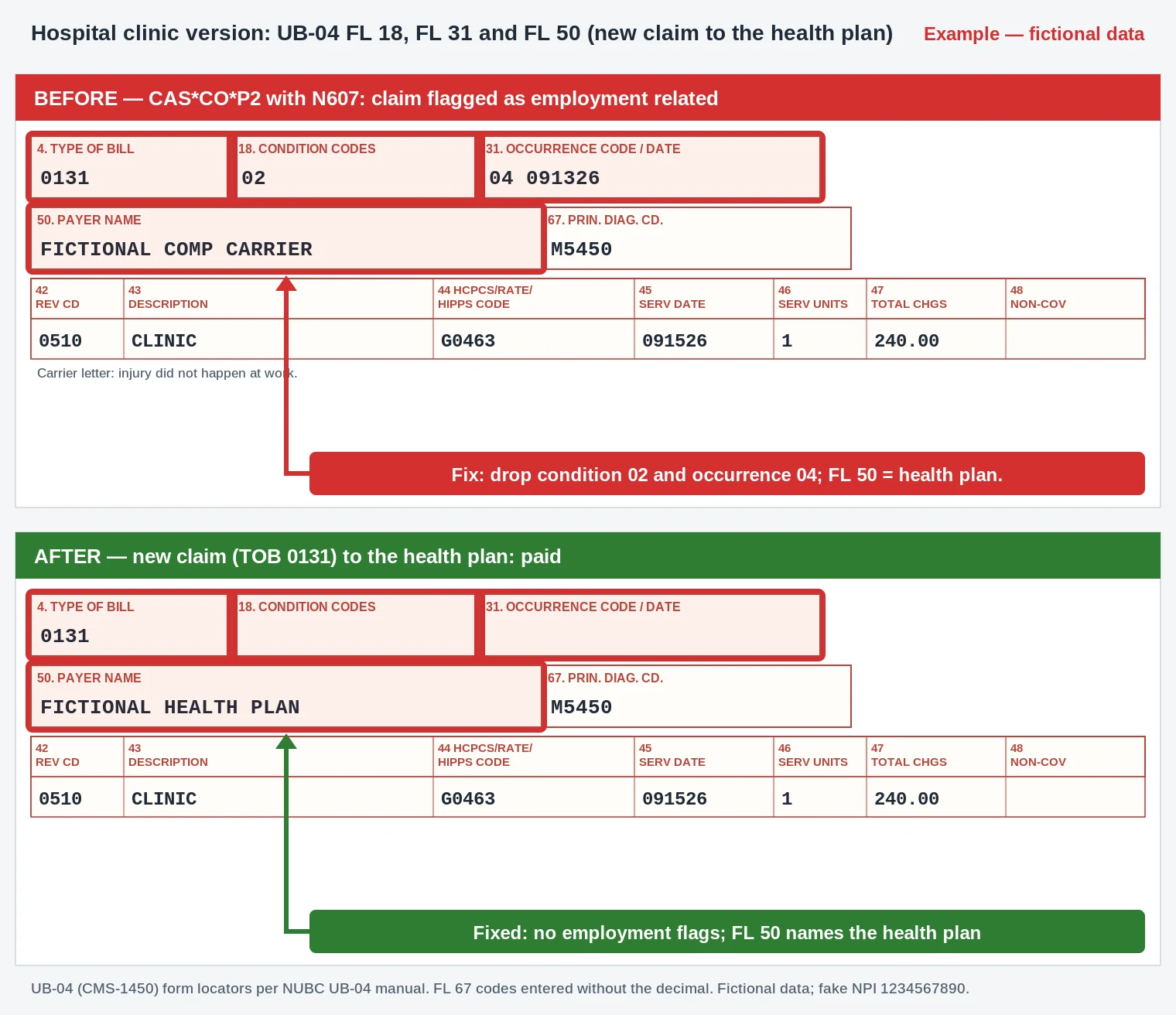
The work-related flags matter. The CMS Medicare Secondary Payer Manual, Chapter 3 lists condition code 02 for an employment-related condition and occurrence code 04 for an employment-related accident. If those stay on the claim, a health plan will often deny it as the comp carrier’s bill.
Example scenario (fictional names), part 2
How the CO-P2 Denial Was Resolved
Dana compared the note with the carrier’s letter. The note said the pain began on Saturday while he moved furniture at home. The patient had mentioned work only because he planned to file a claim.
Fix: she sent a new claim to his group health plan. Box 1 changed to group health plan, Box 10a changed from yes to no, and Box 11 now carried the plan’s group number. 99203 and M54.50 stayed the same.
Outcome: the plan paid the visit under his normal benefits. Dana added a registration step that asks where and when an injury happened before a visit is set up as workers’ comp.
Names and details are illustrative; no real patient data.
Names and details are illustrative; no real patient data.
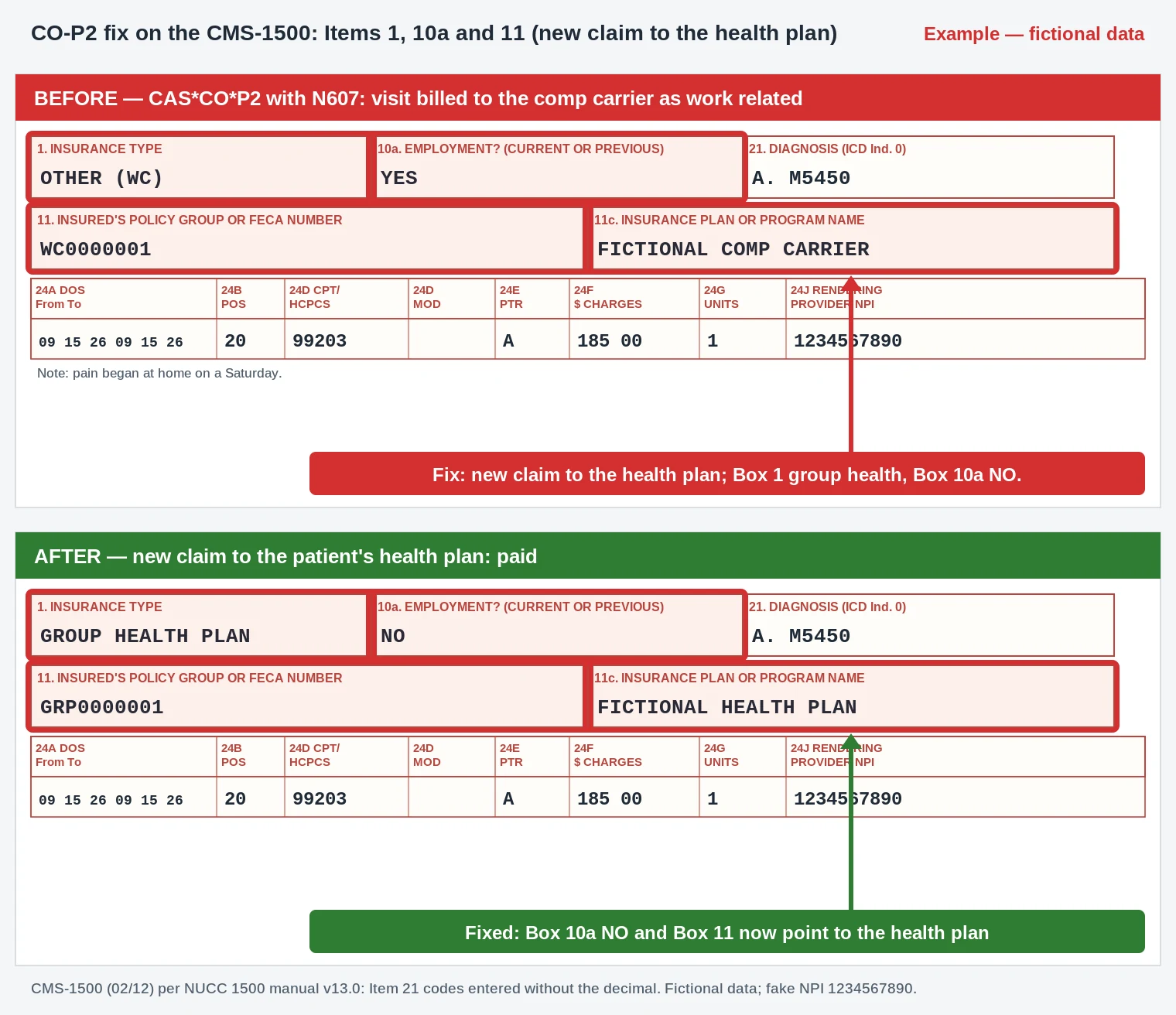
- Box 1 / Box 11 / Box 11c: the payer changed from the comp carrier to the patient’s group health plan, with the plan’s group number. This is a new claim, so Box 22 stays blank.
- Box 10a: employment changed from yes to no, matching the visit note.
- Box 21 / Box 24D: M54.50 (entered as M5450) and 99203 are unchanged.
- UB-04 FL 18 / FL 31: condition code 02 (employment related) and occurrence code 04 (employment-related accident) removed.
- UB-04 FL 50: payer line A now names the health plan; bill type stays 0131 because it is a first claim to that payer.
Can I bill the patient for a CO-P2 denial?
Not right away. The CO group code keeps the balance off the patient while your office identifies the correct payer, so bill the patient’s health plan first. If the patient has no other coverage, follow your self-pay policy and your state’s regulations on workers’ compensation billing.
How do I prevent CARC P2?
Ask three questions at registration: where did the injury happen, when did it happen, and was the employer notified? For example, back pain that hurts at work is not the same as an injury that happened at work. Collect the employer’s documentation, such as a first report of injury and the carrier’s claim number, before you bill workers’ compensation. Keep the patient’s health plan information on file as well, so switching payers takes only one step. The NUCC 1500 instructions explain how to fill Box 10a.
Related codes
| Code | Meaning |
|---|---|
| CO-19 | Work-related injury; the liability of the workers’ comp carrier |
| CO-P1 | State-mandated requirement for property and casualty |
| CO-22 | Care may be covered by another payer under coordination of benefits |
| CO-16 | Claim lacks information or has a submission or billing error |
FAQ
What does CO-P2 mean?
The workers’ comp carrier says the injury or illness is not work related, so it will not pay the claim.
Who should I bill after a CO-P2?
Bill the patient’s health plan, Medicare or Medicaid with the work-related flags removed. Bill the patient only if there is no coverage.
Can the worker challenge a CARC P2 decision?
Yes. The injured worker can dispute the decision through the state workers’ comp agency. Hold the claim while that runs.
What is the difference between CARC P2 and CARC 19?
P2 comes from the comp carrier and says the injury is not work related. CARC 19 comes from a health plan and says the injury is work related.
Which group code comes with CARC P2?
X12 sets no group restriction. CO is the most common pairing, and OA also appears.
Sources
How we checked: the CARC P2 quote was matched word for word with the X12 CARC list on 21 November 2026, and N607 with the X12 RARC list.
- X12, Claim Adjustment Reason Codes (CARC P2, 19, P1, 22, 16). Accessed 21 Nov 2026.
- X12, Remittance Advice Remark Codes (N607). Accessed 21 Nov 2026.
- CMS, WCMSA Reference Guide (billing workers’ comp first). Accessed 21 Nov 2026.
- CMS, Medicare Secondary Payer Manual, Chapter 3 (condition code 02, occurrence code 04). Accessed 21 Nov 2026.
- NUCC, 1500 claim form reference instruction manual. Accessed 21 Nov 2026.
Last updated: 21 November 2026 · Educational content; not legal advice.