
CO-19 is Claim Adjustment Reason Code 19 with group code CO. CARC 19 means the payer has decided the injury or illness is work-related, so the workers’ compensation (WC) carrier is liable instead of the health plan. Many people search for it as “co 19 denial code”, and that is the phrase this page answers. (Primary sources: X12 Claim Adjustment Reason Codes · CMS Medicare Secondary Payer Manual, Ch. 2, §50 · CMS Claims Processing Manual, Ch. 22, §60.1)
Quick answer: Ask the patient and the record one question: did this injury or illness happen at work? If yes, bill the workers’ compensation carrier with the claim number, employer and date of injury. If WC denies, or the condition is not work-related, correct the claim’s accident and employment indicators and send it back to the health plan with the WC denial letter or a signed patient statement.
Part of our denial codes library. Written by Manikandan, a revenue cycle management specialist with more than 10 years of US medical billing experience. Last reviewed: 12 October 2026. Official code wording is quoted word for word from X12; Medicare rules link to their CMS source.
CO-19 denial code description (official X12 wording)
X12 Claim Adjustment Reason Code 19, verbatim:
“This is a work-related injury/illness and thus the liability of the Worker’s Compensation Carrier.”
Source: X12 Claim Adjustment Reason Codes, checked 12 October 2026. Start: 01/01/1995 | Last Modified: 09/30/2007.
The CARC is 19. It usually comes with group code CO because the payer is saying the amount is not its liability. It is not a patient balance. CARC 19 sits in a small family of “another carrier pays” codes: 20 (liability carrier), 21 (no-fault carrier) and 22 (coordination of benefits).
What CO-19 means in plain English
- The health plan or Medicare believes another payer, the workers’ compensation carrier, must pay first.
- The trigger is usually something on the claim or in the payer’s file: an “employment related” indicator, an injury diagnosis with a work-status external cause code, a date of injury, or a WC record the payer already holds.
- CO-19 is not a coding error and not a medical necessity denial. The service may be fully payable, just by a different payer.
- The fix is a payer-order fix: WC first, then the health plan only for what WC does not cover.
- Workers’ compensation is insurance an employer must carry for work injuries. CMS notes that all WC acts make the employer pay for the care the injured worker needs.
- A WCMSA is money from a WC settlement set aside to pay for future care for the work injury.
CO-19 vs CO-20, CO-21, CO-22 and CO-109
| Code | Official X12 idea | What it tells you |
|---|---|---|
| 19 | Work-related injury/illness; liability of the Worker’s Compensation Carrier | Bill the WC carrier |
| 20 | Injury/illness is covered by the liability carrier | Bill the liability (for example premises or auto liability) insurer |
| 21 | Injury/illness is the liability of the no-fault carrier | Bill no-fault (personal injury protection) first |
| 22 | Care may be covered by another payer per coordination of benefits | Another health plan is primary — CO-22 |
| 109 | Not covered by this payer/contractor; send to the correct payer | Wrong payer or wrong contractor — CO-109 |
All five move the claim to someone else. Only 19 names workers’ compensation, so only 19 needs the employer, the WC claim number and the date of injury.
Group code matrix for CARC 19
| Group + 19 | Who carries the amount | Typical next step |
|---|---|---|
| CO-19 | Provider (not billable to the patient while WC is pending) | Bill WC; return to the plan with WC’s decision if needed |
| PR-19 | Patient (rare; follow the remit) | Confirm the plan really made the patient liable before billing |
| OA-19 | Other adjustment | Read the remarks; usually still a WC-first problem |
CMS Ch. 22 §60.1 says CO adjustments are “generally… considered a write off for the provider and are not billed to the patient.” PR is for amounts that “may be billed to the patient or insured.” With CO-19, the amount is not a write-off you should accept forever. It is a signal to bill the right payer.
How Medicare treats work-related care
Medicare’s rule is in the Medicare Secondary Payer (MSP) Manual, Chapter 2, §50. CMS writes that “payment under Medicare may not be made for any items and services to the extent that payment has been made or can reasonably be expected to be made” under a workers’ compensation law or plan (citing §1862(b)(2) of the Social Security Act and 42 CFR 411.40). Key points from the same section:
- WC pays first. If Medicare paid for something WC should have paid, that Medicare payment “constitutes an overpayment.”
- Federal WC programs count too, including the Federal Employees’ Compensation Act, the Longshore and Harbor Workers’ Compensation Act and the Black Lung program.
- WC does not cover everything. Where WC does not pay for a service, Medicare “may be paid” for it (42 CFR 411.40(b)(2)). Example from CMS: a physician not authorized under the WC plan.
- Mixed visits. If only part of the visit was work-related, Medicare may pay for the non-work-related part.
- Contested claims. When a State WC agency denies the claim, the MAC generally allows Medicare claims for that condition, unless the decision clearly shifts WC’s cost to Medicare.
- Set-asides. Where a WC Medicare Set-Aside Arrangement (WCMSA) exists, Medicare does not pay for care related to the settled injury until the set-aside funds are properly exhausted.
- The patient has duties. The beneficiary must file with WC on time. If they do not and WC benefits are lost, CMS says Medicare benefits are not payable to that extent.
Commercial plans and Medicaid plans use the same basic idea in their own contracts: the workers’ compensation carrier is primary for a compensable work injury.
Where CO-19 shows up in the 835
CLP*PCN12345*4*285.00*0.00**12*CLAIM998877~
SVC*HC:99213*185.00*0.00**1~
CAS*CO*19*185.00~
SVC*HC:73610*100.00*0.00**1~
CAS*CO*19*100.00~
- Both lines denied in full with CASCO19.
- Nothing was paid, so there is no allowed amount to post. This is a payer-order denial, not a pricing cut.
Illustrative only. Real remits vary by payer and may add a remark code.
How to fix CO-19: decision path
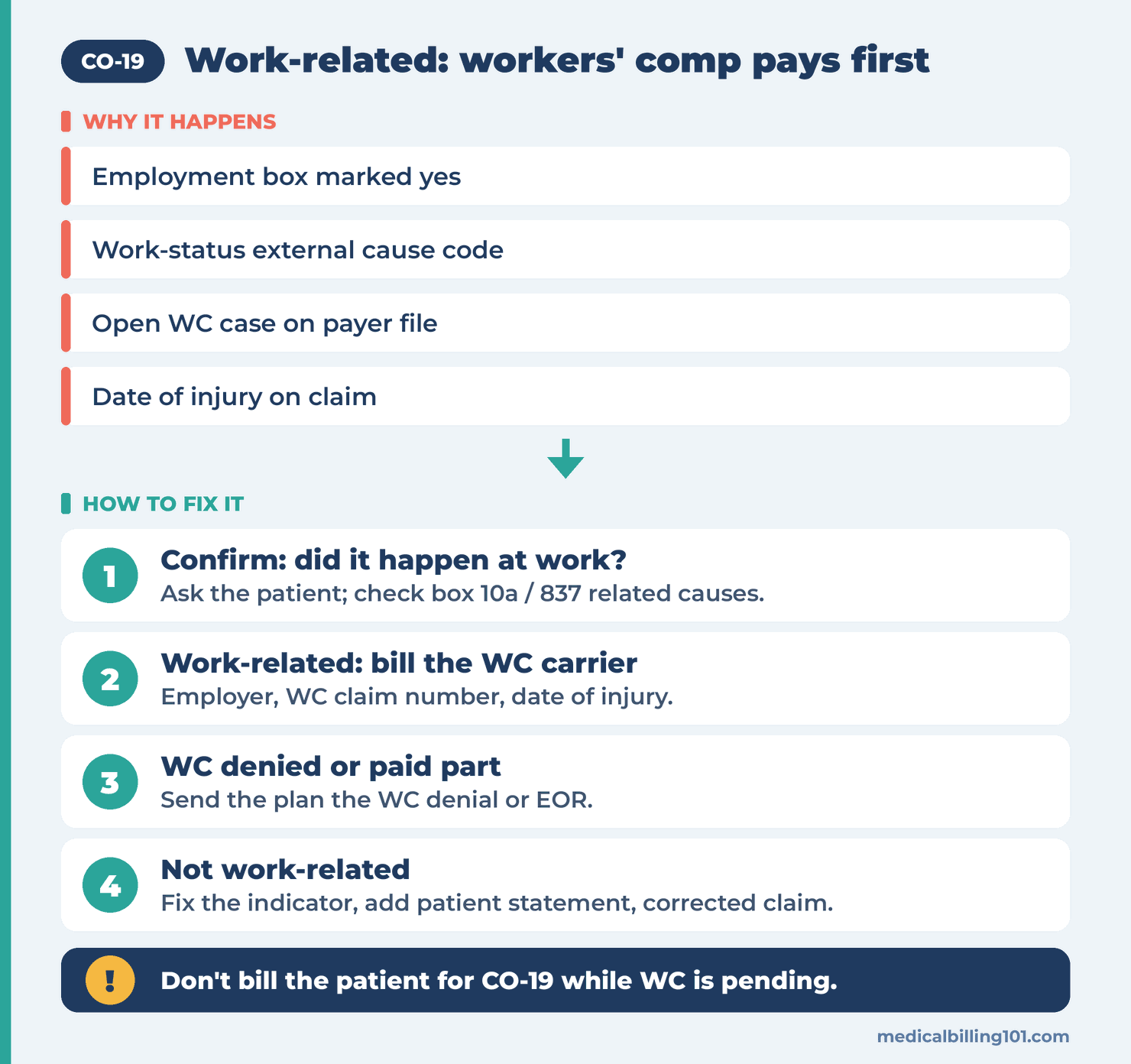
- Check the claim itself first. Look at CMS-1500 box 10a (“Is patient’s condition related to employment?”) or the 837 related-causes field, the accident date, and any work-status external cause code. A wrong “yes” is a common cause.
- Ask the patient. Did it happen at work or while doing paid work? Is there an open WC claim, an employer report or a WC claim number?
- If it is work-related, bill the WC carrier. Include the employer, WC claim number, date of injury and adjuster details. Follow your state’s WC billing forms and fee schedule.
- If WC pays in full, post the WC payment and close the health plan claim. Do not bill the health plan or the patient for the same service.
- If WC denies or pays only part, send the health plan a corrected or secondary claim with the WC denial, explanation of review or settlement paperwork.
- If it is not work-related, correct the employment indicator and accident fields. Get a signed patient statement, then submit a corrected claim (frequency code 7 on an 837) or reopen as the payer allows.
- If the payer’s file is wrong (an old WC case, wrong dates), ask the patient or employer to update it, then reprocess.
- Hold patient statements while WC is pending. CO is not patient responsibility.
Medicare, commercial and Medicaid notes
Medicare. Follow MSP Manual Ch. 2 §50. If Medicare shows an open WC record for the patient, CO-19 can repeat on every related claim until the record is updated or WC’s position is documented. Ask the patient whether they reported the injury to their employer and WC carrier. Where WC denied the claim, keep the denial notice in the account. CMS treats a State agency denial as a reason to allow the Medicare claim in most cases.
Commercial. Health plans usually ask for the WC denial letter, or a signed statement that the condition is not work-related, before they pay. Some send a questionnaire to the member. A late or missing answer keeps the claim stuck on CARC 19.
Medicaid. Medicaid is generally the payer of last resort. If the injury is work-related, bill WC first and keep the WC decision for the Medicaid claim.
Worked example (illustrative)
A warehouse worker comes in with wrist pain after lifting boxes on shift. The front desk marks “employment related: yes” and bills the health plan. The plan returns CASCO19 on both lines.
CO-19 letter to the health plan (WC denied or not work-related)
[Date]
[Payer] Claims Review / Provider Services
[Address, fax or portal]

Re: CARC 19 (work-related injury/illness) — request to reprocess
Patient: [Name]   Member ID: [ID]   DOB: [MM/DD/YYYY]
Claim number: [Claim #]   Date(s) of service: [MM/DD/YYYY]

The remittance shows CAS*CO*19. Please reprocess because:
[ ] The workers' compensation carrier denied liability (letter enclosed).
[ ] WC paid only part of the charges (WC explanation of review enclosed).
[ ] The condition is not work-related (signed patient statement enclosed);
    the employment indicator has been corrected on the attached claim.
[ ] Your file shows an old WC case; the date of injury is [date],
    and this service is for an unrelated condition.

Enclosed: remit, corrected claim, WC denial or EOR, patient statement.

[Name, credentials]  [Practice, NPI]  [Phone / email]
Prevention checklist
- [ ] Ask about work, auto and other accidents at check-in for every injury visit.
- [ ] Capture employer, WC carrier, claim number, adjuster and date of injury.
- [ ] Reset box 10a and the 837 related-causes field on each new encounter.
- [ ] Bill WC first when the injury is work-related; follow state WC forms.
- [ ] Keep WC denial letters and patient statements with the account.
- [ ] Never send a patient statement for a CO-19 amount while WC is pending.
- [ ] Teach the front desk the difference between CO-22 (other health plan) and CO-19 (workers’ comp).
- [ ] Use the CARC and RARC guide for staff training.
Related denial codes
- CO-22: care may be covered by another payer (COB).
- OA-23: impact of prior payer adjudication.
- CO-109: not covered by this payer; send to the correct payer.
- CO-16: claim lacks information or has a billing error.
- CO-197: authorization absent (a different problem; CO-19 is not prior auth).
- CARC and RARC guide.
Key takeaways
CARC 19 means the payer thinks workers’ compensation must pay first. Confirm whether the injury is work-related. Bill WC when it is. When it is not, or WC says no, fix the claim’s employment fields and send the plan the proof.
FAQ
What is the CO-19 denial code description?
X12 describes CARC 19 as “This is a work-related injury/illness and thus the liability of the Worker’s Compensation Carrier.” CO-19 is that reason code with group code CO, so the amount is not billed to the patient while workers’ compensation is pending.
Is the CO-19 denial code the same as CO-197?
No. CO-19 means the workers’ compensation carrier is liable. CO-197 means precertification or authorization was absent. They are different codes with different fixes.
Who do I bill after a CO-19 denial?
Bill the workers’ compensation carrier when the injury or illness is work-related. Include the employer, WC claim number and date of injury. Go back to the health plan only if WC denies or pays part.
Can I bill the patient for CO-19?
Not while the amount is reported with group code CO. CO amounts are generally not billed to the patient. Bill WC or correct the claim instead.
What if the injury was not work-related?
Correct the employment and accident fields on the claim, get a signed statement from the patient, and send a corrected claim to the health plan.
Does Medicare pay when workers’ compensation denies?
Often yes. CMS MSP Manual Ch. 2 §50 says Medicare may pay for services WC does not cover. When a State WC agency denies a contested claim, the MAC generally allows Medicare claims for that condition.
Quick facts
| Item | Value |
|---|---|
| X12 code | 19 |
| X12 start | 01/01/1995 |
| Last modified | 09/30/2007 |
| Usual group code | CO |
| Payer to bill | Workers’ compensation carrier |
| Last reviewed | 12 October 2026 |
Sources
- X12, Claim Adjustment Reason Codes (CARC 19, 20, 21, 22, 109). CARC 19 Start 01/01/1995, Last Modified 09/30/2007. Accessed 12 Oct 2026.
- CMS, Medicare Secondary Payer Manual (IOM 100-05), Ch. 2, §50 Workers’ Compensation. Accessed 12 Oct 2026.
- CMS, Medicare Claims Processing Manual (IOM 100-04), Ch. 22, §60.1 Group Codes. Accessed 12 Oct 2026.
- CMS, ICD-10-CM Official Guidelines for Coding and Reporting FY 2027 (Chapter 20, external cause status). Accessed 12 Oct 2026.
Code wording and Medicare rules on this page were checked on 12 October 2026 against X12 and CMS sources.
Last reviewed: 12 October 2026 · This page is educational and doesn’t replace payer-specific or state workers’ compensation instructions.