
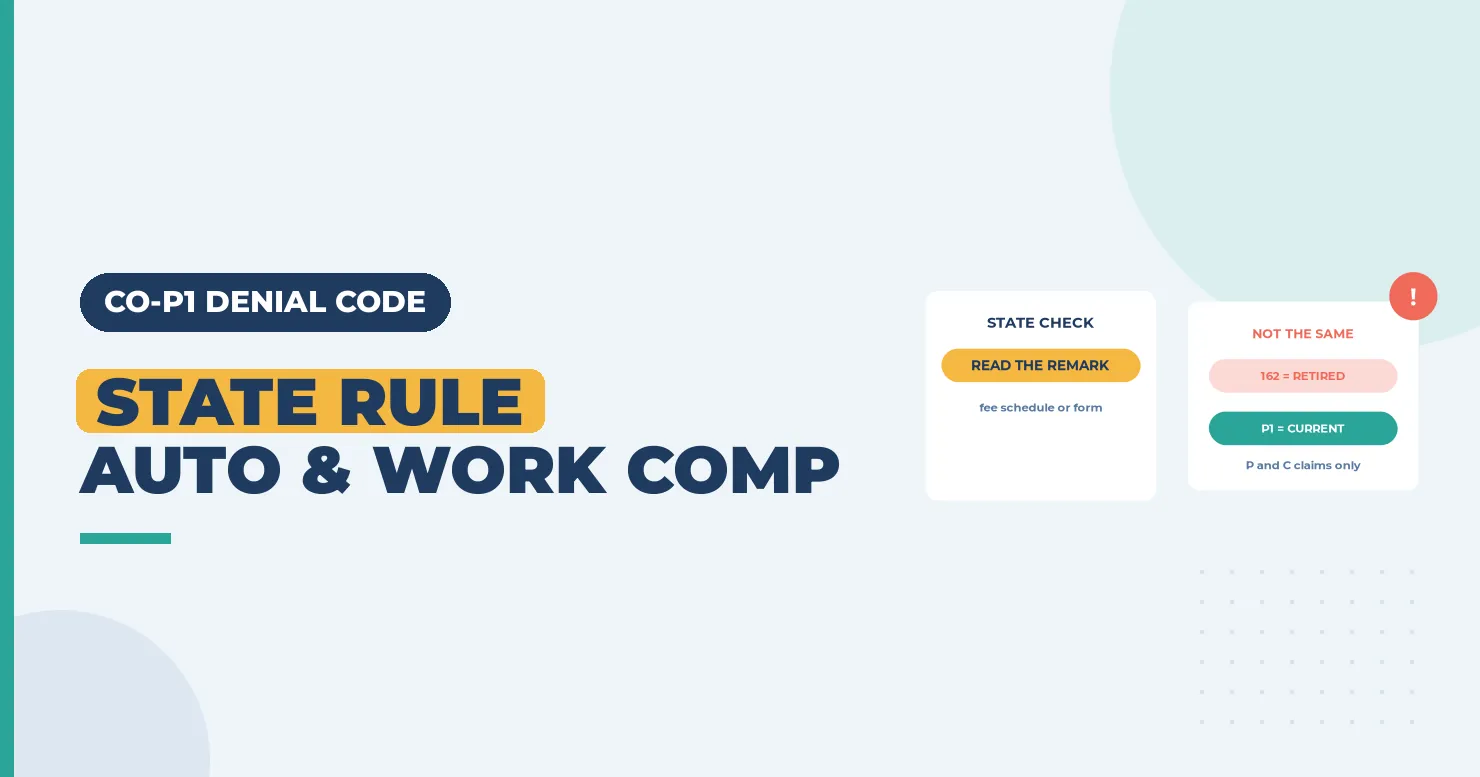
CO-P1 only shows up on one kind of claim: property and casualty. That means auto insurance, including no-fault and personal injury protection, and workers’ compensation. The payer is saying a state law or regulation shaped the adjustment, and that the remark code next to it explains which rule. If you mostly bill health plans, P1 can look strange. If you treat injured workers or car crash patients, it’s routine. (Primary sources: X12 Claim Adjustment Reason Codes · X12 Remittance Advice Remark Codes · U.S. Department of Labor, workers’ compensation).
In brief: CO-P1 means “State-mandated Requirement for Property and Casualty, see Claim Payment Remarks Code for specific explanation.” Read the remark code first, because P1 itself says nothing specific. Then find the state rule it points to, such as a fee schedule, a required form or a provider certification. Fix what the state requires, or dispute through the state process the payer names. Billing the patient is usually restricted on these claims.
Part of our denial codes library. Written by Manikandan J, CPC, CRCR, who has more than 10 years of US medical billing and revenue cycle experience. Published 20 October 2026. Last updated: 20 October 2026. Code wording is quoted word for word from X12.
Official CARC P1 text from X12
| Field | Official X12 text |
|---|---|
| Description | “State-mandated Requirement for Property and Casualty, see Claim Payment Remarks Code for specific explanation. To be used for Property and Casualty only.” |
| Start | 11/01/2013 |
| Notes | Replaces deactivated code 162 |
Source: X12 Claim Adjustment Reason Codes, checked 20 October 2026.
Two details stand out. First, P1 is a “P” code, part of the group X12 created for property and casualty payers. Health plans shouldn’t use it. Second, it replaced CARC 162, which had the same wording and stopped on 07/01/2014. If an old payer letter mentions 162, read it as P1.
Denial code P1, CARC P1, reason code P1
They’re the same thing. Denial code P1 and reason code P1 are everyday names for the X12 code. “CO-P1” adds the group code CO, which puts the adjustment on the provider. Because property and casualty payers follow state fee schedules, the CO amount is often a fee schedule reduction, not a full denial.
What “property and casualty” means here
A property and casualty claim is a medical bill paid by an auto insurer or a workers’ compensation carrier, not by the patient’s health plan. These payers follow state law, not a plan document. A state fee schedule is the official list of maximum payments a state sets for these claims. Many states also require specific forms, reports, provider certifications or treatment guidelines. When one of those rules changes the payment, P1 is how the payer says so.
Group code table
| Group + CARC | Who carries it | What to know |
|---|---|---|
| CO-P1 | Provider | Most common. A state rule reduced or denied the line. Balance billing the injured person is restricted in many states. |
| PR-P1 | Patient | Rare. Only if state law and the policy put the amount on the patient. |
| OA-P1 | Not assigned | Informational or adjusted line. Read the remark. |
| PI-P1 | Provider | Payer-initiated reduction. Treat like CO. |
Common causes and the remark codes behind them
These remarks are quoted from the X12 RARC list. They show the kind of state rules P1 points to. Your payer may use others.
| Cause | Typical RARC | Fix |
|---|---|---|
| Payment set by a state fee schedule | N604, N606 or N599 (state-specific) | Check the state schedule for the code. Dispute only if the math or the schedule year is wrong. |
| Service is non-covered under the state fee schedule | N643 | Read the schedule. Write off or rebill with the code the schedule allows. |
| Charge for a state-required form or report isn’t payable | N621 | Remove the charge, or bill it with the state’s approved report code if one exists. |
| Provider not certified to treat injured workers in that state | N612 | Complete the state’s certification or registration, then ask about reprocessing. |
| Workers’ comp claim number missing or wrong | N625 | Get the carrier’s claim number and send a corrected claim. |
| Service not related to the reported injury | N576 | Send records linking the treatment to the injury, or bill the health plan if it’s unrelated. |
How to work a CO-P1
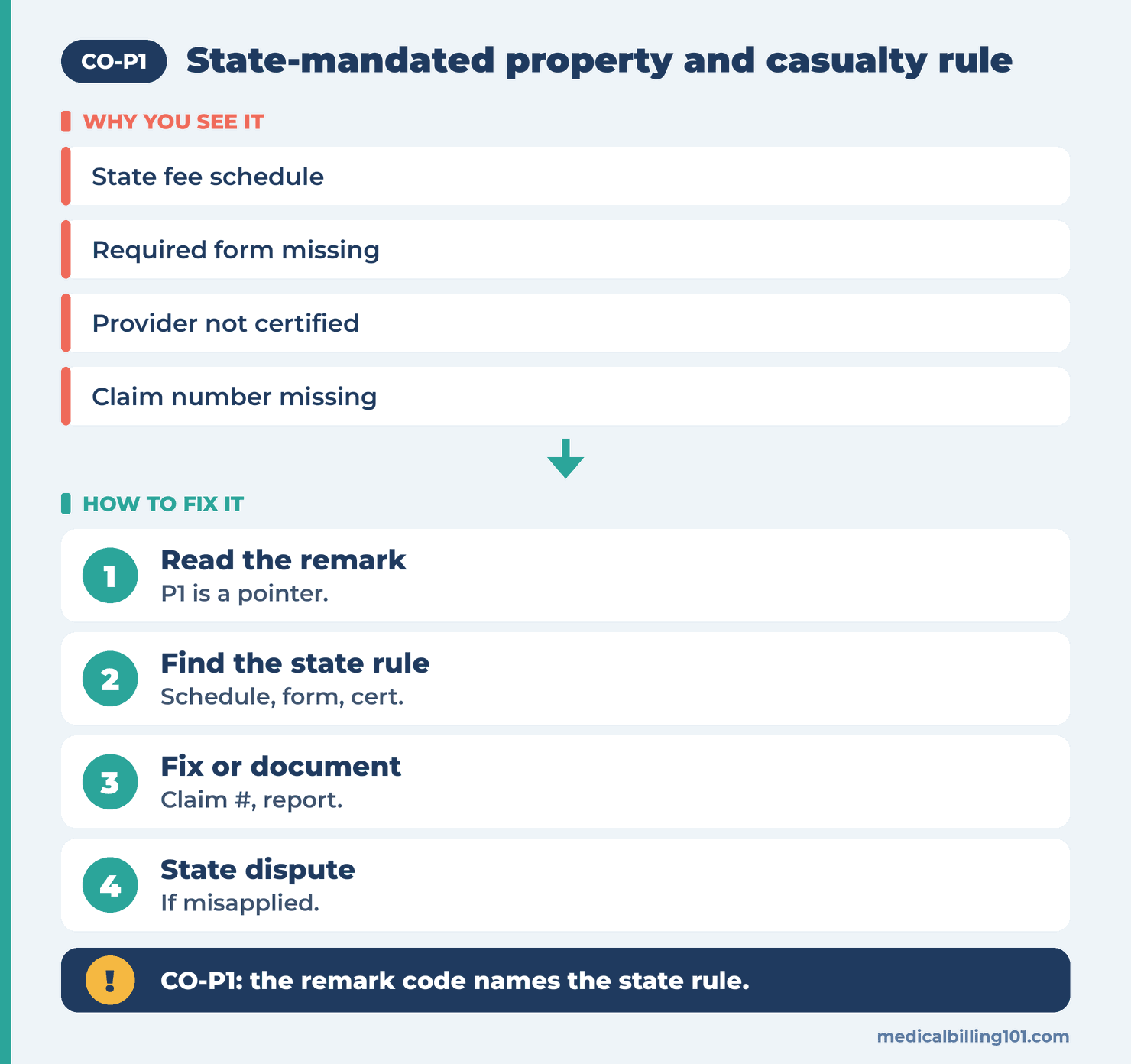
- Read the remark code. P1 is a pointer. The remark is the message.
- Find the state rule. Look up the state’s workers’ comp fee schedule, no-fault regulation or required-forms list for the date of service.
- Check the claim. Confirm the carrier’s claim number, the date of injury, the employer or policy holder and the treating provider’s state registration.
- Fix what you can. Correct the claim number, add the required report, or rebill with the code the schedule allows.
- Dispute if the rule was misapplied. Use the state’s dispute process. Many states route medical fee disputes through their workers’ comp agency or insurance department, often with short deadlines.
- Don’t default to the patient. Many states limit or bar billing the injured person for amounts the payer reduced under a fee schedule.
Appeal and dispute approach
Property and casualty disputes follow state rules, not health plan appeal rules. Before you file:
- confirm the state, the program (workers’ comp or auto) and the date of service;
- find the dispute form and deadline on the state agency’s site, for example the state workers’ comp board;
- attach the remit, the fee schedule page and your calculation;
- add records if the issue is relatedness or medical necessity.
Keep the argument narrow. Show which rule applies, what it allows and how the payer’s figure differs.
Questions to ask the payer about a CO-P1
- Which state rule or fee schedule did you apply?
- Which schedule year or version did you use?
- Is any form or report missing that would change the outcome?
- What is the state dispute process and deadline?
- Can I bill the patient for any part of this, under state law?
Worked example (illustrative)
A physical therapy clinic treats an injured worker and bills its usual rate. The comp carrier’s remit shows CAS*CO*P1*55.00 and a state fee schedule remark on each line. The billing team opens the state’s fee schedule for that year and confirms the allowed amount matches what the carrier paid. The P1 amount is a write-off, not a denial to appeal. Under the state rule, the clinic does not bill the worker for it. The team adds the state fee schedule to its contract module so expected payments match from then on.
Prevention checklist
- [ ] Load each state’s workers’ comp fee schedule into your PM system.
- [ ] Capture the carrier claim number, date of injury and employer at intake.
- [ ] Confirm provider registration with each state comp program you bill.
- [ ] Keep state-required forms and reports on a checklist by state.
- [ ] Separate auto and comp claims from health plan claims in your work queues.
Related denial codes
- CO-22: this care may be covered by another payer per coordination of benefits.
- CO-109: the claim isn’t covered by this payer. Send it to the correct one.
- CO-16: the claim lacks information or has billing errors.
- CO-45: charge exceeds the fee schedule or maximum allowable.
- CARC and RARC guide for how codes combine on a remit.
- Denial codes hub for the full library.
Key takeaways
CO-P1 appears only on auto and workers’ comp claims. It says a state requirement drove the adjustment, and the remark code says which one. Read the remark, find the state rule, fix what’s fixable, and dispute through the state process when the payer applied it wrongly. Check state law before you bill the injured person.
FAQ
What does denial code CO-P1 mean?
It means a state-mandated requirement for property and casualty claims caused the adjustment. The remark code explains the specific rule.
Who uses CARC P1?
Property and casualty payers, meaning auto insurers and workers’ compensation carriers. X12 says it is to be used for property and casualty only.
Is CO-P1 the same as CARC 162?
P1 replaced 162, which had the same wording and was deactivated on 07/01/2014.
Can I bill the patient for a CO-P1 amount?
Usually not. Many states limit billing injured workers or no-fault patients for amounts reduced under the state fee schedule. Check your state’s rules.
How do I dispute a CO-P1 reduction?
Use the state’s dispute process, often run by the workers’ comp agency or insurance department. Attach the fee schedule page and your calculation.
Why is there no remark code on my CO-P1?
X12 says to see the remark code for the specific explanation, so one should be there. Ask the payer for it.
Sources
How we checked: every code quote on this page was compared word for word with the X12 CARC and RARC lists on 20 October 2026.
- X12, Claim Adjustment Reason Codes (CARC P1, 162). Accessed 20 Oct 2026.
- X12, Remittance Advice Remark Codes (N604, N606, N599, N643, N621, N612, N625, N576). Accessed 20 Oct 2026.
- U.S. Department of Labor, Workers’ Compensation. Accessed 20 Oct 2026.
- CMS, Medicare Claims Processing Manual, Ch. 22, §60.1 Group Codes. Accessed 20 Oct 2026.
Last updated: 20 October 2026 · This page is educational and doesn’t replace payer contracts, state rules or coding guidance.