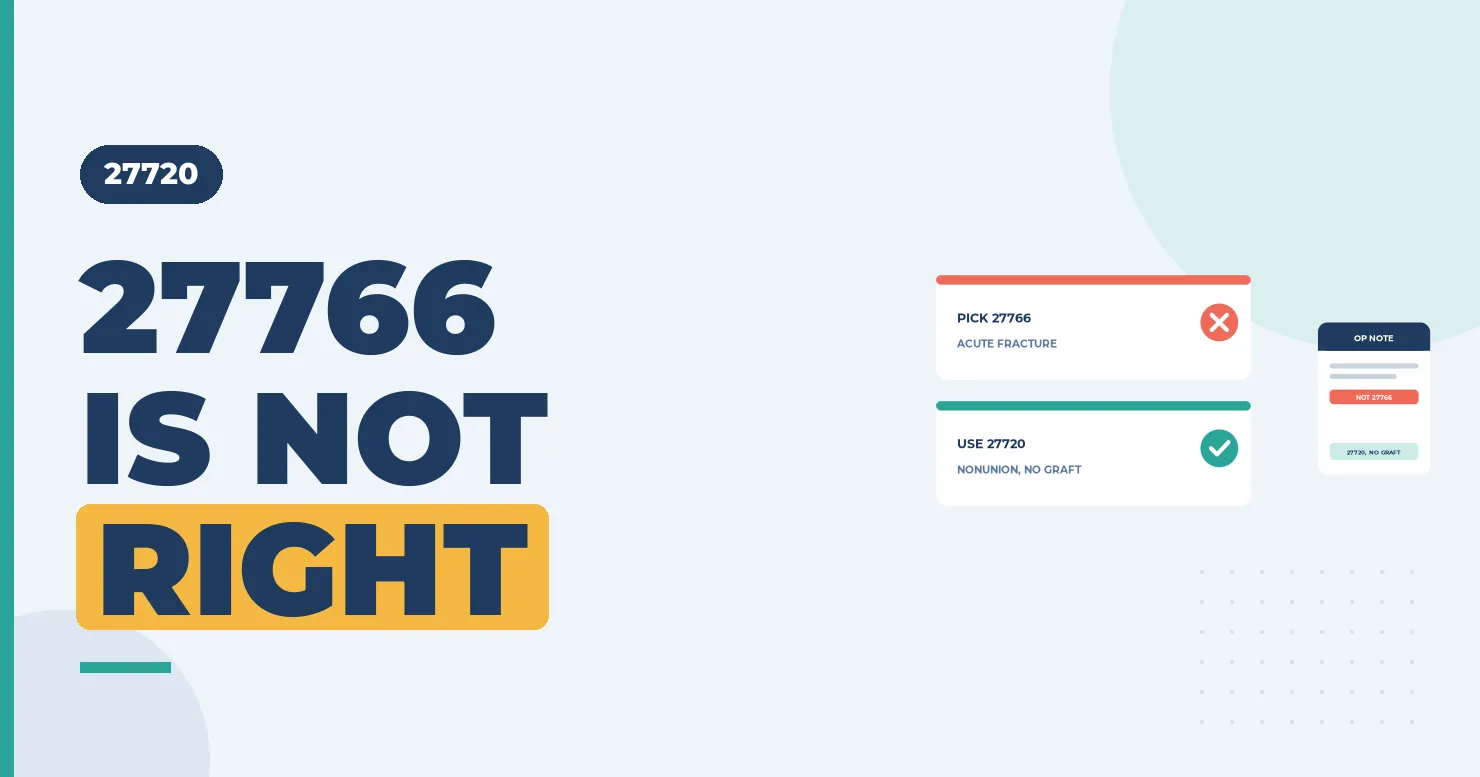
The medial malleolus nonunion CPT code is usually 27720. It fits a takedown and repair done without a bone graft.
The medial malleolus is the lower end of the tibia, so the tibia nonunion codes apply. If a payer pushes 27766, check the diagnosis first and appeal with the anatomy.
TL;DR: Code 27720 when the surgeon repairs a medial malleolus nonunion with no graft, such as a takedown with compression screw fixation. 27766 is for open treatment of the fracture itself. Pair 27720 with the fracture code that ends in 7th character K, such as S82.51XK. Do not bill 20680 when hardware removal is part of the repair. Add RT or LT, and add modifier 78 only inside the first surgery’s global period.
Written by Manikandan J, CPC, CRCR, a certified coder and revenue cycle specialist. Published 28 November 2026. Last updated: 28 November 2026.
Table of Contents
What is the CPT code for medial malleolus nonunion repair?
CPT 27720 reports repair of a tibia nonunion or malunion without a graft, for example by compression. The medial malleolus is the bony bump on the inner ankle. It is part of the distal tibia, so a nonunion there is a tibia nonunion.
ICD-10-CM says the same thing in its code titles. S82.51XK reads “Displaced fracture of medial malleolus of right tibia.” That title is useful proof in an appeal.
Nonunion means a fracture that has failed to heal. Takedown means the surgeon opens the failed union, removes fibrous tissue and freshens the bone ends. Compression technique means fixing the bone ends so they are pressed together, such as with a lag screw.
CPT descriptor wording belongs to the AMA. I describe the codes in my own words here, so check the full text in your current CPT book. AMA CPT Assistant guidance on this exact case is subscription content that I could not verify.
Example scenario (fictional names), part 1
Nonunion coding example: what happened
Lakeview Orthopedic Associates is a fictional practice in Arizona. Marisol Quenneville leads its surgical coding team. Dr. Anselm Petrakis is one of its foot and ankle surgeons.
Eight months after an ankle ORIF, the patient’s medial malleolus had not healed. Dr. Petrakis opened the old incision, took down the fibrous nonunion, freshened the bone edges and fixed it with one compression screw. No bone graft was used.
The coder billed 27720-RT with S82.51XA. The commercial plan denied the line and said another code fit better. The edit pointed to 27766, open treatment of a medial malleolus fracture.
Was 27720 wrong? Keep reading, or jump to how the case was resolved.
Why does the payer say 27766 fits better than 27720?
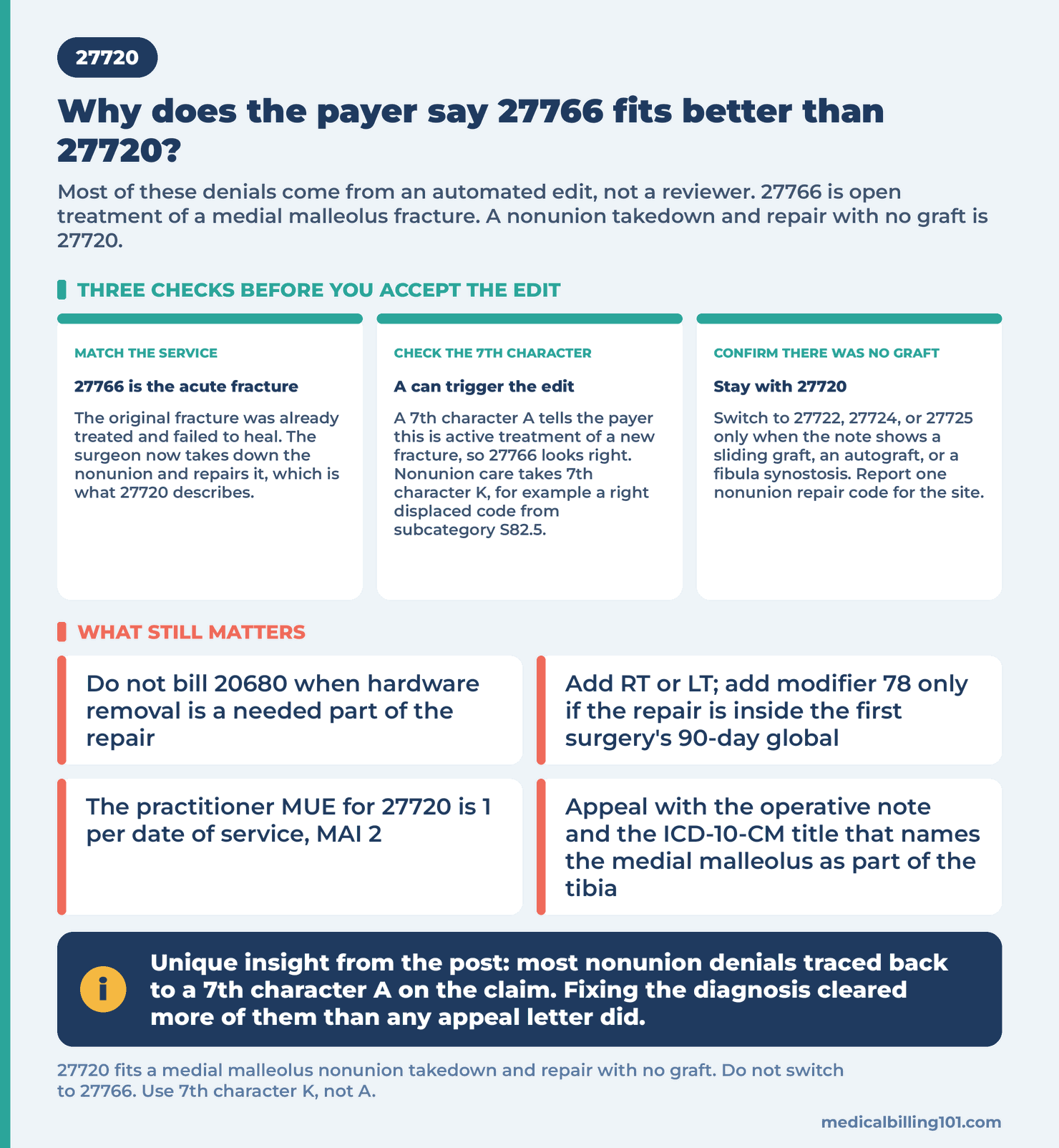
Most of these denials come from an automated edit, not a reviewer. The claim says medial malleolus, and the edit maps that site to 27766. That code is open treatment of a medial malleolus fracture, including internal fixation.
A nonunion repair is a different service. The original fracture was already treated and failed to heal. The surgeon now takes down the nonunion and repairs it, which is what 27720 describes.
The diagnosis often triggers the edit. A 7th character A tells the payer this is active treatment of a new fracture, so a fracture treatment code looks right. Our 29884 vs 29876 answer shows the same op-note-first method for picking between two close codes.
The CMS fee schedule shows why the swap matters. 27720 carries 12.05 work RVUs and 24.29 facility RVUs in the October 2026 file. 27766 carries 7.69 work RVUs and 17.36 facility RVUs.
| CPT code. | CMS short descriptor. | When it fits. | Work RVU / global. |
|---|---|---|---|
| 27720 | Repair of tibia. | Nonunion or malunion repair, no graft. | 12.05 / 090 |
| 27722 | Repair/graft of tibia. | Repair with a sliding graft. | 12.14 / 090 |
| 27724 | Repair/graft of tibia. | Repair with iliac or other autograft. | 18.83 / 090 |
| 27725 | Repair of lower leg. | Repair by synostosis with the fibula. | 16.97 / 090 |
| 27766 | Optx medial ankle fx. | Open treatment of the acute fracture. | 7.69 / 090 |
Short descriptors and RVUs come from the CMS PFS relative value files, file PPRRVU2026_Oct.
Which ICD-10-CM code goes with a medial malleolus nonunion?
Use the medial malleolus fracture code from subcategory S82.5 with 7th character K. K means subsequent encounter for closed fracture with nonunion. ICD-10-CM has no separate nonunion code for this site.
Section I.C.19.c.1 of the FY 2027 ICD-10-CM Official Guidelines says nonunion care takes the 7th character for subsequent care with nonunion. The same section says a fracture not described as displaced or nondisplaced is coded as displaced.
So a right displaced nonunion is S82.51XK. A right nondisplaced nonunion is S82.54XK. Use M84.37-, stress fracture of the ankle, with K only when the first fracture was a stress fracture.
Our ICD-10-CM guidelines cheat sheet lists the fracture 7th characters in one place.
When do you use 27722, 27724 or 27725 instead of 27720?
Switch codes only when the note shows a graft or a fibula synostosis. 27722 adds a sliding graft. 27724 adds iliac or other autograft. 27725 is repair by synostosis with the fibula.
The NCCI procedure-to-procedure edits back this up. 27722 and 27724 each bundle 27720, with the rationale “HCPCS/CPT procedure code definition.” You report one nonunion repair code for the site, not two.
In the case above, the surgeon only debrided the edges and placed a screw. No graft was harvested or placed, so 27720 is the right level.
Can you bill hardware removal or debridement with 27720?
Usually not. Chapter IV, section G.10 of the NCCI Policy Manual says 20670 or 20680 is not separately reportable when removing a pin is a needed part of a nonunion or malunion revision.
The NCCI edit file in version 32.3 also pairs 27720 with 20680 and with debridement codes 11042 to 11044. Those pairs allow a modifier, but only for a truly separate site or service. Bone edge debridement during the takedown is part of 27720.
In the AAPC case, the old screw stayed in place, so there was no removal to report. Read NCCI Policy Manual Chapter IV, or run the pair in our NCCI edit checker.
What global period, MUE and modifiers apply to 27720?
27720 has a 90-day global period in the CMS fee schedule. Its practitioner MUE is 1 per date of service, with an MAI of 2. Its bilateral surgery indicator is 1, so add RT or LT.
Check the original fracture surgery date. If the same surgeon does the repair inside that 90-day global, add modifier 78. CMS Claims Processing Manual Chapter 12, section 40, says Medicare then pays only the intraoperative share, which is 69 percent for 27720.
Most nonunions are treated well after 90 days, so modifier 78 is often not needed. Our global period calculator gives you the end date, and our global surgical package guide explains what the package covers.
In my 10+ years in medical billing, most nonunion denials I worked traced back to a 7th character A on the claim. Fixing the diagnosis cleared more of them than any appeal letter did.
How do you appeal a 27720 denial for a medial malleolus nonunion?
Read the denial reason first. If it says the procedure does not match the diagnosis, it may carry denial code CO-11. Fix the 7th character and send a corrected claim before you appeal.
If the claim was already right, appeal with the operative note. Highlight the words nonunion, takedown and screw compression. Quote the ICD-10-CM title that names the medial malleolus as part of the tibia.
State that no graft was used, so 27722 and 27724 do not apply. Our appeal letter generator gives you a starting letter you can edit.
Example scenario (fictional names), part 2
How the nonunion case was resolved
- Marisol confirmed the procedure code. The note showed a nonunion takedown and compression screw repair with no graft, so 27720 stayed.
- She found the real problem in the diagnosis. S82.51XA describes active treatment of a new fracture, which made 27766 look like the better match.
- She changed the diagnosis to S82.51XK, displaced fracture of the right medial malleolus, subsequent encounter for closed fracture with nonunion.
Fix: a corrected claim went out with 27720-RT and S82.51XK. An appeal letter explained that the medial malleolus is the distal end of the tibia and attached the operative note.
Outcome: the plan paid 27720. The team now checks the 7th character on every nonunion claim before it is sent.
Names and details are illustrative; no real patient data.
3-step checklist
- Read the op note for nonunion, takedown and any graft, then pick 27720, 27722, 27724 or 27725.
- Code the S82.5 fracture with 7th character K, and add RT or LT.
- Check the first surgery’s global period, add 78 only if inside it, and appeal with the anatomy if denied.
FAQ
Which CPT code fits a medial malleolar nonunion takedown?
Use 27720 when the surgeon repairs the nonunion without a bone graft. The medial malleolus is part of the tibia, so the tibia nonunion codes apply. Use 27722, 27724 or 27725 only when the note shows that graft or technique.
Is 27766 correct for a medial malleolus nonunion?
Not usually. 27766 is open treatment of a medial malleolus fracture. A nonunion repair is a separate procedure on a fracture that failed to heal, and the note should match the nonunion code.
What ICD-10-CM code goes with a medial malleolus nonunion?
Use the medial malleolus fracture code with 7th character K. For a displaced right fracture, that is S82.51XK. ICD-10-CM has no separate nonunion code for this site.
Can you bill hardware removal with 27720?
Not when removal is a needed part of the nonunion repair. NCCI policy says 20670 or 20680 is not separately reportable in that case. If the old hardware stays in place, there is nothing extra to bill.
Do you need a modifier on 27720?
Add RT or LT for the side. Add modifier 78 if the repair happens inside the 90-day global period of the first fracture surgery by the same surgeon. Outside that window, no global modifier is needed.
Sources
My methodology was simple. I checked the CMS fee schedule file, the NCCI edit and MUE files, the NCCI Policy Manual, the CMS claims manual and the FY 2027 ICD-10-CM files.
- CMS, Physician Fee Schedule relative value file PPRRVU2026_Oct, codes 27720 to 27725 and 27766 (linked above). Accessed 28 Nov 2026.
- CMS, NCCI procedure-to-procedure edits, practitioner version 32.3. Accessed 28 Nov 2026.
- CMS, NCCI medically unlikely edits, practitioner table effective 1 Oct 2026. Accessed 28 Nov 2026.
- CMS, NCCI Policy Manual for Medicare Services 2026, Chapter IV, section G (linked above). Accessed 28 Nov 2026.
- CMS, Medicare Claims Processing Manual, Chapter 12, section 40. Accessed 28 Nov 2026.
- CMS and NCHS, ICD-10-CM Official Guidelines FY 2027, section I.C.19.c (linked above), and FY 2027 code descriptions for S82.51XK, S82.54XK and M84.371K. Accessed 28 Nov 2026.
Read about the author, or contact us with a question. See our editorial policy.
Last updated: 28 November 2026 · Educational content for U.S. coding and billing teams. Payer policies may be stricter than the national rules shown here.