
The 87500 and 87999 units for a urine resistance PCR are one unit of each on a Medicare claim. Code 87500 covers vanA and vanB together, and 87999 takes one unit for all other targets.
Do not bill one unit per gene. The Medicare MUE for both codes is 1 unit per date of service, and the NCCI manual says to report an unlisted code with a single unit.
TL;DR: Report 87500 x1 for vanA and vanB, because the descriptor names both genes. Report 87999 x1 for the remaining targets that no CPT code describes. Medicare’s MUE is 1 for each code. The NCCI manual says one procedure with many results gets one code, and an unlisted code gets one unit. Commercial payers may differ, so check each policy and send a clear test description.
Written by Manikandan J, CPC, CRCR, a certified coder and revenue cycle specialist. Published 28 November 2026. Last updated: 28 November 2026.
Table of Contents
What does CPT 87500 report for a urine resistance PCR?
CPT 87500 reports infectious agent detection by nucleic acid for vancomycin resistance, such as enterococcus species van A and van B, by amplified probe technique. One unit covers the test, not each gene. The CMS CLFS lists it at $35.09.
CPT 87500 is the vancomycin resistance PCR code. CPT 87999 is the unlisted microbiology code, used when no specific code fits. MUE is the Medically Unlikely Edit, the most units Medicare expects on one date of service.
The descriptor and rate come from the CY2026 Q4 CLFS file on the CMS CLFS files page. That file has no rate for 87999.
Example scenario (fictional names), part 1
Urine PCR example: what happened
Harbor Ridge Reference Lab is a fictional lab in Maryland. Delphine Okonkwo-Hart runs its billing. Dr. Ambrose Vellacott directs the lab.
The lab ran 15 resistance-gene PCR assays on one urine sample. It billed 87500 x2 and 87999 x13 to a Medicare Administrative Contractor (MAC).
The MAC paid one unit of 87500 and denied the rest for units. The lab could not tell what went wrong.
What went wrong? Keep reading, or jump to how the case was resolved.
Is it 87500 x2 or 87500 x1 for vanA and vanB?
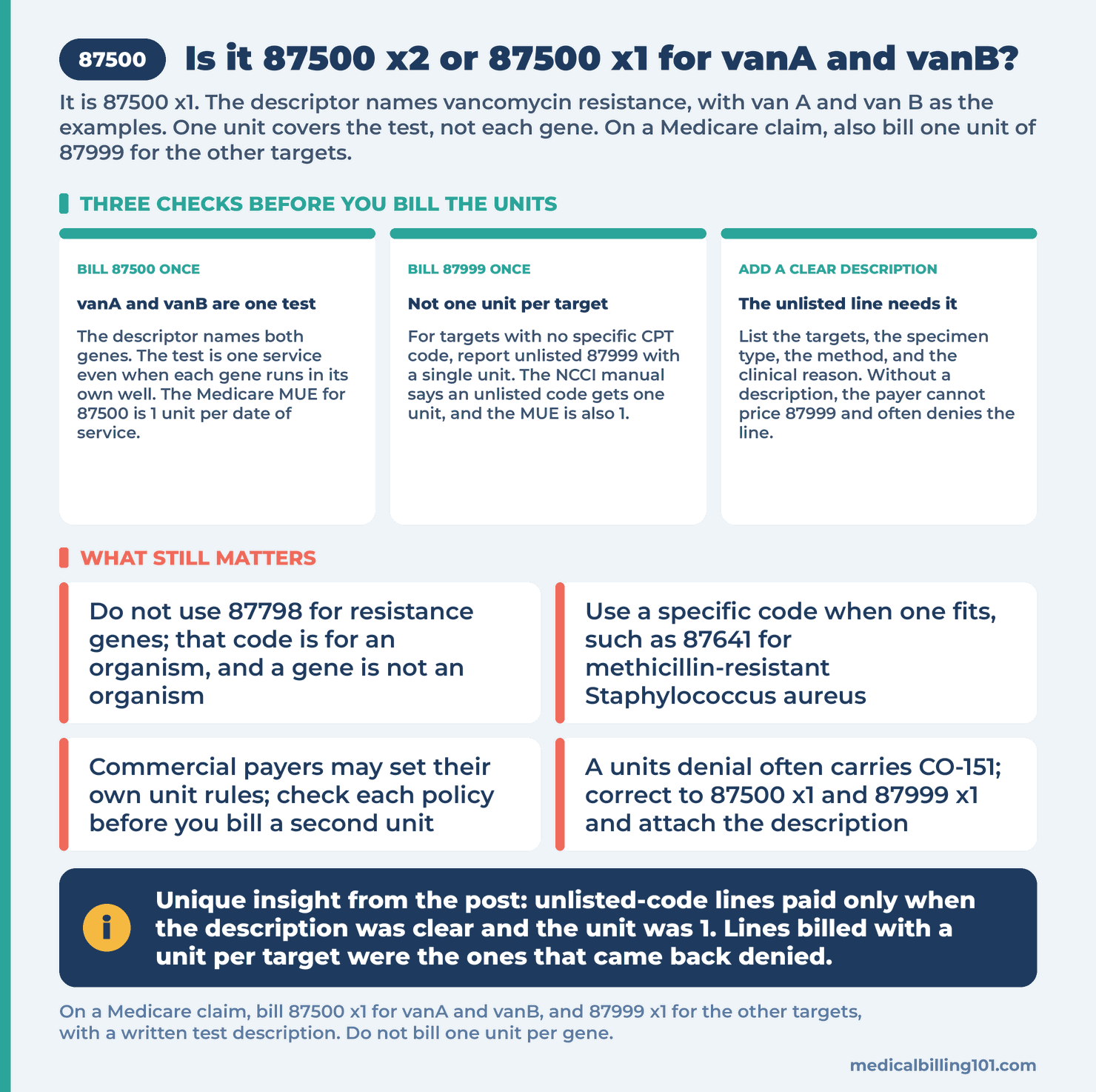
It is 87500 x1. The descriptor names vancomycin resistance, with van A and van B as the examples. The test is one service even when each gene runs in its own well. The Medicare MUE for 87500 is 1 unit.
The NCCI manual adds that molecular codes for infectious agents include all the molecular analyses and processes. So a second unit of 87500 for vanB has no support in Medicare policy.
A commercial payer may follow the CPT Assistant guidance instead. That guidance is AMA subscription material. I could not verify it here, so read your payer’s policy before you bill a second unit.
How many units of 87999 do you bill for the other targets?
Bill one unit of 87999 on a Medicare claim. The NCCI manual says that when no CPT code describes the procedure, the lab reports an unlisted code with a single unit. The MUE for 87999 is also 1 per date of service.
Check first that no specific code fits a target. For example, 87641 covers methicillin-resistant Staphylococcus aureus. Use 87999 only for targets that have no code of their own.
The NCCI manual treats one procedure with multiple reportable results as one code. Separate wells are a lab detail. Medicare has no ruling on them that I could find, so ask your MAC.
| CPT code. | What it reports. | Medicare MUE (Oct 2026). | Units to bill. |
|---|---|---|---|
| 87500. | Vancomycin resistance (van A, van B), amplified probe. | 1, MAI 3. | 1. |
| 87999. | Unlisted microbiology procedure. | 1, MAI 3. | 1, with a description. |
| 87798. | Organism not otherwise specified, amplified probe, each organism. | 13, MAI 3. | One per organism, not per gene. |
| 87641. | Methicillin-resistant Staphylococcus aureus, amplified probe. | 1, MAI 3. | 1, if that target was run. |
The MUE values are from the CMS Medicare NCCI MUE tables for practitioner services and outpatient hospital services, effective 1 October 2026. MAI 3 means a date of service edit based on clinical data. Find any code on our MUE lookup tool.
Can you use 87798 instead of 87999 for resistance genes?
Usually not. The 87798 descriptor says amplified probe technique, each organism. A resistance gene is not an organism. Reserve 87798 for a named organism with no specific CPT code.
The MUE for 87798 is 13, so billing 13 units may look tempting for 13 targets. That would misstate the service. Our post on CPT 87798 denied for 13 units shows how those denials work.
What does an 87999 claim need to get paid?
An 87999 claim needs a plain description of the test. List the targets, the specimen type, the method and the clinical reason for the test. Without it, the payer cannot price the line and often denies it.
The CLFS file has no national rate for 87999, so ask your payer how it prices the code. Some ask for an invoice or a cost basis. Keep the lab’s test validation summary on file.
In my 10+ years in medical billing, unlisted-code lines paid only when the description was clear and the unit was 1. Lines billed with a unit per target were the ones that came back denied.
How do you fix a urine PCR units denial?
First, read the remit. A denial for units often carries denial code CO-151 or a similar remark. Then count the 87500 and 87999 units on that date of service across all claims.
Next, correct the claim to 87500 x1 and 87999 x1, and attach the description. Use our corrected claim guide for the steps by payer type.
If the payer still denies, appeal with the NCCI manual language and the test description. Our appeal letter generator gives you a starting letter. The manual is Chapter X of the NCCI Medicare Policy Manual, sections A and K.
Example scenario (fictional names), part 2
How the urine PCR case was resolved
- Delphine saw that 87500 already covers vanA and vanB, so only one unit applied.
- She saw that 87999 x13 broke the MUE of 1 unit per date of service.
- She wrote one 87999 description listing all 13 targets, the specimen and the method.
Fix: she corrected the claim to 87500 x1 and 87999 x1, and attached the test description.
Outcome: the MAC priced the 87999 line from the lab’s description. The lab now sets one unit on every unlisted line in its charge master.
Names and details are illustrative; no real patient data.
Where can you read more lab billing answers?
For another unit question, see how A9587 is billed at 64 units against a 54-unit MUE. For a lab payer dispute, see why Humana denies 87811-QW and 87804-59-QW. For bundling disputes, read how a lab answers a toxicology bundling challenge.
Medicare limits come from the CMS MUE tables page. Other payers may set lower limits in their own policies.
3-step checklist
- Bill 87500 x1 for vanA and vanB, and check whether any other target has its own CPT code.
- Bill 87999 x1 for the targets with no code, with a written description of the test.
- Check each payer’s policy for unit rules, then appeal with the NCCI manual wording if needed.
FAQ
Is 87500 billed per gene or per test?
Per test. The 87500 descriptor names vancomycin resistance, with van A and van B as examples. Medicare’s MUE for 87500 is 1 unit per date of service, so vanA and vanB together make one unit.
Can you bill 87500 twice for vanA and vanB?
Not to Medicare. The MUE stops at 1 unit, and the code covers both genes. A commercial payer may set its own rule, so read its policy before you send a second unit.
Is 87999 billed with a unit count equal to the number of targets?
For Medicare, no. The NCCI manual says to report an unlisted code with one unit when no CPT code describes the procedure. The MUE for 87999 is also 1.
Can you use 87798 for the other resistance targets?
Usually not. Code 87798 is described as each organism, and a resistance gene is not an organism. Use it only for a named organism that has no specific CPT code.
What does the claim for 87999 need?
A clear description of the test, the targets, the specimen and the method. Many payers also want the lab’s price basis and the test’s clinical purpose. Send these with the claim.
Sources
My methodology was simple. I checked the CMS CLFS file, the Medicare MUE tables and the NCCI Medicare Policy Manual.
- CMS, CY2026 Q4 Clinical Laboratory Fee Schedule file (26CLABQ4), codes 87500, 87641 and 87798 (linked above). Accessed 28 Nov 2026.
- CMS, Medicare NCCI MUE tables, effective 1 Oct 2026, codes 87500, 87798 and 87999 (linked above). Accessed 28 Nov 2026.
- CMS, NCCI Medicare Policy Manual 2026, Chapter X, sections A and K (linked above). Accessed 28 Nov 2026.
Read about the author, or contact us with a question. See our editorial policy.
Last updated: 28 November 2026 · Educational content for U.S. coding and billing teams. Unit limits shown are Medicare rules; check your payer’s policy for its own limits.