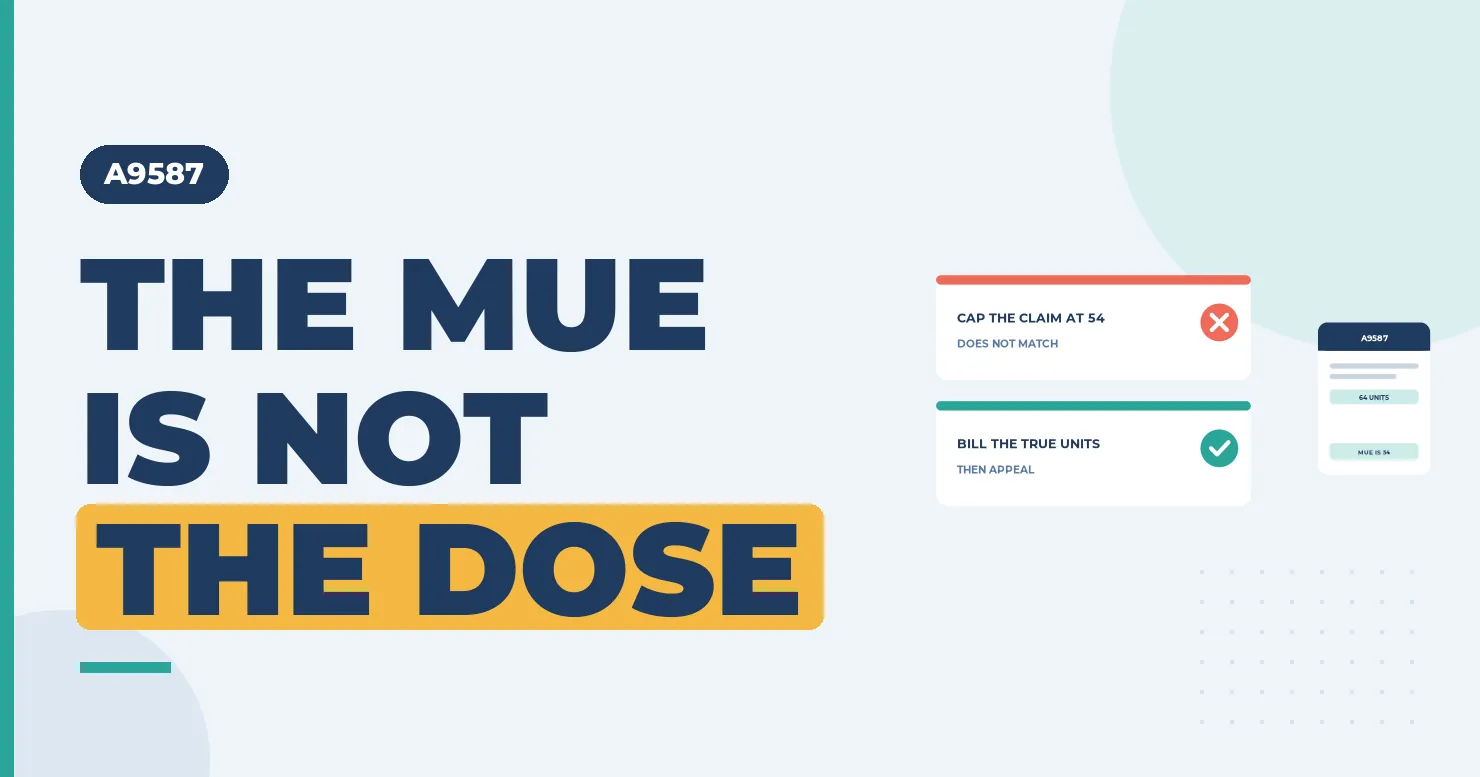
A9587 billing follows the dose given, so 6.33 mCi of Ga-68 dotatate is 64 units, not 54. Bill the true units, expect the 54-unit MUE to deny the line, and appeal with the dose record.
Do not cap the claim at 54 units to slip under the edit. That claim would no longer match the dose in the chart.
TL;DR: One unit of A9587 is 0.1 millicurie. Divide the administered dose by 0.1 and round up, so 6.33 mCi becomes 63.3, then 64 units. The Medicare MUE is 54 units, MAI 3, set from the label maximum of 5.4 mCi. A date-of-service MUE denies every unit on that date, not just the extra 10. Medicare can pay above the MUE on appeal only when records prove the units were given, coded right and medically necessary.
Written by Manikandan J, CPC, CRCR, a certified coder and revenue cycle specialist. Published 27 November 2026. Last updated: 27 November 2026.
Table of Contents
What is HCPCS code A9587?
A9587 is the HCPCS Level II code for gallium Ga-68 dotatate, diagnostic, per 0.1 millicurie. It is the PET imaging agent sold as the NETSPOT kit. The code covers the drug only. The PET scan itself is billed with its own CPT code on the same claim.
A9587 is a radiopharmaceutical supply code, with the unit set at 0.1 mCi. An MUE is a CMS limit on the units a provider can report for one patient on one date of service. An MAI is the MUE Adjudication Indicator, which tells you how that limit is applied.
You can confirm the descriptor in the CMS HCPCS quarterly update files. The unit size drives every number below, so check it before you count units.
Example scenario (fictional names), part 1
A9587 example: what happened
Bluewater Valley Hospital is a fictional hospital in Ohio. Rosalind Fairweather works its outpatient billing queue. Dr. Thaddeus Lindqvist reads its PET scans.
A Medicare patient had a Ga-68 dotatate PET/CT. The claim went out with 78815 and A9587 x 70 units.
The whole A9587 line denied for units. The hospital got nothing for the drug.
What went wrong? Keep reading, or jump to how the case was resolved.
How many units of A9587 do you bill?
Bill the administered dose divided by 0.1 mCi, rounded up to the next whole unit. For example, 4.2 mCi is 42 units, and 6.33 mCi is 63.3, so you bill 64 units. Never bill by the vial, the kit or an activity measured earlier, before decay.
The Medicare Claims Processing Manual, chapter 17 sets the rounding rule. Section 10 says a dose that is not a multiple of the descriptor rounds to the next highest unit. Section 70 repeats it with examples.
| Administered dose. | Math. | Units billed. |
|---|---|---|
| 4.2 mCi. | 4.2 / 0.1 = 42. | 42. |
| 5.4 mCi (label maximum). | 5.4 / 0.1 = 54. | 54, equal to the MUE. |
| 5.95 mCi. | 59.5, round up. | 60, above the MUE. |
| 6.33 mCi. | 63.3, round up. | 64, above the MUE. |
Section 90.2 adds a hospital rule. Reported units must match the quantity actually used for the patient. That rule is the reason a capped claim is a problem.
Why is the A9587 MUE 54 units?
The A9587 MUE is 54 because the label caps the dose at 5.4 mCi. The NETSPOT prescribing information gives 2 MBq/kg, up to 200 MBq, which is 5.4 mCi. At 0.1 mCi per unit, that maximum equals 54 units.
The label also says to measure the syringe in a dose calibrator before injection. The injected activity should be within 10% of the recommended amount. So 5.4 mCi plus 10% is about 5.95 mCi, and 6.33 mCi, about 234 MBq, sits above that range.
The CMS MUE files effective October 1, 2026 list A9587 at 54 units. The practitioner and hospital outpatient files match. Both show MAI 3 and name prescribing information as the source. Check any code in our MUE lookup.
Should you bill 64 units or cap A9587 at 54?
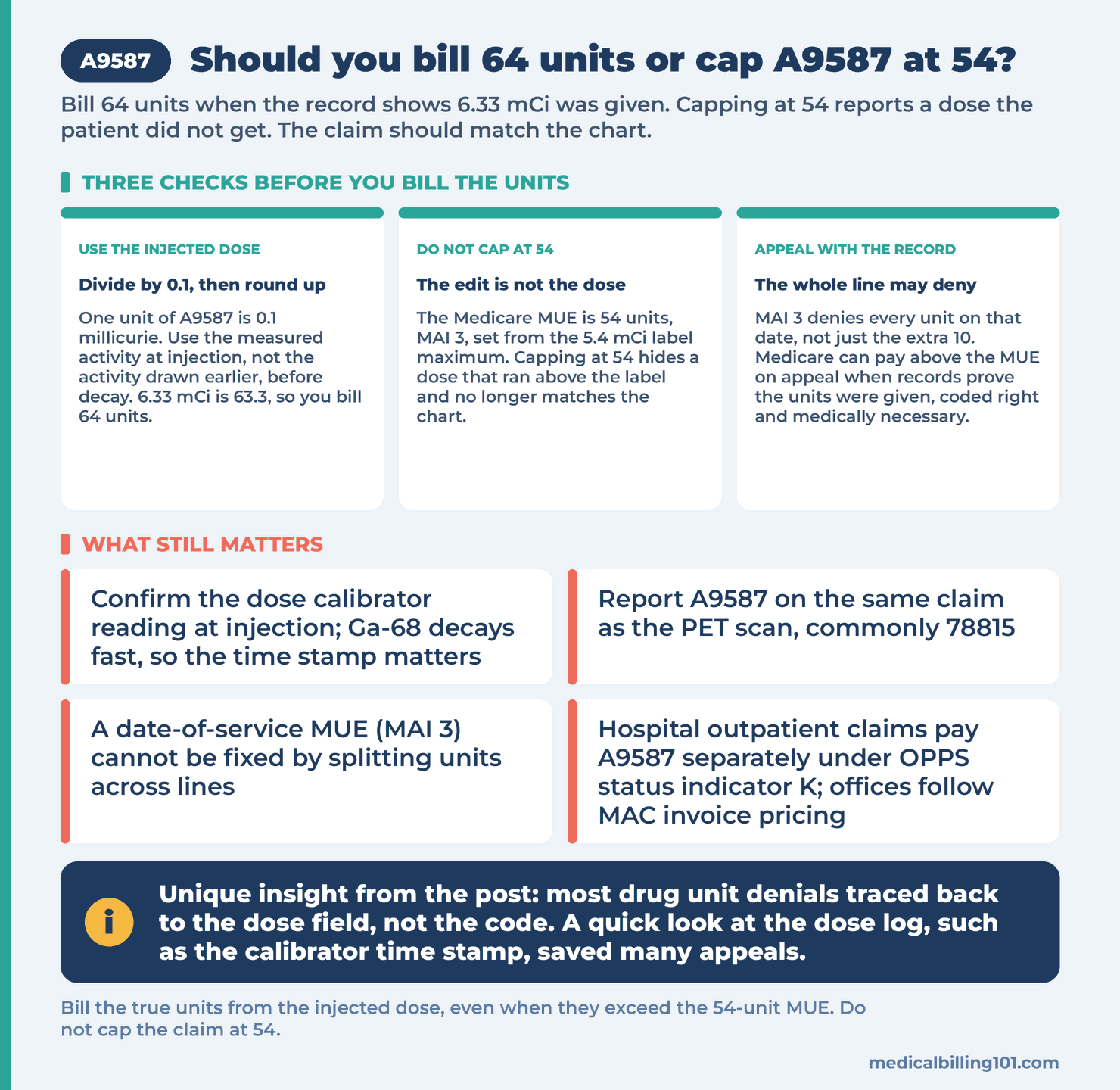
Bill 64 units when the record shows 6.33 mCi was given. Capping at 54 reports a dose the patient did not get. It also hides a dose that ran above the label, which your nuclear medicine team should review. The claim should match the chart.
Before you bill, confirm the number. Check that 6.33 mCi is the measured activity at injection, not the activity drawn or calibrated earlier. Ga-68 decays fast, so the time stamp on the dose record matters.
In my 10+ years of billing and AR work, most drug unit denials I reviewed traced back to the dose field, not the code. A quick look at the dose log, such as the calibrator time stamp, saved many appeals.
What happens when A9587 units exceed the MUE?
The whole A9587 line denies, not just the 10 extra units. MAI 3 is a date-of-service edit, so Medicare adds all A9587 units for that day. If the total passes 54, every unit for that date is denied. Splitting the units across lines does not help.
The NCCI Policy Manual, chapter I explains MAI 3. It is a per-day edit based on clinical benchmarks, such as the label. A contractor may bypass it when records prove the units were given, coded right and medically necessary.
Many unit denials post with a reason code like 151. Our CO-151 guide shows how to read the remark codes on that kind of denial.
How do you appeal an A9587 MUE denial?
Request a reopening or redetermination and send the dose records. Include the dose calibrator reading with time, the order, the PET report and a physician note on the dose. The reviewer checks three things: units given, correct coding, and medical necessity.
Know the risk before you appeal. Chapter I says a reviewer may change the reason to not reasonable and necessary when the units were given but not justified. A dose above the label needs a clear clinical reason in the note.
An ABN does not move an MUE denial to the patient, because it is a coding denial. Follow the steps in how to appeal a denied Medicare claim, and draft the letter with our appeal letter generator.
How is A9587 paid in a hospital versus an office?
Hospital outpatient claims pay A9587 separately under OPPS. The October 2026 OPPS Addendum B gives it status indicator K, APC 9056, at $49.63 per unit. So 64 units is $3,176.32, and 54 units is $2,680.02, before adjustments.
Separate payment is fairly new. The CY 2026 OPPS final rule pays separately for any diagnostic radiopharmaceutical above $655 per day. Products at or below that threshold stay packaged into the scan.
Offices and imaging centers are different. Chapter 17, section 20.1.2, says radiopharmaceuticals are not paid on ASP. Each MAC sets the payment limit and may use invoice pricing, so keep the invoice ready.
Does A9587 need the PET code on the same claim?
Yes. Hospitals must report the radiolabeled product on the same claim as the nuclear medicine scan. Chapter 17, section 90.2, says the outpatient code editor checks this pairing. Ga-68 dotatate PET/CT from skull base to mid-thigh is commonly 78815.
Coverage is a separate question. The Medicare Claims Processing Manual, chapter 13, section 60.19, lets each MAC decide coverage for PET agents used for FDA-approved cancer indications. NETSPOT is approved to localize somatostatin receptor positive neuroendocrine tumors.
A noncovered scan denies with reason code 167, as our CO-167 guide explains. For a related PET diagnosis question, see which diagnosis code goes with 78815 for a PSMA PET.
Example scenario (fictional names), part 2
How the A9587 case was resolved
- Rosalind saw 70 units, which means 7.0 mCi. That is far above the 5.4 mCi label maximum and the 54-unit MUE.
- She pulled the dose log. The 7.0 mCi figure was the activity measured at the draw, before decay, not the injected dose.
- The dose calibrator reading at injection was 5.1 mCi. Dr. Lindqvist’s report showed the same number.
Fix: the hospital sent a corrected claim with A9587 x 51 units and 78815 unchanged. It then mapped billing to the injected-dose field.
Outcome: the corrected line paid under OPPS, and unit denials on this code stopped.
Names and details are illustrative; no real patient data.
To fix units on a sent claim, follow our corrected claim guide. For another drug units denial, see why J1010 was denied with a nerve block.
3-step checklist
- Pull the dose calibrator reading at injection, divide by 0.1 mCi, and round up.
- Bill the true units with the PET code on the same claim, even above 54.
- If units pass 54, send the dose record and a physician note on appeal.
FAQ
What is the unit for A9587?
One unit of A9587 is 0.1 millicurie of gallium Ga-68 dotatate. Divide the administered dose by 0.1 and round up to the next whole unit.
How many units is 6.33 mCi of A9587?
6.33 mCi divided by 0.1 is 63.3. Round up, so you bill 64 units of A9587.
What is the MUE for A9587?
The Medicare MUE for A9587 is 54 units per date of service, MAI 3, for both practitioner and hospital outpatient claims. It matches the 5.4 mCi label maximum.
Can Medicare pay A9587 above 54 units?
Yes, on appeal. MAI 3 lets the contractor bypass the edit when records prove the units were given, coded correctly and medically necessary.
Is A9587 paid separately in the hospital outpatient setting?
Yes. The October 2026 OPPS Addendum B lists A9587 with status indicator K at $49.63 per unit, because it is above the CY 2026 $655 per-day threshold.
Sources
My methodology was simple. I checked the HCPCS descriptor, the NETSPOT label, the October 2026 CMS MUE and OPPS files, the CMS manuals and the CY 2026 OPPS final rule.
- CMS, HCPCS quarterly update, A9587 descriptor (linked above). Accessed 27 Nov 2026.
- NETSPOT (gallium Ga 68 dotatate) prescribing information, DailyMed (linked above). Accessed 27 Nov 2026.
- CMS, Practitioner and Outpatient Hospital MUE files effective 10-01-2026 (linked above). Accessed 27 Nov 2026.
- CMS, NCCI Policy Manual 2026, chapter I, MUE section (linked above). Accessed 27 Nov 2026.
- CMS, Medicare Claims Processing Manual, chapter 17, sections 10, 20.1.2, 70 and 90.2 (linked above). Accessed 27 Nov 2026.
- CMS, Medicare Claims Processing Manual, chapter 13, section 60.19 (linked above). Accessed 27 Nov 2026.
- CMS, October 2026 OPPS Addendum B (linked above). Accessed 27 Nov 2026.
- Federal Register, CY 2026 OPPS and ASC final rule, 25 Nov 2025 (linked above). Accessed 27 Nov 2026.
Read about the author, or contact us with a question. See our editorial policy.
Last updated: 27 November 2026 · Educational content for U.S. coding and billing teams. HCPCS and CPT descriptions are plain-language summaries; check the current code set and your MAC’s policy for full wording.